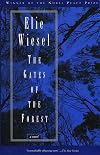
The Gates of the Forest: A Novel
by Elie Wiesel
On This Page
Description
Allegory about a nameless stranger who sacrifices himself to save a Jewish boy hiding in a Hungarian forest in World War two.Tags
Recommendations



























Member Reviews
This is one of Wiesel's relatively early works, published in 1966. It is the story of the life of a teenage Jewish boy, surviving during World War 2 in hiding in a forest in Hungary. As the book opens, the boy is living in a cave where his father has left him, promising to return shortly but then never reappearing. Soon a mysterious stranger appears, and the journey begins.
The story of Gregor, the protagonist, is a story both of the world of men and of the spirit. As is common for Wiesel, the story is as much about his characters' relationship with God as with other men and the events of the world. Or rather, perhaps we can say that Wiesel tells the story of Jews' relationship with God as it has been shaped and driven by the events of show more the world, and especially by the Holocaust.
At any rate, the story of Gregor is a gripping one. We share outward and inward struggles to survive and make sense of the world around him, in a tale told partly in real time and in the real world of people and events, and partly in allegory, with more than a touch of Jewish mysticism blended in.
The wonders of human nature, of human perseverance and capitulation in the face of horrors, are explored with a gentle touch, despite the grim realities being portrayed. And in the end, against all odds, this is a love story. show less
The story of Gregor, the protagonist, is a story both of the world of men and of the spirit. As is common for Wiesel, the story is as much about his characters' relationship with God as with other men and the events of the world. Or rather, perhaps we can say that Wiesel tells the story of Jews' relationship with God as it has been shaped and driven by the events of show more the world, and especially by the Holocaust.
At any rate, the story of Gregor is a gripping one. We share outward and inward struggles to survive and make sense of the world around him, in a tale told partly in real time and in the real world of people and events, and partly in allegory, with more than a touch of Jewish mysticism blended in.
The wonders of human nature, of human perseverance and capitulation in the face of horrors, are explored with a gentle touch, despite the grim realities being portrayed. And in the end, against all odds, this is a love story. show less
In the beginning of the book, Wiesel tells a story about a tradition Rabbis used to save their people. The tradition is not completely passed down to the future generations, and each new Rabbi must do what he can and pray to God that it is enough. By the last generation, all that is left of the tradition is to tell the story, so that's what Wiesel does.
Gregor, a young Hungarian Jew, is hiding in a cave in a forest when he meets a mysterious and mystical man with no name. Gregor gives him his true Jewish name, Gavriel, and Gavriel gives his life to save Gregor. Later, Gregor unintentionally betrays a childhood friend and has to find a way to live the rest of his life with the knowledge that two of the people who were closest to him died show more because of him.
This is one of Wiesel's earlier works, and since it's more about the psychological effects of the Holocaust than actual events, it's not as powerful as Night. Still, it tries to address the very real question of how do people who have lived through this kind of thing cope with being one of the survivors when so many other people died. There's just no answer to that question. show less
Gregor, a young Hungarian Jew, is hiding in a cave in a forest when he meets a mysterious and mystical man with no name. Gregor gives him his true Jewish name, Gavriel, and Gavriel gives his life to save Gregor. Later, Gregor unintentionally betrays a childhood friend and has to find a way to live the rest of his life with the knowledge that two of the people who were closest to him died show more because of him.
This is one of Wiesel's earlier works, and since it's more about the psychological effects of the Holocaust than actual events, it's not as powerful as Night. Still, it tries to address the very real question of how do people who have lived through this kind of thing cope with being one of the survivors when so many other people died. There's just no answer to that question. show less
The story about the Baal Shem Tov and successive generations of rabbinic leaders praying in a special place in the forest to save their followers, but each generation forgetting some of the ritual until all that is left is the story is in big letters before the beginning of the story.
Hoe overleef je als je volk wordt uitgemoord? Door verhalen, door een naam, door te zwijgen tot je niet meer kunt, door bij de partizanen te gaan, en misschien ook door de liefde? Grégor komt pas weer echt tot leven door een rabbi met een onorthodoxe aanpak. En ja, verhalen zijn heel belangrijk!
Jul 20, 2017Dutch
Ratings
Members
- Recently Added By
Lists

Books available on Open Library
171 works; 4 members
Author Information

132+ Works 50,239 Members
Eliezer "Elie" Wiesel was born in Sighet, Romania on September 30, 1928. In 1944, he and his family were deported along with other Jews to the Nazi death camp Auschwitz. His mother and his younger sister died there. He loaded stones onto railway cars in a labor camp called Buna before being sent to Buchenwald, where his father died. He was show more liberated by the United States Third Army on April 11, 1945. After the war ended, he learned that his two older sisters had also survived. He was placed on a train of 400 orphans that was headed to France, where he was assigned to a home in Normandy under the care of a Jewish organization. He was educated at the Sorbonne and supported himself as a tutor, a Hebrew teacher and a translator. He started writing for the French newspaper L'Arche. In 1948, L'Arche sent him to Israel to report on that newly founded state. He also became the Paris correspondent for the daily Yediot Ahronot. In this capacity, he interviewed the novelist Francois Mauriac, who urged him to write about his war experiences. The result was La Nuit (Night). After the publication of Night, Wiesel became a writer, literary critic, and journalist. His other books include Dawn, The Accident, The Gates of the Forest, The Jews of Silence: A Personal Report on Soviet Jewry, and Twilight. He received a numerous awards and honors for his literary work including the William and Janice Epstein Fiction Award in 1965, the Jewish Heritage Award in 1966, the Prix Medicis in 1969, and the Prix Livre-International in 1980. He received the Nobel Peace Prize in 1986 for his work in combating human cruelty and in advocating justice. He had a leading role in the creation of the United States Holocaust Memorial Museum in Washington, D. C. He died on July 2, 2016 at the age of 87. (Bowker Author Biography) show less
Series
Belongs to Publisher Series
ספריה לעם (108)
Seuil, Points roman (R216)
Work Relationships
Is contained in
Common Knowledge
- Original title
- Les Portes de la Foret
- Original publication date
- 1964
- People/Characters
- Gregor; Gavriel; Leib the Lion
- First words
- He had no name, so he gave him his own.
- Quotations
- When the great Rabbi Israel Baal Shem-Tov saw misfortune threatening the Jews it was his custom to go into a certain part of the forest to meditate. There he would light a fire, say a special prayer, and the miracle would be ... (show all)accomplished and the misfortune averted.
Later, when his disciple, the celebrated Magid of Mezritch, had occasion, for the same reason, to intercede with heaven, he would go to the same place in the forest and say: "Master of the Universe, listen! I do not know how to light the fire, but I am still able to say the prayer." And again the miracle would be accomplished.
Still later, Rabbi Moshe-Leib of Sasov, in order to save his people once more, would go into the forest and say: "I do not know how to light the fire, I do not know the prayer, but I know the place and this must be sufficient." It was sufficient and the miracle was accomplished.
Then it fell to Rabbi Israel of Rizhyn to overcome misfortune. Sitting in his armchair, his head in his hands, he spoke to God: "I am unable to light the fire and I do not know the prayer; I cannot even find the place in the forest. All I can do is to tell the story, and this must be sufficient." And it was sufficient.
God made man because he loves stories. - Last words
- (Click to show. Warning: May contain spoilers.)Yes, the last Kaddish would be for him, our messenger to heaven.
- Blurbers
- Steiner, George; Mauriac, Francois
Classifications
- Genres
- Fiction and Literature, General Fiction, Historical Fiction
- DDC/MDS
- 843.914 — Literature & rhetoric French Literature French fiction 1900- 20th Century 1945-1999
- LCC
- PQ2683 .I32 .P613 — Language and Literature French, Italian, Spanish and Portuguese literatures French literature Modern literature 1961-2000
- BISAC
Statistics
- Members
- 476
- Popularity
- 64,006
- Reviews
- 4
- Rating
- (3.88)
- Languages
- 6 — Dutch, English, French, German, Hebrew, Italian
- Media
- Paper, Ebook
- ISBNs
- 11
- ASINs
- 12