On This Page
Description
Sleek androids have spread slowly through the galaxy, threatening human dominance, until a small band of rebels rise up against the humanoid tide.Tags
Recommendations



















Member Reviews
This omnibus contains the classic 1947 science fiction “With Folded Hands” and its sequel the short novel “The Humanoids”, originally published in 1948 as “ … And With Searching Mind”. The collection is capped off with a short but significant afterword by Williamson about the works, “Me and My Humanoids”.
“With Folded Hands” is not only a classic science fiction story but, in its own way, a very memorable horror story about the ultimate paternalistic state, a smothering existence of passivity and futility run by the implacable, incorruptible humanoids – humanoids that efficiently discharge their mandate to “Serve and Obey and Guard Men from Harm”. Even suicide is not an escape route from this world. It can be show more read as a political and cautionary tale about utilitarian politics and making mere happiness the goal of all life. And, for those who might sneer at the outdated technological aspects that are the rationalizing instrumentality of this parable, I think it very possible that its centrally controlled, humanoid robots could be technologically updated to make the same point.
After detailing the trials and tribulations and revolt of Underhill, a seller of robots in “With Folded Hands”, “The Humanoids” starts out with an orphan girl mysteriously showing up at a top secret scientific project. (The desert landscape, the mentions of atomic war devastating several planets, and a sort of Mutually Assured Destruction, all bring the Cold War and its beginnings in the Manhattan Project and Hirsohima to mind.) Forester, leader of the project, is invited by a band of rather pathetic people to join a revolt against the humanoids coming soon to this world. Initially dismissive, Forester soon comes to learn the truth and horror of the humanoid rule and find out that one man in his project, the indolent but mathematically brilliant (and also one-time suitor of Forester’s wife) Ironsmith, seems to have been made some sort of deal with the humanoids to sell humanity out. Can Forester and a band of reputed psychics put an end to the humanoids – and will Ironsmith let them?
I think the intended message of the novel’s end is clear, but Williamson said it was interpreted ambiguously. He has some interesting things to say about how the humanoid-human conflict is not just about technology but the older conflict between those who compromise with a social order and its restrictions and are rewarded and those who don’t and are destroyed. He notes how this conflict was played out in his earlier life as a loner from rural New Mexico learning to live in greater society.
“With Folded Hands” is still worth reading. The sequel is largely unnecessary, but it is fast-moving and of an interest for its moody descriptions of alien worlds, Cold War feel, and as an example of editor John W. Campbell’s interest (which eventually led him to introduce Dianetics to the world) in stories of humans with innate psychic powers. Williamson’s afterword is necessary in confirming one’s take on the novel’s end. show less
“With Folded Hands” is not only a classic science fiction story but, in its own way, a very memorable horror story about the ultimate paternalistic state, a smothering existence of passivity and futility run by the implacable, incorruptible humanoids – humanoids that efficiently discharge their mandate to “Serve and Obey and Guard Men from Harm”. Even suicide is not an escape route from this world. It can be show more read as a political and cautionary tale about utilitarian politics and making mere happiness the goal of all life. And, for those who might sneer at the outdated technological aspects that are the rationalizing instrumentality of this parable, I think it very possible that its centrally controlled, humanoid robots could be technologically updated to make the same point.
After detailing the trials and tribulations and revolt of Underhill, a seller of robots in “With Folded Hands”, “The Humanoids” starts out with an orphan girl mysteriously showing up at a top secret scientific project. (The desert landscape, the mentions of atomic war devastating several planets, and a sort of Mutually Assured Destruction, all bring the Cold War and its beginnings in the Manhattan Project and Hirsohima to mind.) Forester, leader of the project, is invited by a band of rather pathetic people to join a revolt against the humanoids coming soon to this world. Initially dismissive, Forester soon comes to learn the truth and horror of the humanoid rule and find out that one man in his project, the indolent but mathematically brilliant (and also one-time suitor of Forester’s wife) Ironsmith, seems to have been made some sort of deal with the humanoids to sell humanity out. Can Forester and a band of reputed psychics put an end to the humanoids – and will Ironsmith let them?
I think the intended message of the novel’s end is clear, but Williamson said it was interpreted ambiguously. He has some interesting things to say about how the humanoid-human conflict is not just about technology but the older conflict between those who compromise with a social order and its restrictions and are rewarded and those who don’t and are destroyed. He notes how this conflict was played out in his earlier life as a loner from rural New Mexico learning to live in greater society.
“With Folded Hands” is still worth reading. The sequel is largely unnecessary, but it is fast-moving and of an interest for its moody descriptions of alien worlds, Cold War feel, and as an example of editor John W. Campbell’s interest (which eventually led him to introduce Dianetics to the world) in stories of humans with innate psychic powers. Williamson’s afterword is necessary in confirming one’s take on the novel’s end. show less
3/5
Despite their age, the two separate stories within The Humanoids hold up well. This fix-up collects two stories within the same universe, and some ending material from Williamson on his intended themes. This is a world in which a sleek robotic hive mind is designated with creed of: "To Serve and Obey, And Guard Men from Harm", which is then taken to its logical extremes. These robots take over world after world, preventing humans from doing anything that could make them 'unhappy or unsafe' to such an extreme that most humans end up extremely unhappy and unsafe from their own minds. Several human revolts attempt to shut them down, to varying degrees of success.
Williamson has a really strong and clear plot line that drives the stories show more forward decisively. It's a shame that in comparison he doesn't spend as much time getting his writing up to snuff. Sure, most of his prose is average, but there are low points that draw the rest of the material down with them. I have to remind myself though that this was written for the pulp magazines in the 40's, and in that context it's pretty readable and coherent. I enjoyed that the ending can be interpreted multiple ways: one in which Forester has a personal awakening and see that his hatred for the humanoids was delusional hatred, or was he brain-washed by the humanoids, the last individual wiped clean over a 50 years procedure. There's some neat exploration of personal liberty versus freedom in The Humanoids that I found interesting.
There's also a lot of focus put on the exploration of the, at the time, recent advancements in quantum mechanics. Williamson uses this scientific field as the basis for his explanation of teleportation and precognition, both of which are skills that apparently humans all hold the keys to, but are stymied by their own brains from achieving. It's interesting, but the actual technical writing trying to explain this coalescence of multiple science sub-fields into one grand design principle is both confusing and poorly written. Williamson needed to either spend more time fleshing out this explanation, or leave it more to the imagination. His fast-paced plot did not match with the drudgery of this explanation.
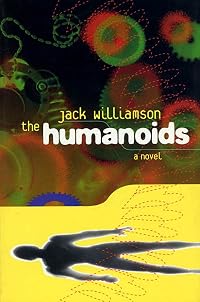
The Humanoids is right on the cusp between a book that I will end up hanging on to, and one that I will probably end up selling off for 50 cents of used book store credit. But I think ultimately it's a short and enjoyable read that's a good example of the genre during the earlier stages of it's popularity. The sick cover is a bonus too. show less
Despite their age, the two separate stories within The Humanoids hold up well. This fix-up collects two stories within the same universe, and some ending material from Williamson on his intended themes. This is a world in which a sleek robotic hive mind is designated with creed of: "To Serve and Obey, And Guard Men from Harm", which is then taken to its logical extremes. These robots take over world after world, preventing humans from doing anything that could make them 'unhappy or unsafe' to such an extreme that most humans end up extremely unhappy and unsafe from their own minds. Several human revolts attempt to shut them down, to varying degrees of success.
Williamson has a really strong and clear plot line that drives the stories show more forward decisively. It's a shame that in comparison he doesn't spend as much time getting his writing up to snuff. Sure, most of his prose is average, but there are low points that draw the rest of the material down with them. I have to remind myself though that this was written for the pulp magazines in the 40's, and in that context it's pretty readable and coherent. I enjoyed that the ending can be interpreted multiple ways: one in which Forester has a personal awakening and see that his hatred for the humanoids was delusional hatred, or was he brain-washed by the humanoids, the last individual wiped clean over a 50 years procedure. There's some neat exploration of personal liberty versus freedom in The Humanoids that I found interesting.
There's also a lot of focus put on the exploration of the, at the time, recent advancements in quantum mechanics. Williamson uses this scientific field as the basis for his explanation of teleportation and precognition, both of which are skills that apparently humans all hold the keys to, but are stymied by their own brains from achieving. It's interesting, but the actual technical writing trying to explain this coalescence of multiple science sub-fields into one grand design principle is both confusing and poorly written. Williamson needed to either spend more time fleshing out this explanation, or leave it more to the imagination. His fast-paced plot did not match with the drudgery of this explanation.
The Humanoids is right on the cusp between a book that I will end up hanging on to, and one that I will probably end up selling off for 50 cents of used book store credit. But I think ultimately it's a short and enjoyable read that's a good example of the genre during the earlier stages of it's popularity. The sick cover is a bonus too. show less
Mi ha lasciato sensazioni simili a quelle che mi ha dato la lettura di Arancia Meccanica (o la visione del film), perchè il libro, una volta tolto il contesto fantascientifico, tratta del libero arbitrio umano.
Nella parte iniziale l'arrivo degli umanoidi segna per molte persone l'annullamento della possibilità di fare qualunque cosa: gli esseri umani sono fragili e tutto è troppo pericoloso.
Il romanzo segue i tentativi di Clay Forester di liberarsi degli ingombranti robot scontrandosi anche con umani che invece li hanno accettati e riescono a avere inspiegabili trattamenti di favore.
La conclusione del romanzo è la parte che più mi ricorda Arancia Meccanica: a Forester viene rimosso il sentimento d'odio nei confronti delle macchine show more che ora gli paiono invece necessarie. All'uomo, bello e perfetto come un automa, è stata definitivamente tolta la capacità di fare del male. show less
Nella parte iniziale l'arrivo degli umanoidi segna per molte persone l'annullamento della possibilità di fare qualunque cosa: gli esseri umani sono fragili e tutto è troppo pericoloso.
Il romanzo segue i tentativi di Clay Forester di liberarsi degli ingombranti robot scontrandosi anche con umani che invece li hanno accettati e riescono a avere inspiegabili trattamenti di favore.
La conclusione del romanzo è la parte che più mi ricorda Arancia Meccanica: a Forester viene rimosso il sentimento d'odio nei confronti delle macchine show more che ora gli paiono invece necessarie. All'uomo, bello e perfetto come un automa, è stata definitivamente tolta la capacità di fare del male. show less
A classic that has not aged at all well, IMO. On the positive side, there's a fine big concept, comparable to Clarke's Childhood's End, around the mechanical robots -- not biological in any sense that humanoid might suggest -- with just one goal: keep all humans safe from harm, even if that means removing pretty much all freedoms. This was first put forth in "With Folded Hands". The novel is not a fix-up but a sequel. Early on there's a fairly adult treatment of a failing marriage, given Williamson was a pulp writer and this was published in 1948. And, there's a possible element of diversity with repeated references to the brown skin of two central characters.
Unfortunately, on the negative side there's just too many cliffhangers, show more repeated and lengthy sequences of running around facing danger and pain, and pages of info dumps, first to set up the background, and later to explain the new (imaginary) physics. The primary character is annoying from page one and wrongheaded to the very end. Even the diversity aspect is minor, since we're told early on that what seems like Earth in the near future is really taking place in the distant future on another planet, with many things translated to familiar terms -- so racial issues are off the table.
Not recommended, except for historical purposes. show less
Unfortunately, on the negative side there's just too many cliffhangers, show more repeated and lengthy sequences of running around facing danger and pain, and pages of info dumps, first to set up the background, and later to explain the new (imaginary) physics. The primary character is annoying from page one and wrongheaded to the very end. Even the diversity aspect is minor, since we're told early on that what seems like Earth in the near future is really taking place in the distant future on another planet, with many things translated to familiar terms -- so racial issues are off the table.
Not recommended, except for historical purposes. show less
It’s psychics versus robots!
We´re not in Asimovian territory...
And it gets weirder from there. I’m not sure if it’s just the nature of Golden Age SF, but this book is a real mess. I remember reading it a long time ago in my teens. The pacing is weird, as Jack Williamson goes through the key moments (like the humanoid takeover of Starmont society), as well as having characters totally disappear (the entire psychic team mostly fades away after an elaborate introduction, eg, Graystone the Great" simply vanishes!).
Plot-lines are foreshadowed without paying off (there are lots of hints about the mysterious origin of Forester’s friend Ironsmith, but he’s really just a robot-loving, wife-stealing jerk). show more
The ending is also a bit of a mess. There’s some unintentional (I think) ambiguity, that gets nowhere.
I should have known better than to start re-reading Golden Age SF at my age... I have a few more in store to read: Heinlein, Phil Dick, Le Guin, Vance, Wolfe, Silverberg, etc.
" show less
We´re not in Asimovian territory...
And it gets weirder from there. I’m not sure if it’s just the nature of Golden Age SF, but this book is a real mess. I remember reading it a long time ago in my teens. The pacing is weird, as Jack Williamson goes through the key moments (like the humanoid takeover of Starmont society), as well as having characters totally disappear (the entire psychic team mostly fades away after an elaborate introduction, eg, Graystone the Great" simply vanishes!).
Plot-lines are foreshadowed without paying off (there are lots of hints about the mysterious origin of Forester’s friend Ironsmith, but he’s really just a robot-loving, wife-stealing jerk). show more
The ending is also a bit of a mess. There’s some unintentional (I think) ambiguity, that gets nowhere.
I should have known better than to start re-reading Golden Age SF at my age... I have a few more in store to read: Heinlein, Phil Dick, Le Guin, Vance, Wolfe, Silverberg, etc.
" show less
Love the Robot Series by Azimov? You will love this book!
It is far, far in the future and many thousands of light years from Mother Earth. The first humans have populated other planets in other solar systems. It has been so long since this occurred, every group of humans evolved differently... different languages, customs, ... but they all met with the same conclusion: superiority complex which led to war and the extinction of humans from their planet. The Humanoids (robots) were created to change this tragic ending, they were created to protect man from any harm, to ensure their continual happiness and the way this has evolved is that the humanoids decide what protection and happiness is. This makes some people unhappy and they rebel show more against the choices of the humanoids and so the humanoids do what they must to ensure happiness and protection to all: they drug those deemed unhappy in order to protect them. In this way, there is an ordered society in which all have the same focus and are eternally protected by these robots.
A few people rebel against the loss of individuality; this is the story of a small group of people who rebel and attempt to stop this continual evasion. What they do, why and how....
Jack Williamson wrote this after WWII as a social commentary. What is it to be an individual? To what extent should "the good of the may over the good of the few" persist? No answer is given, simply a glimpse into each side of the argument. A brilliant example of Social Science Fiction. show less
It is far, far in the future and many thousands of light years from Mother Earth. The first humans have populated other planets in other solar systems. It has been so long since this occurred, every group of humans evolved differently... different languages, customs, ... but they all met with the same conclusion: superiority complex which led to war and the extinction of humans from their planet. The Humanoids (robots) were created to change this tragic ending, they were created to protect man from any harm, to ensure their continual happiness and the way this has evolved is that the humanoids decide what protection and happiness is. This makes some people unhappy and they rebel show more against the choices of the humanoids and so the humanoids do what they must to ensure happiness and protection to all: they drug those deemed unhappy in order to protect them. In this way, there is an ordered society in which all have the same focus and are eternally protected by these robots.
A few people rebel against the loss of individuality; this is the story of a small group of people who rebel and attempt to stop this continual evasion. What they do, why and how....
Jack Williamson wrote this after WWII as a social commentary. What is it to be an individual? To what extent should "the good of the may over the good of the few" persist? No answer is given, simply a glimpse into each side of the argument. A brilliant example of Social Science Fiction. show less
Interesting in that there's a lot of science, based on an attempt to explore ideas raised by quantum mechanics as opposed to Newtonian physics. "There I think we've found it--the mechanics of teleportation! No transfer of actual substance, but rather an exchange of identities, brought on by controlled probability. That gets us around the old electromagnetic problems of inertia and instantaneous acceleration...." Much is made of something called "rhodomagnetics," too.
Otherwise, the concept is covered more effectively in the short story, [b:With Folded Hands|20360889|With Folded Hands|Jack Williamson|https://d2arxad8u2l0g7.cloudfront.net/books/1388425200s/20360889.jpg|23996500], imo.
Howeverthe ending of this confuses me. Is it really show more bleak, in that Forester is now brain-washed? Or has he come to see past his hatred to accept the humanoids as partners? I do own the sequel so I'll have to check.... show less
Otherwise, the concept is covered more effectively in the short story, [b:With Folded Hands|20360889|With Folded Hands|Jack Williamson|https://d2arxad8u2l0g7.cloudfront.net/books/1388425200s/20360889.jpg|23996500], imo.
However
Members
- Recently Added By
Lists

The 5 Parsec Shelf
50 works; 7 members
Author Information

210+ Works 10,095 Members
Author Jack Williamson was born in Bisbee, Arizona on April 29, 1908. In the 1950's, he received both his BA and MA degress in English from Eastern New Mexico University. After receiving his PhD from the University of Colorado, he taught linguistics, the modern novel and literary criticism at Eastern New Mexico University until he retired in 1977. show more At the age of 20, he published his first story, The Metal Man, in a December 1928 issue of Amazing Stories. Since then he has written more than 50 novels and at least 15 short story collections. Some of his best known works are The Humanoids, The Legion of Time, Manseed, and Lifeburst. He also published numerous collaborations with fellow science fiction author Frederik Pohl. He received numerous awards including the Pilgrim Award from the Science Fiction Research Association, the Hugo Award, and the Nebula Award. He was an inaugural inductee in the Science Fiction and Fantasy Hall of Fame and was named a Grand Master of Science Fiction by the Science Fiction Writers of America in 1976. He died at his home in Portales, New Mexico on November 10, 2006. (Bowker Author Biography) show less
Some Editions
Awards and Honors
Distinctions
Notable Lists
Series

Belongs to Publisher Series
Galaxy SF Novel (21)
Work Relationships
Common Knowledge
- Canonical title
- The Humanoids
- Original title
- The Humanoids
- Original publication date
- 1949
- Original language
- English
- Canonical DDC/MDS
- 813.08762
Classifications
- Genres
- Science Fiction, Fiction and Literature
- DDC/MDS
- 813.08762 — Literature & rhetoric American literature in English American fiction in English By type Genre fiction Adventure fiction Speculative fiction Science fiction
- LCC
- PZ3 .W67764 .H — Language and Literature Fiction and juvenile belles lettres Fiction and juvenile belles lettres Fiction in English
- BISAC
Statistics
- Members
- 644
- Popularity
- 44,957
- Reviews
- 18
- Rating
- (3.55)
- Languages
- 7 — Danish, English, French, German, Italian, Polish, Spanish
- Media
- Paper, Ebook
- ISBNs
- 19
- ASINs
- 39