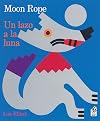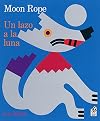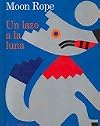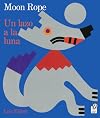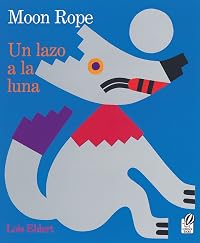
Moon Rope: A Peruvian Folktale / Un lazo a la luna: una leyenda peruana
by Lois Ehlert
On This Page
Description
An adaptation of the Peruvian folktale in which Fox and Mole try to climb to the moon on a rope woven of grass.Tags
Recommendations











Member Reviews
Fox longs to travel to the moon in this bilingual picture book retelling of a traditional Peruvian folktale from author/illustrator Lois Ehlert. Convincing Mole to accompany him and some birds to take his grass rope and hang it over the that celestial body, Fox begins to climb, followed by his talpine friend. Mole's subsequent fall, and the ridicule he experiences at the hands of the other animals drives him underground, where he remains, a burrowing creature. And Fox? Some say you can still see Fox in the moon...
Adapted from a tale called The Fox and the Mole, found in Enriqueta Herrera's collection, Leyendas y fabulas peruanas, the story in Moon Rope is told in English by Ehlert and translated back into Spanish by Amy Prince. It is an show more engaging pourquoi tale, explaining both how moles came to be how they are, and why you can see a fox (in this tale, anyway) in the moon. It's fascinating to think of the different figures various human cultures have spied in the moon, from the fox seen here to the rabbit that Chinese folklore sees in that heavenly orb. This phenomenon is known as pareidolia—the human tendency to perceive patterns or meaning where there is none—and in the west, tradition supplies a man in the moon, with numerous cultural references to this figure. In any case, I enjoyed the story here, and thought that the collage-style illustrations, inspired by Peruvian decorative motifs, were striking. Recommended to young folklore enthusiasts, and to anyone seeking Peruvian stories. show less
Adapted from a tale called The Fox and the Mole, found in Enriqueta Herrera's collection, Leyendas y fabulas peruanas, the story in Moon Rope is told in English by Ehlert and translated back into Spanish by Amy Prince. It is an show more engaging pourquoi tale, explaining both how moles came to be how they are, and why you can see a fox (in this tale, anyway) in the moon. It's fascinating to think of the different figures various human cultures have spied in the moon, from the fox seen here to the rabbit that Chinese folklore sees in that heavenly orb. This phenomenon is known as pareidolia—the human tendency to perceive patterns or meaning where there is none—and in the west, tradition supplies a man in the moon, with numerous cultural references to this figure. In any case, I enjoyed the story here, and thought that the collage-style illustrations, inspired by Peruvian decorative motifs, were striking. Recommended to young folklore enthusiasts, and to anyone seeking Peruvian stories. show less
Fox wants one thing: the moon... but how is he going to get it? With some help from other animals, they devise a plan to bring the moon down to earth by creating a rope. Fox climbs the rope up, up, up, while bird flies above and mole holds the bottom. Then, mole falls, and bird falls, but where did fox go? The birds might say that they can see him looking down on them in a full moon.
I remember this story! I love the block-like illustrations. The fact that it is bilingual in English and Spanish makes it more accessible to my dual language kiddos as well.
I remember this story! I love the block-like illustrations. The fact that it is bilingual in English and Spanish makes it more accessible to my dual language kiddos as well.
This folktale, told in both English and Spanish, was a good book. My first observation was regarding the illustrations. They are very geometric, which is not typical of folktales. Though I though the pictures were cool and fun to look at, I don’t think they offered much insight about the story. It was a ‘pourquoi’ folktale, explaining why moles dig underground. However, the story is mainly about the fox’s adventure as he tries to get to the moon. The story is very short and flows quickly. My favorite part about it was the magical elements. The surrealistic aspects make the story bouncy and fun; the reader finds enjoyment in the imaginative details of the story about two friends. The Peruvian folktale is told in two languages, show more allowing more readers to interact with the text. The big idea is that when looking for adventure outside of typical bounds, one must not fear the unknown. show less
This is a classic Peruvian folktale about a fox wanting to go to the moon. Fox convinces mole to go with him, but soon enough falls down from the rope they managed to build. The animals laugh at him, and from then on moles prefers his solitary tunnel. This is a great book to introduce folktale. It has vibrant authentic pictures and is a great story to tell the classroom. This book can be for 1st grade to 5th grade.
This book is about a fox that wants to go to the moon. The mole decides he will also go only because the fox told him that there were huge worms up there. The fox decides to make a rope to get to the moon. The fox then decides that him and the mole can climb the rope until they reached the moon. He would learn that he would need other help to reach the moon because the rope alone would not work. This book does a good job of showing that students sometimes have to work together to accomplish a given task.
This book is about a fox who wants to go to the moon. One day he comes across a mole and tells him that he wants to go to the moon and asks if the mole will go with him. The fox tells him that there are a lot of worms on the moon so the mole decides that he will go too. The fox gets the birds to tie a rope to the tip of the moon so he and the mole can climb to the top. When the fox and mole start to climb, the mole slips that falls back to the land. He is so embrassed when the animals start to make fun of him that he digs a hole and decides to stay there all day and only come out at night so the animals can not make fun of him.
This book is written in English and Spanish. It tells the story of a fox wanting to go visit the moon.
Members
- Recently Added By
Lists

The Story of the World: History for the Classical Child: Activity Book Two
415 works; 2 members
Author Information

48+ Works 32,411 Members
Lois Ehlert was born November 9, 1934, in Beaver Dam, Wisconsin. She is a graduate of the University of Wisconsin, Milwaukee, and the Layton School of Art. She has also worked as an art teacher, freelance illustrator, and designer. She has created 38 books for young reader and is known for her colorful collage artwork. Her work as an author and an show more illustrator has appeared in countless publications and has received numerous awards and honors. In addition to creating books, Ehlert has produced toys, games, clothes for children, posters, brochures, catalogs, and banners. She has received the Caldecott Honor Book, 1989, for Color Zoo, a Publishers Weekly Best Book of the Year for Snowballs, the Booklist Editors' Choice for Cuckoo/Cucú: A Mexican Folktale/Un Cuento Folklórico Mexicano, the IRA Teachers' Choice and NCTE Notable Children's Trade Book in the Language Arts for Feathers for Lunch, the American Library Association Notable Children's Book and Boston Globe-Horn Book Honor Award for Chicka Chicka Boom Boom. The first book that she wrote and illustrated was Growing Vegetable Soup (1987). Some of her other works include Planting a Rainbow (2003), Feathers for Lunch (1996), Snowballs (1999), Leaf Man (2005), Moon Rope/ Un Lazo de Luna (2003), which is based on a Peruvian folktale, and Rrralph (2013), Rain Fish (2016), and Heart to Heart (2017). Lois Ehlert died in Milwaukee, Wisconsin on May 25, 2021. She was 86. (Bowker Author Biography) show less
All Editions
Awards and Honors
Awards
Common Knowledge
- Canonical title
- Moon Rope: A Peruvian Folktale / Un lazo a la luna: una leyenda peruana
Classifications
- Genres
- Children's Books, Picture Books
- DDC/MDS
- 398.24 — Society, government, & culture Customs, etiquette & folklore Folklore & Folktales Folk literature Fables, Magical Creatures
- LCC
- PZ8.1 .E3 .M — Language and Literature Fiction and juvenile belles lettres Fiction and juvenile belles lettres Juvenile belles lettres
- BISAC
Statistics
- Members
- 502
- Popularity
- 60,280
- Reviews
- 8
- Rating
- (3.57)
- Languages
- English, French
- Media
- Paper, Audiobook
- ISBNs
- 14
- ASINs
- 6