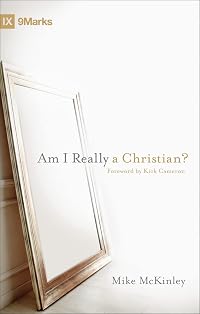
Am I Really a Christian? (9Marks)
by Mike McKinley
On This Page
Description
McKinley challenges new and nominal Christians to take a deeper look at their Christian faith. This book addresses five key criteria to evaluate one's standing before God.Tags
Recommendations






Member Reviews
A couple of months ago, I had the opportunity to attend a conference where Mike McKinley was one of the speakers. I enjoyed his presentations and sermons immensely and was fortunate enough to meet him and trade a few emails. I committed at that conference to buy both the books he has written and review them for you. Am I Really a Christian? (2011, Crossway) is really the second of his books. I will post a review of the other in a few weeks.
I am more conflicted over this book than I have been over a book in a long time. First let me say, it is a really good book. Further, it addresses a real issue in the church: people who think they are Christians but are not. But how do you know who is and who is not really a Christian? It is less show more important for me or you to identify who is or is not; it is vitally important for me to be able to identify whether I am or not. and that is what McKinley tries to help us answer.
This book does not seem to be a direct reply to the doctrines of "Free Grace Theology" – inasmuch as it does not directly reference those belief systems or their proponents. Instead, it is a prophetic voice to a Christian subculture that often elevates professions and image above a genuine relationship with the God of the universe through the salvation that comes only in Jesus Christ.
In Am I Really a Christian?, McKinley identifies seven traits or characteristics which he thinks out to help an individual determine whether or not he is a Christian; he then writes a chapter based on each of these characteristics from the negative perspective. The chapter titles all begin: “You Are Not a Christian …”:
McKinley’s writing is conversational and easy to follow. Most importantly, it is rooted in the scripture. And this is a good place to address why I am conflicted over this book. I appreciate that it uses the truth of the Gospel as the foundation. The problem is that I disagree with some of his interpretation. Don’t get me wrong; most of it is spot-on. He could not be more right. The problem is where I think he gets it wrong, he gets it very wrong. This is most true of Chapter 5: “You Are Not a Christian If You Do Not Endure to the End”.
When I ordered the book, I was fully aware of McKinley’s Calvinist or Reformed beliefs; and I have an appreciation for them. The chapter about enduring did not surprise me. It is the depth of my reaction that surprised me.
The other surprise was my response to the scriptures he used to support his Calvinst position. I would use pretty much the same passages to support my Reformation Arminian position. It really is a matter of interpretation!
I don’t want to be uncharitable. I count Mike McKinley as a bother and co-laborer in ministry. He desires to desires to associate and work alongside brothers and sisters who do not share his Calvinist soteriology, as do I.
He closes the book with a chapter where he asks then tries to answer the question: Can I ever really know if I am a Christian? followed by a chapter stressing the importance of membership in the local church. The chapter on church membership is perhaps the best in the book. My hope is that he will soon write an entire book on that topic.
Am I Really a Christian? is really quite a good book. That being said, as a reader you must go in with your eyes wide open. McKinley definitely approaches the subject through the lens of his deeply held Reformed theology, as he should.
This is a book I would recommend to pastors and teachers, along with those who are confident enough in their understanding of scripture to prevent being unduly influenced by the areas where I think McKinley just gets it wrong. I am hesitant to recommend it to individuals who struggle with assurance because the chapter on perseverance breeds the very false assurance McKinley tries to guard against. The book would also make a great general outline for a preaching or teaching series.
Thoughts? show less
I am more conflicted over this book than I have been over a book in a long time. First let me say, it is a really good book. Further, it addresses a real issue in the church: people who think they are Christians but are not. But how do you know who is and who is not really a Christian? It is less show more important for me or you to identify who is or is not; it is vitally important for me to be able to identify whether I am or not. and that is what McKinley tries to help us answer.
This book does not seem to be a direct reply to the doctrines of "Free Grace Theology" – inasmuch as it does not directly reference those belief systems or their proponents. Instead, it is a prophetic voice to a Christian subculture that often elevates professions and image above a genuine relationship with the God of the universe through the salvation that comes only in Jesus Christ.
In Am I Really a Christian?, McKinley identifies seven traits or characteristics which he thinks out to help an individual determine whether or not he is a Christian; he then writes a chapter based on each of these characteristics from the negative perspective. The chapter titles all begin: “You Are Not a Christian …”:
Just Because You Say That You Are
If You Haven’t Been Born Again
Just Because You Like Jesus
If You Enjoy Sin
If You Do Not Endure to the End
If You Don’t Love Other People
If You Love Your Stuff
McKinley’s writing is conversational and easy to follow. Most importantly, it is rooted in the scripture. And this is a good place to address why I am conflicted over this book. I appreciate that it uses the truth of the Gospel as the foundation. The problem is that I disagree with some of his interpretation. Don’t get me wrong; most of it is spot-on. He could not be more right. The problem is where I think he gets it wrong, he gets it very wrong. This is most true of Chapter 5: “You Are Not a Christian If You Do Not Endure to the End”.
When I ordered the book, I was fully aware of McKinley’s Calvinist or Reformed beliefs; and I have an appreciation for them. The chapter about enduring did not surprise me. It is the depth of my reaction that surprised me.
The other surprise was my response to the scriptures he used to support his Calvinst position. I would use pretty much the same passages to support my Reformation Arminian position. It really is a matter of interpretation!
I don’t want to be uncharitable. I count Mike McKinley as a bother and co-laborer in ministry. He desires to desires to associate and work alongside brothers and sisters who do not share his Calvinist soteriology, as do I.
He closes the book with a chapter where he asks then tries to answer the question: Can I ever really know if I am a Christian? followed by a chapter stressing the importance of membership in the local church. The chapter on church membership is perhaps the best in the book. My hope is that he will soon write an entire book on that topic.
Am I Really a Christian? is really quite a good book. That being said, as a reader you must go in with your eyes wide open. McKinley definitely approaches the subject through the lens of his deeply held Reformed theology, as he should.
This is a book I would recommend to pastors and teachers, along with those who are confident enough in their understanding of scripture to prevent being unduly influenced by the areas where I think McKinley just gets it wrong. I am hesitant to recommend it to individuals who struggle with assurance because the chapter on perseverance breeds the very false assurance McKinley tries to guard against. The book would also make a great general outline for a preaching or teaching series.
Thoughts? show less
Review of Am I Really a Christian? by Mike McKinley
If you don’t want to be a Christian this book is not for you. Put it down. If you believe you are a Christian and are satisfied with your grasp of the doctrine of salvation, the role of faith in salvation, personal assurance of salvation and the manner in which your life lines up with your belief system, this book has nothing to offer you. Walk away. There is danger, however, in thinking you are past the point of need for self-examination or for peer-accountability regarding the direction of your life. Since your eternal destination hangs in the balance, the subject matter should be worth your consideration. With these statements Mike McKinley, the pastor of a Baptist congregation, show more pinpoints the intended audience of Am I really a Christian: the most important question you’re not asking (Crossway, 2011).
Christian jargon can bring more confusion than clarity. In the context of Am I really a Christian?, McKinley’s perspective of “born again” is one of regeneration. The regenerating love and mercy of God is the cause of salvation while the fruit of the believer’s life is the result or effect of salvation. Being a “Christian” goes beyond respect for Jesus to belief and faith in him. McKinley addresses the concept of faith as consisting of both objective content (doctrine) and a personal trust in Christ. McKinley also addresses the often tossed about “once saved, always saved” catch-phrase and the concept of “losing” salvation when a Christian doesn’t persevere in his faith. This is an area of dispute among Christian denominations. A genuine Christian, McKinley states, “perseveres in following Christ” (emphasis is the author’s). A onetime decision is important and it should be followed by a daily decision to follow Christ.
Am I really a Christian? is scripture rich. McKinley relies heavily on passages of scripture and points readers to them by providing direct quotations within the text. Like John Piper’s Think: the life of the mind and the love of God (Crossway, 2010), McKinley compels readers to look past feelings and common Christian expressions to contemplate questions like the following: What do I believe? Do I agree? Does scripture bear out his arguments? How should I respond in light of these truths?
McKinley’s message is to the church. He speaks as a fellow sojourner wanting to guide, encourage and strengthen the faith of believers. He takes care to reassure Christians with sensitive consciences. His pastoral gifting rings true. He is a builder and a gatherer. The author continually brings to the forefront the need for believers to be surrounded by brothers and sisters that can be trusted to come alongside to encourage and guide you as you walk out your faith. As the body of Christ, the goal should be self-evaluation in consultation with trusted mentors in order to seek and find evidence that the cause of our salvation (God’s regenerating love and mercy) has taken root and our lives are beginning to reveal the fruit (effect) of that salvation. To aid in this process, McKinley recommends the formation of year-long one-on-one mentoring relationships.
The format for each chapter is text followed by a How to Respond section containing four points: reflect, repent, remember, and report. The book contains three appendices: Notes, containing sources for in-text references divided by chapter; Subject Index and Scripture Index.
Am I Really a Christian? can be useful to individuals apart from a group environment. Its best and most complete use will come in the form of small groups of either new believers or those seeking membership within the body of a local congregation. A person’s willingness to engage in such a small group would be a good indicator to leadership of the individual’s desire to become a Christian and/or to participate in the life of that body. If you are willing to put quality time into self-evaluation in consultation with trusted friends at your local congregation, Am I Really a Christian? is worth your time and attention.
NOTE: I requested and received a copy of this title via NetGalley.com but made no commitment to review it. show less
If you don’t want to be a Christian this book is not for you. Put it down. If you believe you are a Christian and are satisfied with your grasp of the doctrine of salvation, the role of faith in salvation, personal assurance of salvation and the manner in which your life lines up with your belief system, this book has nothing to offer you. Walk away. There is danger, however, in thinking you are past the point of need for self-examination or for peer-accountability regarding the direction of your life. Since your eternal destination hangs in the balance, the subject matter should be worth your consideration. With these statements Mike McKinley, the pastor of a Baptist congregation, show more pinpoints the intended audience of Am I really a Christian: the most important question you’re not asking (Crossway, 2011).
Christian jargon can bring more confusion than clarity. In the context of Am I really a Christian?, McKinley’s perspective of “born again” is one of regeneration. The regenerating love and mercy of God is the cause of salvation while the fruit of the believer’s life is the result or effect of salvation. Being a “Christian” goes beyond respect for Jesus to belief and faith in him. McKinley addresses the concept of faith as consisting of both objective content (doctrine) and a personal trust in Christ. McKinley also addresses the often tossed about “once saved, always saved” catch-phrase and the concept of “losing” salvation when a Christian doesn’t persevere in his faith. This is an area of dispute among Christian denominations. A genuine Christian, McKinley states, “perseveres in following Christ” (emphasis is the author’s). A onetime decision is important and it should be followed by a daily decision to follow Christ.
Am I really a Christian? is scripture rich. McKinley relies heavily on passages of scripture and points readers to them by providing direct quotations within the text. Like John Piper’s Think: the life of the mind and the love of God (Crossway, 2010), McKinley compels readers to look past feelings and common Christian expressions to contemplate questions like the following: What do I believe? Do I agree? Does scripture bear out his arguments? How should I respond in light of these truths?
McKinley’s message is to the church. He speaks as a fellow sojourner wanting to guide, encourage and strengthen the faith of believers. He takes care to reassure Christians with sensitive consciences. His pastoral gifting rings true. He is a builder and a gatherer. The author continually brings to the forefront the need for believers to be surrounded by brothers and sisters that can be trusted to come alongside to encourage and guide you as you walk out your faith. As the body of Christ, the goal should be self-evaluation in consultation with trusted mentors in order to seek and find evidence that the cause of our salvation (God’s regenerating love and mercy) has taken root and our lives are beginning to reveal the fruit (effect) of that salvation. To aid in this process, McKinley recommends the formation of year-long one-on-one mentoring relationships.
The format for each chapter is text followed by a How to Respond section containing four points: reflect, repent, remember, and report. The book contains three appendices: Notes, containing sources for in-text references divided by chapter; Subject Index and Scripture Index.
Am I Really a Christian? can be useful to individuals apart from a group environment. Its best and most complete use will come in the form of small groups of either new believers or those seeking membership within the body of a local congregation. A person’s willingness to engage in such a small group would be a good indicator to leadership of the individual’s desire to become a Christian and/or to participate in the life of that body. If you are willing to put quality time into self-evaluation in consultation with trusted friends at your local congregation, Am I Really a Christian? is worth your time and attention.
NOTE: I requested and received a copy of this title via NetGalley.com but made no commitment to review it. show less
You may think you are, but you may not be. After all, Jesus himself said that some people will do seemingly “Christian” things in his name but will not truly know him. Or maybe you know you are not a Christian and you wonder what it really means to be one.
To be sure, however, there is clarity from God’s perspective. He is not confused about who does and does not know him. And though our self-awareness is certainly limited, we have been given biblical criteria to help us evaluate whether we are indeed followers of Christ.
Mike McKinley shows us the importance of examining our standing with God and helps us to fearlessly ask the hard questions, ultimately allowing us to see whether we are in the faith and what exactly that entails.
To be sure, however, there is clarity from God’s perspective. He is not confused about who does and does not know him. And though our self-awareness is certainly limited, we have been given biblical criteria to help us evaluate whether we are indeed followers of Christ.
Mike McKinley shows us the importance of examining our standing with God and helps us to fearlessly ask the hard questions, ultimately allowing us to see whether we are in the faith and what exactly that entails.
God knows his own. Just saying we’re a Christian doesn’t make it so. God sees “us clearly, we don’t see ourselves clearly.” I loved to Willy Wonka and how God makes it clear what we have to do to be a Christian. There are no “hidden clauses.” He uses many analogies. “Our life is destroyed by sin, not damaged by it. He used a rotted closet to represent our sinful lives. We can’t patch it up. Christ must replace every bit of the rot with his love and grace,( see page 35). Just “liking” Jesus doesn’t make us a Christian.
Being a Christian means “changing teams and having new allegiances”, (page 60). I loved the analogy that many people think of forgiveness like a vaccination you get once that protects you against show more hell’s fires, while you continue to do what you want to do!” (page 79) show less
Being a Christian means “changing teams and having new allegiances”, (page 60). I loved the analogy that many people think of forgiveness like a vaccination you get once that protects you against show more hell’s fires, while you continue to do what you want to do!” (page 79) show less
A lot to think on, self analysis. It's ok to have doubt, go deeper, let go. The questions and "tasks" at the end of each chapter are great, simple suggestions to understand yourself better, and improve your walk!
NCLA Review: In the Introduction, the author states, “There are a lot of people in this world who think they are Christians but are not. This is a book aimed at convincing you that you may not be a Christian.” In five of the nine chapters, McKinley uses passages in the Bible which focus on explaining why the reader is really not a Christian. He also talks about assurance and the role of the church in helping in the decision of who is a genuine Christian. He says that he is a self-important jerk much of the time, but he is writing this book because he wants to help, and it is not intended to be mean spirited. Maybe not, but readers who know they are Christians don’t need a book that tells them they are not. Rating: 2 —AMB
Perfectly boils down the instructions for how to be a true Christian.
full review here: http://notmytypee.blogspot.com/2011/07/am-i-really-christian.html
full review here: http://notmytypee.blogspot.com/2011/07/am-i-really-christian.html
Members
- Recently Added By
Lists

Sycamore Baptist Church Book Study Reading List
156 works; 5 members
Author Information
17 Works 1,507 Members
Mike McKinley is the pastor of Sterling Park Baptist Church in Sterling, Virginia, adjunct professor of biblical studies at Patrick Henry College, and author of a number of books for Christian living.
Series
Belongs to Publisher Series
Classifications
Statistics
- Members
- 423
- Popularity
- 73,031
- Reviews
- 8
- Rating
- (4.23)
- Languages
- English, Portuguese (Portugal), Spanish
- Media
- Paper, Ebook
- ISBNs
- 6
- ASINs
- 2