On This Page
Description
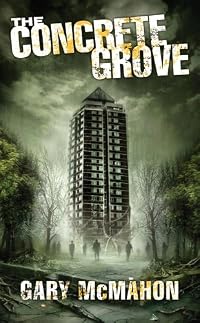
Imagine a place where all your nightmares become real. Think of dark urban streets where crime, debt and violence are not the only things to fear. Picture an estate that is a gateway to somewhere else, a realm where ghosts and monsters stir hungrily in the shadows. Welcome to the Concrete Grove. It knows where you live.Tags
Recommendations














Member Reviews
The book opens with this quote: "One of the widespread beliefs is that hummingbirds, in some way, are messengers between worlds. As such they help shamans keep nature and spirit in balance"
Great. Hummingbirds. What's so scary about that you say? Plenty about that is scary, which is why you should read this book.
The Concrete Grove is described as what we here in the U.S. would call the projects. It's an urban area, filled with drug dealers, gang members and violence. At the center of these circularly laid out projects stands the needle.There are things living in the needle.Our 14 year old protagonist, Hailey, is drawn there, to them, for reasons unknown. It turns out that the needle is a sort of gateway, and what is coming through may show more or may not be pleasant, depending on the viewer. The Slitten are a force to be dealt with. Will 14 year old Hailey make it through? You will have to read this book to find out.
This book is populated with bleak, hopeless characters trapped in a bleak, grey environment. We have a woman, Hailey's mother, fighting to keep their financial heads above water. We have Tom, caring for his obese, paralyzed wife, (who got that way during a rendezvous with her lover.) At the same time we have Banjo, the drug addict and Monte Bright the local loan shark and instrument of mayhem. We won't even talk about Mr. Boater. These characters came alive to me, with all of their flaws and troubles. To me, that's an amazing piece of writing.
I was not aware at the time I bought this book that it was the beginning of a series. It looks as each book focuses on a different set of characters. I picked up the remaining two books in the series and I am looking forward to checking them out.
Recommended for fans of urban horror and for fans of science fiction type stories with heavy hints of horror! show less
Great. Hummingbirds. What's so scary about that you say? Plenty about that is scary, which is why you should read this book.
The Concrete Grove is described as what we here in the U.S. would call the projects. It's an urban area, filled with drug dealers, gang members and violence. At the center of these circularly laid out projects stands the needle.There are things living in the needle.Our 14 year old protagonist, Hailey, is drawn there, to them, for reasons unknown. It turns out that the needle is a sort of gateway, and what is coming through may show more or may not be pleasant, depending on the viewer. The Slitten are a force to be dealt with. Will 14 year old Hailey make it through? You will have to read this book to find out.
This book is populated with bleak, hopeless characters trapped in a bleak, grey environment. We have a woman, Hailey's mother, fighting to keep their financial heads above water. We have Tom, caring for his obese, paralyzed wife, (who got that way during a rendezvous with her lover.) At the same time we have Banjo, the drug addict and Monte Bright the local loan shark and instrument of mayhem. We won't even talk about Mr. Boater. These characters came alive to me, with all of their flaws and troubles. To me, that's an amazing piece of writing.
I was not aware at the time I bought this book that it was the beginning of a series. It looks as each book focuses on a different set of characters. I picked up the remaining two books in the series and I am looking forward to checking them out.
Recommended for fans of urban horror and for fans of science fiction type stories with heavy hints of horror! show less
Many countries, including the United States, house their poor in such unpleasant places that they are rethinking the way to provide housing assistance for them. Numerous high rise facilities have been demolished, like the infamous Cabrini Green in Chicago or Atlanta’s Bowen Homes, and replaced with mixed-income housing projects. In England, they are called council estates. High rises are even more problematic there, for England has never taken much to the skyscraper, at least as a place to live. So it’s not surprising that there are places like The Grove, with an abandoned high rise in the center and flats surrounding it in a concentric pattern. Such is the nature of The Grove in Gary McMahon’s The Concrete Grove, because that’s show more all you see there: no trees, no grass, no flowers, only concrete.
Hailey lives in the Grove with her mother. The place scares her, because she is not accustomed to it. It wasn’t supposed to be like this, but her father lost the family’s money and committed suicide, and now they’re stuck living on as best they can. Hailey yearns for a place she can be on her own, and for someone, or something, to save her. She often heads for the Needle, the abandoned skyscraper in the middle of the Grove, for some private time. It isn’t exactly a pleasant place, being filled with trash and unpleasant smells, but it’s a place she can grab some time for herself. One day after school, she happens upon a flock of hummingbirds in the room she usually frequents in the Needle. She is enraptured, especially because hummingbirds are not native to England; she’s never seen one before. But these hummingbirds seem to be messengers of a sort, from a literal grove that existed before the Concrete Grove existed, and right there, in Chapter One, unpleasant things begin happening.
McMahon quickly introduces us to another viewpoint character, Tom, who likes to run to keep in shape, but also to escape from his wife. It’s an especially sad marriage. His wife is a paraplegic, having been in a automobile accident while on her way to a tryst with a paramour. She no longer makes the slightest effort to be a wife in any way, not even leaving her bed any longer, simply eating herself to death. One day – that same day Hailey had her encounter with the hummingbirds – Tom is out running near the Grove when he comes across Hailey, crumpled by the side of the road. He rescues her from what appears to be a faint, and takes her home to her mother, Lana. Lana and Tom have an immediate physical attraction to each other, an attraction that they refuse to deny.
But the Grove has something to say about that, and things continue to get darker as this very black novel continues. We learn that Lana is in deep with the Grove’s resident loan shark, who is as brutal – no, actually more brutal – than one can imagine. McMahon does not spare his readers, but he doesn’t need to overwhelm us with gory details. He tells us just enough so that our own imaginations soar into a darkness we never thought lived there, seeing in our mind’s eye what he only hints at. It takes a true master to make a reader paint the picture after he has merely drawn the outline.
McMahon hints at a deeper story than the horrific picture he draws, though, and the reader is left wishing that he had filled in more of the details. One guesses that he is attempting to use the trope of an oak grove as the home of ancient powers that are insensible to humans, seeing them, if at all, only as tools. The Concrete Grove seems to be built over one of these old places of power. It transforms the older grove rather than replacing it, and McMahon seems to want us to see that the transformation has warped those powers. This would have been a better story if McMahon had done more with the deep background. Desperation, frustration and terror lurk in the pages of The Concrete Grove, and one wishes for an explanation. Publicity for the book states that this is the first novel in a trilogy, so maybe we’ll learn more as the trilogy goes on.
But then, perhaps the lack of a reason is all the reason for the horror McMahon means for us to see for now. Hopelessness emanates from every page; no character seems to have a way out of the awefulness in which he or she lives. McMahon’s horror is existential as well as experiential, and it’s hard to say which is the more terrifying. show less
Hailey lives in the Grove with her mother. The place scares her, because she is not accustomed to it. It wasn’t supposed to be like this, but her father lost the family’s money and committed suicide, and now they’re stuck living on as best they can. Hailey yearns for a place she can be on her own, and for someone, or something, to save her. She often heads for the Needle, the abandoned skyscraper in the middle of the Grove, for some private time. It isn’t exactly a pleasant place, being filled with trash and unpleasant smells, but it’s a place she can grab some time for herself. One day after school, she happens upon a flock of hummingbirds in the room she usually frequents in the Needle. She is enraptured, especially because hummingbirds are not native to England; she’s never seen one before. But these hummingbirds seem to be messengers of a sort, from a literal grove that existed before the Concrete Grove existed, and right there, in Chapter One, unpleasant things begin happening.
McMahon quickly introduces us to another viewpoint character, Tom, who likes to run to keep in shape, but also to escape from his wife. It’s an especially sad marriage. His wife is a paraplegic, having been in a automobile accident while on her way to a tryst with a paramour. She no longer makes the slightest effort to be a wife in any way, not even leaving her bed any longer, simply eating herself to death. One day – that same day Hailey had her encounter with the hummingbirds – Tom is out running near the Grove when he comes across Hailey, crumpled by the side of the road. He rescues her from what appears to be a faint, and takes her home to her mother, Lana. Lana and Tom have an immediate physical attraction to each other, an attraction that they refuse to deny.
But the Grove has something to say about that, and things continue to get darker as this very black novel continues. We learn that Lana is in deep with the Grove’s resident loan shark, who is as brutal – no, actually more brutal – than one can imagine. McMahon does not spare his readers, but he doesn’t need to overwhelm us with gory details. He tells us just enough so that our own imaginations soar into a darkness we never thought lived there, seeing in our mind’s eye what he only hints at. It takes a true master to make a reader paint the picture after he has merely drawn the outline.
McMahon hints at a deeper story than the horrific picture he draws, though, and the reader is left wishing that he had filled in more of the details. One guesses that he is attempting to use the trope of an oak grove as the home of ancient powers that are insensible to humans, seeing them, if at all, only as tools. The Concrete Grove seems to be built over one of these old places of power. It transforms the older grove rather than replacing it, and McMahon seems to want us to see that the transformation has warped those powers. This would have been a better story if McMahon had done more with the deep background. Desperation, frustration and terror lurk in the pages of The Concrete Grove, and one wishes for an explanation. Publicity for the book states that this is the first novel in a trilogy, so maybe we’ll learn more as the trilogy goes on.
But then, perhaps the lack of a reason is all the reason for the horror McMahon means for us to see for now. Hopelessness emanates from every page; no character seems to have a way out of the awefulness in which he or she lives. McMahon’s horror is existential as well as experiential, and it’s hard to say which is the more terrifying. show less
It is worthwhile pursuing this trilogy. Gary McMahon's books deserve to be read. I felt an instant connection with the estate the book was set on having had a brief, experimental year living in similar surroundings. (I did not have to live there, but I choose to knowing my family would never visit unaccompanied by an elite security force, so I could get some PEACE).
The ending disappointed me and I found one character in particular surplus to requirements in both this book and the 3rd in which he makes a brief appearance.
If you are going to force a character to roam about your series of books, at least give them something decent to do.
The ending disappointed me and I found one character in particular surplus to requirements in both this book and the 3rd in which he makes a brief appearance.
If you are going to force a character to roam about your series of books, at least give them something decent to do.
Urgh. This book is seedy, overwritten and totally confused about what it wants to be.
Lana and her daughter Hailey have fallen on hard times and are living on a council estate in North-East England. Lana is in debt to the local gangster and Hailey is a lost soul at school.
This book just couldn't decide what it wanted to be. The familial relationship part of the story was okay, but the supernatural element was introduced far too late in the game (and inexplicably) making it seem tacked on. It was also a bit rubbish, really.
I didn't feel that the ending sent an entirely positive message either, given that the characters had spent the rest of the book fighting instead of giving up.
I was going to give one star, but it got two because I read show more till the end regardless. show less
Lana and her daughter Hailey have fallen on hard times and are living on a council estate in North-East England. Lana is in debt to the local gangster and Hailey is a lost soul at school.
This book just couldn't decide what it wanted to be. The familial relationship part of the story was okay, but the supernatural element was introduced far too late in the game (and inexplicably) making it seem tacked on. It was also a bit rubbish, really.
I didn't feel that the ending sent an entirely positive message either, given that the characters had spent the rest of the book fighting instead of giving up.
I was going to give one star, but it got two because I read show more till the end regardless. show less
Tom Stains is trapped in a loveless marriage to a crippled wife who never leaves her bed. Lana Fraser is a widow saddled with a large financial debt and a teenaged daughter named Hailey. One night Hailey wanders into the Needle, the monolithic tower at the center of the urban wasteland known as the Concrete Grove, and is entered through a bloody orifice by a dark force, which causes her to undergo changes not usual for a fourteen year-old girl.
This is a bleak novel. It's not that it's particularly heavy, but it's so depressing. Everyone is miserable and there's no humor at all. The characters are shallowly-drawn and mostly unlikeable. I didn't really buy Tom and Lana's love-at-first-sight. I get that they are both needy but in real life show more no one would want to spend more than five minutes with either of them. Hailey is the only one that's somewhat interesting and after the first couple chapters she fades into the background for the most part.
The prose is only serviceable so the story plods on to its inevitable, yet vaguely-defined conclusion. This is intended to be the first part of a trilogy, but I've no desire to continue. show less
This is a bleak novel. It's not that it's particularly heavy, but it's so depressing. Everyone is miserable and there's no humor at all. The characters are shallowly-drawn and mostly unlikeable. I didn't really buy Tom and Lana's love-at-first-sight. I get that they are both needy but in real life show more no one would want to spend more than five minutes with either of them. Hailey is the only one that's somewhat interesting and after the first couple chapters she fades into the background for the most part.
The prose is only serviceable so the story plods on to its inevitable, yet vaguely-defined conclusion. This is intended to be the first part of a trilogy, but I've no desire to continue. show less
Scary book with a desperate and moody setting: the inner-city of England. The supernatural horrors are not as horrifying as the real-life monsters.
Very powerful and enticing imagery that was stronger than the story itself. Will keep reading, though.
Members
- Recently Added By
Author Information

74+ Works 553 Members
Series

Common Knowledge
- Epigraph
- One of the widespread beliefs is that hummingbirds, in some way, are messengers between worlds. As such they help shamans keep nature and spirit in balance. Source: www.hummingbirdworld.com
- First words
- Her name was Hailey. She was just fourteen years old.
And she was afraid.
No, that wasn't quite right. Hailey wasn't afraid, not exactly; she was sad and confused and worried about her mother, and all she ... (show all)really wanted was to be left alone. Just for a few minutes, maybe as much as half an hour. She needed some time on her own, during which she could think about things and set the facts in order. The world always seemed a little less harsh when the facts were put in place, with everything lined up in neat little rows where she could see them properly Like her books on their shelves or her stuffed toys sitting against the skirting board at home. -Chapter One - Canonical DDC/MDS
- 823.92
- Canonical LCC
- PR6113.C564
Classifications
Statistics
- Members
- 85
- Popularity
- 373,713
- Reviews
- 8
- Rating
- (3.34)
- Languages
- English
- Media
- Paper, Ebook
- ISBNs
- 4
- ASINs
- 2