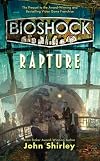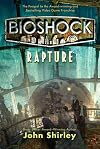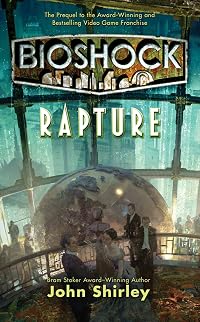
BioShock: Rapture
by John Shirley
On This Page
Description
It was the end of World War II. FDR's New Deal had redefined American politics. Taxes were at an all-time high. The bombing of Hiroshima and Nagasaki had created a fear of total annihilation. The rise of secret government agencies and sanctions on business had many watching their backs. America's sense of freedom was diminishing . . . and many were desperate to take that freedom back. Among them was a great dreamer, an immigrant who'd pulled himself from the depths of poverty to become one show more of the wealthiest and most admired men in the world. That man was Andrew Ryan, and he believed that great men and women deserved better. So he set out to create the impossible, a utopia free from government, from censorship, and from moral restrictions on science, where what you gave was what you got. He created Rapture - the shining city below the sea. But this utopia suffered a great tragedy. This is the story of how it all came to be . . . and how it all ended. show lessTags
Recommendations

Member Reviews
I have never read a novel based on a video game before, and in fact I had no idea that this book even existed! I just happened up on while scouring the shelves of charity shops for bargains. I got quite excited when I saw it, and it was only £1 so not much of a risk to take! I have a weird relationship with the BioShock games. I sort of love them, I love the ideas behind them and the world and the insane, unsettling atmosphere. However it is this creepy, disturbing atmosphere that prevents me from playing them myself. I'm too much of a wimp, I get too stressed out and I have to turn the Xbox off. Pathetic I know. I need somebody play it for me, because I love the story so much I need to know what happens. I do, from watching my brother show more play it, have a pretty good idea of the story of the first game. I was overjoyed by finding this book because I could get more involved in the world without actually having the threat of a splicing jumping out of nowhere with a manic cackle and killing me.
I've given it five stars, obviously. It is bloody brilliant! I have low expectations to begin with.. but it is so good. I'm blown away! It tells the story of the beginnings of Rapture, of the great man himself Andrew Ryan and how it all went so horrifying wrong. It started off as a great ideal, a utopia without restrictions or government interference. Ryan recruited like-minded people to populate his secret new land, and they achieved the feat of building an underwater city. Only human nature and the cold hard reality of capital economics meant it could never last. Plus you chick a few plasmids in there too.. And it gets very messy. If you are fan of the games, read this. Read it now. Must read. OMGITSSOGOOD.
The story if told from a number of perspectives, including Andrew Ryan. He is a figure that looms large in Rapture, and through out the game you hear his recorded messages playing. It was fascinating to spend a little bit of time with him, to see how he built it all and how he crumbled with the pressure of maintaining his impossible ideal. In the end, as an obvious egomaniac and control freak (with a bizarre naivety about human nature), he becomes frustrated with his friend and his toys not doing what he wants them do. All of the other characters from the game are introduced - Dr Tennenbaum (her story is particularly interesting to learn given how we see her in the game),Dr Suchong, Dr Lamb, Dr Steinman (who I think freaked me out more than anybody else in the game), Sandor Cohen, and of course Frank Fontaine and Atlas.
Fontaine had more than a hand in the demise of Rapture, and you learnt a lot about his life before he arrived there and indeed how it was he became a citizen. Without him you have to wonder if things would have turned out different, or at least not have deteriorated quite so fast. There is also the origins to imprint the son he stole from Ryan, which is of course the plot of the first game.
Not forgetting the Little Sisters and the Big Daddy's. The way that morality deteriorates in Rapture to the point that the men in charge - Fontaine and then Ryan - hardly bat an eyelid at turning orphaned girls into monsters for farming ADAM is unsettling and disgusting, although obviously inevitable. It's hard to have you heart-break for them. You also witness the way the plasmid addicts spread through the population, disfiguring people and eventually driving them into homicidal maniacs, to the point where life is Rapture is a live saturated in chaos and violence.
In the middle of all of this we have Bill McDonagh, the man who's engineering helped to build Rapture. I believe he plays quite a small role in the story of the game but in this novel he is our way in and the conscious of Rapture. A conscious being something so many of Ryan's handpicked citizen's lack. He means well, he has a good heart and he believe whole heartedly in Ryan's mission and the idea of Rapture. He does his best to the situation and it deteriorates, but his words fall on deaf hears. In the end he has to choose between keeping his familiar, and the remaining sane people safe, and his loyalty the man who made him and had been his good friend.
All the character and the world are so richly drawn I don't think you HAVE to have played the game to enjoy this book, but it may help you to get the most out of it. It found it a really compelling read, I honestly couldn't put it down! I knew what was going to happen, but I needed to know the details and I needed to know how. It's a brilliant behind the scenes look, and I think definitely adds the tapestry of the world. It's made me really want to re/play BioShock. If can I be brave enough.
It's awesome. Read it, especially if you're a BioShock fan. For what it is, I can't fault it. show less
I've given it five stars, obviously. It is bloody brilliant! I have low expectations to begin with.. but it is so good. I'm blown away! It tells the story of the beginnings of Rapture, of the great man himself Andrew Ryan and how it all went so horrifying wrong. It started off as a great ideal, a utopia without restrictions or government interference. Ryan recruited like-minded people to populate his secret new land, and they achieved the feat of building an underwater city. Only human nature and the cold hard reality of capital economics meant it could never last. Plus you chick a few plasmids in there too.. And it gets very messy. If you are fan of the games, read this. Read it now. Must read. OMGITSSOGOOD.
The story if told from a number of perspectives, including Andrew Ryan. He is a figure that looms large in Rapture, and through out the game you hear his recorded messages playing. It was fascinating to spend a little bit of time with him, to see how he built it all and how he crumbled with the pressure of maintaining his impossible ideal. In the end, as an obvious egomaniac and control freak (with a bizarre naivety about human nature), he becomes frustrated with his friend and his toys not doing what he wants them do. All of the other characters from the game are introduced - Dr Tennenbaum (her story is particularly interesting to learn given how we see her in the game),Dr Suchong, Dr Lamb, Dr Steinman (who I think freaked me out more than anybody else in the game), Sandor Cohen, and of course Frank Fontaine and Atlas.
Fontaine had more than a hand in the demise of Rapture, and you learnt a lot about his life before he arrived there and indeed how it was he became a citizen. Without him you have to wonder if things would have turned out different, or at least not have deteriorated quite so fast. There is also the origins to imprint the son he stole from Ryan, which is of course the plot of the first game.
Not forgetting the Little Sisters and the Big Daddy's. The way that morality deteriorates in Rapture to the point that the men in charge - Fontaine and then Ryan - hardly bat an eyelid at turning orphaned girls into monsters for farming ADAM is unsettling and disgusting, although obviously inevitable. It's hard to have you heart-break for them. You also witness the way the plasmid addicts spread through the population, disfiguring people and eventually driving them into homicidal maniacs, to the point where life is Rapture is a live saturated in chaos and violence.
In the middle of all of this we have Bill McDonagh, the man who's engineering helped to build Rapture. I believe he plays quite a small role in the story of the game but in this novel he is our way in and the conscious of Rapture. A conscious being something so many of Ryan's handpicked citizen's lack. He means well, he has a good heart and he believe whole heartedly in Ryan's mission and the idea of Rapture. He does his best to the situation and it deteriorates, but his words fall on deaf hears. In the end he has to choose between keeping his familiar, and the remaining sane people safe, and his loyalty the man who made him and had been his good friend.
All the character and the world are so richly drawn I don't think you HAVE to have played the game to enjoy this book, but it may help you to get the most out of it. It found it a really compelling read, I honestly couldn't put it down! I knew what was going to happen, but I needed to know the details and I needed to know how. It's a brilliant behind the scenes look, and I think definitely adds the tapestry of the world. It's made me really want to re/play BioShock. If can I be brave enough.
It's awesome. Read it, especially if you're a BioShock fan. For what it is, I can't fault it. show less
I've never played the Bioshock game, but I was drawn by the novel's premise. Rapture is an equivalent of the Atlantis valley from Ayn Rand's "Atlas Shrugged", moved to an underwater setting where everything goes tragically wrong. Industrialist Andrew Ryan is tired of government interference, so he sets up his own city outside of national boundaries to create a tax-free libertarian utopia. Its only downside is that once you're in, you can't leave. The flaws of Rapture are soon evident, when it becomes riddled with immoral characters who have no problem stomping on the rights of others and can't be sufficiently controlled. Meanwhile the underclass swells and quickly reaches a dead end. With large numbers of its citizens feeling trapped in show more this enclosed society where hand-outs are frowned upon, trouble is soon brewing. Layered over this is the necessary setup for the video games that will carry the story forward past this novel's end: we see bizarre new technologies being employed in this 1950s setting that are still the stuff of sci-fi today, arising from a complete lack of regulation and regard for morality. Scenes of horror ensue.
I wondered whether this novel would be openly judgemental of Ayn Rand's philosophy (represented in the person of Andrew Ryan) but it is only a straightforward exploration of how her envisioned utopia’s rise and fall might play out, building on the premise that a fall would indeed happen. As a novel it would have been more successful had it remained focused on the two contrasting characters it starts with: Bill the plumber, who becomes a significant figure in Rapture's maintenance and Ryan's most trusted advisor, the kind of person Rapture was intended for; and Fontaine the mobster, who represents the darker side of people who are drawn by what Rapture has to offer. These could have sufficed to tell the entire story by themselves and been made to play off one another. Fontaine is the engine by which the fall comes about, but Bill's story is essentially that of the novel. Their stories and character depth become watered down due to other characters’ perspectives competing for page count, so it isn’t all that it could have been but the threads are there.
I became well-versed in what are presumably the game's key elements, except for the Big Daddies: in contrast to other things that were evolving step-by-step (e.g. the Little Sisters), I didn't see the same logical development of how the Daddies came to be; they just suddenly were. This was costly to fully portraying the latter half of Ryan's character arc as he’s confronted with the downfall of Rapture, something I'd anticipated reading to see how it was handled.
Bioshock: Rapture is a fast-paced story, it makes some fun allusions, and it displays some real effort and interest on the author's part that I’d feared would be lacking. Narrower focus and a less episodic structure would have helped, but I didn't feel the novel was simply riding on the video game's reputation. Viewed as a tragedy the utopia story is complete and I don’t feel forced to play the game afterward. As to how politically and socially realistic you find this tragedy’s portrayal to be, that will depend on the baggage you bring with you. show less
I wondered whether this novel would be openly judgemental of Ayn Rand's philosophy (represented in the person of Andrew Ryan) but it is only a straightforward exploration of how her envisioned utopia’s rise and fall might play out, building on the premise that a fall would indeed happen. As a novel it would have been more successful had it remained focused on the two contrasting characters it starts with: Bill the plumber, who becomes a significant figure in Rapture's maintenance and Ryan's most trusted advisor, the kind of person Rapture was intended for; and Fontaine the mobster, who represents the darker side of people who are drawn by what Rapture has to offer. These could have sufficed to tell the entire story by themselves and been made to play off one another. Fontaine is the engine by which the fall comes about, but Bill's story is essentially that of the novel. Their stories and character depth become watered down due to other characters’ perspectives competing for page count, so it isn’t all that it could have been but the threads are there.
I became well-versed in what are presumably the game's key elements, except for the Big Daddies: in contrast to other things that were evolving step-by-step (e.g. the Little Sisters), I didn't see the same logical development of how the Daddies came to be; they just suddenly were. This was costly to fully portraying the latter half of Ryan's character arc as he’s confronted with the downfall of Rapture, something I'd anticipated reading to see how it was handled.
Bioshock: Rapture is a fast-paced story, it makes some fun allusions, and it displays some real effort and interest on the author's part that I’d feared would be lacking. Narrower focus and a less episodic structure would have helped, but I didn't feel the novel was simply riding on the video game's reputation. Viewed as a tragedy the utopia story is complete and I don’t feel forced to play the game afterward. As to how politically and socially realistic you find this tragedy’s portrayal to be, that will depend on the baggage you bring with you. show less
Bioshock Rapture by John Shirley, Jeffrey Kafer (Narrator)
Published by Tantor Media
I checked the Bioshock Rapture audio book from my library via Hoopla Digital. I do not think I would have read this book as a book (physical or ebook). The audio book interested me more because not being a gamer, I thought the audio book would work better for me. It did.
Jeffrey Kafer did a spectacular job narrating. There are a variety of voices, accents, ages, and classes. All the voices are believable. The women's voices are very good. The only voice that got to me was the splicers but that is what their purpose is so it was actually a good job.
[SPOILER] Having watched my son play Bioshock, I found the story fascinating. It tells the events that show more preceded the game. How Rapture was conceived and built. How it was originally settled. And how it inevitably destroyed itself.
Having listened to the book, I need to seek out more narrations by Jefrey Kafer. If you have played Bioshock, I suggest you listen to this audio book (or read it). Then play Bioshock again. I think it will give the player a whole new appreciation for the incredible world that was Rapture. show less
Published by Tantor Media
I checked the Bioshock Rapture audio book from my library via Hoopla Digital. I do not think I would have read this book as a book (physical or ebook). The audio book interested me more because not being a gamer, I thought the audio book would work better for me. It did.
Jeffrey Kafer did a spectacular job narrating. There are a variety of voices, accents, ages, and classes. All the voices are believable. The women's voices are very good. The only voice that got to me was the splicers but that is what their purpose is so it was actually a good job.
[SPOILER] Having watched my son play Bioshock, I found the story fascinating. It tells the events that show more preceded the game. How Rapture was conceived and built. How it was originally settled. And how it inevitably destroyed itself.
Having listened to the book, I need to seek out more narrations by Jefrey Kafer. If you have played Bioshock, I suggest you listen to this audio book (or read it). Then play Bioshock again. I think it will give the player a whole new appreciation for the incredible world that was Rapture. show less
This is... not terribly great prose. It reminds me of when I wrote my first story. This is not a compliment.
The structure is all over the place. Characters get introduced, then forgotten about. There's about a thousand stories happening at once. In a book like "The Stand", each character was introduced slowly. Here there's no slow development. It feels like they're thrown in when they need to be. There's no quest, no viewpoint character, no antagonist. This really feels like bad fan fiction, written solely to make money. I think the author literally read the BioShock Wiki, all the dialogue and audio diaries, and simply wrote a story in a way to include all those bits.
The thing is there are more than a hundred diaries in Bioshock alone. show more And the author tries to include every one. It's character soup -- a hundred stories, plotlines upon plotlines, crossing over characters. There's simply too much here to make a novel, unless you're making "Les Miserables" or "War and Peace".
There's no interlocking, no crossover. The "Finding the Sea Slug" event is written basically word-for-word. No attempt to incorporate or connect events or make story flow non-linearly or give some flesh to people that otherwise only exist in snippets of spoken dialogue.
No attempt to innovate or enhance the storyline like good fan fiction should do. I was hoping for some explanation why everyone's walking around carrying giant tape recorders, or why society didn't immediately collapse when people discovered they could have psychic powers. It brings nothing new to the table.
The thing about Bioshock is that it's up to you, the player, to connect the storylines. And the more I read this book, the more I felt I could do better (that is, if I could handle the historical aspect). The culture is great, but the characters and story are practically plagiarized. The people who didn't play Bioshock won't understand anything and the people who did would be better off playing the game again. show less
The structure is all over the place. Characters get introduced, then forgotten about. There's about a thousand stories happening at once. In a book like "The Stand", each character was introduced slowly. Here there's no slow development. It feels like they're thrown in when they need to be. There's no quest, no viewpoint character, no antagonist. This really feels like bad fan fiction, written solely to make money. I think the author literally read the BioShock Wiki, all the dialogue and audio diaries, and simply wrote a story in a way to include all those bits.
The thing is there are more than a hundred diaries in Bioshock alone. show more And the author tries to include every one. It's character soup -- a hundred stories, plotlines upon plotlines, crossing over characters. There's simply too much here to make a novel, unless you're making "Les Miserables" or "War and Peace".
There's no interlocking, no crossover. The "Finding the Sea Slug" event is written basically word-for-word. No attempt to incorporate or connect events or make story flow non-linearly or give some flesh to people that otherwise only exist in snippets of spoken dialogue.
No attempt to innovate or enhance the storyline like good fan fiction should do. I was hoping for some explanation why everyone's walking around carrying giant tape recorders, or why society didn't immediately collapse when people discovered they could have psychic powers. It brings nothing new to the table.
The thing about Bioshock is that it's up to you, the player, to connect the storylines. And the more I read this book, the more I felt I could do better (that is, if I could handle the historical aspect). The culture is great, but the characters and story are practically plagiarized. The people who didn't play Bioshock won't understand anything and the people who did would be better off playing the game again. show less
Well written, captivating, and dark. As someone who's never managed to finish a bioshock game this Book has inspired me to give them another try.
I really enjoyed this prequel to the Bioshock games. I think it did a great job to break down the creation of Rapture to the very moments everything fell apart.
It is a really good read especially if you are a fan of videogames. It explains everything perfectly from Frank Fan Taine’s Uprising and Ryan’s Police Takeover to Plasmids and Splicers. However, if you weren’t a fan of the games, it is still a good read. I read this book because I was a fan of the video games. I saw a prequel to them and I was very interested.
Members
- Recently Added By
Lists

BbBooBooks
28 works; 2 members
Author Information

120+ Works 5,071 Members
John Shirley is the author of numerous novels and books of stories. He was co-screenwriter of The Crow, and has written scripts for television series and cable movies. He lives in California
Some Editions
Common Knowledge
- Original title
- BioShock: Rapture
- Original publication date
- 2011-07
- People/Characters
- Andrew Ryan; Sullivan; Bill McDonagh; Frank Fontaine; Simon Wales; Daniel Wales (show all 17); Sander Cohen; Brigid Tenenbaum; Peach Wilkins; Julie Langford; Augustus Sinclair; Eleanor Lamb; Sofia Lamb; Grace Holloway; Stanley Poole; Dr. Yi Suchong; Diane McClintock
- Important places
- Fifth Avenue, Manhattan, New York, New York, USA; Park Avenue, Manhattan, New York, New York, USA; Rapture (fictional place)
- Important events
- Fall of Rapture (1959)
- Dedication
- Dedicated to the fans of BioShock and BioShock 2.
- First words
- Sullivan, chief of security, found the Great Man standing in front of the enormouswindow in his corporate office.
- Last words
- (Click to show. Warning: May contain spoilers.)Yes, he would have.
- Original language
- English
Classifications
Statistics
- Members
- 629
- Popularity
- 46,307
- Reviews
- 15
- Rating
- (3.71)
- Languages
- 9 — English, French, German, Hungarian, Italian, Korean, Portuguese, Spanish, Turkish
- Media
- Paper, Audiobook, Ebook
- ISBNs
- 22
- ASINs
- 8