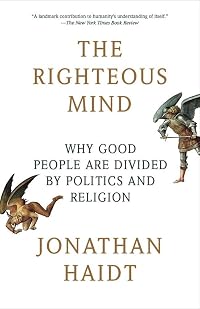
The Righteous Mind: Why Good People Are Divided by Politics and Religion
by Jonathan Haidt
On This Page
Description
A groundbreaking investigation into the origins of morality, which turns out to be the basis for religion and politics. The book explains the American culture wars and refutes the "New Atheists."Tags
Recommendations










Member Recommendations

Member Reviews
An incredibly interesting and insightful book discussing peoples moral foundations, where they come from, and what it means for society. Rather than following Dawkin's proposal that religion has evolved as a parasitic meme, Haidt proposes that religion evolved as a group selection process. Religion became a corner stone of every society because it enables people to co-exist in groups where we have no family connection. Societies with religion (and morals) were competed out of existance. He goes on to talk about the impact of moral foundations on current politics. If nothing else, read the concluding chapter!
There's a lot of good food for thought here, and a lot of important insights into how liberals and conservatives view the world differently. Haidt presents his ideas very clearly, backs them up with research, and provides useful summaries at the end of each chapter.
Each chapter could the the subject of an entire book, so sometimes it feels like some of the information is less developed than it could be. I found the first half of the book to be far more enlightening than the second half, which seemed to be building towards a big revelation that never quite materialized.
For me, the most interesting part of the book was the discussion of moral foundations. These are the criteria we use to judge morality. For liberals, morality centers show more around harm and freedom: liberals consider something to be immoral if it causes harm to people or limits their freedom to make their own choices. Conservatives agree, but conservatives also make moral decisions based on authority (whether authority structures are maintained or subverted), group structure (whether the greater good of the group is maintained), fairness (whether people get to keep what they earn), and respect for the sacred. In other words, the two groups use totally different criteria to judge right from wrong, but we don't talk about our underlying assumptions about what is moral, so we feel like we're speaking different languages when we talk to each other.
This was written in the early years of the Obama administration - I wonder how different it would be if written today during the Trump years. show less
Each chapter could the the subject of an entire book, so sometimes it feels like some of the information is less developed than it could be. I found the first half of the book to be far more enlightening than the second half, which seemed to be building towards a big revelation that never quite materialized.
For me, the most interesting part of the book was the discussion of moral foundations. These are the criteria we use to judge morality. For liberals, morality centers show more around harm and freedom: liberals consider something to be immoral if it causes harm to people or limits their freedom to make their own choices. Conservatives agree, but conservatives also make moral decisions based on authority (whether authority structures are maintained or subverted), group structure (whether the greater good of the group is maintained), fairness (whether people get to keep what they earn), and respect for the sacred. In other words, the two groups use totally different criteria to judge right from wrong, but we don't talk about our underlying assumptions about what is moral, so we feel like we're speaking different languages when we talk to each other.
This was written in the early years of the Obama administration - I wonder how different it would be if written today during the Trump years. show less
Невероятна книга, бързам да го кажа, главно щото няма друг начин да я опиша, без да почна да я преразказвам. Джонатан Хаидт е еволюционен психолог - изучава това как човешката психика и съзнание е станала такава, каквато е, в процеса на еволюцията. По-точно, той се занимава с човешкия морал - опитва се да даде отговор на това какво точно е морал, от къде идва, защо го има и най-вече защо е различен при различните show more хора.
Книгата синтезира и анализира множество психологически есперименти и на тяхна база представя виждането за човека като "90% шимпанзе и 10% пчела" - демек като цяло дива, себична и животинска същност, поддържана от малко стремеж към сътрудничество и общо благо.
Именно от това противопоставяне на вътрешния ни ин-ян и начина, по който сме еволюирали от приматите се дължат и разликите в морала и начина, по който възприемаме света и другите. Погледнати през тази призма, политическото и религиозно разделение изглеждат не глупави, а съвсем нормални - защото ние самите сме такива, няма как общественият ни живот да е различен.
Това е книгата, която ме извади от редиците на войнстващият атеизъм и ми показа, че религиозността е съвсем нормална част от човешката природа, развила се в мозъка ни по съвсем рационални еволюционни причини. Че религиозните хора не са "глупави", както и че "праведният ум" не е характеристика само на религиозните хора, а го имат всички, вкл. и особено - ...атеистите като мен :)
Едит 2019г.: предвид прочетеното и изводите, че мозъците ни са програмирани от еволюцията да са не само податливи към религия, ами дори да се нуждаят от нея и предвид събитията в САЩ и Силициевата долина, дето технологичните фирми са толкова радикално "либерални" че като че ли се намират на друга планета, почвам да си мисля, че поведението на хората в тях показва всички признаци на религиозност.
Така те се сплотяват с обща идеология и вярвания, които сакрализират, увеличавайки по този начин социални си капитал и взаимното доверие, безкрайните задължителни семинари по толерантност, сексуална дискриминация и т.н. са своево рода религиозни служби, протестите и виканията на слогани, в които тоя тип хора често участват са именно описаните от Хайд групови танци около огъня за постигане на ултра-социални квази-религиозни изживявания (простестите - рейвовете на 21 век лол).
Демонизирането на техните идеологически противници сплотява още повече общността и я кара да си сътрудничи по-добре, а взаимните нападки и надцакване кой е по-по-най привилегирован не са нищо повече от модерен лов на вещици за намаляване на вътрегруповото напрежение. show less
Книгата синтезира и анализира множество психологически есперименти и на тяхна база представя виждането за човека като "90% шимпанзе и 10% пчела" - демек като цяло дива, себична и животинска същност, поддържана от малко стремеж към сътрудничество и общо благо.
Именно от това противопоставяне на вътрешния ни ин-ян и начина, по който сме еволюирали от приматите се дължат и разликите в морала и начина, по който възприемаме света и другите. Погледнати през тази призма, политическото и религиозно разделение изглеждат не глупави, а съвсем нормални - защото ние самите сме такива, няма как общественият ни живот да е различен.
Това е книгата, която ме извади от редиците на войнстващият атеизъм и ми показа, че религиозността е съвсем нормална част от човешката природа, развила се в мозъка ни по съвсем рационални еволюционни причини. Че религиозните хора не са "глупави", както и че "праведният ум" не е характеристика само на религиозните хора, а го имат всички, вкл. и особено - ...атеистите като мен :)
Едит 2019г.: предвид прочетеното и изводите, че мозъците ни са програмирани от еволюцията да са не само податливи към религия, ами дори да се нуждаят от нея и предвид събитията в САЩ и Силициевата долина, дето технологичните фирми са толкова радикално "либерални" че като че ли се намират на друга планета, почвам да си мисля, че поведението на хората в тях показва всички признаци на религиозност.
Така те се сплотяват с обща идеология и вярвания, които сакрализират, увеличавайки по този начин социални си капитал и взаимното доверие, безкрайните задължителни семинари по толерантност, сексуална дискриминация и т.н. са своево рода религиозни служби, протестите и виканията на слогани, в които тоя тип хора често участват са именно описаните от Хайд групови танци около огъня за постигане на ултра-социални квази-религиозни изживявания (простестите - рейвовете на 21 век лол).
Демонизирането на техните идеологически противници сплотява още повече общността и я кара да си сътрудничи по-добре, а взаимните нападки и надцакване кой е по-по-най привилегирован не са нищо повече от модерен лов на вещици за намаляване на вътрегруповото напрежение. show less
Jonathan Haidt did a great job rounding up lots of historical, philosophical, and scientific perspectives to adequately explain modern manifestations of tribal evolution. The insights and expansions at times were mindblowing, or at least made a lot about human behavior, groupthink, and personality click together. This is a great book for someone interested in personality or moral psychology because it integrates understanding of individuals, groups, and societies and how they emerge in sequence like Russian nesting dolls. I appreciated the compassion of Dr. Haidt when relaying his understanding of human tendencies, and his optimism about human potential. The earnestness and passion in his explanations elevated this one.
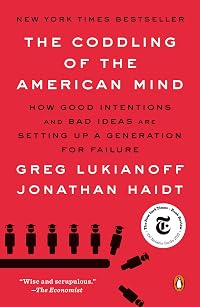
(10) I read and enjoyed 'The Coddling of the American Mind' and came across another mention of this author and a snippet of his work and decided to read this - and I am glad that I did. It is an accessible work about moral psychology written for non-psychologists, but not dumbed down like much popular non-fiction is these days. The ideas about the evolution of morals are described in order for us to understand religion and politics - hence the subtitle - "why good people are divided by politics and religion.' And I think the book really does answer that question.
I have been struggling with internal doubts and push-back of the liberal philosophy and outlook that I have adhered to since engaging in a liberal arts education and living show more amongst "WEIRD" people (Westernized, Educated, Industrialized, Rich, and Democratic) in particular around or in academia in recent years. This book helped me to see that it is not just because I am reverting to evil-type, but instead perhaps growing wiser, more well-rounded and able to see a more full picture of human nature. This book, however, was written before Trumpism. Would love Haidt's insight on that phenomenon.
Anyway, there were a few times the book was hard to follow. Some long sentences and logic that required close reading and flipping back to previous chapters, so at times my mind wandered. I loved the story-telling from other times and cultures in history as well as the descriptions of the experiments and questionnaires that were administered. I loved the insight re: people care much more about appearing virtuous than being virtuous. And also that reasoning is done post-hoc intuition and action. Our reasoning is no more than our own internal press secretary trying to justify our actions. Great, its not just me...
Very interesting and will inform my thinking going forward. I can't give a higher rating because it was a bit dry and felt a bit dated given the moral outrage on both sides that has engulfed our world for the last 5 years. show less
I have been struggling with internal doubts and push-back of the liberal philosophy and outlook that I have adhered to since engaging in a liberal arts education and living show more amongst "WEIRD" people (Westernized, Educated, Industrialized, Rich, and Democratic) in particular around or in academia in recent years. This book helped me to see that it is not just because I am reverting to evil-type, but instead perhaps growing wiser, more well-rounded and able to see a more full picture of human nature. This book, however, was written before Trumpism. Would love Haidt's insight on that phenomenon.
Anyway, there were a few times the book was hard to follow. Some long sentences and logic that required close reading and flipping back to previous chapters, so at times my mind wandered. I loved the story-telling from other times and cultures in history as well as the descriptions of the experiments and questionnaires that were administered. I loved the insight re: people care much more about appearing virtuous than being virtuous. And also that reasoning is done post-hoc intuition and action. Our reasoning is no more than our own internal press secretary trying to justify our actions. Great, its not just me...
Very interesting and will inform my thinking going forward. I can't give a higher rating because it was a bit dry and felt a bit dated given the moral outrage on both sides that has engulfed our world for the last 5 years. show less
Haidt is much better psychologist than political philosopher, and this book is both monumental and dangerously flawed.
On the good side: Haidt draws broadly from research in psychology, anthropology, and biology to develop a six-factor basis for morality (Care/Harm, Liberty/Oppression, Fairness/Cheating, Loyalty/Betrayal, Authority/Subversion, Sanctity/Degradation), and show that moral judgement is an innate intuitive ability accompanied by post-hoc justifications. Morality serves to bind non-related groups, i.e. society, together, and moral skills have been favored by various evolutionary mechanisms over human history. This theory is, frankly, really good and really well developed.
Haidt then goes on to show that Liberalism draws from show more only the first three moral factors while Conservatism draws from all six. This explains both the differences between liberals and conservatives, and why conservatives beat the stuffing out of liberals at the polls. This is also incontrovertible.
But Haidt is unwilling to follow his theory to its ultimate question: Can a democratic political system that privileged the rights of the minority procedurally sustain decision-making based on all six moral factors? Care/Harm, Liberty/Oppression, and Fairness/Cheating are universal factors; everybody uses them, and we mostly agree on when they are upheld or violated. Loyalty/Betrayal, Authority/Subversion, and Sanctity/Degradation are intrinsically provincial factors; they're different for every culture, and every individual.
A moral order for a pluralistic society which takes the latter three factors seriously must either force people to uphold a morality they do not believe in, or segregate people based on their different interpretations of morality. Perhaps I'm particularly sensitive to such concerns because I'm a liberal Jew, but forcing false beliefs on and/or ghettoizing people seems profoundly wrong. Conversely, giving a Moral Minority the ability to gum up the works whenever they feel their rights are under attack is killing good governance.
Where conservatism fails is that we are no longer living in separate communities. It's one global economy, one atmosphere, one water cycle, one oil supply, etc. Haidt faults liberalism for damaging American moral capital in the 60s and 70s, but he doesn't explain how conservatism can become big enough rule the globe. show less
On the good side: Haidt draws broadly from research in psychology, anthropology, and biology to develop a six-factor basis for morality (Care/Harm, Liberty/Oppression, Fairness/Cheating, Loyalty/Betrayal, Authority/Subversion, Sanctity/Degradation), and show that moral judgement is an innate intuitive ability accompanied by post-hoc justifications. Morality serves to bind non-related groups, i.e. society, together, and moral skills have been favored by various evolutionary mechanisms over human history. This theory is, frankly, really good and really well developed.
Haidt then goes on to show that Liberalism draws from show more only the first three moral factors while Conservatism draws from all six. This explains both the differences between liberals and conservatives, and why conservatives beat the stuffing out of liberals at the polls. This is also incontrovertible.
But Haidt is unwilling to follow his theory to its ultimate question: Can a democratic political system that privileged the rights of the minority procedurally sustain decision-making based on all six moral factors? Care/Harm, Liberty/Oppression, and Fairness/Cheating are universal factors; everybody uses them, and we mostly agree on when they are upheld or violated. Loyalty/Betrayal, Authority/Subversion, and Sanctity/Degradation are intrinsically provincial factors; they're different for every culture, and every individual.
A moral order for a pluralistic society which takes the latter three factors seriously must either force people to uphold a morality they do not believe in, or segregate people based on their different interpretations of morality. Perhaps I'm particularly sensitive to such concerns because I'm a liberal Jew, but forcing false beliefs on and/or ghettoizing people seems profoundly wrong. Conversely, giving a Moral Minority the ability to gum up the works whenever they feel their rights are under attack is killing good governance.
Where conservatism fails is that we are no longer living in separate communities. It's one global economy, one atmosphere, one water cycle, one oil supply, etc. Haidt faults liberalism for damaging American moral capital in the 60s and 70s, but he doesn't explain how conservatism can become big enough rule the globe. show less
Haidt has a pretty good response to any criticism, which is that it comes from the critic’s precommitments/moral tastes based in genes as guided in their expression by environment, but oh well. There are several big ideas here (presented as a business book with lots of repetition), including that there are six “flavors” of morality, of which liberals use only three (care/harm, fairness, liberty/oppression), while conservatives use all six at different levels (fairness to them means proportionality, plus sanctity, respect/authority, and loyalty). Haidt suggests that liberals have particular trouble understanding conservatives because those three considerations don’t even seem moral to them. Haidt also argues in favor of group show more selection as one way in which natural selection operates, not just individual selection (the dominant account for decades), suggesting that it’s the best way to explain why certain aspects of human behavior seem group-promoting rather than individual-promoting (e.g., willingness to die in battle for one’s group).
It was a provocative but frustrating book, in part because Haidt seemed unwilling to acknowledge the deepness of the divides even while talking about them. For example, he discussed flagburning as an issue where one “side” sees nothing special about the flag while the other sees it as sacred. But I’ve never heard of an instance of flagburning where the burner’s position was “this flag is meaningless.” (One of Haidt's survey questions asks about a woman who uses a flag as a cleaning rag, but it's a hypothetical.) To the contrary, both the burner and the people who support the burner’s free speech right to burn despite the offense it gives understand quite well that the burner isn’t trying to stay warm. The sides agree on the meaning of the flag, but not on the acceptable implications of that meaning. Authority/subversion isn’t just an axis of morality that goes only in one positive direction—it’s possible for people to believe that subversion is justified and even good. I don’t need to be convinced that the flag has meaning—that’s not where I disagree with those who would ban flagburning.
Another version of this: Haidt makes some brief historical and European references, but treats liberalism/conservatism as genetically based while drawing all his examples from contemporary American politics. “Conservatives are predisposed against change” and “liberals are predisposed towards change” is a weak enough thesis that it doesn’t really do much to help explain our current mess; on the other side it’s hard to derive a genetic basis for opposing Obamacare or opposing teacher’s unions specifically. Or for explaining how cultures and politics change; I'm willing to accept his weak thesis without thinking it has any implications for policy. This difficulty making the leap from genetics to policy comes out particularly at the end of the book, where Haidt suggests that we should all try to understand each other better so that we can get along (but doesn’t have much advice for gay people about how that should work with people who think they’re destroying the country) and also says conservatives are right about markets being good at getting (some) incentives right and therefore health insurance is bad. See, because you don’t pay for the full costs of your routine care, you don’t comparison shop and so health care costs keep rising. Setting aside the ways in which this is a weird description of seeking health care in the US and ignores the credence good character of healthcare that makes comparison shopping quite difficult, it perfectly encapsulates Haidt’s complete American-centricness as he advances his universalist thesis.
Don’t even get me started on his experience in India where the “silent wives” initially freaked him out, but then he got to know people—he doesn’t say whether any of them were wives—and realized that their system had upsides and positive values as well as downsides, which I’m sure it does but I would have appreciated examples instead of platitudes about how the powerful have obligations in these systems too, notwithstanding that they sometimes abuse their power. This is a book about conflict that doesn’t really have violence in it, because Haidt wants us to approve of imposing sanctions on moral misbehavior, but I don’t think he wants us to face the question of whether beating someone up for violating community norms (including norms I endorse, like “don’t cheat people”) is a good idea. Basically, Haidt really likes some features of “red” morality (cf. Cahn & Carbone’s Red Families v. Blue Families and Luker’s Abortion and the Politics of Motherhood), but can’t bring himself to say what those other authors, also sympathetic to conservatives without agreeing with them, do: red morality only works if people can’t opt out of it. This means that if things go wrong—if you marry a man who beats you, if you get pregnant while unmarried—you must suffer to protect others. Conservatives identify other victims of blue morality, and some I will concede; the point is that, while Haidt says we should try to get along because we’re all stuck here for a while, morality also requires punishing deviants (which he acknowledges elsewhere, but not in his celebration of understanding the other's point of view), and you have to face up to who the deviants are and what will happen to them in any moral system. show less
It was a provocative but frustrating book, in part because Haidt seemed unwilling to acknowledge the deepness of the divides even while talking about them. For example, he discussed flagburning as an issue where one “side” sees nothing special about the flag while the other sees it as sacred. But I’ve never heard of an instance of flagburning where the burner’s position was “this flag is meaningless.” (One of Haidt's survey questions asks about a woman who uses a flag as a cleaning rag, but it's a hypothetical.) To the contrary, both the burner and the people who support the burner’s free speech right to burn despite the offense it gives understand quite well that the burner isn’t trying to stay warm. The sides agree on the meaning of the flag, but not on the acceptable implications of that meaning. Authority/subversion isn’t just an axis of morality that goes only in one positive direction—it’s possible for people to believe that subversion is justified and even good. I don’t need to be convinced that the flag has meaning—that’s not where I disagree with those who would ban flagburning.
Another version of this: Haidt makes some brief historical and European references, but treats liberalism/conservatism as genetically based while drawing all his examples from contemporary American politics. “Conservatives are predisposed against change” and “liberals are predisposed towards change” is a weak enough thesis that it doesn’t really do much to help explain our current mess; on the other side it’s hard to derive a genetic basis for opposing Obamacare or opposing teacher’s unions specifically. Or for explaining how cultures and politics change; I'm willing to accept his weak thesis without thinking it has any implications for policy. This difficulty making the leap from genetics to policy comes out particularly at the end of the book, where Haidt suggests that we should all try to understand each other better so that we can get along (but doesn’t have much advice for gay people about how that should work with people who think they’re destroying the country) and also says conservatives are right about markets being good at getting (some) incentives right and therefore health insurance is bad. See, because you don’t pay for the full costs of your routine care, you don’t comparison shop and so health care costs keep rising. Setting aside the ways in which this is a weird description of seeking health care in the US and ignores the credence good character of healthcare that makes comparison shopping quite difficult, it perfectly encapsulates Haidt’s complete American-centricness as he advances his universalist thesis.
Don’t even get me started on his experience in India where the “silent wives” initially freaked him out, but then he got to know people—he doesn’t say whether any of them were wives—and realized that their system had upsides and positive values as well as downsides, which I’m sure it does but I would have appreciated examples instead of platitudes about how the powerful have obligations in these systems too, notwithstanding that they sometimes abuse their power. This is a book about conflict that doesn’t really have violence in it, because Haidt wants us to approve of imposing sanctions on moral misbehavior, but I don’t think he wants us to face the question of whether beating someone up for violating community norms (including norms I endorse, like “don’t cheat people”) is a good idea. Basically, Haidt really likes some features of “red” morality (cf. Cahn & Carbone’s Red Families v. Blue Families and Luker’s Abortion and the Politics of Motherhood), but can’t bring himself to say what those other authors, also sympathetic to conservatives without agreeing with them, do: red morality only works if people can’t opt out of it. This means that if things go wrong—if you marry a man who beats you, if you get pregnant while unmarried—you must suffer to protect others. Conservatives identify other victims of blue morality, and some I will concede; the point is that, while Haidt says we should try to get along because we’re all stuck here for a while, morality also requires punishing deviants (which he acknowledges elsewhere, but not in his celebration of understanding the other's point of view), and you have to face up to who the deviants are and what will happen to them in any moral system. show less
Members
- Recently Added By
Lists

Vote: Science, Religion, and History Group Reads
30 works; 17 members

Top Five Books of 2013
1,562 works; 721 members

Non-Fiction Worth Reading
1,016 works; 262 members

Attaining Belief
14 works; 2 members

Wisdom
31 works; 5 members

Fake Top 100 Nonfiction
79 works; 3 members

Phi Beta Kappa reading list
260 works; 8 members

Política - Clásicos
164 works; 2 members

Books Read in 2017
4,249 works; 130 members

Mind Expanding Books by hackerkid
581 works; 8 members

Shaykh Hamza's Book Recommendations
439 works; 3 members

Books Read in 2022
5,226 works; 115 members

Foundations of Morality
10 works; 1 member
Books That Changed Our Perspective
423 works; 168 members

Governerds Insider
32 works; 1 member

Books Cited in Blueprint by Nicholas Christakis
261 works; 1 member
Author Information

14+ Works 11,230 Members
Awards and Honors
Awards
Distinctions
Notable Lists
Work Relationships
Common Knowledge
- Canonical title*
- Oikeamielinen : Miksi hyvät ihmiset riitelevät politiikasta ja uskonnosta
- Original publication date
- 2012
- People/Characters
- Émile Durkheim; E. O. Wilson; Glaucon
- Important places
- Orissa, India
- Epigraph
- I have striven not to laugh at human actions, not to weep at them, not to hate them, but to understand them.
- Baruch Spinoza, Tractatus Politicus, 1676 - Dedication
- In memory of my father, Harold Haidt
- First words
- "Can we all get along?" That appeal was made famous on May 1, 1992, by Rodney King, a black man who had been beaten nearly to death by four Los Angeles police officers a year earlier.
- Quotations
- The mind is divided, like a rider on an elephant, and the rider's job is to serve the elephant.
The righteous mind is like a tongue with six taste receptors.
We Are 90 Percent Chimp and 10 Percent Bee.
I could not understand how any thinking person would voluntarily embrace the party of evil, and so I and my fellow liberals looked for psychological explanations for conservatism, but not for liberalism.
In psychology, theories are cheap.
Libertarians are basically liberals who love markets and lack bleeding hearts. (show all 8)
When libertarians talk about the miracle of "spontaneous order" that emerges when people are allowed to make their own choices, the rest of us should listen.
Emphasizing differences makes many people more racist, not less. - Last words
- (Click to show. Warning: May contain spoilers.)We're all stuck here for a while, so let's try to work it out.
- Blurbers
- Wilson, Edward O.; Baron-Cohen, Simon
- Original language
- English
- Canonical DDC/MDS
- 201.615
- Canonical LCC
- BJ45
*Some information comes from Common Knowledge in other languages. Click "Edit" for more information.
Classifications
- Genres
- Sociology, Philosophy, General Nonfiction, Religion & Spirituality, Nonfiction, Politics and Government
- DDC/MDS
- 201.615 — Religion The Bible & Christianity Religious mythology, general classes of religion, interreligious relations and attitudes, social theology Religions and secular disciplines Philosophy and religion Psychology and religion
- LCC
- BJ45 — Philosophy, Psychology and Religion Ethics Ethics
- BISAC
Statistics
- Members
- 4,205
- Popularity
- 3,638
- Reviews
- 92
- Rating
- (4.09)
- Languages
- 11 — Chinese, Dutch, English, Finnish, Italian, Polish, Romanian, Serbian, Spanish, Swedish, Portuguese (Portugal)
- Media
- Paper, Audiobook, Ebook
- ISBNs
- 29
- UPCs
- 4
- ASINs
- 18