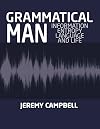
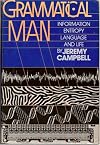
Grammatical Man: Information, Entropy, Language and Life
by Jeremy Campbell
On This Page
Description
Just as physics made sense out of the mysteries of earth, air, fire, and water, it can be said that the science of information enriches and unifies an amazing diversity of modern sciences, from physics and mathematics to biology and linguistics. Because symbols, messages, and codes are the stuff not only of computers and telecommunications, but also of living organisms and the forms of human knowledge, information, and thus information theory, is universal. This is the first book to tell the show more story of information theory, how it arose with the development of radar during World War II, and how it evolved. This thought-provoking book describes how the laws and discoveries of information theory support controversial revisions to Darwinian evolution, begin to unravel the mysteries of language, memory and dreams, and stimulate provocative ideas in psychology, philosophy, art, music, computers, and even the structure of society. The insights of information theory make us look at our world in an entirely new and different way--but perhaps its most fascinating and unexpected surprise is the suggestion that order and complexity may be as natural as disorder and disorganization.--From publisher description. show lessTags
Recommendations










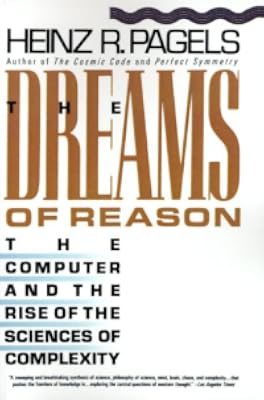
Member Recommendations
The View from the Center of the Universe: Discovering Our Extraordinary Place in the Cosmos by Joel R. Primack
br77rino Another well-written scientific book on the countering of that great Doom, the Second Law of Thermodynamics. Both invoke Information as evidence for their optimism, and I think both are descendants of Koestler's Ghost in the Machine.
Member Reviews
Interesting and new (to me) ideas about information theory and how it applies to evolution, genetics, and language. It is not overly technical, which is both a plus and a minus: It is easy to read and isn't overwhelming for a layperson, but it lacks depth and clarity in some areas.
"Grammatical man" is a gentle peep into the world of information theory for the general reader with little or no background in mathematics. It explains how come we live in a more and more complex world despite the physical laws of entropy, and how information theoretical forces may be at play in our DNA and in evolution.
My personal reason for reading this book was I had developed an interest in the area as a linguist/philosopher who have used it in connection with work in Statistical Machine Translation, and hoped this book might throw some light on why crude mathematical methods sometimes give better results than more theoretical linguistically pure.
So I was disappointed that the author, in linguistics, had "sold his soul" to Noam show more Chomskys theory of linguistics, which I believe runs counter some of the strengths of information theory with its strong dependence on innateness and poverty of stimulus. But the non-linguistic reader will probably not notice this. show less
My personal reason for reading this book was I had developed an interest in the area as a linguist/philosopher who have used it in connection with work in Statistical Machine Translation, and hoped this book might throw some light on why crude mathematical methods sometimes give better results than more theoretical linguistically pure.
So I was disappointed that the author, in linguistics, had "sold his soul" to Noam show more Chomskys theory of linguistics, which I believe runs counter some of the strengths of information theory with its strong dependence on innateness and poverty of stimulus. But the non-linguistic reader will probably not notice this. show less
Wonderful book tying together information, entropy and complexity. I happened to be reading Joel Primack's 'View from the Center of the Universe' at the same time and I found they complemented each other to an extraordinary degree.
I think it's bit outdated but can be interesting at times if you are new to information theory. I think the author sometimes tried to extend the idea of information theory to evolution too much. Also sometimes it reads too dry. I had hard time finishing the book.
Read correctly, this book can change your life, how you run your business and how those who report to you should do so.
Book Description: New York: Simon and Schuster, 1982. Soft Cover. Very Good. 51/2x81/2. 320 pages.
Ratings
Members
- Recently Added By
Lists

Shaykh Hamza's Book Recommendations
439 works; 3 members
Author Information
Some Editions
Awards and Honors
Distinctions
Common Knowledge
- Original publication date
- 1982
- First words
- Foreword: This book is an attempt to tell the story of information theory and how it evolved out of the ferment of scientific activity during the Second World War.
- Last words
- (Click to show. Warning: May contain spoilers.)If Aristotle was a philosopher preeminently able to look at all nature and human affairs as an undivided process full of beauty, which is above all intelligible to human beings, can it be a coincidence that he was also, alone among classical thinkers, a man who arrived at the first glimmerings of a theory of information?
- Original language
- English
- Canonical DDC/MDS
- 001.53'9
- Canonical LCC
- Q360.C33
Classifications
- Genres
- Nonfiction, Science & Nature, General Nonfiction, Philosophy
- DDC/MDS
- 001.53 — Computer science, information & general works Computer science, knowledge & systems Knowledge and learning in general [Formerly: Communication] [formerly : Cybernetics]
- LCC
- Q360 .C33 — Science Science (General) Cybernetics Information theory
- BISAC
Statistics
- Members
- 478
- Popularity
- 63,699
- Reviews
- 6
- Rating
- (3.99)
- Languages
- 5 — Dutch, English, French, Italian, Spanish
- Media
- Paper, Ebook
- ISBNs
- 6
- ASINs
- 2