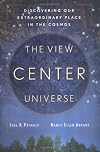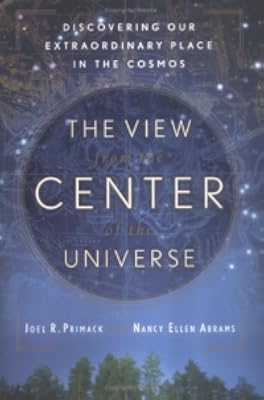
The View from the Center of the Universe: Discovering Our Extraordinary Place in the Cosmos
by Joel R. Primack, Nancy Ellen Abrams
On This Page
Description
Draws on recent advances in astronomy, physics, and cosmology to present a theory of how to understand the universe and the role of our own world, in an account that offers insight into the origins and evolutionary coherence of the universe.Tags
Recommendations



Member Recommendations

br77rino Another well-written scientific book on the countering of that great Doom, the Second Law of Thermodynamics. Both invoke Information as evidence for their optimism, and I think both are descendants of Koestler's Ghost in the Machine.
br77rino While Primack uses cosmology to counter the inherent pessimism of The Second Law of Thermodynamics, Koestler uses psychology and evolution.
Member Reviews
This is a visionary book that sets out to change the world by changing how we see our place in the universe, by changing peoples attitudes about the metaphors and stories we use to describe the universe and mans place in it. Instead of seeing ourselves in entrenched Newtonian existential terms (a small rock circling a small star in an average galaxy in a nearly infinite scale universe where nothing that humans do matters in the big picture like a lone plankton floating in the ocean), the authors re-position earth and humans to a central importance, supported by the latest science findings. Incredibly, they make a convincing case, and along the way educate the reader about the latest scientific findings in cosmology.
The idea of mans show more centrality to the universe has been the norm for most of history - the medieval model, Egyptian cosmology, etc.. all saw man and earth at the center of the universe - the first third of the book discusses this. It was with Newtonian physics that our place in the center was over-turned. But incredibly in the past 10-15 years its become apparent we really are at the center - depending on your perspective, as discussed in the middle portion of the book - 1)We are made of the rarest material in the universe (visible matter) 2) We live in the center of a "Cosmic Sphere of Time" (every point in the universe is physically in the middle because there is no middle of the universe) 3) We live in a mid-point of time - most nearby galaxy's are middle age 4) We live in the middle of all possible sizes - there are 14 orders of magnitude difference between the smallest and largest, we are in the middle 5) We live at the mid-point in the age of our planet. 6) We live at a turning point for our species when population and environmental questions are raising serious questions about sustainability.
The last third of the book becomes more subjective about going forward into the future how we can change our attitude about the universe to be more optimistic and meaningful: "The choice of attitude is not a casual one.. cosmology is not a game it has the power to overturn fundamental institutions of society.. Once we made this mental shift and opened our eyes to the view from the center of the universe.. it evoked the opposite emotions from the existential stance-not despair but hope, not resignation but excitement. These may be arbitrary emotions, but they lead to non-arbitrary actions." show less
The idea of mans show more centrality to the universe has been the norm for most of history - the medieval model, Egyptian cosmology, etc.. all saw man and earth at the center of the universe - the first third of the book discusses this. It was with Newtonian physics that our place in the center was over-turned. But incredibly in the past 10-15 years its become apparent we really are at the center - depending on your perspective, as discussed in the middle portion of the book - 1)We are made of the rarest material in the universe (visible matter) 2) We live in the center of a "Cosmic Sphere of Time" (every point in the universe is physically in the middle because there is no middle of the universe) 3) We live in a mid-point of time - most nearby galaxy's are middle age 4) We live in the middle of all possible sizes - there are 14 orders of magnitude difference between the smallest and largest, we are in the middle 5) We live at the mid-point in the age of our planet. 6) We live at a turning point for our species when population and environmental questions are raising serious questions about sustainability.
The last third of the book becomes more subjective about going forward into the future how we can change our attitude about the universe to be more optimistic and meaningful: "The choice of attitude is not a casual one.. cosmology is not a game it has the power to overturn fundamental institutions of society.. Once we made this mental shift and opened our eyes to the view from the center of the universe.. it evoked the opposite emotions from the existential stance-not despair but hope, not resignation but excitement. These may be arbitrary emotions, but they lead to non-arbitrary actions." show less
I found this book patronising at first ("...imagine you are an ancient Egyptian sitting on a hilltop..."), and very American (monkey-in-the-middle, dollar bill), but as I read on, I found I was learning and understanding the physics I would have like to have been taught at school. Below is a highlight of the contents:
Part one serves as a brief outline of the history of human understanding of the cosmos; from the Huichol Indians of Mexico myths, cave paintings, Ancient Egyptian god's and goddesses (Nut, Geb, Seth, Osiris, Nun, etc), the Hebrew creation story, the Babylonian astronomers/astrologers, the Ancient Greeks (Thales of Miletus, Anaximander, Pythagoras, Heraclitus, Plato, Euclid, etc), the Alexandrians (Eratosthenes, Archimedes, show more Ptolemy, etc), the Medieval Kabbalah (Jewish mystic movement), the Copernican revolution, the Cartesian Bargain, to the scientific astronomer, Pierre Simon Laplace.
Reference to Joseph Campbell's The Inner Reaches of Outer Space.
Part 2: galaxies, atoms, dark matter, Vera Rubin's speed of stars around a galaxy, gravitational lensing, Double Dark theory (Dark Energy plus Cold Dark Matter, aka LCDM), supersymmetry, neutrinos and WIMPs, dark energy and the increasingly faster expansion of the universe. Authors provide suggested artwork to illustrate the new scientific discoveries (they argue that in the past, theories of the cosmos had mythological and religion to portray them) - a pyramid composed of matter at the top, and dark matter at the bottom. Legend of the capstone of Egypt's Great Pyramid. Time.
The outer boundary of our visible universe is the Cosmic Horizon
Description of the chronological events from the big bang on the subatomic level. The Violent Relaxation of dark matter. The difference between pure mathematics (being infinite in powers of 10), and physics (minimum mass is about 10 to the minus 33 - the Planck length, is the smallest possible size). The largest size is 10 to the power of 28 - the distance to our cosmic horizon. Uroboros - ancient Greek for a serpent swallowing its tail. The effects of gravity on size - fluctuates from strong to weak on large to small, but then weak to strong on small to very small. Entropy - behaviour of a movie of two snooker balls striking cannot be distinguished playing forwards or backwards, but snooker ball hitting a triangle of balls can only play one way: Second law of thermodynamics the tendency towards increasing disorder.
Reference to Konstantin Tsiolkovsky, he was a cosmist. They believed that "consciousness exists in every particle in the universe, including every star and galaxy, and that humans and intelligent aliens have the highest concentration of consciousness and therefore the greatest responsibility to further the peaceful development of still higher consciousness".
End of chapter 6 (part 2) puts into poetic perspective the relative distances between stars, between galaxies, between atoms, cells, humans, the earth, the sun, etc., Eternal Inflation (The inflation that occurred before the big bang), relating it to the Kabbalah teaching that creation happened in ten stages, called Sephirot.
References to Stephen Jay Gould, and Simon Conway Morris on evolution
SETI
Part 3 how we rely on metaphors to understand everything. Population explosion. show less
Part one serves as a brief outline of the history of human understanding of the cosmos; from the Huichol Indians of Mexico myths, cave paintings, Ancient Egyptian god's and goddesses (Nut, Geb, Seth, Osiris, Nun, etc), the Hebrew creation story, the Babylonian astronomers/astrologers, the Ancient Greeks (Thales of Miletus, Anaximander, Pythagoras, Heraclitus, Plato, Euclid, etc), the Alexandrians (Eratosthenes, Archimedes, show more Ptolemy, etc), the Medieval Kabbalah (Jewish mystic movement), the Copernican revolution, the Cartesian Bargain, to the scientific astronomer, Pierre Simon Laplace.
Reference to Joseph Campbell's The Inner Reaches of Outer Space.
Part 2: galaxies, atoms, dark matter, Vera Rubin's speed of stars around a galaxy, gravitational lensing, Double Dark theory (Dark Energy plus Cold Dark Matter, aka LCDM), supersymmetry, neutrinos and WIMPs, dark energy and the increasingly faster expansion of the universe. Authors provide suggested artwork to illustrate the new scientific discoveries (they argue that in the past, theories of the cosmos had mythological and religion to portray them) - a pyramid composed of matter at the top, and dark matter at the bottom. Legend of the capstone of Egypt's Great Pyramid. Time.
The outer boundary of our visible universe is the Cosmic Horizon
Description of the chronological events from the big bang on the subatomic level. The Violent Relaxation of dark matter. The difference between pure mathematics (being infinite in powers of 10), and physics (minimum mass is about 10 to the minus 33 - the Planck length, is the smallest possible size). The largest size is 10 to the power of 28 - the distance to our cosmic horizon. Uroboros - ancient Greek for a serpent swallowing its tail. The effects of gravity on size - fluctuates from strong to weak on large to small, but then weak to strong on small to very small. Entropy - behaviour of a movie of two snooker balls striking cannot be distinguished playing forwards or backwards, but snooker ball hitting a triangle of balls can only play one way: Second law of thermodynamics the tendency towards increasing disorder.
Reference to Konstantin Tsiolkovsky, he was a cosmist. They believed that "consciousness exists in every particle in the universe, including every star and galaxy, and that humans and intelligent aliens have the highest concentration of consciousness and therefore the greatest responsibility to further the peaceful development of still higher consciousness".
End of chapter 6 (part 2) puts into poetic perspective the relative distances between stars, between galaxies, between atoms, cells, humans, the earth, the sun, etc., Eternal Inflation (The inflation that occurred before the big bang), relating it to the Kabbalah teaching that creation happened in ten stages, called Sephirot.
References to Stephen Jay Gould, and Simon Conway Morris on evolution
SETI
Part 3 how we rely on metaphors to understand everything. Population explosion. show less
I was really disappointed with this book, as it promised to deliver far more than it was able. The book couldn't decide whether it was a science book or a philosophy book, and ultimately failed to do either very well. The authors were attempting to use modern science to give mankind a sense of meaning that's was taken away with the Copernican Revolution, but I felt it failed to actually provide any meaning.
We live about halfway through the lifespan of our planet. There's no center to the universe, so you might as well pretend you're the center. Our size is in the middle (in terms of orders of magnitude) of the size scales of the universe (between the quantum world and galaxy clusters). Therefore, you should feel meaningful! I don't show more think that follows at all.
The science was decently interesting, but you can find far better if you're interested in the developments of modern physics or cosmology. The philosophy was unconvincing, and also included long sections on past cosmologies that gave people significance in the world (i.e. myths) and proposed new ways of viewing the world. For example, a great (I'm being sarcastic) New Year's tradition would be to have The Cosmic Dessert: a pyramid-shaped dessert of 70% chocolate cake (representing dark energy), 25% chocolate ice cream (dark matter), 4% chopped nuts (invisible mixed atoms), 0.5% whipped cream (hydrogen/helium), a bit of cinnamon (stardust/heavy elements), and a cherry on top (intelligent life, not to scale). Clever I guess, but are we really this desperate for holiday events? And if we are... do you really want your value to come from being made of stardust instead of dark energy? show less
We live about halfway through the lifespan of our planet. There's no center to the universe, so you might as well pretend you're the center. Our size is in the middle (in terms of orders of magnitude) of the size scales of the universe (between the quantum world and galaxy clusters). Therefore, you should feel meaningful! I don't show more think that follows at all.
The science was decently interesting, but you can find far better if you're interested in the developments of modern physics or cosmology. The philosophy was unconvincing, and also included long sections on past cosmologies that gave people significance in the world (i.e. myths) and proposed new ways of viewing the world. For example, a great (I'm being sarcastic) New Year's tradition would be to have The Cosmic Dessert: a pyramid-shaped dessert of 70% chocolate cake (representing dark energy), 25% chocolate ice cream (dark matter), 4% chopped nuts (invisible mixed atoms), 0.5% whipped cream (hydrogen/helium), a bit of cinnamon (stardust/heavy elements), and a cherry on top (intelligent life, not to scale). Clever I guess, but are we really this desperate for holiday events? And if we are... do you really want your value to come from being made of stardust instead of dark energy? show less
Joel Primack and his wife Nancy do a great job of showing Cosmology in its present form, emphasizing that it is more optimistic than it's ever been. There is a good discussion of Egyptian cosmology involving Nun, Nut, Isis/Sirius, Osiris/Orion, the annual floods, and the birth of geometry. They also discuss cosmic inflation, eternal inflation, the ouroboros, dark matter, dark energy, element evolution, life evolution, human evolution, the cosmiic horizon, benevolent chaos, and angular momentum's counterbalancing of thermodynamic rundown. Their main point is that mankind appears to have an incredibly central place in it all.
A big takeaway for me was their revelation of conceptual mistakes based on an ignorance of the importance of show more scale. To wit, just as a universe is not like a galaxy and a galaxy is not like a solar system, so too humanity is not like a nation, a nation is not like a family, and a family is not like a person. Ignoring scale is ignoring reality, and leads to all sorts of problems.
But the biggest was this: the fundamental behavior of the universe has been to grow in complexity. show less
A big takeaway for me was their revelation of conceptual mistakes based on an ignorance of the importance of show more scale. To wit, just as a universe is not like a galaxy and a galaxy is not like a solar system, so too humanity is not like a nation, a nation is not like a family, and a family is not like a person. Ignoring scale is ignoring reality, and leads to all sorts of problems.
But the biggest was this: the fundamental behavior of the universe has been to grow in complexity. show less
The authors believe that their 21st century readers have lost their way because we don't have a valid cosmology to tell us where we've come from (and presumably where we're going). They give a good summary of Egyptian, Hebrew and Greek cosmologies as an introduction to producing a scientific cosmology based on recent astrophysics research. I found their explanations of dark matter, dark energy, expansion of the universe, etc helpful. I haven't finished yet but my biggest disappointment is their assumption that none of their readers hold a (valid) cosmology.
What to say about this book? I both liked it and was infuriated by it. The authors have a great idea - at least I believe it's a good and valuable one. The idea alone is, I suppose, worth the price of entry.
But the style of the book manages to be both informally conversational and extremely dense and difficult. There is often a sense that the authors are going round in circles, and I wondered, are they just bad writers, or are they not themselves sure what they mean sometimes.
Although there are a lot of remarks about "latest scientific discoveries", and a wealth of footnotes (material judged too dense or boring even for their narrative), in terms of factual information the book promises far more than it delivers.
I think there's a book show more there that deserved to be written, and the authors may well be the ones to do it, but it's a pity the editor didn't make them re-write until they got good at it. show less
But the style of the book manages to be both informally conversational and extremely dense and difficult. There is often a sense that the authors are going round in circles, and I wondered, are they just bad writers, or are they not themselves sure what they mean sometimes.
Although there are a lot of remarks about "latest scientific discoveries", and a wealth of footnotes (material judged too dense or boring even for their narrative), in terms of factual information the book promises far more than it delivers.
I think there's a book show more there that deserved to be written, and the authors may well be the ones to do it, but it's a pity the editor didn't make them re-write until they got good at it. show less
One of my favorite books on cosmology.
Members
- Recently Added By
Author Information

3 Works 402 Members

6 Works 494 Members
Nancy Ellen Abrams is coauthor, with Joel R. Primack, of The View from, the Center of the Universe and The New Universe and the Human Future.
Common Knowledge
- Original publication date
- 2006
- First words
- Preface: This is a pivotal moment in human history.
Introduction: In their hearts, most people are still living in an imagined unierse, where space is simply emptiness, stars are scattered randomly, and common sense is a reliable guide.
There are few familiar words that can describe the universe as a whole. - Last words
- (Click to show. Warning: May contain spoilers.)Then we too, like our ancient ancestors the world over, can say once again with confidence that we uphold the universe.
Classifications
Statistics
- Members
- 354
- Popularity
- 89,324
- Reviews
- 10
- Rating
- (3.79)
- Languages
- English, French, Norwegian (Bokmål), Portuguese
- Media
- Paper, Ebook
- ISBNs
- 8
- ASINs
- 5