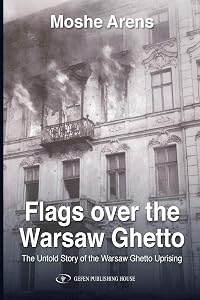
Flags over the Warsaw ghetto
by Moshe Arens
On This Page
Description
The Warsaw Ghetto Uprising has become a symbol of heroism throughout the world. A short time before the uprising began, Pawel Frenkel addressed a meeting of the Jewish Military fighters: "Of course we will fight with guns in our hands, and most of us will fall. But we will live on in the lives and hearts of future generations and in the pages of their history... We will die before our time but we are not doomed. We will be alive for as long as Jewish history lives!" On the eve of Passover, show more 19 April 1943, German forces entered the Warsaw ghetto equipped with tanks, flame throwers, and machine guns. Against them stood an army of a few hundred young Jewish men and women, armed with pistols and Molotov cocktails. Who were these Jewish fighters who dared oppose the armed might of the SS troops under the command of SS General Juergen Stroop? Who commanded them in battle? What were their goals? In this groundbreaking work, Israel's former Minister of Defence, Professor Moshe Arens, recounts a true tale of daring, courage, and sacrifice that should be accurately told -- out of respect for and in homage to the fighters who rose against the German attempt to liquidate the Warsaw ghetto, and made a last-ditch fight for the honour of the Jewish people. The generally accepted account of the Warsaw Ghetto Uprising is incomplete. The truth begins with the existence of not one, but two resistance organizations in the ghetto. Two young men, Mordechai Anielewicz of the Jewish Fighting Organization (ZOB), and Pawel Frenkel of the Jewish Military Organization (ZZW), rose to lead separate resistance organisations in the ghetto, which did not unite despite the desperate battle they were facing. Included is the complete text of "The Stroop Report" translated into English. show lessTags
Recommendations
























Member Recommendations
Hedgepeth Excellent details of daily ghetto life.

susanbooks The story of survivors in the immediate aftermath of the destruction of the Ghetto.

meggyweg Another book about the oft-overlooked role of the ZZW in the Warsaw Ghetto Uprising.
Member Reviews
(I got this book free from LibraryThing Early Reviewers.) Whew! Just when you think you know everything... I've read many books about the Warsaw Ghetto Uprising but this really opened my eyes.
The accepted story is this: After years of oppression and starvation the Jews of Warsaw, realizing they were all condemned to die, decided to at least take a few Nazis out with them. They formed the ZOB (Jewish Fighting Organization), started a bloody rebellion and went down in history as heroes for all time.
However, as Dr. Arens says in this astonishing book, it's not as simple as that: there were actually TWO rebel organizations, the ZOB and the ZZW (Jewish Military Union), each waging their own personal fight against the Nazis. They were roughly show more equal in terms of their size and impact -- in fact, the ZZW, which was actually lead by trained soldiers, might have been the better of the two. But the ZZW got the shaft in the history books. Whereas several ZOB fighters survived to write memoirs, all of the ZZW's leaders and senior commanders were killed in the Uprising. The ZOB people, wanting to claim all the credit for themselves, said very little about the other organization and, when they did they tended to disparage it. Marek Edelman, for example, called them "porters, smugglers and thieves." I have read so many Holocaust books but before this one had never even heard of the ZZW -- though the name of their leader, Pawel Frankel, rings a bell.
You might think that the idea of two military organizations both fighting against an enemy determined to kill them all, but refusing to join forces, was pretty stupid. And it was. But the ZOB and ZZW were separated on pre-war ideological grounds. The ZOB, which was founded by Jewish Socialist youth leaders, refused to accept fighters who weren't already members of one of the many Jewish youth groups; the ZZW would take anybody. It all seems silly to me. Like splitting Democrats and Republicans into separate military units.
The books begins slowly, and it would be hard to understand without prior knowledge of the Warsaw Ghetto Uprising. So many people were mentioned, and acronyms: ZOB, ZZW, ZKK, ZKN, PLAN, IZL, AK, AL, that it's hard to keep them all straight. (There's an index of acronyms in the back though.) But for serious students of the Holocaust in Poland, this is a can't miss. show less
The accepted story is this: After years of oppression and starvation the Jews of Warsaw, realizing they were all condemned to die, decided to at least take a few Nazis out with them. They formed the ZOB (Jewish Fighting Organization), started a bloody rebellion and went down in history as heroes for all time.
However, as Dr. Arens says in this astonishing book, it's not as simple as that: there were actually TWO rebel organizations, the ZOB and the ZZW (Jewish Military Union), each waging their own personal fight against the Nazis. They were roughly show more equal in terms of their size and impact -- in fact, the ZZW, which was actually lead by trained soldiers, might have been the better of the two. But the ZZW got the shaft in the history books. Whereas several ZOB fighters survived to write memoirs, all of the ZZW's leaders and senior commanders were killed in the Uprising. The ZOB people, wanting to claim all the credit for themselves, said very little about the other organization and, when they did they tended to disparage it. Marek Edelman, for example, called them "porters, smugglers and thieves." I have read so many Holocaust books but before this one had never even heard of the ZZW -- though the name of their leader, Pawel Frankel, rings a bell.
You might think that the idea of two military organizations both fighting against an enemy determined to kill them all, but refusing to join forces, was pretty stupid. And it was. But the ZOB and ZZW were separated on pre-war ideological grounds. The ZOB, which was founded by Jewish Socialist youth leaders, refused to accept fighters who weren't already members of one of the many Jewish youth groups; the ZZW would take anybody. It all seems silly to me. Like splitting Democrats and Republicans into separate military units.
The books begins slowly, and it would be hard to understand without prior knowledge of the Warsaw Ghetto Uprising. So many people were mentioned, and acronyms: ZOB, ZZW, ZKK, ZKN, PLAN, IZL, AK, AL, that it's hard to keep them all straight. (There's an index of acronyms in the back though.) But for serious students of the Holocaust in Poland, this is a can't miss. show less
 This review was written for LibraryThing Early Reviewers.
As an American jew I grew up having read many factual historical and fictionalized accounts of the Warsaw Ghetto Uprising and its having become for the world and Jews especially a symbol of heroism and sacrifice.On the eve of Passover, April 19, 1943, German forces entered the Warsaw ghetto equipped with tanks, flame throwers, and machine guns expecting an easy operation against sheep for the slaughter. Against them stood a few hundred young Jewish men and women, armed with pistols, homemade handgrenades and Molotov cocktails. In this wonderfully written book, Israel’s former Minister of Defense, Prof. Moshe Arens, tells a true and detailed history of courage, and extreme self sacrifice that should be told out of the respect we all show more should show for the fighters who rose against the German attempt to liquidate the Warsaw ghetto, and made a final and knowingly doomed fight for the honor of all Jewish people. The book shows clearly that the accepted writrings to date of the Warsaw Ghetto Uprising are not only incomplete but wrong due to political and other views held by people clouding their judgement and wisdom. The truth starts with the existence of not one, but two resistance organizations in the ghetto. Two young men, Mordechai Anielewicz of the Jewish Fighting Organization (ZOB), and Pawel Frenkel of the Jewish Military Organization (ZZW), rose to lead separate resistance organizations in the ghetto, which did not unite despite the desperate battle they were facing. Professor Moshe Arens shows us clearly the truth about Jewish heroism and self-sacrifice in the Warsaw ghetto. His research brings into the light of history the groups and individuals whose exceptional bravery have up until now been ignored and left out of the pages of history. Facing horrible odds and internal political differences, these men and women fought and in most cases died for the honor of the Jewish people, and they deserve the recognition they recieve from Moshe Arens work. I will forever be appreciative for having been given this book for review and as not only a student and former teacher of History and American Jew who is grateful to learn more of the actual sacrifices of other Jews so that I may sit here today writing to you. show less
This review was written for LibraryThing Early Reviewers.Bravo for a balanced portrayal of the Warsaw Ghetto uprising.
The book was very well written. It was easy to follow the action as the uprising progressed and the language was appropriate for the average reader. Details were provided without becoming a recitation of minutiae. I never felt lost as we followed day to day action. This book should be highly recommended for those who wish to study the plight of the Jews during the Holocaust.
The book was very well written. It was easy to follow the action as the uprising progressed and the language was appropriate for the average reader. Details were provided without becoming a recitation of minutiae. I never felt lost as we followed day to day action. This book should be highly recommended for those who wish to study the plight of the Jews during the Holocaust.
This review was written for LibraryThing Early Reviewers.This is the first book that I have read about the Warsaw Ghetto uprising. I was of course very familiar with the general story - from articles, memorials and special museum exhibits, like the one at the kibbutz that bears the name of the leader of uprising Mordechai Anilewicz. I don't think I was aware that the heroes of the uprising, as it has been memorialized, were all members of the left wing and communist Jewish youth groups that abounded in Poland before and during the war - and which, of course, all had their political counterparts in Palestine and later Israel. The case Moshe Arens makes is that, because members of these organizations were virtually the only ones to survive the uprising and tell the tale, we consequently have show more heard nothing about the role that the right wing Revisionists played. In fact, it has been deliberately obscured and marginalized.
Arens painstakingly reconstructs, from multiple sources, the days of the uprising and documents impartially the role of the ZOB, the left wing groups' fighting organization, as well as that of the ZZW , the Revisionist fighters. Apart from the grim facts of the Germans' determination to liquidate the Warsaw Ghetto, and the selfless heroism of all the Jewish fighters, I was shocked by the revelation that - even in the face of impending extermination - the right and left could not put aside their political differences to form a common fighting front. According to Arens, the Revisionists - who had already formed a Jewish defense organization, Betar - were the better prepared and better armed of the two. It took the left wing organizations much longer to organize; in fact resolving their own internal political differences - between the Bundists, the socialist groups and the communists - and setting up a political coordination committee, was a necessary prerequisite for setting up a fighting organization. The Bundists and the communists were concerned throughout to coordinate all their activities with the non-Jewish Polish resistance movements whose political agenda they shared, and from whom they received very little help during the uprising. Betar were apparently prepared to welcome people of any affiliation into their organization, whereas the left wings groups' antagonism toward the Revisionists was such as to preclude them joining with them.
Arens' account leaves no doubt that during and after the days of the uprising, all of the fighters - whatever their political affiliation - gave of their utmost and displayed unbelievable determination and valor in the face of what they knew would almost certainly be their own personal extinction. Whether the ultimate outcome would have been different had the two groups fought as a unified force, is doubtful. But that is not the author's point; he just wants to set the record straight in the face of what he says has been a deliberate attempt to manipulate the historical record for political purposes. Given the multiple sources he cites - including the daily journal of the SS officer in charge of the operation against the ghetto, which is quoted in full in an appendix - one is left in no doubt about the major role of the Revisionist fighters in the uprising, nor about its subsequent excision from the many accounts and memorials. show less
Arens painstakingly reconstructs, from multiple sources, the days of the uprising and documents impartially the role of the ZOB, the left wing groups' fighting organization, as well as that of the ZZW , the Revisionist fighters. Apart from the grim facts of the Germans' determination to liquidate the Warsaw Ghetto, and the selfless heroism of all the Jewish fighters, I was shocked by the revelation that - even in the face of impending extermination - the right and left could not put aside their political differences to form a common fighting front. According to Arens, the Revisionists - who had already formed a Jewish defense organization, Betar - were the better prepared and better armed of the two. It took the left wing organizations much longer to organize; in fact resolving their own internal political differences - between the Bundists, the socialist groups and the communists - and setting up a political coordination committee, was a necessary prerequisite for setting up a fighting organization. The Bundists and the communists were concerned throughout to coordinate all their activities with the non-Jewish Polish resistance movements whose political agenda they shared, and from whom they received very little help during the uprising. Betar were apparently prepared to welcome people of any affiliation into their organization, whereas the left wings groups' antagonism toward the Revisionists was such as to preclude them joining with them.
Arens' account leaves no doubt that during and after the days of the uprising, all of the fighters - whatever their political affiliation - gave of their utmost and displayed unbelievable determination and valor in the face of what they knew would almost certainly be their own personal extinction. Whether the ultimate outcome would have been different had the two groups fought as a unified force, is doubtful. But that is not the author's point; he just wants to set the record straight in the face of what he says has been a deliberate attempt to manipulate the historical record for political purposes. Given the multiple sources he cites - including the daily journal of the SS officer in charge of the operation against the ghetto, which is quoted in full in an appendix - one is left in no doubt about the major role of the Revisionist fighters in the uprising, nor about its subsequent excision from the many accounts and memorials. show less
In the early 1970's my husband took a one year course in Semitic History from a badly distracted Professor Netanyahu. Having taught an amazing first semester of ancient and medieval course, Professor Netanyahu was barely able to articulate modern Jewish History to his class, especially the period around WW2. One platitude that Professor Netanyahu repeated ad infinitum was the historical inability of Jews to see their destruction on the horizon. He stressed that Jews throughout history always looked at the brighter side of their lives noting how they saw themselves as part of the non-Jewish community in which they dwelled. Until it was too late. Moshe Arens' excellent "Flags Over the Warsaw Ghetto" fills in the gap left by Professor show more Netanyahu and makes it clear that the Polish Jews had the same blind spot and social fragmentation that runs throughout Jewish History. While one can get lost in the jungle of names and acronyms of the time, the story that is told is clear and compelling. The lessons of the costs of social fragmentation, delay, and their cost is useful for today's Jews and the rest of the world confronting another wave of darkness. show less
This review was written for LibraryThing Early Reviewers.Other reviewers have done a wonderful job summarizing this book. I'll just say that it is indeed a well-written and compelling work. What other reviewers haven't noted and which seems pertinent, is that whatever else this book is, it's a political tract. Arens is a right-wing former Israeli Defense Minister, Foreign Minister, ambassador, and member of the Knesset who voted against the Camp David accords. Here he contends that the Warsaw Ghetto Uprising, an event often seen as being led by left-wing groups, was actually largely organized by the right. Because the book is thus a way for him to enhance the pedigree of his politics, Arens does not always feel like a reliable source. He continually says the right-wing Ghetto group was show more marginalized due to issues that had become "irrelevant" once the Germans invaded. Yet the people at the time obviously thought their differences were important, hence their extreme reluctance to work with a group that even moderates, according to Arens, termed "fascist." (Arens has himself been called a fascist on not a few occassions.) Given his unwillingness to explain what the specific political differences were, or why the right-wing Zionists were thought of as fascists, I found it hard to trust him when he made other statements that went against the traditional history of the Uprising. For me it also didn't help that one of the sources he uses most in support of his theory is the Nazi officer in charge of destroying the ghetto and its inhabitants. Surviving Jews from the ghetto, Arens admits, have always told a very different story from his.
In any case, the bravery of the men and women in this book is indisputable and the story Arens tells is thrilling, tragic, and horrifying. I only give it 3.5 stars because of my doubts as to Arens' trustworthiness as a historian. show less
In any case, the bravery of the men and women in this book is indisputable and the story Arens tells is thrilling, tragic, and horrifying. I only give it 3.5 stars because of my doubts as to Arens' trustworthiness as a historian. show less
This review was written for LibraryThing Early Reviewers.Although literature on the Warsaw Ghetto uprising is somewhat plentiful, including historical monographs and eye-witness accounts from survivors, Moshe Arens presents a new narrative of the uprising with a group of Jews that has often gone ignored in many accounts of the revolt. At times it is amazing to see that even in the face of death and wholesale slaughter, Jews were still letting political and ideological dogma steer them into noncooperation with other Jews that might have resulted in lives saved and further damage inflicted on the enemy. But in the end, that is the real story of the uprising. Arens devotes two thirds of the book (some 200 pages) to the lead up to the uprising painting a portrait of the war and the various Jewish show more organizations active throughout Poland and Palestine at the time. While some truly despised each other, Warsaw was one of the few places that saw that split continue even as tens of thousands of Jews were being transported to their death at Treblinka. Arens provides evidence that Jews in other ghettos were able to put their differences aside and participate in actions against the Germans together, but the history of the Warsaw ghetto seemed to prevent that from happening.
In many ways Arens seems to point to the ZZW (the organization often omitted from, and at times even vilified in, recollections and histories of the uprising) as the more organized, trained, and armed formation within the confines of the Warsaw Ghetto. Additionally, they created two tunnels to the Aryan side through which they regularly received weapons and training. There is enough evidence to support Arens's position in that ZZW played a significant role and were the better prepared for the uprising (they were also among the only ones who consistently advocated for an uprising and continually tried to warn the other factions about what awaited them at the hands of the Germans; regrettably, they were regularly ignored for a variety of reasons). Unfortunately, the leadership of the ZZW perished during the uprising in one way or another and the leading figures of the other faction (ZOB) were able to escape and eventually make a name not only for themselves but also their organization(s). They assumed the leading role in the uprising while ridiculing or wholly passing over the actions of the ZZW while dissenting voices were few and usually ignored by the mainstream. Fortunately, with this volume Arens has crafted a new narrative that incorporates the actions and sacrifices of the ZZW and puts their role in the uprising in a new context of not only Jewish resistance during the Second World War but also in the way the memory of the Holocaust and the Second World War in general was crafted in the post-war period. show less
In many ways Arens seems to point to the ZZW (the organization often omitted from, and at times even vilified in, recollections and histories of the uprising) as the more organized, trained, and armed formation within the confines of the Warsaw Ghetto. Additionally, they created two tunnels to the Aryan side through which they regularly received weapons and training. There is enough evidence to support Arens's position in that ZZW played a significant role and were the better prepared for the uprising (they were also among the only ones who consistently advocated for an uprising and continually tried to warn the other factions about what awaited them at the hands of the Germans; regrettably, they were regularly ignored for a variety of reasons). Unfortunately, the leadership of the ZZW perished during the uprising in one way or another and the leading figures of the other faction (ZOB) were able to escape and eventually make a name not only for themselves but also their organization(s). They assumed the leading role in the uprising while ridiculing or wholly passing over the actions of the ZZW while dissenting voices were few and usually ignored by the mainstream. Fortunately, with this volume Arens has crafted a new narrative that incorporates the actions and sacrifices of the ZZW and puts their role in the uprising in a new context of not only Jewish resistance during the Second World War but also in the way the memory of the Holocaust and the Second World War in general was crafted in the post-war period. show less
This review was written for LibraryThing Early Reviewers.Members
- Recently Added By
Author Information

5 Works 106 Members
Moshe Arens was born in Kovno, Lithuania on December 27, 1925. His family moved to the United States when he was 13 years old. He graduated from the Massachusetts Institute of Technology. He served as a technical sergeant in the United States Army Corps of Engineers in World War II before leaving to fight in Israel's 1948 war of independence. show more After going back to the United States for graduate studies at the California Institute of Technology and a stint in the American aviation industry, he returned to Israel in 1957. He worked as an associate professor of aeronautical engineering at the Technion-Israel Institute of Technology in Haifa and as vice president for engineering at the state-owned Israel Aircraft Industries. He became a politician who served three times as defense minister, as a foreign minister, and Israel's ambassador to the United States. He wrote several books including Flags Over the Warsaw Ghetto and In Defense of Israel. He died on January 7, 2019 at the age of 93. (Bowker Author Biography) show less
Common Knowledge
- Canonical title
- Flags over the Warsaw ghetto
Classifications
- Genres
- Nonfiction, History, General Nonfiction
- DDC/MDS
- 940.531853841 — History & geography History of Europe History of Europe 1918- World War II, 1939-1945 Social, political, economic history; Holocaust Holocaust Ghettos and extermination camps maintained by Axis Powers Germany & Central Europe Poland Warsaw
- LCC
- D765.2 .W3 .A854513 — History of Europe, Asia, Africa and Oceania History (General) World War II (1939-1945)
Statistics
- Members
- 54
- Popularity
- 565,231
- Reviews
- 21
- Rating
- (4.47)
- Languages
- English
- Media
- Paper, Ebook
- ISBNs
- 2