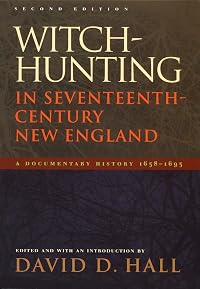
Witch-Hunting In Seventeenth-Century New England: A Documentary History, 1638-1693
by David D. Hall
On This Page
Description
This superb documentary collection illuminates the history of witchcraft and witch-hunting in seventeenth-century New England. The cases examined begin in 1638, extend to the Salem outbreak in 1692, and document for the first time the extensive Stamford-Fairfield, Connecticut, witch-hunt of 1692-1693. Here one encounters witch-hunts through the eyes of those who participated in them: the accusers, the victims, the judges. The original texts tell in vivid detail a multi-dimensional story that show more conveys not only the process of witch-hunting but also the complexity of culture and society in early America. The documents capture deep-rooted attitudes and expectations and reveal the tensions, anger, envy, and misfortune that underlay communal life and family relationships within New England's small towns and villages. Primary sources include court depositions as well as excerpts from the diaries and letters of contemporaries. They cover trials for witchcraft, reports of diabolical possessions, suits of defamation, and reports of preternatural events. Each section is preceded by headnotes that describe the case and its background and refer the reader to important secondary interpretations. In his incisive introduction, David D. Hall addresses a wide range of important issues: witchcraft lore, antagonistic social relationships, the vulnerability of women, religious ideologies, popular and learned understandings of witchcraft and the devil, and the role of the legal system. This volume is an extraordinarily significant resource for the study of gender, village politics, religion, and popular culture in seventeenth-century New England. David D. Hall is Bartlett Professor of New England Church History at the Harvard Divinity School. His books include Puritans in the New World: A Critical Anthology; Worlds of Wonder, Days of Judgment: Popular Religious Belief in Early New England; and Antinomian Controversy, 1636-1638: A Documentary History, published by Duke University Press. show lessTags
Recommendations












Member Reviews
David Hall's "Witch-Hunting in Seventeenth Century New England: 1638-1692" collects all the primary sources for witch trials that happened between 1641-1692.
Did you know that there were SEVERAL witch trials in New England long before Salem? That the Salem Witch Trials were not the largest, but rather it was the Hartford Trials in Connecticut? That the punishment could be whipping, banishment, hanging OR house arrest?There's around 30 cases included before Salem in 1692.
The first person to be executed in New England was Alice Young in Hartford, Connecticut. The majority of these cases were petty squabbles between neighbors. It's never JUST "witchcraft" obviously, there's always an underlying behavioral or societal reason for it. Women show more accused women, men accused men, but some cases were originally defamation suits, which evolved into a full witchcraft trial.
We learn that Widow Marshfield of Springfield won her suit, as did Mary Staples in Fairfield and Jane Waldord in Portsmouth. Nicholas Bayley and his wife were banished for sowing discord and gossiping, and Alice Lake was hanged for infanticide. Some cases include the classic shapeshifting, animal familiars and witches marks, but not all. Mary Parsons of Northampton was suspected of all three, and yet was acquitted. John Bradstreet was whipped for bragging about his magical powers and John Godfrey was loathed by everyon The oddest case though was Lydia Gilbert of Windsor. She was accused of causing the accidental gunshot wound that killed Henry Stiles, three years after the fact. She was hanged in 1654. The Greensmiths of the Hartford Trials were even forced to undergo the infamous swimming test! Evidence ranges from invisible dogs, to spoiled milk or cheese, poltergeist activity, shapeshifting,apparitions, paralyzing victims, visions of birds, bees and bears, cats climbing up the walls, pinching and difficult labor.
However, this book did not include accusations of witchcraft against those of other religious sects. Quakers were loathed by Puritans, and were hunted down and hanged. Also, any reference to Native American religious practices needed more thorough notation/explanation, etc. Still a great resource for any paper or writing project. show less
Did you know that there were SEVERAL witch trials in New England long before Salem? That the Salem Witch Trials were not the largest, but rather it was the Hartford Trials in Connecticut? That the punishment could be whipping, banishment, hanging OR house arrest?There's around 30 cases included before Salem in 1692.
The first person to be executed in New England was Alice Young in Hartford, Connecticut. The majority of these cases were petty squabbles between neighbors. It's never JUST "witchcraft" obviously, there's always an underlying behavioral or societal reason for it. Women show more accused women, men accused men, but some cases were originally defamation suits, which evolved into a full witchcraft trial.
We learn that Widow Marshfield of Springfield won her suit, as did Mary Staples in Fairfield and Jane Waldord in Portsmouth. Nicholas Bayley and his wife were banished for sowing discord and gossiping, and Alice Lake was hanged for infanticide. Some cases include the classic shapeshifting, animal familiars and witches marks, but not all. Mary Parsons of Northampton was suspected of all three, and yet was acquitted. John Bradstreet was whipped for bragging about his magical powers and John Godfrey was loathed by everyon The oddest case though was Lydia Gilbert of Windsor. She was accused of causing the accidental gunshot wound that killed Henry Stiles, three years after the fact. She was hanged in 1654. The Greensmiths of the Hartford Trials were even forced to undergo the infamous swimming test! Evidence ranges from invisible dogs, to spoiled milk or cheese, poltergeist activity, shapeshifting,apparitions, paralyzing victims, visions of birds, bees and bears, cats climbing up the walls, pinching and difficult labor.
However, this book did not include accusations of witchcraft against those of other religious sects. Quakers were loathed by Puritans, and were hunted down and hanged. Also, any reference to Native American religious practices needed more thorough notation/explanation, etc. Still a great resource for any paper or writing project. show less
Godbeer, Richard. (1991). New England Quarterly 64(September).
Ratings
Members
- Recently Added By
Lists

New England Witch Trials -- nonfiction
9 works; 1 member

Books in the Bibliography of Contested Continent by Peter Mancall
495 works; 1 member
Author Information

21+ Works 1,082 Members
David D. Hall is professor emeritus of American religious history at Harvard Divinity School. His books include A Reforming People: Puritanism and the Transformation of Public Life in New England.
Common Knowledge
- People/Characters
- Jane Hawkins; Mary Dyer; Alice Young; Margaret Jones; Mary Johnson; Elizabeth Kendall (show all 184); Widow Marshfield; Joan Carrington; John Carrington; Alice Lake; Mary Parsons; Hugh Parsons; William Pynchon; George Lancton; Hannah Lancton; Thomas Miller; Thomas Cooper; Simon Beamon; Rice Bedortha; Thomas Burnham; Sarah Edwards; Alexander Edwards; George Colton; Anthony Dorchester; Jonathan Burt; Goody Cooley; Sara Leonard; Benjamin Cooley; Francis Pepper; Mary Ashley; Thomas Merick; Prudence Morgan; Sara Miller; Ann Stebbins; William Branch; Jonathan Taylor; Elizabeth Godman; Stephen Goodyear; Goodwife Larrimore; Allen Ball; Mary Staples; Goodwife Bassett; Goodwife Knapp; John Banks; Roger Ludlow; Hester Ward; Lucy Pell; Elizabeth Brewster; Susan Lockwood; Thomas Shervington; Christopher Comstock; John Bradstreet; Lydia Gilbert; Thomas Allyn; Henry Stiles; Anne Hibbons; William Hubbard; Nicholas Bayley; Goodwife Bayley; Jane Walford; Elizabeth Rowe; Susannah Trimmings; Elisa Barton; Agnes Puddington; Nicholas Jennings; Margaret Jennings; Sarah Bridgman; Joseph Parsons; William Hannum; Elizur Holyoke; Margaret Bliss; John Bliss; William Houlton; John Mathews; Robert Bartlett; Hannah Broughton; John Webb; Richard Sikes; John Godfrey; Isabelle Holdred; Job Tyler; Nathan Gould; Charles Brown; William Osgood; John Remington; Abraham Whitaker; Edward Youmans; Jonathan Singletary; Mathias Button; Andrew Grele; Abiel Sommerby; Elizabeth Button; Robert Lord; Robert Pike; Winifred Holman; Mary Holman; Rebecca Stearns; Elizabeth Bowers; Nathaniel Greensmith; Rebecca Greensmith; Ann Cole; Elizabeth Seager; Elizabeth Kelly; Goodwife Ayres; Mary Barnes; James Wakeley; Goodwife Sanford; Judith Varlet; Joseph Marsh; Robert Stern; Maria Screech; Hanna Robbins; Alice Wakely; Margaret Garrett; William Graves; Abigail Dibble; Samuel Dibble; Mary Scholfield; Thomas Steedwell; Katherine Harrison; Rebecca Smith; William Warren; John Kells; Mary Olcott; Richard Montague; Joseph Dickinson; John Graves; Joan Francis; Mary Kercum; Mary Hale; Ann Burt; Bethiah Carter; Phillip Read; John Knight; Mary Burnop; Madeleine Pearson; Thomas Farrar; Nicholas Disborough; Rachel Fuller; Isabelle Towle; Elizabeth Denham; Hezron Leavitt; Samuel Willard; Elizabeth Knapp; Eunice Cole; Joanna Sleeper; Goodman Wedgewood; Thomas Philbrick; Richard Ormsby; Abraham Drake; Ann Smith; Brigit Clifford; Ephraim Winslow; John Mason; Hopestill Austin; Elizabeth Shaw; Elizabeth Morse; Caleb Powell; John Badger; Thomas Titcomb; Elizabeth Titcomb; John Mighill; Robert Earle; Elizabeth Morse; Margaret Mirick; Mary Webster; Cotton Mather; Mary Glover; John Goodwin; Samuel Parris; Betty Parris; George Burroughs; Tituba; Sarah Good; Sarah Osborne; John Hathorne; Abigail Williams; Ann Putnam, Jr.; Rebecca Nurse; Elizabeth Proctor; Mercy Lewis; Nicholas Noyes; Giles Corey; Martha Corey
- Important places
- Boston, Massachusetts, USA; Hartford, Connecticut, USA; Charlestown, Massachusetts, USA; Wethersfield, Connecticut, USA; Watertown, Massachusetts, USA; Springfield, Massachusetts, USA (show all 20); New Haven, Connecticut, USA; Rowley, Massachsetts, USA; Ipswich, Massachusetts, USA; Portsmouth, New Hampshire, USA; Little Harbor, Piscataqua, New Hampshire, USA; Northampton, Connecticut, USA; Andover, Massachusetts, USA; Cambridge, Massachusetts, USA; Farmington, Connecticut, USA; Stamford, Connecticut, USA; Wethersfield, Connecticut, USA; Groton, Massachusetts, USA; Hadley, Massachusetts, USA; Salem, Massachusetts, USA
- Important events
- Antinomian Controversy (1636 | 1637); Hartford Witch-Hunt (1662 | 1665); Salem Witch-Hunt (1692)
- Dedication
- This rampant hag, Martha Carrier was the person, of whom the confessions of the witches, and of her own children among the rest, agreed, that the devil had promised her, she should be queen of hell.
- First words
- The purpose of this book is to tell the history of witchcraft and witch-hunting in seventeenth-century New England - a history that, as related here, emerges through the original documents.
- Last words
- (Click to show. Warning: May contain spoilers.)This rampant hag, Martha Carrier was the person, of whom the confessions of the witches, and of her own children among the rest, agreed, that the devil had promised her, she should be queen of hell.
Classifications
- Genres
- Nonfiction, History, Religion & Spirituality, Hunting and Fishing, General Nonfiction, Sports and Leisure
- DDC/MDS
- 133.4 — Philosophy & psychology Parapsychology & occultism Specific topics in parapsychology and occultism Demonology and witchcraft
- LCC
- BF1575 .W62 — Philosophy, Psychology and Religion Psychology Occult sciences Witchcraft
- BISAC
Statistics
- Members
- 100
- Popularity
- 323,636
- Reviews
- 2
- Rating
- (4.21)
- Languages
- English
- Media
- Paper, Ebook
- ISBNs
- 9
- ASINs
- 2