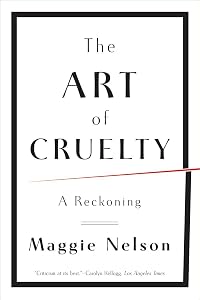
The Art of Cruelty: A Reckoning
by Maggie Nelson
On This Page
Description
Today both reality and entertainment crowd our fields of vision with brutal imagery. The pervasiveness of images of torture, horror, and war has all but demolished the twentieth-century hope that such imagery might shock us into a less alienated state, or aid in the creation of a just social order. What to do now? When to look, when to turn away? Genre-busting author Maggie Nelson brilliantly navigates this contemporary predicament, with an eye to the question of whether or not focusing on show more representations of cruelty makes us cruel. In a journey through high and low culture (Kafka to reality TV), the visual to the verbal (Paul McCarthy to Brian Evenson), and the apolitical to the political (Francis Bacon to Kara Walker), Nelson offers a model of how one might balance strong ethical convictions with an equally strong appreciation for work that tests the limits of taste, taboo, and permissibility. show lessTags
Recommendations


















Member Recommendations
Member Reviews
Maggie Nelson writes:
Even if and when Santiago Sierra’s diagnoses are spot-on, the pity he has expressed toward his subjects gives me pause, and evaporates whatever interest in the work I might have otherwise been able to muster. For this pity doesn’t just stand behind the scenes; it also structures the forms of the artwork at hand. As he told the BBC about 10 people paid to masturbate, “Nobody said no and for me that was very tough. When I made this piece I would go to bed crying.” It’s one thing to set up situations that aim to alert the world – even if just the art world – to the bad news of radical exploitation, even if one feels the lamentable need to exploit others to make one’s point. It’s quite another to show more decide in advance on the terms of human dignity (i.e., that a willingness to film oneself jerking off for money signifies that you have none), set up situations which prove (to you) that someone is utterly debased, then weep over the fulfillment of your puritanical prognostication. show less
Even if and when Santiago Sierra’s diagnoses are spot-on, the pity he has expressed toward his subjects gives me pause, and evaporates whatever interest in the work I might have otherwise been able to muster. For this pity doesn’t just stand behind the scenes; it also structures the forms of the artwork at hand. As he told the BBC about 10 people paid to masturbate, “Nobody said no and for me that was very tough. When I made this piece I would go to bed crying.” It’s one thing to set up situations that aim to alert the world – even if just the art world – to the bad news of radical exploitation, even if one feels the lamentable need to exploit others to make one’s point. It’s quite another to show more decide in advance on the terms of human dignity (i.e., that a willingness to film oneself jerking off for money signifies that you have none), set up situations which prove (to you) that someone is utterly debased, then weep over the fulfillment of your puritanical prognostication. show less
So Maggie Nelson on a bad day is better than just about anyone on their best day. Am I disappointed that I was not as crazy about this essay collection as I was "Bluets" or "Argonauts?" A little bit. Her assertions are a bit more academic than I like (that's really only because I am not nearly as smart as Maggie Nelson) and the spoonful of Bluets and cupful of Argonauts that are about Maggie Nelson herself to me balance out the density of her citations, research and ideas. We don't get any of that here and I missed it.
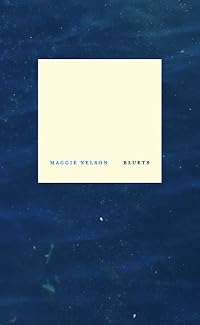
Still, I would read Maggie Nelson write anything. I started with Bluets a year ago and have been screaming "more, more" since. I've only got one book of her essays left and then I'll start on the poetry. This one may not show more be my favorite but I maintain that every new Maggie Nelson book cannot arrive fast enough. show less
Still, I would read Maggie Nelson write anything. I started with Bluets a year ago and have been screaming "more, more" since. I've only got one book of her essays left and then I'll start on the poetry. This one may not show more be my favorite but I maintain that every new Maggie Nelson book cannot arrive fast enough. show less
I've never read any Maggie Nelson and I am glad I have. I disagree with some of her arguments, but most of it is extremely salient, and hard to stomach. It also gets points for shouting out ; Angela Carter (for the Sadeian Woman), Anais Nin (for the graphic description of the seduction of her father in Incest: A Diary of Love) and a bunch of other women I strongly admire for their own grotesque behaviors. Takes a minute and my audiobook version is read by someone I really don't like (the voice really makes the audiobook) but it's something I can ignore at this point.
Fellow arts journalists love Maggie Nelson and I finally got around to reading her this year, in part because "The Argonauts" was assigned in Louis Menand's class during my fellowship. This book is in many ways a more serious read on the culture, a companion, for instance, to Susan Sontag's "Regarding the Pain of Others," but a bit less of a delight, at least for me. While "The Argonauts" was written with a natural confidence and authenticity, this writing seems to has something to prove. And, yet, prove it does. I have pretty much decided I'll read everything Nelson writes, if that's any indication.
There is a lot to ponder here. I wish it had been more logically ordered. Nelson moves among genres--theater, art, performance art, found art, pornography, novel, poetry, photography, art criticism--in a nondiscriminatory way. I frequently had trouble seeing the synthesis she evidently saw in her wish to discuss together representations of documented, actual cruelty (Abu Ghraib) vs. staged artful cruelty (for example, Yoko Ono's performance art, "Cut Piece"). In this way Nelson's work differs markedly from Susan Sontag's remarkable [b:Regarding the Pain of Others|52373|Regarding the Pain of Others|Susan Sontag|https://d.gr-assets.com/books/1355997884s/52373.jpg|430074], which laser-focused on the problem of our response to photography show more that depicts actual, terrible acts.
Also, I wish Nelson had spent more time discussing when the art of cruelty claims veracity and instruction as its reason to exist. Sometimes the examples of cruelty in the works I'm thinking of are so graphic and detailed and exhaustive that I wonder when they become exploitative rather than instructive. In spite of the existence of the dismissive label of "victim art" for these works, it also seems to be important to the audience that the artist has actually been a victim--otherwise the work might be deemed less authentic or genuinely exploitative. If you have been a victim of such acts then your work is absolved from being called exploitative and is called "true" and "brave" instead. I'm not sure if "I experienced it" works as an aesthetic or moral argument for judging art--it seems that the art object or novel or poem should stand on its own. Nelson does discuss works in this category of "cruel" but her argument is diluted by the scope of her examples. show less
Also, I wish Nelson had spent more time discussing when the art of cruelty claims veracity and instruction as its reason to exist. Sometimes the examples of cruelty in the works I'm thinking of are so graphic and detailed and exhaustive that I wonder when they become exploitative rather than instructive. In spite of the existence of the dismissive label of "victim art" for these works, it also seems to be important to the audience that the artist has actually been a victim--otherwise the work might be deemed less authentic or genuinely exploitative. If you have been a victim of such acts then your work is absolved from being called exploitative and is called "true" and "brave" instead. I'm not sure if "I experienced it" works as an aesthetic or moral argument for judging art--it seems that the art object or novel or poem should stand on its own. Nelson does discuss works in this category of "cruel" but her argument is diluted by the scope of her examples. show less
2.9 A careful and studious Cultural Studies look at the way cruelty is contained in art. Nelson is articulate and interesting, but ultimately unsatisfyingly indecisive. The examples and semi-theses repeat a bit clumsily and the book comes across as serious-voiced overstatement. Some of the examples are unbearable, others fascinating. Mostly it seems as if Nelson began the book without a complete idea then realized it had been covered by Barthes'[b:The Neutral: Lecture Course At The College De France 1977-1978|112600|The Neutral Lecture Course At The College De France 1977-1978 (European Perspectives a Series in Social Thought and Cultural Ctiticism)|Roland Barthes|http://photo.goodreads.com/books/1171660007s/112600.jpg|108414]
I loved the eerie and foreboding tone of this novel, but felt that there were some pacing issues that I couldn't get past.
Members
- Recently Added By
Lists

Top Five Books of 2017
757 works; 230 members
Author Information

17+ Works 5,753 Members
Maggie Nelson is a poet, critic, and nonfiction author of several books including The Argonauts, The Art of Cruelty: A Reckoning, Bluets, and Jane: A Murder: She teaches in the School of Critical Studies at CalArts and lives in Los Angeles, California.
Classifications
Statistics
- Members
- 420
- Popularity
- 73,525
- Reviews
- 7
- Rating
- (4.07)
- Languages
- English, Spanish
- Media
- Paper, Audiobook, Ebook
- ISBNs
- 8
- UPCs
- 1
- ASINs
- 4