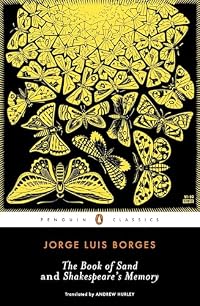
The Book of Sand and Shakespeare's Memory
by Jorge Luis Borges
On This Page
Description
The acclaimed translation of Borges's valedictory stories, in its first stand-alone edition Jorge Luis Borges has been called the greatest Spanish-language writer of the twentieth century. Now Borges's remarkable last major story collection, The Book of Sand , is paired with a handful of writings from the very end of his life. Brilliantly translated, these stories combine a direct and at times almost colloquial style coupled with Borges's signature fantastic inventiveness. Containing such show more marvelous tales as "The Congress," "Undr," "The Mirror and the Mask," and "The Rose of Paracelsus," this edition showcases Borges's depth of vision and superb image-conjuring power. For more than seventy years, Penguin has been the leading publisher of classic literature in the English-speaking world. With more than 1,700 titles, Penguin Classics represents a global bookshelf of the best works throughout history and across genres and disciplines. Readers trust the series to provide authoritative texts enhanced by introductions and notes by distinguished scholars and contemporary authors, as well as up-to-date translations by award-winning translators. show lessTags
Recommendations














Member Reviews
I wrote in my earlier review of Fictions (Ficciones) that the short stories of Jorge Luis Borges are so unique and innovative, so strange and mind-bending, that they almost seem as though they were authored by an alien polymath who has studied mankind for centuries and has decided to write in High English. The stories in The Book of Sand and Shakespeare's Memory, Borges' final two collections, are a bit different: innovative, still, and thought-provoking, but more human, more vulnerable – a bit more tired. But, in showing us this other side of the author, they are all the more fascinating for that.
That the stories are more vulnerable is perhaps inevitable: Borges was, by this time, not only in his eighties but a hard eighties – show more increasingly blind, frail and without much in the way of family or organic support structures. This is not an attempt at excusing – there is nothing to excuse, because both The Book of Sand and Shakespeare's Memory are excellent – but an acknowledgement of where Borges' head was at when he was composing these stories. The higher metaphysical concepts of previous collections are still here, but have taken a back seat to questions about the acceptance of age, death and the regrets of memory. The tone of the stories reminded me of the musician Leonard Cohen's similarly graceful artistic twilight, in that the themes are dealt with in such a composed and gentlemanly way. "Gradual blindness is not tragic," Borges tells his younger self in the first story, 'The Other'. "It's like the slowly growing darkness of a summer evening." (pg. 10)
Though not the recommended first port of call for those looking to read Borges, The Book of Sand and Shakespeare's Memory will be plenty rewarding to established admirers who already know how to approach Borges' laconic labyrinths and are willing to meet him there. Borges is infinitely compelling and, for all the influences he acknowledges here (there are individual stories which recall Lovecraft, Kipling and the titular Shakespeare), he is one of the very few writers who is indisputably unique and original. show less
That the stories are more vulnerable is perhaps inevitable: Borges was, by this time, not only in his eighties but a hard eighties – show more increasingly blind, frail and without much in the way of family or organic support structures. This is not an attempt at excusing – there is nothing to excuse, because both The Book of Sand and Shakespeare's Memory are excellent – but an acknowledgement of where Borges' head was at when he was composing these stories. The higher metaphysical concepts of previous collections are still here, but have taken a back seat to questions about the acceptance of age, death and the regrets of memory. The tone of the stories reminded me of the musician Leonard Cohen's similarly graceful artistic twilight, in that the themes are dealt with in such a composed and gentlemanly way. "Gradual blindness is not tragic," Borges tells his younger self in the first story, 'The Other'. "It's like the slowly growing darkness of a summer evening." (pg. 10)
Though not the recommended first port of call for those looking to read Borges, The Book of Sand and Shakespeare's Memory will be plenty rewarding to established admirers who already know how to approach Borges' laconic labyrinths and are willing to meet him there. Borges is infinitely compelling and, for all the influences he acknowledges here (there are individual stories which recall Lovecraft, Kipling and the titular Shakespeare), he is one of the very few writers who is indisputably unique and original. show less
You have to be careful reading Borges - too much all at once and you start to feel a dreamy disconnect from the world. Much the same effect can result from reading a large chunk of Mervyn Peake’s Gormenghast trilogy. I enjoy this disconnected state of mind, although it does impede normal life activities somewhat. What is perhaps more extraordinary is that this effect is produced by a translation, despite the fact that Alberto Manguel (who ought to know) commented rather dismissively on English translations of Borges. I would love to read his work in the original, but unfortunately the only Spanish I know is swearing. (It’s a great language for swearing in my opinion.) Perhaps I could find some French translations?
‘The Book of Sand show more and Shakespeare’s Memory’ are apparently the last two books of stories that Borges completed. The translator’s afterword discusses the ways in which they are ‘old man’s stories’. The afterword, in fact, contains a variation on just about every remark I could think to make about the themes and patterns within the book, and many others besides. So I’ll leave those comments to the expert and concentrate on what I liked best.
The first handful of stories, although beautifully written as ever, left me relatively unmoved. Then there was a cluster that I absolutely adored: ‘The Mirror and the Mask’, ‘Undr’, and ‘A Weary Man’s Utopia’. The latter is a Borgesian science fiction with an utterly magnificent deadpan tone. A few stories further along came my favourite of the lot, ‘The Book of Sand’. It contains this paragraph, which I feel is faultless:
I couldn’t say quite why I love this particular story so, although my obsession with books probably has a lot to do with it. Borges is an incredible writer and his stories are heady fare. They make you wonder, as he addresses in the story 'August 25, 1983', what a long novel by him would be like. I think it would be terrifying, a book to swallow you up and entirely take over your reality. Wouldn’t it be glorious if someone made a film on that theme? I wonder who could play Borges... show less
‘The Book of Sand show more and Shakespeare’s Memory’ are apparently the last two books of stories that Borges completed. The translator’s afterword discusses the ways in which they are ‘old man’s stories’. The afterword, in fact, contains a variation on just about every remark I could think to make about the themes and patterns within the book, and many others besides. So I’ll leave those comments to the expert and concentrate on what I liked best.
The first handful of stories, although beautifully written as ever, left me relatively unmoved. Then there was a cluster that I absolutely adored: ‘The Mirror and the Mask’, ‘Undr’, and ‘A Weary Man’s Utopia’. The latter is a Borgesian science fiction with an utterly magnificent deadpan tone. A few stories further along came my favourite of the lot, ‘The Book of Sand’. It contains this paragraph, which I feel is faultless:
’Summer was drawing to a close, and I realised that the book was monstrous. It was cold consolation to think that I, who looked upon it with my eyes and fondled it with my ten flesh-and-bone fingers, was no less monstrous than the book. I felt it was a nightmare thing, an obscene thing, and that it defiled and corrupted reality.
I couldn’t say quite why I love this particular story so, although my obsession with books probably has a lot to do with it. Borges is an incredible writer and his stories are heady fare. They make you wonder, as he addresses in the story 'August 25, 1983', what a long novel by him would be like. I think it would be terrifying, a book to swallow you up and entirely take over your reality. Wouldn’t it be glorious if someone made a film on that theme? I wonder who could play Borges... show less
The Book of Sand and Shakespeare’s Memory in Estonian
A review of the Loomingu Raamatukogu Kuldsari paperback (2023) reissued from (2017) as originally translated by Kai Aareleid from the Spanish language originals "El libro de la arena" (1975) and "La memoria de Shakespeare" (1983).
[3.9 Average rounded up to a 4 star for GR]
Considering that I use a quote from Borges as my motto*, I haven't actually read that many of his works. This recent reissue of the Estonian translation of his last two collections gave me a chance to amend that, as well as read in my heritage language which can always use some practice.
Argentinean writer Jorge Luis Borges (1899-1986) was blind after the age of 55, so these late stories were all dictated. Of the 4 show more contained in the final collection Shakespeare's Memory (1983), 3 were actually published in journals in 1977.
See image at https://scontent-yyz1-1.xx.fbcdn.net/v/t39.30808-6/468431898_28687251734206906_4...
An AI generated image drawn from the prompt: Draw an old man reading a book of sand.
I quite enjoyed getting reacquainted with Borges and his mix of fantasy, mythology and philosophy. I hope to read further soon. While reading, I did individual story ratings and setups as status updates in Estonian. The following are my English language summaries.
1. Other **** Borges as himself starts off by saying that he avoiding telling this story previously as it would have driven him insane. This supposedly happened to him in Boston in 1969. The 70 year old Borges sits down on a park bench and his 20 year old self sits down beside him. The elder tells the younger about what future awaits him.
2. Ulrika *** Javier from Colombia meets Ulrika, a Norwegian, at a conference. Ulrika says that she prefers to walk alone. Javier says that is also his preference and that they could do that together. When they walk they talk of the Nibelung Sagas and how Sigurd and Brunhild slept with a sword between them. When they return to the hotel they go too bed, but there is no sword between them. [This is the only time that Borges wrote a romance story.]
3. The Congress ***** The narrator, Alejandro Ferri, arrives in Buenos Aires in 1899. He is asked to join a sort of secret society called The Congress of the World, an effort to represent all of humanity. Various steps are taken such as collecting a library, building a headquarters, and deciding on the common language. Eventually the Congress is dissolved but regardless of that, it still carries on in all of us. [Borges himself considered this his best story ever.]
4. There Are More Things: In memory of H.P. Lovecraft **** A nephew inherits a supposed cursed house, the Red House but explores it one night nevertheless. He discovers items which indicate that a large creature, possibly of extraterrestrial origin is living there. In typical Lovecraft fashion, the final sentence leaves us anticipating the horror to come.
5. The Sect of 30 *** A work that purports to be a translation of an ancient 4th century manuscript of a sect that worships both Jesus and Judas while otherwise giving up all their possessions and refusing to be converted to regular Christianity. The very short 3-page story simply stops mid-sentence and then states that the rest of the manuscript is lost.
6. The Night of Gifts **** A man tells a story of when he was younger and visited a store with a friend. In that store a young woman talks about bandit raids, when they are attacked by the Argentinean bandit Juan Moreira. The boy hides with the girl. When they reappear, a sergeant has killed Moreira. The man says his younger self had the gift of seeing love and death that night.
7. The Mirror and the Mask *** In an alternate universe, after the Battle of Clontarf, the High King asks his bard to write a poem in commemoration, for which a silver mirror is given as a reward. After another year and poem, a golden mask is the reward. But then after the third year, the poem is only a single line, with fateful consequences.
8. Undr *** Purports to be a translation of a lost manuscript written by the 11th century chronicler Adam of Bremen who listens to the story of an Icelandic poet Ulf Sigurdarson who lived with a tribe called the Urns whose poems were single words.
9. A Weary Man’s Utopia **** A 70 year old language teacher and writer of fantasy (like Borges) named Eudoro Acevedo arrives at a house which is apparently Utopia in the future. He meets a man in the house who tells him that trivial things no longer exist, nor do governments. He gifts Acevedo a painting which travels back with him to the past.
10. The Bribe *** A professor of Old English has to decide between two candidates as to who to recommend for a future position. One of the candidates is rather bland and the other is youthful and ambitious. The second one has insulted the professor in one of his published papers.
11. Avelino Arredondo *** An imagined life of the title character in the two months leading up to the fateful day of August 25, 1897 when he assassinated the President of Uruguay.
12. The Disk **** A man seeks shelter in the hut of a woodcutter. He reveals that he is a king and descended from Odin and is the keeper of the disk of Odin, which is one sided. He reveals the disk, which is invisible, but when it is touched a chill is felt and a flash is seen. The woodcutter covets the disk.
13. The Book of Sand ***** A man buys a book from a Bible seller which is written in an unknown language with occasional illustrations. The cover says that it is holy writ, but it is otherwise known as the book of sand. He discovers that the book is of infinite length. As you turn pages, more pages start to grow in the front and the back.
14. Afterword **** Borges writes: "Writing a foreword to stories that the reader hasn't read yet is an almost impossible task, because it requires talking about plots that shouldn't really be told in advance. That's why I decided to write an epilogue instead."
15. 25. August 1983 ***** Borges was born August 24, 1899. This is yet another version of the doppelgänger first story of The Book of Sand called Other. A 61-year-old Borges checks into a hotel where he sees that his even older self has already registered. The younger rushes up to the room to confront the older 84 year old who tells him about the events which are yet to happen to him.
16. Blue Tigers **** A tiger-obsessed Scottish professor travels to India because he has heard that blue tigers have been seen. When he goes to live in a village of Hindus, various magical events occur there such as finding blue stones which multiply themselves.
17. The Rose of Paraclesus **** A potential acolyte approaches the alchemist Paracelsus and says that he will devote his life to following him if only Paracelsus will resurrect a rose blossom after it has been burnt to ashes.
18. Shakespeare’s Memory **** A Shakespeare obsessed German receives Shakespeare’s memory from another man who wanted to get rid of it. He finds that gradually his own language and memories are disappearing and his memory is being taken over by those of Shakespeare.
19. Borges Looks Back ***** This is the Afterword by Klaarika Kaldjärv. As always with the Estonian Loomingu Raamatukogu this provides an excellent overview of the career and writings of the original writer.
* Footnote
[When I imagine Heaven, I always picture it as a kind of library.]
Trivia and Links
The LR Kuldsari (Estonian: Golden Series) presents readers with a selection of works published in the Loomingu Raamatukogu (Estonian: The Creative's Library) throughout the ages. These are favorites from over the past six decades which confirm that the classics never get old! Six books will be published annually, one every two months. - translated from the publisher's website.
The Loomingu Raamatukogu is a modestly priced Estonian literary journal which initially published weekly (from 1957 to 1994) and which now publishes 40 issues in about 20 volumes a year as of 1995. It is a great source for discovery as its relatively cheap prices (currently 8 to 9€ per issue) allow for access to a multitude of international writers in Estonian translation and of shorter works by Estonian authors themselves. These include poetry, theatre, essays, short stories, novellas and novels. The lengthier works are usually counted as several issues but printed in a single volume.
For a complete listing of all works issued to date by Loomingu Raamatukogu including those in the Golden Series (at the bottom) see Estonian Wikipedia at: https://et.wikipedia.org/wiki/Loomingu_Raamatukogus_ilmunud_teoste_loend_aastak%... show less
A review of the Loomingu Raamatukogu Kuldsari paperback (2023) reissued from (2017) as originally translated by Kai Aareleid from the Spanish language originals "El libro de la arena" (1975) and "La memoria de Shakespeare" (1983).
[3.9 Average rounded up to a 4 star for GR]
Considering that I use a quote from Borges as my motto*, I haven't actually read that many of his works. This recent reissue of the Estonian translation of his last two collections gave me a chance to amend that, as well as read in my heritage language which can always use some practice.
Argentinean writer Jorge Luis Borges (1899-1986) was blind after the age of 55, so these late stories were all dictated. Of the 4 show more contained in the final collection Shakespeare's Memory (1983), 3 were actually published in journals in 1977.
See image at https://scontent-yyz1-1.xx.fbcdn.net/v/t39.30808-6/468431898_28687251734206906_4...
An AI generated image drawn from the prompt: Draw an old man reading a book of sand.
I quite enjoyed getting reacquainted with Borges and his mix of fantasy, mythology and philosophy. I hope to read further soon. While reading, I did individual story ratings and setups as status updates in Estonian. The following are my English language summaries.
1. Other **** Borges as himself starts off by saying that he avoiding telling this story previously as it would have driven him insane. This supposedly happened to him in Boston in 1969. The 70 year old Borges sits down on a park bench and his 20 year old self sits down beside him. The elder tells the younger about what future awaits him.
2. Ulrika *** Javier from Colombia meets Ulrika, a Norwegian, at a conference. Ulrika says that she prefers to walk alone. Javier says that is also his preference and that they could do that together. When they walk they talk of the Nibelung Sagas and how Sigurd and Brunhild slept with a sword between them. When they return to the hotel they go too bed, but there is no sword between them. [This is the only time that Borges wrote a romance story.]
3. The Congress ***** The narrator, Alejandro Ferri, arrives in Buenos Aires in 1899. He is asked to join a sort of secret society called The Congress of the World, an effort to represent all of humanity. Various steps are taken such as collecting a library, building a headquarters, and deciding on the common language. Eventually the Congress is dissolved but regardless of that, it still carries on in all of us. [Borges himself considered this his best story ever.]
4. There Are More Things: In memory of H.P. Lovecraft **** A nephew inherits a supposed cursed house, the Red House but explores it one night nevertheless. He discovers items which indicate that a large creature, possibly of extraterrestrial origin is living there. In typical Lovecraft fashion, the final sentence leaves us anticipating the horror to come.
5. The Sect of 30 *** A work that purports to be a translation of an ancient 4th century manuscript of a sect that worships both Jesus and Judas while otherwise giving up all their possessions and refusing to be converted to regular Christianity. The very short 3-page story simply stops mid-sentence and then states that the rest of the manuscript is lost.
6. The Night of Gifts **** A man tells a story of when he was younger and visited a store with a friend. In that store a young woman talks about bandit raids, when they are attacked by the Argentinean bandit Juan Moreira. The boy hides with the girl. When they reappear, a sergeant has killed Moreira. The man says his younger self had the gift of seeing love and death that night.
7. The Mirror and the Mask *** In an alternate universe, after the Battle of Clontarf, the High King asks his bard to write a poem in commemoration, for which a silver mirror is given as a reward. After another year and poem, a golden mask is the reward. But then after the third year, the poem is only a single line, with fateful consequences.
8. Undr *** Purports to be a translation of a lost manuscript written by the 11th century chronicler Adam of Bremen who listens to the story of an Icelandic poet Ulf Sigurdarson who lived with a tribe called the Urns whose poems were single words.
9. A Weary Man’s Utopia **** A 70 year old language teacher and writer of fantasy (like Borges) named Eudoro Acevedo arrives at a house which is apparently Utopia in the future. He meets a man in the house who tells him that trivial things no longer exist, nor do governments. He gifts Acevedo a painting which travels back with him to the past.
10. The Bribe *** A professor of Old English has to decide between two candidates as to who to recommend for a future position. One of the candidates is rather bland and the other is youthful and ambitious. The second one has insulted the professor in one of his published papers.
11. Avelino Arredondo *** An imagined life of the title character in the two months leading up to the fateful day of August 25, 1897 when he assassinated the President of Uruguay.
12. The Disk **** A man seeks shelter in the hut of a woodcutter. He reveals that he is a king and descended from Odin and is the keeper of the disk of Odin, which is one sided. He reveals the disk, which is invisible, but when it is touched a chill is felt and a flash is seen. The woodcutter covets the disk.
13. The Book of Sand ***** A man buys a book from a Bible seller which is written in an unknown language with occasional illustrations. The cover says that it is holy writ, but it is otherwise known as the book of sand. He discovers that the book is of infinite length. As you turn pages, more pages start to grow in the front and the back.
14. Afterword **** Borges writes: "Writing a foreword to stories that the reader hasn't read yet is an almost impossible task, because it requires talking about plots that shouldn't really be told in advance. That's why I decided to write an epilogue instead."
15. 25. August 1983 ***** Borges was born August 24, 1899. This is yet another version of the doppelgänger first story of The Book of Sand called Other. A 61-year-old Borges checks into a hotel where he sees that his even older self has already registered. The younger rushes up to the room to confront the older 84 year old who tells him about the events which are yet to happen to him.
16. Blue Tigers **** A tiger-obsessed Scottish professor travels to India because he has heard that blue tigers have been seen. When he goes to live in a village of Hindus, various magical events occur there such as finding blue stones which multiply themselves.
17. The Rose of Paraclesus **** A potential acolyte approaches the alchemist Paracelsus and says that he will devote his life to following him if only Paracelsus will resurrect a rose blossom after it has been burnt to ashes.
18. Shakespeare’s Memory **** A Shakespeare obsessed German receives Shakespeare’s memory from another man who wanted to get rid of it. He finds that gradually his own language and memories are disappearing and his memory is being taken over by those of Shakespeare.
19. Borges Looks Back ***** This is the Afterword by Klaarika Kaldjärv. As always with the Estonian Loomingu Raamatukogu this provides an excellent overview of the career and writings of the original writer.
* Footnote
yo, que me figuraba el Paraiso
bajo la especie de una biblioteca.
- Jorge Luis Borges (Poema de los Dones)
[When I imagine Heaven, I always picture it as a kind of library.]
Trivia and Links
The LR Kuldsari (Estonian: Golden Series) presents readers with a selection of works published in the Loomingu Raamatukogu (Estonian: The Creative's Library) throughout the ages. These are favorites from over the past six decades which confirm that the classics never get old! Six books will be published annually, one every two months. - translated from the publisher's website.
The Loomingu Raamatukogu is a modestly priced Estonian literary journal which initially published weekly (from 1957 to 1994) and which now publishes 40 issues in about 20 volumes a year as of 1995. It is a great source for discovery as its relatively cheap prices (currently 8 to 9€ per issue) allow for access to a multitude of international writers in Estonian translation and of shorter works by Estonian authors themselves. These include poetry, theatre, essays, short stories, novellas and novels. The lengthier works are usually counted as several issues but printed in a single volume.
For a complete listing of all works issued to date by Loomingu Raamatukogu including those in the Golden Series (at the bottom) see Estonian Wikipedia at: https://et.wikipedia.org/wiki/Loomingu_Raamatukogus_ilmunud_teoste_loend_aastak%... show less
Aesthetic experience is extraordinary in the sense that it is always ours alone, uniquely ours. And some aesthetic experiences hit us right between the eyes with a knockout punch - these are encounters we will never forget. One such encounter was my reading this collection of stories by Jorge Luis Borges some thirty years ago. The images of the book of sand with its infinite pages, the hermit looking for a one-sided disk, an author's pristine lovemaking with a beautiful woman - for me, all aesthetic knockout punches. I would encourage anybody who would like to expand their horizons, expand their inner universe, and exercise their imagination to pick up and read this most wonderful collection. As a way of providing a sample, here are my show more top ten questions on the title story – The Book of Sand. And below my questions, the actual story.
1. In what way or ways can any short work of fiction be true?
2. What would be your initial thought and feeling if someone handed you the book of sand?
3. What book in your personal library would you trade for the book of sand?
4. Is the book of sand a metaphor for all great works of literature in the sense those works have no end or bottom?
5. What book comes to mind for you as one where the more you reread, the more question arise?
6. Are all works of literature infinite since they expand in different directions each time they are read by a different reader?
7. Are you inextricably bound to a certain book, or, in other words, is there any book holding you as prisoner?
8. What is it about certain books that they refuse to be mastered by anybody?
9. Would you feel uneasy owning the book of sand?
10. Where would you hide the book of sand if you never wanted the book to be discovered?
THE BOOK OF SAND by Jorge Luis Borges
The line is made up of an infinite number of points; the plane of an infinite number of lines; the volume of an infinite number of planes; the hypervolume of an infinite number of volumes. . . . No, unquestionably this is not—more geometrico—the best way of beginning my story. To claim that is it true is nowadays the convention of every made-up story. Mine, however, is true.
I live alone in a fourth-floor apartment on Belgrano Street, in Buenos Aires. Late one evening, a few months back, I heard a knock at my door. I opened it and a stranger stood there. He was a tall man, with nondescript features—or perhaps it was my myopia that made them seem that way. Dressed in gray and carrying a gray suitcase in his hand, he had an unassuming look about him. I saw at once that he was a foreigner. At first, he struck me as old; only later did I realize that I had been misled by his thin blond hair, which was, in a Scandinavian sort of way, almost white. During the course of our conversation, which was not to last an hour, I found out that he came from the Orkneys.
I invited him in, pointing to a chair. He paused awhile before speaking. A kind of gloom emanated from him—as it does now from me.
"I sell Bibles," he said.
Somewhat pedantically, I replied, "In this house are several English Bibles, including the first—John Wiclif's. I also have Cipriano de Valera's, Luther's—which, from a literary viewpoint, is the worst—and a Latin copy of the Vulgate. As you see, it's not exactly Bibles I stand in need of."
After a few moments of silence, he said, "I don't only sell Bibles. I can show you a holy book I came across on the outskirts of Bikaner. It may interest you."
He opened the suitcase and laid the book on a table. It was an octavo volume, bound in cloth. There was no doubt that it had passed through many hands. Examining it, I was surprised by its unusual weight. On the spine were the words "Holy Writ" and, below them, "Bombay."
"Nineteenth century, probably," I remarked.
"I don't know," he said. "I've never found out."
I opened the book at random. The script was strange to me. The pages, which were worn and typographically poor, were laid out in a double column, as in a Bible. The text was closely printed, and it was ordered in versicles. In the upper corners of the pages were Arabic numbers. I noticed that one left-hand page bore the number (let us say) 40,514 and the facing right-hand page 999. I turned the leaf; it was numbered with eight digits. It also bore a small illustration, like the kind used in dictionaries—an anchor drawn with pen and ink, as if by a schoolboy's clumsy hand.
It was at this point that the stranger said, "Look at the illustration closely. You'll never see it again."
I noted my place and closed the book. At once, I reopened it. Page by page, in vain, I looked for the illustration of the anchor. "It seems to be a version of Scriptures in some Indian language, is it not?" I said to hide my dismay.
"No," he replied. Then, as if confiding a secret, he lowered his voice. "I acquired the book in a town out on the plain in exchange for a handful of rupees and a Bible. Its owner did not know how to read. I suspect that he saw the Book of Books as a talisman. He was of the lowest caste; nobody but other untouchables could tread his shadow without contamination. He told me his book was called the Book of Sand, because neither the book nor the sand has any beginning or end."
The stranger asked me to find the first page.
I laid my left hand on the cover and, trying to put my thumb on the flyleaf, I opened the book. It was useless. Every time I tried, a number of pages came between the cover and my thumb. It was as if they kept growing from the book.
"Now find the last page."
Again I failed. In a voice that was not mine, I barely managed to stammer, "This can't be."
Still speaking in a low voice, the stranger said, "It can't be, but it is. The number of pages in this book is no more or less than infinite. None is the first page, none the last. I don't know why they're numbered in this arbitrary way. Perhaps to suggest that the terms of an infinite series admit any number."
Then, as if he were thinking aloud, he said, "If space is infinite, we may be at any point in space. If time is infinite, we may be at any point in time."
His speculations irritated me. "You are religious, no doubt?" I asked him.
"Yes, I'm a Presbyterian. My conscience is clear. I am reasonably sure of not having cheated the native when I gave him the Word of God in exchange for his devilish book."
I assured him that he had nothing to reproach himself for, and I asked if he were just passing through this part of the world. He replied that he planned to return to his country in a few days. It was then that I learned that he was a Scot from the Orkney Islands. I told him I had a great personal affection for Scotland, through my love of Stevenson and Hume.
"You mean Stevenson and Robbie Burns," he corrected.
While we spoke, I kept exploring the infinite book. With feigned indifference, I asked, "Do you intend to offer this curiosity to the British Museum?"
"No. I'm offering it to you," he said, and he stipulated a rather high sum for the book.
I answered, in all truthfulness, that such a sum was out of my reach, and I began thinking. After a minute or two, I came up with a scheme.
"I propose a swap, " I said. "You got this book for a handful of rupees and a copy of the Bible. I'll offer you the amount of my pension check, which I've just collected, and my black-letter Wiclif Bible. I inherited it from my ancestors."
"A black-letter Wiclif!" he murmured.
I went to my bedroom and brought him the money and the book. He turned the leaves and studied the title page with all the fervor of a true bibliophile.
"It's a deal," he said.
It amazed me that he did not haggle. Only later was I to realize that he had entered my house with his mind made up to sell the book. Without counting the money, he put it away.
We talked about India, about Orkney, and about the Norwegian jarls who once ruled it. It was night when the man left. I have not seen him again, nor do I know his name.
I thought of keeping the Book of Sand in the space left on the shelf by the Wiclif, but in the end I decided to hide it behind the volumes of a broken set of The Thousand and One Nights. I went to bed and did not sleep. At three or four in the morning, I turned on the light. I got down the impossible book and leafed through its pages. On one of them I saw engraved a mask. The upper corner of the page carried a number, which I no longer recall, elevated to the ninth power.
I showed no one my treasure. To the luck of owning it was added the fear of having it stolen, and then the misgiving that it might not truly be infinite. These twin preoccupations intensified my old misanthropy. I had only a few friends left; I now stopped seeing even them. A prisoner of the book, I almost never went out anymore. After studying its frayed spine and covers with a magnifying glass, I rejected the possibility of a contrivance of any sort. The small illustrations, I verified, came two thousand pages apart. I set about listing them alphabetically in a notebook, which I was not long in filling up. Never once was an illustration repeated. At night, in the meager intervals my insomnia granted, I dreamed of the book.
Summer came and went, and I realized that the book was monstrous. What good did it do me to think that I, who looked upon the volume with my eyes, who held it in my hands, was any less monstrous? I felt that the book was a nightmarish object, an obscene thing that affronted and tainted reality itself.
I thought of fire, but I feared that the burning of an infinite book might likewise prove infinite and suffocate the planet with smoke. Somewhere I recalled reading that the best place to hide a leaf is in a forest. Before retirement, I worked on Mexico Street, at the Argentine National Library, which contains nine hundred thousand volumes. I knew that to the right of the entrance a curved staircase leads down into the basement, where books and maps and periodicals are kept. One day I went there and, slipping past a member of the staff and trying not to notice at what height or distance from the door, I lost the Book of Sand on one of the basement's musty shelves. show less
The Book Of Sand incorporates elements of autobiography, as was his wont, notably themes of old age, solitude and approaching death (as he was).
There are flashes of beautiful writing, interesting philosophy and erudition here, but many of the stories feel like failed experiments and failed to engage me. Highlights are: ‘There Are More Things’ for its mystery and menace, dedicated to H P Lovecraft and reminiscent of Poe; ‘The Disk’ is a good cautionary fairytale; ‘The Book Of Sand’ is easily the best of the lot, showcasing the best aspects of myth, fairytale and short story.
Shakespeare's Memory was Borges' last collection. Many of the same themes as Book Of Sand (doubles, unquantifiable infinity, an apparent gift that becomes show more a curse) but shorter at just over 30 pages. Interesting rather than gripping, again, but worth reading. show less
There are flashes of beautiful writing, interesting philosophy and erudition here, but many of the stories feel like failed experiments and failed to engage me. Highlights are: ‘There Are More Things’ for its mystery and menace, dedicated to H P Lovecraft and reminiscent of Poe; ‘The Disk’ is a good cautionary fairytale; ‘The Book Of Sand’ is easily the best of the lot, showcasing the best aspects of myth, fairytale and short story.
Shakespeare's Memory was Borges' last collection. Many of the same themes as Book Of Sand (doubles, unquantifiable infinity, an apparent gift that becomes show more a curse) but shorter at just over 30 pages. Interesting rather than gripping, again, but worth reading. show less
“It’s not the reading that matters, but the rereading.”
So true of all JLB’s works
I have the Collected Fictions, but am splitting my review of that into its components, listed in publication order: Collected Fictions - all reviews. The Book of Sand is the eighth, published in 1975.
After the generally quite straightforward stories of Brodie's Report, this is a (welcome) return to more mystical, metaphysical tales.
This review does NOT include the four stories published as Shakespeare’s Memory.
The Other 6*
“The encounter was real, but the other man spoke to me in a dream.”
How often have you wondered what you would tell your younger self, if you had the chance? Would your younger self take any notice? What else would you talk show more about? More importantly, would you give them a glimpse of “my past, which is now the future that awaits you”, and if you did, would you be constraining that future by doing so?
So many of JLB’s stories have semi-fictionalised aspects of himself, or a person meeting another version of themselves; this has both. (See also “August 25, 1983”, below, and “Borges and I” in Dreamtigers.) But although it is described in pleasant terms, JLB says it was “almost horrific while it lasted” and mentions “elemental fear” and the “sleepless nights that followed”.
They talk about literature, of course (and family). Young JLB has recently read Dostoyevsky’s The Double, which is apt. It’s awkward, though: “We were too different, yet too alike. We could not deceive each other and that made conversation hard. Each of us was almost a caricature of the other.”
JLB realises “There was no point in giving advice,,, because the young man’s fate was to be the man that I am now.” He concludes that the meeting was real for him, but merely a dream for his younger self.
This story is also an opportunity for JLB, by then in his mid-seventies, to appraise his life, work and influence. He’s quite harsh, saying he “wrote too many” books, including “poetry that will give you a pleasure that others will not fully share, and stories of a fantastical turn”.
Ulrikke
A rarity in JLB’s writings: this features a woman – and as the subject of intense and sudden love and desire.
Ulrikke is a Norwegian with an air of “calm mystery”, staying in York, where she meets the narrator, “a celibate middle-aged man” who is a professor visiting from Columbia.
The tender one-night stand that ensues is idealised and ethereal but with signs of looming death. The bedroom is dark, with “a vague glass” and then “no more furniture, no more mirrors… Like sand, time sifted away. Ancient in the dimness flowed love, and for the first and last time, I possessed the image of Ulrikke”. As so often with JLB, the reader is left unsure how much of this is real, and if not, what it means: is Ulrikke the perfect woman or the yin to JLB’s yang, or something else altogether?
The Congress 5*
This has a separate review because I ran out of words here: The Congress.
There are More Things 6*
"There are more things in heaven and earth, Horatio, than are dreamt of in your philosophy." – Hamlet.
One of the homilies drummed into us at school was “Send postcards to people when they’re alive, not flowers when they’re dead”. In this, a man visits the former house of the dead uncle who taught him philosophy and “felt what we always feel when someone dies – the sad awareness, now futile, of how little it would have cost us to be more loving”. But this isn’t straightforward remembrance.
The house was auctioned and bought by a secretive foreigner for twice as much as anyone else offered. The purchaser dumped all the books and furniture, and tried (and failed) to get the original architect to remodel it. Others were brought in to do the work, which was completed in two weeks, overnight, and the owner was never seen again. It’s having dark fairytale qualities now.
The nephew is curious. In fact his curiosity has previously led him to “marriage to a woman utterly unlike myself… trying laudanum… into an exploration of transfinite numbers” and now this “terrifying adventure”.
“In order to truly see a thing, one must first understand it. An armchair implies the human body… scissors the act of cutting… The passenger does not see the same ship’s rigging as the crew. If we truly saw the universe, perhaps we would understand it.”
He visits the architect, who was a personal friend of his uncle, but he learns little, other than that the new owner is Jewish and wanted a “monstrosity” built in place of the original house. That night, he dreams of a labyrinth, and next day he visits the carpenter who did some of the refurbishments. He’s evasive: he says that the customer is always right, but that Preetorious was “not quite right”.
Over the next few days, the nephew walks around the boarded up house until, sheltering from a storm, he discovers the gate is unlocked and the door ajar. The floor is bare earth and the furniture is scattered – and strange.
“None of the insensate forms… corresponded to the human figure or any conceivable use. They inspired horror and revulsion.” It’s pertinent that this story is dedicated to H P Lovecraft.
Then he hears “something heavy and slow and plural. Curiosity got the better of fear, and I did not close my eyes.” Then it stops! Who, what, why did he see?
The Sect of Thirty
“There is no man that does not carry out, wittingly or not, the plan traced by the All-Wise.”
I wish I believed in pre-destination: I could do whatever I liked, without fear of any more damnation that I would have had anyway – though I suppose the fact I think that condemns me in itself.
This is another story based on the discovery of a partial manuscript, in this case, a Christian sect of the name in the title. Their views, though varied (especially about death) and actions would be considered heretical by most Christians, and one aspect repulsive (and illegal) to all. But there is a Biblical logic, however twisted. I take it as a warning against fundamentalism, and especially looking so much at the details that you lose the broader context of right and wrong.
Their generosity to the poor means they do not even have clothes for themselves. Because looking at a woman lustfully is as sinful as having sex with her, and the former is impossible to suppress, they are promiscuous (what about lustful women, consent etc?). The sect’s name comes from Judas’ payment for betraying Jesus (thirty pieces of silver), and because all the participants in the crucifixion are unknown except for Judas and Jesus, “the sect venerates the two equally and absolves the others”. Crucifixion is key: in breach of the fifth commandment, members are crucified when they reach the age at which it happened to Jesus (thirty three).
The Night of the Gifts
This revisits the Platonic idea that knowing is really just recognising because we’ve seen all things in some former world (see also The Congress, above).
When the narrator was nearly thirteen, he went to town on a Saturday night with an older labourer. Bars, dancing, drink, women… You can guess the gist, but it has a slightly unreal quality, especially towards the end, when you wonder how much of it was real, and how much embroidery. The narrator asks that question himself, drawing parallels with “the Captive” Indian girl and the story she told of the Indian raid that led her to her current situation.
”Within the space of a few hours I’d learned how to make love and I’d seen death at first hand.
The Mirror and The Mask 5*
Like “Undr” below and The Library of Babel (in The Garden of Forking Paths), this explores the paradox of infinity coupled with minimalism. More than that, it’s about the sacred danger of true beauty.
A king wants to be immortalised in song. He gives a poet a year to compose such a piece. The song is a triumph and the poet is given a silver mirror. He is also given another year to write an even better song.
In the second song, “the verses were strange… They were not a description of the battle, they were the battle.” But the king liked the obscurity of the verses and gave the poet a golden mask (is this like The Emperor’s New Clothes?). The third year, the poet returns with a single line. “The poet and the king mouthed the poem as though it were a secret supplication, or a blasphemy.” The kind is amazed that all wonders are encompassed so succinctly, but he and the poet now share “the sin of having known Beauty, which is a gift forbidden mankind”. The final gift is a dagger, which the poet dutifully uses as expected. The king “is a beggar who wanders the roads of Ireland, which once was his kingdom, and…has never spoken the poem again.”
”Undr”
I’ve written so many words about JLB, and yet this story is all about encompassing a whole life, a whole word, in a single sound. How is that possible? How close can we get? Why would we try?
Like The Mirror and the Mask above and The Library of Babel (in The Garden of Forking Paths), this explores the paradox of infinity coupled with minimalism – and the peril of such perfection.
A man travels to a remote northern country where they have “true faith in Christ”. They carve runes of Odin (not very Christian), rather than writing on paper or parchment. Perhaps that is why “the poetry of the Urns is a poetry of a single word”. Carvings around the town are of different symbols, but all are, apparently, the Word (with a capital W – very Biblical).
The Urns are also prone to crucifying strangers (again, not very Christian). To avoid that fate, the traveller composes a laudatory poem. It seems to be well received: the king gives him a silver ring (but he glimpses a dagger under the king’s cushion). The next man presents a poem of a single word, and everyone is deeply moved by it. The traveller doesn’t catch the word, but another poet warns him he’ll die for hearing it, and helps him escape. He can’t tell the traveller the word because it is a sworn secret, “no one can teach another anything” and “You must seek it on your own”.
He travels for many years, eventually returning to find the poet and old man. On his deathbed, he tells the traveller a single Word, and in it, he sees everything: the poet’s life and his own. Then he picks up the harp and composes his own single word, demonstrating he has understood.
A Weary Man’s Utopia 6*
A glimpse of a possible, simpler, future, but I’m not sure it’s one I’d want to live in, even if there were no poverty or war. I’m reminded of Le Guin’s short story The Ones Who Walk Away from Omelas. The ending has an unexpected punch.
A traveller meets a very tall man with “peculiar eyes” who realises, by the clothing that the traveller has come from another time. The only common language they can find is Latin: “The diversity of languages encouraged the diversity of nations… the earth has returned to Latin.” Esperanto has no place in this vision (it was rejected in The Congress, above, as well).
For a utopia, envisaged by a writer, there are some surprising features, especially regarding books. On the other hand, is does presage some of the downsides of the internet – despite being published in 1975.
“No one cares about facts anymore. They are mere points of departure for speculation and exercises in creativity. In school, we are taught Doubt, and the Art of Forgetting.” There are no libraries or museums because “we want to forget the past” and “Each person must produce on his own the arts and sciences that he has need for… Every man must be his own Bernard Shaw, his own Jesus Christ, and his own Archimedes”. That sounds inefficient and solitary. “We live in time, which is successive, but we try to live sub aeternitatis” [under eternity].
“It’s not the reading that matters, but the rereading”: the old man has not read more than half a dozen books in his four hundred year life. Similarly, printing has been banned “for it tended to multiply unnecessary tests to a dizzying degree”. A brief trawl of the internet shows the truth of that, and the potential for information overload: “All this was no sooner read than forgotten… blotted out by new trivialities.” “People believed only what they could read on the printed page” – and boy do they believe: it was on a website or in an email that said it was reported on CNN, so it must be true. “esse est percipi - to be is to be portrayed”: selfies and general online validation, yep JLB saw that too.
In this utopia, there is of course, no poverty – and therefore no “vulgar wealth”, and indeed, no money. Governments “gradually fell into disuse (some former politicians found success as comedians and witch doctors!). Space travel ceased when “we found we could never escape the here and now… every journey is a journey through space”.
It sounds lonely, though: each person has only one child, and the old man lives alone; “When an individual has reached a hundred years of age, he is able to do without love and friendship” – but why would he? Being the master of your own life also means being the master of your own death, but this is no Soylent Green scenario; each chooses their own time.
After the leisured description of this time/place, there is a neat but shocking ending to the story.The traveller sees strange art that is “almost blank… painted with colours that your ancient eyes cannot see”. He is given one as “a souvenir of a future friend”. Then others arrive, help the old man strip the house and they all walk off to the crematory: “The death chamber… was invented by a philanthropist whose name, I believe, was Adolf Hitler.” Such a subtle way to make the point that Martin Amis was perhaps trying to make in the crass Time’s Arrow and Vonnegut did rather better in Slaughterhouse Five. “In my study… still hangs the canvas that someone will paint, thousands of years from now, with substances that are now scattered across the planet.”
The Bribe
In the afterword, JLB says this is an exploration of “Americans’ obsession with ethics”; he reckons “it couldn’t have happened anywhere else”. I’m not sure about that, but nevertheless, it’s a straightforward short story of university politics – no mystical allusions in this one. Dr Winthrop has to pick one of two candidates to chair a conference. The characters and relative merits of the two candidates were rather dull – until I realised the twist of the tale.
One of the candidates realises Dr Winthrop will strive to be impartial – and to be seen as such. So he publishes a paper criticising Dr Winthrop’s work, on the assumption that will get him the job. “Written in the correct English of the non-native speaker, never stooped to incivility, yet it did have a certain belligerence… Not once was Winthrop’s name mentioned, but Winthrop felt persistently attacked.” It worked, and the winner then goes to Winthrop to tell him! They conclude they share the sin of vanity: one boasting of his strategy, and the other proud of his integrity.
Avelino Arredondo
This is based on a historical event, outlined in the notes. However, it works quite well as a story, even without that knowledge.
Arredondo says farewell to his friends and sweetheart, saying he’s going away. However, he’s really hiding in his back room, reading the Bible (having sold all his other books), but without trying to understand it. There is an unexplained deadline of August 25 (which is the title of a story in Shakespeare’s Memory), though we’re told he won’t finish reading the Bible, and there are chaotic games of chess, with missing pieces, that won’t end. “He missed his friends terribly, though he knew without bitterness that they didn’t miss him.”
It was all preparation for assassinating the president – though he had to ask who he was, to be sure he shot the right man! He cut himself off from friends and newspapers so they could not be blamed.
The Disk
Greed, futility, loneliness, magic. An old woodcutter lets a traveller into his hut. The traveller has the disk of Odin, which is unique because it has only one side. It also makes him king. The woodcutter can’t see it when the king opens his palm, but he can feel it, and he thinks he catches a glint.
The woodcutter kills the king so he can get an sell the disk – but he never finds it. Ever.
The Book of Sand
A travelling Bible salesman sells a holy book from India, The Book of Sand, so called because “neither sand nor this book has a beginning or an end”. It is like The Library of Babel (in The Garden of Forking Paths) in miniature. It is written in an unknown script, with occasionally illustrations, and page numbers that are non-sequential and change every time.
“If space is infinite, we are anywhere, at any point in space. If time is infinite, we are at any point in time.”
They buyer/narrator/JLB cipher tells no one what he has bought. He fears theft, but also the possible discovery that the book is not actually infinite. He becomes an obsessive recluse: the book is monstrous, and so is he - like Gollum and his “precious”, and of course JLB’s own story of The Zahir, in The Aleph.
“It defiled and corrupted reality”. What to do? “I considered fire, but I feared that the burning of an infinite book might be similarly infinite.” He eventually hides it in a shady corner of the national library.
Quotes
• “America, hobbled by the superstition of democracy, can’t make up its mind whether to be a democracy.”
• “The miraculous inspires fear.”
• On blindness, he is “able to see the colour yellow, and light and shadow. But don’t worry. Gradual blindness is not tragic. It’s like the slowly growing darkness of a summer evening.”
• “Indecisiveness or oversight, or perhaps other reasons, let to my never marrying.”
•
• “Love that flows in shadow, like a secret river.”
• “Time – that infinite web of yesterday, today, the future, forever, never – is the only true enigma.”
• “In time, one inevitable comes to resemble one’s enemies.”
• “His face would have been anonymous had it not been rescued by his eyes, which were both sleepy and full of energy.”
• Newspapers are “museums of ephemera”. show less
So true of all JLB’s works
I have the Collected Fictions, but am splitting my review of that into its components, listed in publication order: Collected Fictions - all reviews. The Book of Sand is the eighth, published in 1975.
After the generally quite straightforward stories of Brodie's Report, this is a (welcome) return to more mystical, metaphysical tales.
This review does NOT include the four stories published as Shakespeare’s Memory.
The Other 6*
“The encounter was real, but the other man spoke to me in a dream.”
How often have you wondered what you would tell your younger self, if you had the chance? Would your younger self take any notice? What else would you talk show more about? More importantly, would you give them a glimpse of “my past, which is now the future that awaits you”, and if you did, would you be constraining that future by doing so?
So many of JLB’s stories have semi-fictionalised aspects of himself, or a person meeting another version of themselves; this has both. (See also “August 25, 1983”, below, and “Borges and I” in Dreamtigers.) But although it is described in pleasant terms, JLB says it was “almost horrific while it lasted” and mentions “elemental fear” and the “sleepless nights that followed”.
JLB realises “There was no point in giving advice,,, because the young man’s fate was to be the man that I am now.” He concludes that the meeting was real for him, but merely a dream for his younger self.
This story is also an opportunity for JLB, by then in his mid-seventies, to appraise his life, work and influence. He’s quite harsh, saying he “wrote too many” books, including “poetry that will give you a pleasure that others will not fully share, and stories of a fantastical turn”.
Ulrikke
A rarity in JLB’s writings: this features a woman – and as the subject of intense and sudden love and desire.
Ulrikke is a Norwegian with an air of “calm mystery”, staying in York, where she meets the narrator, “a celibate middle-aged man” who is a professor visiting from Columbia.
The Congress 5*
This has a separate review because I ran out of words here: The Congress.
There are More Things 6*
"There are more things in heaven and earth, Horatio, than are dreamt of in your philosophy." – Hamlet.
One of the homilies drummed into us at school was “Send postcards to people when they’re alive, not flowers when they’re dead”. In this, a man visits the former house of the dead uncle who taught him philosophy and “felt what we always feel when someone dies – the sad awareness, now futile, of how little it would have cost us to be more loving”. But this isn’t straightforward remembrance.
The house was auctioned and bought by a secretive foreigner for twice as much as anyone else offered. The purchaser dumped all the books and furniture, and tried (and failed) to get the original architect to remodel it. Others were brought in to do the work, which was completed in two weeks, overnight, and the owner was never seen again. It’s having dark fairytale qualities now.
The nephew is curious. In fact his curiosity has previously led him to “marriage to a woman utterly unlike myself… trying laudanum… into an exploration of transfinite numbers” and now this “terrifying adventure”.
“In order to truly see a thing, one must first understand it. An armchair implies the human body… scissors the act of cutting… The passenger does not see the same ship’s rigging as the crew. If we truly saw the universe, perhaps we would understand it.”
Over the next few days, the nephew walks around the boarded up house until, sheltering from a storm, he discovers the gate is unlocked and the door ajar. The floor is bare earth and the furniture is scattered – and strange.
“None of the insensate forms… corresponded to the human figure or any conceivable use. They inspired horror and revulsion.” It’s pertinent that this story is dedicated to H P Lovecraft.
Then he hears “something heavy and slow and plural. Curiosity got the better of fear, and I did not close my eyes.” Then it stops! Who, what, why did he see?
The Sect of Thirty
“There is no man that does not carry out, wittingly or not, the plan traced by the All-Wise.”
I wish I believed in pre-destination: I could do whatever I liked, without fear of any more damnation that I would have had anyway – though I suppose the fact I think that condemns me in itself.
This is another story based on the discovery of a partial manuscript, in this case, a Christian sect of the name in the title. Their views, though varied (especially about death) and actions would be considered heretical by most Christians, and one aspect repulsive (and illegal) to all. But there is a Biblical logic, however twisted. I take it as a warning against fundamentalism, and especially looking so much at the details that you lose the broader context of right and wrong.
The Night of the Gifts
This revisits the Platonic idea that knowing is really just recognising because we’ve seen all things in some former world (see also The Congress, above).
When the narrator was nearly thirteen, he went to town on a Saturday night with an older labourer. Bars, dancing, drink, women… You can guess the gist, but it has a slightly unreal quality, especially towards the end, when you wonder how much of it was real, and how much embroidery. The narrator asks that question himself, drawing parallels with “the Captive” Indian girl and the story she told of the Indian raid that led her to her current situation.
The Mirror and The Mask 5*
Like “Undr” below and The Library of Babel (in The Garden of Forking Paths), this explores the paradox of infinity coupled with minimalism. More than that, it’s about the sacred danger of true beauty.
A king wants to be immortalised in song. He gives a poet a year to compose such a piece. The song is a triumph and the poet is given a silver mirror. He is also given another year to write an even better song.
”Undr”
I’ve written so many words about JLB, and yet this story is all about encompassing a whole life, a whole word, in a single sound. How is that possible? How close can we get? Why would we try?
Like The Mirror and the Mask above and The Library of Babel (in The Garden of Forking Paths), this explores the paradox of infinity coupled with minimalism – and the peril of such perfection.
A man travels to a remote northern country where they have “true faith in Christ”. They carve runes of Odin (not very Christian), rather than writing on paper or parchment. Perhaps that is why “the poetry of the Urns is a poetry of a single word”. Carvings around the town are of different symbols, but all are, apparently, the Word (with a capital W – very Biblical).
He travels for many years, eventually returning to find the poet and old man. On his deathbed, he tells the traveller a single Word, and in it, he sees everything: the poet’s life and his own. Then he picks up the harp and composes his own single word, demonstrating he has understood.
A Weary Man’s Utopia 6*
A glimpse of a possible, simpler, future, but I’m not sure it’s one I’d want to live in, even if there were no poverty or war. I’m reminded of Le Guin’s short story The Ones Who Walk Away from Omelas. The ending has an unexpected punch.
A traveller meets a very tall man with “peculiar eyes” who realises, by the clothing that the traveller has come from another time. The only common language they can find is Latin: “The diversity of languages encouraged the diversity of nations… the earth has returned to Latin.” Esperanto has no place in this vision (it was rejected in The Congress, above, as well).
For a utopia, envisaged by a writer, there are some surprising features, especially regarding books. On the other hand, is does presage some of the downsides of the internet – despite being published in 1975.
“No one cares about facts anymore. They are mere points of departure for speculation and exercises in creativity. In school, we are taught Doubt, and the Art of Forgetting.” There are no libraries or museums because “we want to forget the past” and “Each person must produce on his own the arts and sciences that he has need for… Every man must be his own Bernard Shaw, his own Jesus Christ, and his own Archimedes”. That sounds inefficient and solitary. “We live in time, which is successive, but we try to live sub aeternitatis” [under eternity].
“It’s not the reading that matters, but the rereading”: the old man has not read more than half a dozen books in his four hundred year life. Similarly, printing has been banned “for it tended to multiply unnecessary tests to a dizzying degree”. A brief trawl of the internet shows the truth of that, and the potential for information overload: “All this was no sooner read than forgotten… blotted out by new trivialities.” “People believed only what they could read on the printed page” – and boy do they believe: it was on a website or in an email that said it was reported on CNN, so it must be true. “esse est percipi - to be is to be portrayed”: selfies and general online validation, yep JLB saw that too.
In this utopia, there is of course, no poverty – and therefore no “vulgar wealth”, and indeed, no money. Governments “gradually fell into disuse (some former politicians found success as comedians and witch doctors!). Space travel ceased when “we found we could never escape the here and now… every journey is a journey through space”.
It sounds lonely, though: each person has only one child, and the old man lives alone; “When an individual has reached a hundred years of age, he is able to do without love and friendship” – but why would he? Being the master of your own life also means being the master of your own death, but this is no Soylent Green scenario; each chooses their own time.
After the leisured description of this time/place, there is a neat but shocking ending to the story.
The Bribe
In the afterword, JLB says this is an exploration of “Americans’ obsession with ethics”; he reckons “it couldn’t have happened anywhere else”. I’m not sure about that, but nevertheless, it’s a straightforward short story of university politics – no mystical allusions in this one. Dr Winthrop has to pick one of two candidates to chair a conference. The characters and relative merits of the two candidates were rather dull – until I realised the twist of the tale.
Avelino Arredondo
This is based on a historical event, outlined in the notes. However, it works quite well as a story, even without that knowledge.
Arredondo says farewell to his friends and sweetheart, saying he’s going away. However, he’s really hiding in his back room, reading the Bible (having sold all his other books), but without trying to understand it. There is an unexplained deadline of August 25 (which is the title of a story in Shakespeare’s Memory), though we’re told he won’t finish reading the Bible, and there are chaotic games of chess, with missing pieces, that won’t end. “He missed his friends terribly, though he knew without bitterness that they didn’t miss him.”
The Disk
Greed, futility, loneliness, magic. An old woodcutter lets a traveller into his hut. The traveller has the disk of Odin, which is unique because it has only one side. It also makes him king. The woodcutter can’t see it when the king opens his palm, but he can feel it, and he thinks he catches a glint.
The Book of Sand
A travelling Bible salesman sells a holy book from India, The Book of Sand, so called because “neither sand nor this book has a beginning or an end”. It is like The Library of Babel (in The Garden of Forking Paths) in miniature. It is written in an unknown script, with occasionally illustrations, and page numbers that are non-sequential and change every time.
“If space is infinite, we are anywhere, at any point in space. If time is infinite, we are at any point in time.”
“It defiled and corrupted reality”. What to do? “I considered fire, but I feared that the burning of an infinite book might be similarly infinite.” He eventually hides it in a shady corner of the national library.
Quotes
• “America, hobbled by the superstition of democracy, can’t make up its mind whether to be a democracy.”
• “The miraculous inspires fear.”
• On blindness, he is “able to see the colour yellow, and light and shadow. But don’t worry. Gradual blindness is not tragic. It’s like the slowly growing darkness of a summer evening.”
• “Indecisiveness or oversight, or perhaps other reasons, let to my never marrying.”
•
• “Love that flows in shadow, like a secret river.”
• “Time – that infinite web of yesterday, today, the future, forever, never – is the only true enigma.”
• “In time, one inevitable comes to resemble one’s enemies.”
• “His face would have been anonymous had it not been rescued by his eyes, which were both sleepy and full of energy.”
• Newspapers are “museums of ephemera”. show less
This book contains the last short stories Borges published. While I was reading the first half of the book, I wasn't as impressed (I almost wrote "surprised," surprise perhaps being what I expect from Borges) as I thought I'd be, but by the time I started the second half, my opinion changed. The stories cover ideas such as taking on Shakespeare's memory, the perfect one-word poem and a book that has neither end nor order. I even enjoyed the translator's notes. Definitely one to re-read.
Members
- Recently Added By
Author Information

859+ Works 58,704 Members
Born in Buenos Aires, Argentina, in 1899, Jorge Borges was educated by an English governess and later studied in Europe. He returned to Buenos Aires in 1921, where he helped to found several avant-garde literary periodicals. In 1955, after the fall of Juan Peron, whom he vigorously opposed, he was appointed director of the Argentine National show more Library. With Samuel Beckett he was awarded the $10,000 International Publishers Prize in 1961, which helped to establish him as one of the most prominent writers in the world. Borges regularly taught and lectured throughout the United States and Europe. His ideas have been a profound influence on writers throughout the Western world and on the most recent developments in literary and critical theory. A prolific writer of essays, short stories, and plays, Borges's concerns are perhaps clearest in his stories. He regarded people's endeavors to understand an incomprehensible world as fiction; hence, his fiction is metaphysical and based on what he called an esthetics of the intellect. Some critics have called him a mystic of the intellect. Dreamtigers (1960) is considered a masterpiece. A central image in Borges's work is the labyrinth, a mental and poetic construct, that he considered a universe in miniature, which human beings build and therefore believe they control but which nevertheless traps them. In spite of Borges's belief that people cannot understand the chaotic world, he continually attempted to do so in his writing. Much of his work deals with people's efforts to find the center of the labyrinth, symbolic of achieving understanding of their place in a mysterious universe. In such later works as The Gold of the Tigers, Borges wrote of his lifelong descent into blindness and how it affected his perceptions of the world and himself as a writer. Borges died in Geneva in 1986. (Bowker Author Biography) show less
Some Editions
Series
Belongs to Publisher Series
Work Relationships
Contains
Common Knowledge
- Canonical title
- The Book of Sand and Shakespeare's Memory
- Original publication date
- 1975
Classifications
- Genres
- Fiction and Literature, General Fiction
- DDC/MDS
- 813 — Literature & rhetoric American literature in English American fiction in English
- LCC
- PQ7797 .B635 .L513 — Language and Literature French, Italian, Spanish and Portuguese literatures Spanish literature Provincial, local, colonial, etc. Spanish America
- BISAC
Statistics
- Members
- 414
- Popularity
- 74,502
- Reviews
- 11
- Rating
- (4.14)
- Languages
- English, Estonian, Spanish
- Media
- Paper, Audiobook
- ISBNs
- 4
- ASINs
- 5