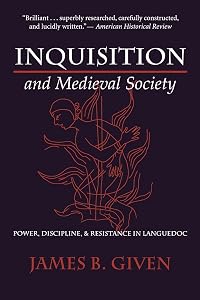
Inquisition and Medieval Society: Power, Discipline, and Resistance in Languedoc
by James B. Given
On This Page
Description
James B. Given analyzes the inquisition in one French region in order to develop a sociology of medieval politics. Established in the early thirteenth century to combat widespread popular heresy, inquisitorial tribunals identified, prosecuted, and punished heretics and their supporters. The inquisition in Languedoc was the best documented of these tribunals because the inquisitors aggressively used the developing techniques of writing and record keeping to build cases and extract show more confessions.Using a Marxist and Foucauldian approach, Given focuses on three inquiries: what techniques of investigation, interrogation, and punishment the inquisitors worked out in the course of their struggle against heresy; how the people of Languedoc responded to the activities of the inquisitors; and what aspects of social organization in Languedoc either facilitated or constrained the work of the inquisitors. Punishments not only inflicted suffering and humiliation on those condemned, he argues, but also served as theatrical instruction for the rest of society about the terrible price of transgression. Through a careful pursuit of these inquires, Given elucidates medieval society's contribution to the modern apparatus of power. show lessTags
Recommendations



















Member Reviews
INQUISITION AND MEDIEVAL SOCIETY: POWER, DISCIPLINE,
AND RESISTANCE IN LANGUEDOG
INTRODUCTION
FEW SUBJECTS OF medieval history arouse as much passion as the
inquisition of heretical depravity. Polemicists, propagandists, novelists
and historians-amateur and professional- have all tried their hands at
this topic. For several centuries monographs, treatises, diatribes, and apologies
have spilled from the presses. The 1983 edition of Vekené's Bibliotheca
bibliographica historiae Sanctae Inquisitionis, the fundamental guide to the literature of
all the inquisition, both medieval and carly modern, lists 4,808 titles.gr
The fascination of the subject for writers of all stripes has itself become the subject of
scholarly study. Edward Peters's show more Inquisition (1988) brilliantly outlines the ways in
which the history of the inquisition has been created, reshaped, reinvented, falsified,
and mythologized by generations of writers pursuing agendas that have
ranged from the scientific to the romantic and from the scholarly to the perverse
Given this abundance, the reader might well wonder what could justify yet
another work on the inquisition of the Middle Ages, especially one that restricts
itself to the region of southern France known as Languedoc. My justification for
returning to such an oft-studied subject is that it gives us an unusual opportuni-
ty to construct a case study of the sociology of medieval politics.
A CASE STUDY OF THE EXERCISE
OF MEDIEVAL POLITICAL POWER
Among the most important aspects of European history in the late Middle
Ages and the early modern period was the progressive elaboration of ever more
powerful political organizations and the development of more coherent, intru
sive, and coercive forms of governance. These phenomena have often been
discussed. Library shelves contain an imposing array of books devoted to the
histories of the proto-states of medieval Europe, to their administrative and
financial histories, and to the legal-juridical apparatuses they devised to justify
and rationalize their authority.
Yet much of this scholarship has a strangely bloodless feel to it. We know a
great deal about the ways in which medieval rulers and administrators organized
themselves, kept their records, and justified their authority to one another and to
their subjects. However, our picture of the actual process of governance in this
critical period when the first lineaments of European states were being hammered show less
AND RESISTANCE IN LANGUEDOG
INTRODUCTION
FEW SUBJECTS OF medieval history arouse as much passion as the
inquisition of heretical depravity. Polemicists, propagandists, novelists
and historians-amateur and professional- have all tried their hands at
this topic. For several centuries monographs, treatises, diatribes, and apologies
have spilled from the presses. The 1983 edition of Vekené's Bibliotheca
bibliographica historiae Sanctae Inquisitionis, the fundamental guide to the literature of
all the inquisition, both medieval and carly modern, lists 4,808 titles.gr
The fascination of the subject for writers of all stripes has itself become the subject of
scholarly study. Edward Peters's show more Inquisition (1988) brilliantly outlines the ways in
which the history of the inquisition has been created, reshaped, reinvented, falsified,
and mythologized by generations of writers pursuing agendas that have
ranged from the scientific to the romantic and from the scholarly to the perverse
Given this abundance, the reader might well wonder what could justify yet
another work on the inquisition of the Middle Ages, especially one that restricts
itself to the region of southern France known as Languedoc. My justification for
returning to such an oft-studied subject is that it gives us an unusual opportuni-
ty to construct a case study of the sociology of medieval politics.
A CASE STUDY OF THE EXERCISE
OF MEDIEVAL POLITICAL POWER
Among the most important aspects of European history in the late Middle
Ages and the early modern period was the progressive elaboration of ever more
powerful political organizations and the development of more coherent, intru
sive, and coercive forms of governance. These phenomena have often been
discussed. Library shelves contain an imposing array of books devoted to the
histories of the proto-states of medieval Europe, to their administrative and
financial histories, and to the legal-juridical apparatuses they devised to justify
and rationalize their authority.
Yet much of this scholarship has a strangely bloodless feel to it. We know a
great deal about the ways in which medieval rulers and administrators organized
themselves, kept their records, and justified their authority to one another and to
their subjects. However, our picture of the actual process of governance in this
critical period when the first lineaments of European states were being hammered show less
Apr 27, 2024Spanish
Ratings
Members
- Recently Added By
Lists


Author Information
3 Works 74 Members
Common Knowledge
- Important places
- France
Classifications
- Genres
- Nonfiction, History, Religion & Spirituality, Politics and Government, General Nonfiction
- DDC/MDS
- 272.2 — Religion History of Christianity Persecutions in church history Heretics by Inquisition for Holy Office (Since 1470)
- LCC
- BX1712 .G58 — Philosophy, Psychology and Religion Christian Denominations Christian Denominations Catholic Church History
- BISAC
Statistics
- Members
- 43
- Popularity
- 688,194
- Reviews
- 1
- Rating
- (4.50)
- Languages
- English
- Media
- Paper, Ebook
- ISBNs
- 3