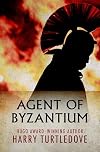
Agent of Byzantium
by Harry Turtledove
On This Page
Description
A dashing master spy takes on the enemies of the Byzantine Empire and discovers impossible inventions like gunpowder and telescopes in a magnificent romp from the maestro of alternate-history science fiction In another, very different timeline-one in which Mohammed embraced Christianity and Islam never came to be-the Byzantine Empire still flourishes in the fourteenth century, and wondrous technologies are emerging earlier than they did in our own. Having lost his family to the ravages of show more smallpox, Basil Argyros has decided to dedicate his life to Byzantium. A stalwart soldier and able secret agent, Basil serves his emperor courageously, going undercover to unearth Persia's dastardly plots and disrupting the dark machinations of his beautiful archenemy, the Persian spy Mirrane, while defusing dire threats emerging from the Western realm of the Franco-Saxons. But the world Basil so staunchly defends is changing rapidly, and he must remain ever vigilant, for in this great game of empires, the player who controls the most advanced tools and weaponry-tools like gunpowder, printing, vaccines, and telescopes-must certainly emerge victorious. A collection of interlocking stories that showcase the courage, ingenuity, and breathtaking derring-do of superspy Basil Argyros, Agent of Byzantium presents the great Harry Turtledove at his alternate-world-building best. At once intricate, exciting, witty, and wildly inventive, this is a many-faceted gem from a master of the genre. show lessTags
Recommendations























Member Reviews
Some things do not age well. I had enjoyed these stories back when originally published and decided to purchase the collection as a classic. On rereading they come off as shallow formula stories with cardboard characters. Pity. It is one of the classics of alternate history. However my taste has moved on. Then again I have soured on Turtledove over time which could be part of the problem.
E se... Maometto si fosse convertito al cristianesimo? Da questo presupposto Harry Turtledove imbastisce un'ucronia che vede un Impero Bizantino del quattordicesimo secolo ancora potenza mondiale, rivale dell'altrettanto potente Persia. In questo mondo i musulmani non esistono e Costantinopoli non ha mai conosciuto il declino che ne decretò la fine nella storia che tutti noi conosciamo.
In questa ambientazione si muove Basil Argyros, una specie di agente speciale al soldo dell'imperatore, inviato a risolvere questioni spinose e potenziali crisi.
Il fascino maggiore del romanzo è l'ambientazione. Harry Turtledove è un'esperto di storia bizantina e in questo libro infonde tutta la sua conoscenza, gioca con la storia e crea il mondo che show more probabilmente lui amerebbe. Tuttavia se come storico e ucronista Turtledove non ha pari, come narratore purtroppo resta piuttosto verboso. Fatto già dimostrato con la saga della Legione Perduta, ambientata in mondo alternativa che deve molto alle suggestioni della storia bizantina. Non ha sicuramente la verve dell'ammirato Lyon Sprague De Camp, che con il suo stupendo "Abisso del passato", ispirò non solo gli studi accademici di Turtledove, ma evidentemente anche questo romanzo.
Il romanzo è frammentario, episodico, con l'handicap particolare di narrare eventi poco interessanti e di presentare un protagonista a tratti anonimo e a tratti odioso.
L'affresco che ne risulta, però, è affascinante e vale la lettura dell'opera.
Consigliato soprattutto ai fan di Turtledove e ai lettori di ucronie. Agli altri potrebbe risultare superfluo e pedante. show less
In questa ambientazione si muove Basil Argyros, una specie di agente speciale al soldo dell'imperatore, inviato a risolvere questioni spinose e potenziali crisi.
Il fascino maggiore del romanzo è l'ambientazione. Harry Turtledove è un'esperto di storia bizantina e in questo libro infonde tutta la sua conoscenza, gioca con la storia e crea il mondo che show more probabilmente lui amerebbe. Tuttavia se come storico e ucronista Turtledove non ha pari, come narratore purtroppo resta piuttosto verboso. Fatto già dimostrato con la saga della Legione Perduta, ambientata in mondo alternativa che deve molto alle suggestioni della storia bizantina. Non ha sicuramente la verve dell'ammirato Lyon Sprague De Camp, che con il suo stupendo "Abisso del passato", ispirò non solo gli studi accademici di Turtledove, ma evidentemente anche questo romanzo.
Il romanzo è frammentario, episodico, con l'handicap particolare di narrare eventi poco interessanti e di presentare un protagonista a tratti anonimo e a tratti odioso.
L'affresco che ne risulta, però, è affascinante e vale la lettura dell'opera.
Consigliato soprattutto ai fan di Turtledove e ai lettori di ucronie. Agli altri potrebbe risultare superfluo e pedante. show less
One of my favorite Turtledove novels. It is a little less fantasy and more historical fiction, but he created a very believable Byzantium. The setting and characters are excellent. I put this up there with his early Videssos books for quality.
E se... Maometto si fosse convertito al cristianesimo? Da questo presupposto Harry Turtledove imbastisce un'ucronia che vede un Impero Bizantino del quattordicesimo secolo ancora potenza mondiale, rivale dell'altrettanto potente Persia. In questo mondo i musulmani non esistono e Costantinopoli non ha mai conosciuto il declino che ne decretò la fine nella storia che tutti noi conosciamo.
In questa ambientazione si muove Basil Argyros, una specie di agente speciale al soldo dell'imperatore, inviato a risolvere questioni spinose e potenziali crisi.
Il fascino maggiore del romanzo è l'ambientazione. Harry Turtledove è un'esperto di storia bizantina e in questo libro infonde tutta la sua conoscenza, gioca con la storia e crea il mondo che show more probabilmente lui amerebbe. Tuttavia se come storico e ucronista Turtledove non ha pari, come narratore purtroppo resta piuttosto verboso. Fatto già dimostrato con la saga della Legione Perduta, ambientata in mondo alternativa che deve molto alle suggestioni della storia bizantina. Non ha sicuramente la verve dell'ammirato Lyon Sprague De Camp, che con il suo stupendo "Abisso del passato", ispirò non solo gli studi accademici di Turtledove, ma evidentemente anche questo romanzo.
Il romanzo è frammentario, episodico, con l'handicap particolare di narrare eventi poco interessanti e di presentare un protagonista a tratti anonimo e a tratti odioso.
L'affresco che ne risulta, però, è affascinante e vale la lettura dell'opera.
Consigliato soprattutto ai fan di Turtledove e ai lettori di ucronie. Agli altri potrebbe risultare superfluo e pedante. show less
In questa ambientazione si muove Basil Argyros, una specie di agente speciale al soldo dell'imperatore, inviato a risolvere questioni spinose e potenziali crisi.
Il fascino maggiore del romanzo è l'ambientazione. Harry Turtledove è un'esperto di storia bizantina e in questo libro infonde tutta la sua conoscenza, gioca con la storia e crea il mondo che show more probabilmente lui amerebbe. Tuttavia se come storico e ucronista Turtledove non ha pari, come narratore purtroppo resta piuttosto verboso. Fatto già dimostrato con la saga della Legione Perduta, ambientata in mondo alternativa che deve molto alle suggestioni della storia bizantina. Non ha sicuramente la verve dell'ammirato Lyon Sprague De Camp, che con il suo stupendo "Abisso del passato", ispirò non solo gli studi accademici di Turtledove, ma evidentemente anche questo romanzo.
Il romanzo è frammentario, episodico, con l'handicap particolare di narrare eventi poco interessanti e di presentare un protagonista a tratti anonimo e a tratti odioso.
L'affresco che ne risulta, però, è affascinante e vale la lettura dell'opera.
Consigliato soprattutto ai fan di Turtledove e ai lettori di ucronie. Agli altri potrebbe risultare superfluo e pedante. show less
Really reverse fantasy, in that all the things that seem to have supernatural causes are really the product of new (but actual) technology. Turtledove's not much of a writer, but these stories are solidly interesting.
Harry Turtledove has a well-deserved reputation as a writer of alternate history. Here is a collection of short stories set in a medieval world where Islam never developed and the Byzantine Empire of the Justinian Age continued onward.
The stories feature Basil Argyros, a soldier and agent/spy for the Empire. During the course of his adventures, we get to explore the world as it might have been if history had taken a different course. The author's well written stories make this alternate world come alive.
Turtledove must have quite a love of the Byzantine Empire, since his Videssos fantasy series is also based on Byzantine history and culture.
The stories feature Basil Argyros, a soldier and agent/spy for the Empire. During the course of his adventures, we get to explore the world as it might have been if history had taken a different course. The author's well written stories make this alternate world come alive.
Turtledove must have quite a love of the Byzantine Empire, since his Videssos fantasy series is also based on Byzantine history and culture.
Mr. Turtledove, like Isaac Asimov, is an ideas man, not a stylist. The book is an adequate entertainment.
Members
- Recently Added By
Author Information

279+ Works 43,080 Members
Harry Turtledove was born in Los Angeles, California on June 14, 1949. He received a Ph.D. in Byzantine history from UCLA in 1977. From the late 1970's to the early 1980's, he worked as a technical writer for the Los Angeles County Office of Education. He left in 1991 to become full-time writer. His first two novels, Wereblood and Werenight, were show more published in 1979 under the pseudonym Eric G. Iverson because his editor did not think people would believe that Turtledove was his real name. He used this name until 1985 when he published Herbig-Haro and And So to Bed under his real name. He has received numerous awards including the Homer Award for Short Story for Designated Hitter in 1990, the John Esthen Cook Award for Southern Fiction for Guns of the Southand in 1993, and the Hugo Award for Novella for Down in the Bottomlands in 1994. (Bowker Author Biography) show less
Some Editions
Series
Belongs to Publisher Series
Work Relationships
Common Knowledge
- Canonical title
- Agent of Byzantium
- Alternate titles
- Isaac Asimov Presents Agent of Byzantium
- Original publication date
- 1987 (collection) (collection)
- People/Characters
- Basil Argyros
- Important places
- Constantinople, Byzantine Empire; Alexandria, Egypt
- Dedication
- For John and Steve,
who went through it with me - First words
- The steppe country north of the Danube made Basil Argyros think of the sea.
- Last words
- (Click to show. Warning: May contain spoilers.)"Well, why not?" she said.
- Blurbers
- de Camp, L. Sprague; Zelazny, Roger; Card, Orson Scott
- Original language
- English
- Disambiguation notice
- published in two distinct editions: The first edition , published in 1987 by Congdon & Weed, includes six stories: Unholy Trinity, Archetypes, The Eyes of Argos, Strange Eruptions, Images, Superwine. The second edition, publi... (show all)shed in 1994 by Baen Books, adds the story Pillar of Cloud, Pillar of Fire.
Classifications
Statistics
- Members
- 570
- Popularity
- 51,559
- Reviews
- 11
- Rating
- (3.61)
- Languages
- 6 — English, Greek, Italian, Korean, Portuguese, Spanish
- Media
- Paper, Audiobook, Ebook
- ISBNs
- 14
- ASINs
- 7