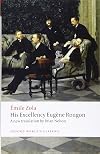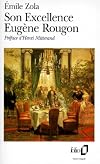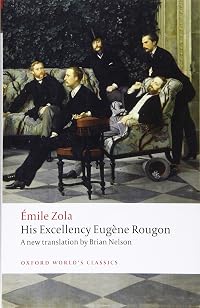
His Excellency Eugène Rougon
by Émile Zola
Les Rougon-Macquart (publication order) (6), Les Rougon-Macquart (Zola's recommended reading order) (2)
On This Page
Description
'He loved power for power's sake . . . He was without question the greatest of the Rougons.' His Excellency Eug�ne Rougon (1876) is the sixth novel in Zola's twenty-volume Rougon-Macquart cycle. A political novel set in the corridors of power and in the upper echelons of French Second Empire society, including the Imperial court, it focuses on the fluctuating fortunes of the authoritarian Eug�ne Rougon, the "vice-Emperor." But it is more than just a chronicle. It plunges the reader into show more the essential dynamics of the political: the rivalries, the scheming, the jockeying for position, the ups and downs, the play of interests, the lobbying and gossip, the patronage and string-pulling, the bribery and blackmail, and, especially, the manipulation of language for political purposes. The novel's themes--especially its treatment of political discourse--have remarkable contemporary resonance. His Excellency Eug�ne Rougon is about politics everywhere. show lessTags
Recommendations


















Member Reviews
Engrossing account of the inner functioning of a rump parliament written with a mighty, yet at times hilarious hand, by M. Emile Zola.
Written 6 years after the fall of the French Second Empire, it deciphers how such a populist assembly votes as one body on the most boring or absurd proposals of this Carnival Empire. The pump and circumstances of politics are shown with much insight and at times lampooned for the better enjoyment of the reader. Very useful book for the modern political scientist on how to interpret today's rise of populism and stolen elections across the world.
Written 6 years after the fall of the French Second Empire, it deciphers how such a populist assembly votes as one body on the most boring or absurd proposals of this Carnival Empire. The pump and circumstances of politics are shown with much insight and at times lampooned for the better enjoyment of the reader. Very useful book for the modern political scientist on how to interpret today's rise of populism and stolen elections across the world.
Eugène Rougon, the eldest son of Pierre and Félicité, was a small-town lawyer who ventured to Paris to make his fortune. In the first book of the Rougon-Macquart cycle, Eugène was a key player in the coup d'état that made Napoleon III Emperor. When this novel opens, however, Eugène's fortunes are at an ebb, and he has just resigned from his position as president of the legislature. His friends are in a tizzy, because they have been riding his coattails as he rose in power. Led by the beautiful but ambitious and manipulative, Clorinde Balbi, they begin scheming to put the "great man" back in power.
Eugène is a blunt man, the powerful fist, as opposed to his nemesis, the Count de Marsy, who is the gloved hand. Eugène is forthright show more in his desire for power and authoritarian rule. When the Emperor needs him, Eugène's fortunes rise and he has almost unlimited power, when the Emperor needs to appease the populace, Eugène is pastured until the next time he is needed. Clorinde is in some ways his mirror—bold, intelligent, and ruthless—but she is hampered from participating openly in politics due to her sex. So instead, she works in the shadows, trading sexual favors for information and deals. When Eugène spurns her advances, she begins to plot against him.
She might have liked to try and strangle him with those slender fingers of hers, but she wanted to do it properly, and the patience with which she waited for her claws to grow was itself a form of enjoyment.
Although this novel was published sixth in the cycle, Zola recommended it be read second. I procrastinated beginning it, because the idea of a political novel about a time period of which I am ignorant, seemed daunting and uninteresting. Instead, I found the novel fascinating, with vivid characters, a fast-moving plot, and enough background information provided by translator Brian Nelson, to be easily digestible. Zola's writing feels modern, and the translation is crisp. In addition, I found Eugène a sympathetic character, despite his love of power, and am curious about what his life was like outside this five year snapshot. Altogether a surprisingly pleasant read. show less
Eugène is a blunt man, the powerful fist, as opposed to his nemesis, the Count de Marsy, who is the gloved hand. Eugène is forthright show more in his desire for power and authoritarian rule. When the Emperor needs him, Eugène's fortunes rise and he has almost unlimited power, when the Emperor needs to appease the populace, Eugène is pastured until the next time he is needed. Clorinde is in some ways his mirror—bold, intelligent, and ruthless—but she is hampered from participating openly in politics due to her sex. So instead, she works in the shadows, trading sexual favors for information and deals. When Eugène spurns her advances, she begins to plot against him.
She might have liked to try and strangle him with those slender fingers of hers, but she wanted to do it properly, and the patience with which she waited for her claws to grow was itself a form of enjoyment.
Although this novel was published sixth in the cycle, Zola recommended it be read second. I procrastinated beginning it, because the idea of a political novel about a time period of which I am ignorant, seemed daunting and uninteresting. Instead, I found the novel fascinating, with vivid characters, a fast-moving plot, and enough background information provided by translator Brian Nelson, to be easily digestible. Zola's writing feels modern, and the translation is crisp. In addition, I found Eugène a sympathetic character, despite his love of power, and am curious about what his life was like outside this five year snapshot. Altogether a surprisingly pleasant read. show less
This is a sort of counterpoise to La Curée: we're back in Paris, in the second half of the 1850s, but the focus is on national rather than local politics, and the central character this time is Aristide's brother Eugène Rougon, a career politician in Napoleon III's government, with the highly desirable quality in a man of his profession that he can bounce back almost effortlessly into office from the depths of whatever scandal he lands in.
Astonishingly, for once, Zola manages to put together a plot without any doomed under-age sexual relationships in it: the main axis of erotic tension this time is between Eugène and the beautiful Clorinde, a femme fatale clawing her way up into Second Empire society from nowhere. Since they are show more both far more turned on by power than by conventional sexual allure, and neither of them wants to concede an inch to the other, their relationship is far from straightforward, but Zola wouldn't be Zola without a magnificently symbolic sex-scene, so at one point in the story they are allowed to get hands-on with a horsewhip in the riding-stables. Zola would definitely have enjoyed the possibilities of cinema.
A narrative trick that Zola re-uses from La fortune des Rougons is to tell us a lot of the story through a group of minor characters, here Eugène's hangers-on, the little people who spread propaganda on his behalf in exchange for the prospect of favours when he gets into office, in a less well regulated version of the 18th century clientage system. And of course it is usually the greed and ingratitude of these people that push him into over-reaching and get him into trouble so that he has to start clawing his way back again.
The main point of the book, though, is to show us the corrupt and hypocritical workings of government under Napoleon III: We open with the puppet Assembly of 1856, in an atmosphere of the deepest possible tedium and pointlessness, voting through a huge budget allocation for the baptismal ceremonies for the Emperor's infant son; there is more high-level royal tedium in a hunting party at Compiègne (Zola turns out to be surprisingly good at conveying boredom entertainingly); We move forward to the Orsini assassination plot of 1858, which gives Eugène another chance to come back into power, this time as the minister charged with implementing repressive anti-terrorism measures; There's a glorious set-piece cabinet meeting at which Eugène argues convincingly that only a policy of hardline repression and a climate of fear can sustain an absolutist empire in 19th century Europe - possibly Eugène is the only person in the room who misses the obvious conclusion that this is an argument against absolutism, not one in favour of repression - and then digs himself in deeper by condemning a "subversive" popular education book which - again, Zola doesn't tell us in so many words, but we can see it dawning on everyone around the table and the Emperor trying to keep a straight face - is a transparent rip-off of the Emperor's famous 1844 socialist pamphlet, Extinction du paupérisme; And we close with another, far less tedious but equally pointless, session of the Assembly, in which the Bonapartist delegates get to shout insults at the tiny Opposition group who are attempting to point out the hollowness of the 1861 reforms. And who is the government spokesman? None other than our old friend E. Rougon... show less
Astonishingly, for once, Zola manages to put together a plot without any doomed under-age sexual relationships in it: the main axis of erotic tension this time is between Eugène and the beautiful Clorinde, a femme fatale clawing her way up into Second Empire society from nowhere. Since they are show more both far more turned on by power than by conventional sexual allure, and neither of them wants to concede an inch to the other, their relationship is far from straightforward, but Zola wouldn't be Zola without a magnificently symbolic sex-scene, so at one point in the story they are allowed to get hands-on with a horsewhip in the riding-stables. Zola would definitely have enjoyed the possibilities of cinema.
A narrative trick that Zola re-uses from La fortune des Rougons is to tell us a lot of the story through a group of minor characters, here Eugène's hangers-on, the little people who spread propaganda on his behalf in exchange for the prospect of favours when he gets into office, in a less well regulated version of the 18th century clientage system. And of course it is usually the greed and ingratitude of these people that push him into over-reaching and get him into trouble so that he has to start clawing his way back again.
The main point of the book, though, is to show us the corrupt and hypocritical workings of government under Napoleon III: We open with the puppet Assembly of 1856, in an atmosphere of the deepest possible tedium and pointlessness, voting through a huge budget allocation for the baptismal ceremonies for the Emperor's infant son; there is more high-level royal tedium in a hunting party at Compiègne (Zola turns out to be surprisingly good at conveying boredom entertainingly); We move forward to the Orsini assassination plot of 1858, which gives Eugène another chance to come back into power, this time as the minister charged with implementing repressive anti-terrorism measures; There's a glorious set-piece cabinet meeting at which Eugène argues convincingly that only a policy of hardline repression and a climate of fear can sustain an absolutist empire in 19th century Europe - possibly Eugène is the only person in the room who misses the obvious conclusion that this is an argument against absolutism, not one in favour of repression - and then digs himself in deeper by condemning a "subversive" popular education book which - again, Zola doesn't tell us in so many words, but we can see it dawning on everyone around the table and the Emperor trying to keep a straight face - is a transparent rip-off of the Emperor's famous 1844 socialist pamphlet, Extinction du paupérisme; And we close with another, far less tedious but equally pointless, session of the Assembly, in which the Bonapartist delegates get to shout insults at the tiny Opposition group who are attempting to point out the hollowness of the 1861 reforms. And who is the government spokesman? None other than our old friend E. Rougon... show less
"Good citizens may be reassured; bad citizens alone may tremble."
Zola's Rougon-Macquart cycle follows several branches of a family over the 20 years of France's Second Empire, from 1851 to the early 1870s, and is one of the true delights of naturalist French literature. His Excellency is perhaps one of the lesser novels in the series, if only because it relies heavily on historical knowledge and a roman a clef approach to its characters, but its exploration of politics near the top of the food chain rings alarmingly true today.
Eugene Rougon, mover and shaker in the court of Napoleon III, experiences a political rollercoaster over the course of several years, battered against the tides of public opinion, private malice, and personal show more gain. The engaging character of Clorinde is a highlight, and Zola's use of symbolism remains sublime, from a charity auction where men are bidding literally for toothpicks (more for social recognition than compassion for charity) to dogs, foaming at the mouth as they tear apart the corpse of a stag, perfectly juxtaposed with the would-be aristocrats eager to pounce on anyone whose social persona betrays even the slightest weakness.
"I became what I am with the Empire. I made the Empire, and the Empire made me."
What the novel does best is what Zola does best in general: examining how each individual person's fears, foibles and needs contribute to a society in decline, even when no-one can be specifically blamed for the overall problem. The pack mentality alluded to by the canine symbolism reveals the true tragedy of all imperial and fascist regimes: most people would be better off without them, but most people are only able to act for their own gain, or the gain of those in their immediate sphere, and so widespread change is hindered at every turn.
The final pages especially - Eugene Rougon's stinging affirmation of the Empire - are a masterclass in political writing, and remind us (if we need it, at this point) how close 1858 is to 2018. show less
Zola's Rougon-Macquart cycle follows several branches of a family over the 20 years of France's Second Empire, from 1851 to the early 1870s, and is one of the true delights of naturalist French literature. His Excellency is perhaps one of the lesser novels in the series, if only because it relies heavily on historical knowledge and a roman a clef approach to its characters, but its exploration of politics near the top of the food chain rings alarmingly true today.
Eugene Rougon, mover and shaker in the court of Napoleon III, experiences a political rollercoaster over the course of several years, battered against the tides of public opinion, private malice, and personal show more gain. The engaging character of Clorinde is a highlight, and Zola's use of symbolism remains sublime, from a charity auction where men are bidding literally for toothpicks (more for social recognition than compassion for charity) to dogs, foaming at the mouth as they tear apart the corpse of a stag, perfectly juxtaposed with the would-be aristocrats eager to pounce on anyone whose social persona betrays even the slightest weakness.
"I became what I am with the Empire. I made the Empire, and the Empire made me."
What the novel does best is what Zola does best in general: examining how each individual person's fears, foibles and needs contribute to a society in decline, even when no-one can be specifically blamed for the overall problem. The pack mentality alluded to by the canine symbolism reveals the true tragedy of all imperial and fascist regimes: most people would be better off without them, but most people are only able to act for their own gain, or the gain of those in their immediate sphere, and so widespread change is hindered at every turn.
The final pages especially - Eugene Rougon's stinging affirmation of the Empire - are a masterclass in political writing, and remind us (if we need it, at this point) how close 1858 is to 2018. show less
This is the second volume in Zola's sweeping Rougon-Macquart cycle. This is rather different from its predecessor The Fortune of the Rougons. It is really a political study of the rise and fall and partial rise of the title character under the rule of Emperor Napoleon III. It contains a lot of wry observations about political patronage and the mutual dependency between patrons and clients, still very relevant today. The characters are generally based on amalgamations of real historical personages during the early rule of the Emperor, and the events depicted closely mirror reality, according to the translator's preface in this Delphi ebook version. That said, I did find the narrative dragged in places and I found myself skimming show more considerable chunks, and, while it's cleverly constructed, I can't say I really enjoyed it as a novel. show less
The second book in Zola's Rougon-Macquart series (based on the order recommended by Zola) and another kind of "meh" book for me. I'm glad I know that I absolutely love his later work, or I'm not sure I'd keep going.
Eugene Rougon is all about power. As France itself has power shifts, Rougon's power ebbs and flows as well. Most of the book is about political machinations, and people trying to use others to further themselves. There is one very memorable character, Clorinde. Clorinde is a young woman who has positioned herself to be around powerful men and to be admired by them. Her ambitions are high and she intends to attain them. As with many of Zola's characters, especially the women, she has plenty of quirks to make her memorable and show more special.
This book was fine, but it never grabbed me and didn't have the shock value that I have come to expect and love from Zola. show less
Eugene Rougon is all about power. As France itself has power shifts, Rougon's power ebbs and flows as well. Most of the book is about political machinations, and people trying to use others to further themselves. There is one very memorable character, Clorinde. Clorinde is a young woman who has positioned herself to be around powerful men and to be admired by them. Her ambitions are high and she intends to attain them. As with many of Zola's characters, especially the women, she has plenty of quirks to make her memorable and show more special.
This book was fine, but it never grabbed me and didn't have the shock value that I have come to expect and love from Zola. show less
Politicians and men are different species…
' Yes, beware of women,' Rougon repeated, pausing after each word so as to glance at his papers. ' When a woman does not put a crown on your head she slips a halter round your neck. At our age a man's heart wants as carefully looking after as his stomach.'
(Kindle Locations 710-712)
Then JM. Kahn, gazing blankly into the distance, murmured as though he were speaking to himself : ' A man knows when he falls, but never knows whether he will rise again.'
(Kindle Locations 1053-1055)
Rougon, for his part, sat back and gazed at Clorinde, and gradually fell into a dreamy state in which the girl seemed to him to expand into gigantic proportions. A woman was certainly a wonderful piece of mechanism, he show more reflected. It was a matter that he had never before thought of studying; but now he began to have vague mental glimpses of extraordinary intricacies. For a moment he was filled with a distinct consciousness of the power of those bare shoulders, which seemed strong enough to shake a world.
(Kindle Locations 1365-1368)
The great man had never before tasted such complete contentment. He felt well and strong, and was putting on flesh. Health had come back to him with his return to power.
(Kindle Locations 4509-4510)
They had thronged around him, hung on to his knees, then to his breast, then to his throat, and finally they had choked him. They had availed themselves of him in every way. They had used his feet to climb with, his hands to plunder with, his jaws to devour with. They had, so to say, used his body as their own, used it for their personal gratification, indulging in every fancy without a thought of the morrow. And now, having drained his body, and hearing its frame-work crack, they abandoned him like rats, whom instinct warns of the approaching collapse of a house, the foundations of which they have undermined.
(Kindle Locations 7197-7202)
' Ah ! ' said she (Clorinde), 'in spite of everything, you (Rougon) are a wonderfully able fellow !'
(Kindle Location 7721) show less
' Yes, beware of women,' Rougon repeated, pausing after each word so as to glance at his papers. ' When a woman does not put a crown on your head she slips a halter round your neck. At our age a man's heart wants as carefully looking after as his stomach.'
(Kindle Locations 710-712)
Then JM. Kahn, gazing blankly into the distance, murmured as though he were speaking to himself : ' A man knows when he falls, but never knows whether he will rise again.'
(Kindle Locations 1053-1055)
Rougon, for his part, sat back and gazed at Clorinde, and gradually fell into a dreamy state in which the girl seemed to him to expand into gigantic proportions. A woman was certainly a wonderful piece of mechanism, he show more reflected. It was a matter that he had never before thought of studying; but now he began to have vague mental glimpses of extraordinary intricacies. For a moment he was filled with a distinct consciousness of the power of those bare shoulders, which seemed strong enough to shake a world.
(Kindle Locations 1365-1368)
The great man had never before tasted such complete contentment. He felt well and strong, and was putting on flesh. Health had come back to him with his return to power.
(Kindle Locations 4509-4510)
They had thronged around him, hung on to his knees, then to his breast, then to his throat, and finally they had choked him. They had availed themselves of him in every way. They had used his feet to climb with, his hands to plunder with, his jaws to devour with. They had, so to say, used his body as their own, used it for their personal gratification, indulging in every fancy without a thought of the morrow. And now, having drained his body, and hearing its frame-work crack, they abandoned him like rats, whom instinct warns of the approaching collapse of a house, the foundations of which they have undermined.
(Kindle Locations 7197-7202)
' Ah ! ' said she (Clorinde), 'in spite of everything, you (Rougon) are a wonderfully able fellow !'
(Kindle Location 7721) show less
Members
- Recently Added By
Lists

Vine Reads
60 works; 1 member
Talk Discussions
Past Discussions
November 2024 His Excellency, Eugene Rougon Preface, Ch 1-3 in Emile Zola Group Read (January 2025)
His Excellency Eugene Rougon by Zola in Author Theme Reads (January 2013)
Author Information

703+ Works 35,850 Members
Zola was the spokesperson for the naturalist novel in France and the leader of a school that championed the infusion of literature with new scientific theories of human development drawn from Charles Darwin (see Vol. 5) and various social philosophers. The theoretical claims for such an approach, which are considered simplistic today, were show more outlined by Zola in his Le Roman Experimental (The Experimental Novel, 1880). He was the author of the series of 20 novels called The Rougon-Macquart, in which he attempted to trace scientifically the effects of heredity through five generations of the Rougon and Macquart families. Three of the outstanding volumes are L'Assommoir (1877), a study of alcoholism and the working class; Nana (1880), a story of a prostitute who is a femme fatale; and Germinal (1885), a study of a strike at a coal mine. All gave scope to Zola's gift for portraying crowds in turmoil. Today Zola's novels have been appreciated by critics for their epic scope and their visionary and mythical qualities. He continues to be immensely popular with French readers. His newspaper article "J'Accuse," written in defense of Alfred Dreyfus, launched Zola into the public limelight and made him the political conscience of his country. (Bowker Author Biography) show less
Some Editions
Series

Les Rougon-Macquart (publication order)
21 works (6)

Les Rougon-Macquart (Zola's recommended reading order)
20 works (2)
Belongs to Publisher Series
Work Relationships
Is contained in
Common Knowledge
- Canonical title
- His Excellency Eugène Rougon
- Original title
- Son excellence Eugène Rougon
- Alternate titles
- His Excellency
- Original publication date
- 1876
- People/Characters
- Eugene Rougon
- Important places
- Paris, France
- First words
- The President of the Chamber remained standing until the faint stir caused by his entry subsided.
- Last words
- (Click to show. Warning: May contain spoilers.)"I must say you're very impressive, you know!"
- Original language
- French
Classifications
Statistics
- Members
- 392
- Popularity
- 79,459
- Reviews
- 15
- Rating
- (3.67)
- Languages
- 8 — Dutch, English, French, German, Hungarian, Italian, Spanish, Swedish
- Media
- Paper, Audiobook, Ebook
- ISBNs
- 45
- ASINs
- 26