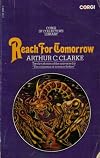
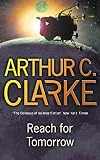
Reach for Tomorrow
by Arthur C. Clarke
On This Page
Description
This collection of short stories brings numerous lesser-known works from the world's foremost master of science fiction together for the first time. Reach for Tomorrow includes twelve highly memorable stories. Included is "Rescue Party," a short story that may have served as an origin story for the renowned Rama series. As a cross-section of Clarke's work, Reach For Tomorrow is astonishingly diverse. Readers will find tales ranging in scope from the time of the dinosaurs to the unimaginably show more distant future; locations as far-flung as distant galaxies and as close as London; and voyages to the center of the earth and beyond the stars. It's a fun and fascinating read for any fan of Clarke or science fiction in general. show lessTags
Recommendations












Member Recommendations
Member Reviews
This is an early collection of Clarke's stories published from 1946 to 1953. The opening story is not just his first sale but the most famous--"Rescue Party." In the Preface Clarke writes "a depressing number of people still consider it my best." I'd rate other Clarke short stories higher, but I'd still rate this one high--it's my favorite of this collection. Partly for it's double twist--but also because it epitomizes so much I've found in Clarke--the optimism about humanity. Surprisingly it's one of the few upbeat stories here, most of which, despite scientific rather than supernatural underpinnings, could be classified as horror. Certainly that's true of "A Walk in the Dark" a fine work of suspense with a twist that has the irony of show more a Saki story. It's true as well of "The Parasite," with its well-drawn characters and psychological insight. "Jupiter Five" epitomizes another side of Clarke, and is another favorite out of the collection, even if I agree with the reviewer that called the ending disappointing--the awe of enormous scale--in time, space. Another strong candidate for best of the collection is "Trouble with the Natives." This isn't simply one of the few upbeat stories, it's funny! Clarke's aliens remind me of Rowling's wizards among the Muggles. I enjoyed it from amusing beginning to the twist in the tale.
Clarke in his Preface claims for science fiction that when done well at the very least it should satisfy like a "good puzzle"and be "enjoyable and entertaining." Even if few in this collection are stories I'd pluck from here to put in a collection of Clarke's best (and at his best Clarke is one of the great science fiction short story writers) at the very least, all the stories here can claim they're enjoyable and entertaining--and some are more than that. show less
Clarke in his Preface claims for science fiction that when done well at the very least it should satisfy like a "good puzzle"and be "enjoyable and entertaining." Even if few in this collection are stories I'd pluck from here to put in a collection of Clarke's best (and at his best Clarke is one of the great science fiction short story writers) at the very least, all the stories here can claim they're enjoyable and entertaining--and some are more than that. show less
http://nhw.livejournal.com/376820.html
A dozen vintage Clarke short stories from the early years of his career (1945-1953). More than half I already knew - I see that "A Walk in the Dark", "Rescue Party", "The Curse", and "The Possessed" were also in The Nine Billion Names of God, and "Trouble with the Natives", "The Forgotten Enemy" and "The Fires Within" are in Of Time and Stars, of which I still have a battered Puffin copy. Oddly, "A Walk in the Dark", "Rescue Party", and "The Possessed" are rather weak stories to have been collected twice; all three of them basically long set-ups for a rather trivial punchline ("It's in front of you!" "Humans are smarter than you think!" and "Lemmings!"). "The Curse" works rather better, partly show more because the punchline is tragic rather than funny, but mainly because it is much shorter.
"Trouble with the Natives" is sheer slapstick, but I've always liked it. "The Fires Within" is another favourite of mine which manages the twist of perception while maintaining the tone of sinister tragedy well. "The Forgotten Enemy" I've always felt is over-rated; scientifically (as Clarke admits in the prologue) it's a bit implausible, and the enemy turns out to be one that you can literally walk away from; I don't feel the denouement satisfies the build-up.
The five new stories for me were "Technical Error", an entertaining engineering story with a Fourth Dimension twist; "The Parasite", a rather unsuccessful attempt at time-travelling horror; "The Awakening", a brief but effective Sleeper Outlives Humanity story (though this has been done better since by others, eg Zelazny's "Go Starless in the Night"); "Jupiter Five", an early attempt at the themes later more successfully developed in Rendezvous With Rama which unfortunately falls a bit flat in its characterisation; and my personal favourite of the bunch, "Time's Arrow", which brings paleontologists and time-travelling physicists together - and although I saw the punchline coming from miles away, I still thought it was carried off well. show less
A dozen vintage Clarke short stories from the early years of his career (1945-1953). More than half I already knew - I see that "A Walk in the Dark", "Rescue Party", "The Curse", and "The Possessed" were also in The Nine Billion Names of God, and "Trouble with the Natives", "The Forgotten Enemy" and "The Fires Within" are in Of Time and Stars, of which I still have a battered Puffin copy. Oddly, "A Walk in the Dark", "Rescue Party", and "The Possessed" are rather weak stories to have been collected twice; all three of them basically long set-ups for a rather trivial punchline ("It's in front of you!" "Humans are smarter than you think!" and "Lemmings!"). "The Curse" works rather better, partly show more because the punchline is tragic rather than funny, but mainly because it is much shorter.
"Trouble with the Natives" is sheer slapstick, but I've always liked it. "The Fires Within" is another favourite of mine which manages the twist of perception while maintaining the tone of sinister tragedy well. "The Forgotten Enemy" I've always felt is over-rated; scientifically (as Clarke admits in the prologue) it's a bit implausible, and the enemy turns out to be one that you can literally walk away from; I don't feel the denouement satisfies the build-up.
The five new stories for me were "Technical Error", an entertaining engineering story with a Fourth Dimension twist; "The Parasite", a rather unsuccessful attempt at time-travelling horror; "The Awakening", a brief but effective Sleeper Outlives Humanity story (though this has been done better since by others, eg Zelazny's "Go Starless in the Night"); "Jupiter Five", an early attempt at the themes later more successfully developed in Rendezvous With Rama which unfortunately falls a bit flat in its characterisation; and my personal favourite of the bunch, "Time's Arrow", which brings paleontologists and time-travelling physicists together - and although I saw the punchline coming from miles away, I still thought it was carried off well. show less
This collection of a dozen of Clarke's early short stories is a bit of a mixed bag. The best of them are thought provoking but none of them do much to develop empathy for the characters and none of them could really by called compelling. Many of these stories are more about revealing a clever scientific concept than storytelling. My favorites were "Rescue Party" (Clarke's first published story, about alien starfarers who explore an about to be destroyed Earth), "A Walk in the Dark" (a story about a man walking through a pitch black alien landscape wondering whether something is going to get him), and "Trouble With the Natives" (a reasonably humorous first contact story). “Jupiter Five” could be seen as an early take on ideas that show more would be much more fully developed in Rendezvous with Rama. show less
I don't think I've ever sat down and read a collection of short stories cover to cover before. Usually I am the type to read a few of the stories here or there between novels and epic 12 book series (uggg). I was wandering through a thrift store when I came across this book longing for something short and easy. I was not disappointed.
I think it would be silly to compare Clarke's short stories to his novels, although it is interesting to note that his most famous novel
[b:2001: A Space Odyssey|70535|2001 A Space Odyssey|Arthur C. Clarke|http://photo.goodreads.com/books/1170735590s/70535.jpg|208362], was based an a short story of his (the sentinel). This collection offers a mixed bag of tales. That was a strong point for me, several of show more the stories are fairly shocking, often ending in a cliffhanger, while others were well rounded and easy going. Because of this I was never able to know what to expect. After a few stories I expected everything to be wrought with tragedy, only to be greeted by endings where everyone hugs and gets home safe, no worse for wear. My favorites were "Jupiter Five" and "The Parasite", both of which I could see made into spectacular sci-fi novels. I think it's a good sign when a bit of science fiction leaves you begging for more. Oddly enough I really enjoyed the little preface in the beginning, mainly because I love little peeks into the authors process and opinions of their own work. If I were to pick one story I did not enjoy I would lean towards the curse, which seemed a bit too melodramatic for me (then again it's not 1956 anymore). Overall a nice read for the sci-fi buff.
Attribution: http://gestclarinetist.wordpress.com/2010/05/31/reach-for-tomorrow-arthur-c-clar... show less
I think it would be silly to compare Clarke's short stories to his novels, although it is interesting to note that his most famous novel
[b:2001: A Space Odyssey|70535|2001 A Space Odyssey|Arthur C. Clarke|http://photo.goodreads.com/books/1170735590s/70535.jpg|208362], was based an a short story of his (the sentinel). This collection offers a mixed bag of tales. That was a strong point for me, several of show more the stories are fairly shocking, often ending in a cliffhanger, while others were well rounded and easy going. Because of this I was never able to know what to expect. After a few stories I expected everything to be wrought with tragedy, only to be greeted by endings where everyone hugs and gets home safe, no worse for wear. My favorites were "Jupiter Five" and "The Parasite", both of which I could see made into spectacular sci-fi novels. I think it's a good sign when a bit of science fiction leaves you begging for more. Oddly enough I really enjoyed the little preface in the beginning, mainly because I love little peeks into the authors process and opinions of their own work. If I were to pick one story I did not enjoy I would lean towards the curse, which seemed a bit too melodramatic for me (then again it's not 1956 anymore). Overall a nice read for the sci-fi buff.
Attribution: http://gestclarinetist.wordpress.com/2010/05/31/reach-for-tomorrow-arthur-c-clar... show less
Reach for Tomorrow is a collection of Arthur C. Clarke short stories culled from various sources. Overall, most stories are enjoyable but forgettable. There are some gems, however.
A Walk in the Dark: On a planet with no indigenous life, a man makes his way alone along a trail in the middle of the night to reach a spaceport. His head is filled with stories of nocturnal monsters that roam the barren lands. During his walk, fear and logic battle it out in his mind. Clarke maintains tension well with absolutely no dialogue.
Technical Error: A technician at a power plant is accidentally exposed to several gigawatts of power. When he awakens, his entire physiology and certain mental abilities are found to be the exact reverse of normal! As show more his body begins to shut down, the scientists theorize a course of action to save not only the man's life, but also avoid trouble for the corporation...
Trouble with the Natives: Two well-intentioned, but slightly misinformed aliens with no fashion sense are sent to Earth to meet with our leaders. They encounter several different people who test their understanding of the human race--until they land in jail...
Time's Arrow: While on a dig, a group of archaeologists become curious about a research facility just over the hill. After their professor meets with one of the physicists there, he learns of a startling new experiment but is sworn to secrecy. His two assistants begin speculating and end up figuring out the nature of the experiment, a little too late for the professor and the physicist.
Jupiter 5: A team of scientists venture to the moons of Jupiter to explore the smallest of them, which turns out not to be a moon at all but the key to understanding a mysterious civilization that perished on Mars eons ago. show less
A Walk in the Dark: On a planet with no indigenous life, a man makes his way alone along a trail in the middle of the night to reach a spaceport. His head is filled with stories of nocturnal monsters that roam the barren lands. During his walk, fear and logic battle it out in his mind. Clarke maintains tension well with absolutely no dialogue.
Technical Error: A technician at a power plant is accidentally exposed to several gigawatts of power. When he awakens, his entire physiology and certain mental abilities are found to be the exact reverse of normal! As show more his body begins to shut down, the scientists theorize a course of action to save not only the man's life, but also avoid trouble for the corporation...
Trouble with the Natives: Two well-intentioned, but slightly misinformed aliens with no fashion sense are sent to Earth to meet with our leaders. They encounter several different people who test their understanding of the human race--until they land in jail...
Time's Arrow: While on a dig, a group of archaeologists become curious about a research facility just over the hill. After their professor meets with one of the physicists there, he learns of a startling new experiment but is sworn to secrecy. His two assistants begin speculating and end up figuring out the nature of the experiment, a little too late for the professor and the physicist.
Jupiter 5: A team of scientists venture to the moons of Jupiter to explore the smallest of them, which turns out not to be a moon at all but the key to understanding a mysterious civilization that perished on Mars eons ago. show less
Reach for Tomorrow is a compilation of 12 short stories by Arthur C. Clarke which were written between 1946 and 1953. Each is equally enjoyable and different. Each shows a different vision of the future, the past, the possibilities as we travel through the solar system and beyond. It's a great book to keep in your bag, glove box or where ever you keep a small book for quick reads as you wait in line or just need something to "kill time" other than scrolling through your phone!
Clarke seems obsessed with the rise and fall of civilizations.
Members
- Recently Added By
Lists

The Short Story Collections of Arthur C. Clarke
10 works; 1 member
Author Information

862+ Works 130,030 Members
Arthur C. Clarke was born in Minehead, Somerset, England, on December 16, 1917. During World War II, he served as a radar specialist in the RAF. His first published piece of fiction was Rescue Party and appeared in Astounding Science, May 1946. He graduated from King's College in London with honors in physics and mathematics, and worked in show more scientific research before turning his attention to writing fiction. His first book, Prelude to Space, was published in 1951. He is best known for his book 2001: A Space Odyssey, which was later turned into a highly successful and controversial film under the direction of Stanley Kubrick. His other works include Childhood's End, Rendezvous with Rama, The Garden of Rama, The Snows of Olympus, 2010: A Space Odyssey II, 2062: Odyssey III, and 3001: The Final Odyssey. During his lifetime, he received at least three Hugo Awards and two Nebula Awards. He died of heart failure on March 19, 2008 at the age of 90. (Bowker Author Biography) show less
Some Editions
Series
Belongs to Publisher Series
Work Relationships
Contains
Common Knowledge
- Canonical title
- Reach for Tomorrow
- Original title
- Reach for Tomorrow
- Alternate titles
- Demain, moisson d'étoiles
- Original publication date
- 1956 (Collection) (Collection); 1951 (The Awakening) (The Awakening); 1952 (The Curse) (The Curse); 1949 (The Fires Within) (The Fires Within); 1953 (The Forgotten Enemy) (The Forgotten Enemy); 1953 (Jupiter Five) (Jupiter Five) (show all 13); 1953 (The Parasite) (The Parasite); 1952 (The Possessed) (The Possessed); 1946 (Rescue Party) (Rescue Party); 1950 (Technical Error) (Technical Error); 1952 (Time's Arrow) (Time's Arrow); 1951 (Trouble with the Natives) (Trouble with the Natives); 1950 (A Walk in the Dark) (A Walk in the Dark)
- Dedication
- To Scott Meredith for selling all these stories at least once.
- Original language
- English
Classifications
Statistics
- Members
- 982
- Popularity
- 26,628
- Reviews
- 16
- Rating
- (3.66)
- Languages
- English, French, German, Spanish
- Media
- Paper, Ebook
- ISBNs
- 26
- ASINs
- 29