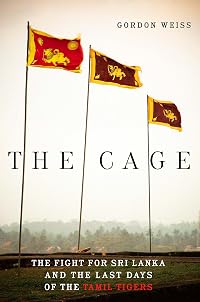
The Cage: The Fight for Sri Lanka and the Last Days of the Tamil Tigers
by Gordon Weiss
On This Page
Description
An incisive first account of the formation, history, and bloody dissolution of the rebel Tamil Tigers in Sri Lanka.Tags
Recommendations


Member Recommendations

Member Reviews
I came to this book with a set of vague impressions--that the Tamil Tigers were a vicious crew of killers but nevertheless not comparable to al-Qaeda and that ilk--rebels, not terrorists; that my love for MIA, b. Maya Arulpragasam, father a cadre of EROS, the Eelam Revolutionary Organsation of Students, might be romanticizing or exoticiing (= romoticizing) my judgment a little; that I was pretty sure some baaaad shit went down on that emerald isle in the spring of 2009, and maybe the Tigers were responsible but they sure didn't come out of it looking like winners. Gordon Weiss, who spent years in Sri Lanka as a journalist and then as UN spokesguy, used all his briefing-writing powers to give me what I wanted--a brief (230-page), show more well-supported (the whole book, including preface, maps, pictures, glossary, list of acronyms, timeline, dramatis personae, notes, bibliography, and index, is more like 360 pages) account of the almost casual way in which things so often fall apart when they're gonna fall all the way; the "paranoia of a society deranged by war psychosis"; and the final atrocity that played out on the sand spit that became known as "the Cage."
I learned a lot of stuff about how the aforesaid paranoia is indistinguishable from megalomania, with Sri Lankan government officials routinely issuing absurd pronouncements treating the UN and the Red Cross as little more than Tiget fronts; about how capriciously the ethnic genie was let out of the bottle, with racial laws passed eagerly by multiple governments for short-lived political advantage or the ability to prosecute a war "more effectively" that instead grew with every new unjust decree; the power of the terrorist bugbear to prevent Western governments in that apocalyptic decade just past from seeing with their eyes what was going on; the absolutely fucked-up nature of the things that happened to Lankan society, with kangaroo courts beginning by reading out the addresses of the families of all the witnesses, laws saying anyone who had any interaction with any Tiger, even unknowingly, could be imprisoned indefinitely, and a law enforcement establishment that treated any Tamil as a Tiger; one domination-minded family that now controls 70% of the country's finances (!) and has legislated itself into power basically until the system crumbles, using the rebels as a pretext. Weiss has an exceptional ability to express things pithily not only from the perspectives of the prime actors, stepping out of the Western lens and helping his audience see their leaders and their practices as Otherly--"the country's readiness to play the rogue nation card and to court support from Iran, among others, provoked timidity from a group of influential nations traditionally far more assertive regarding morality in foreign policy"--but also from that of the suffering people, many of whose individual stories are here, and heart breaking.
Most importantly, I learned that Mahinda and Gotabaya Rajapaksa, aided by thousands of Sinhalese with varying degrees of culpability, bottled their enemies up in a little package of land smaller than Vancouver's Stanley Park along with 330,000 civilians and then bombed and blasted them indiscriminately until tens of thousands were dead, more willing to kill Tamils seemingly indefinitely than let the adversaries escape again.
Some people will read that and words like "bleeding heart" will arise in their rage brains and they will say things like war is war and they were terrists and it worked dinnit but this is a good litmus baseline for that kind of talk, because Weiss only implicitly says this is an elected government and it should be better than a terrorist organization--in fact, he elaborately acknowledges the Sri Lankan govenrment's right to defend its territory even at the cost of some undefined degree of oppression of its own people. What he does say is even if we can't expect them to be better, we shouldn't expect them to be ten times worse. The Tigers were holding people hostage and killing them to the tune of thousands with their li'l guns, so the government took a leaf from somekind of ultraviolent comicplaybook and said U TTHINK WE GIVE A FUCK and killed the hostages themselves, ten times faster, just so Prabhakaran and his cronies would shit themselves. So evil!
And that's not even taking into account the fact that they had already won, that it was more and more a mopping up operation, only the mop was second-hand Chinese artillery. This isn't Israel--it's Israel with even more of the moral ambiguity removed; it's Somalia but not in the facilitating context of the total breakdown of civil society, Syria but with everybody in Colombo still going about their lives and graduating from law school. This is an important book because we don't know what happened there, we have a vague sad concern, but we are easily distracted. This is testimony, and it doesn't make us any better but it still means something that we hear it.
From a military or a, like, insurgency perspective, too, this is a primer on the risks of trying to operate as a traditional army, let alone a traditional country. The Tigers were the best there was at what they did and for thirty years they were unbeatable--melting into shadows, 'ssassinatin' political leaders, maintaining a whole clandestine and legit economy across the globe, and a merchant marine, and an air force! And they were so good that ten years ago they had basically won--Eelam was baasically a country, and they were even providing basic services! Magnificent. But then you go from being able to melt into shadows to having to go to your office and, like, read a budget proposal, not to mention provide peace for a ppulation that has suffered long, and that's when the much larger nation to the south totally dedicated to your destruction gets the chance to strike with its traditional army, and you're on their turf now, and it DOES NOT go well. It's like, the Tamil Tigers were Gozer and they had to draw him into a physical host to destroy him. But like, not evil Gozer. Well, yes, evil Gozer, but the Ghostbusters in this case are even worse. Look, this was a tragedy and the perpetrators got away Sinhal free and not all my offensive metaphorizing will change that. show less
I learned a lot of stuff about how the aforesaid paranoia is indistinguishable from megalomania, with Sri Lankan government officials routinely issuing absurd pronouncements treating the UN and the Red Cross as little more than Tiget fronts; about how capriciously the ethnic genie was let out of the bottle, with racial laws passed eagerly by multiple governments for short-lived political advantage or the ability to prosecute a war "more effectively" that instead grew with every new unjust decree; the power of the terrorist bugbear to prevent Western governments in that apocalyptic decade just past from seeing with their eyes what was going on; the absolutely fucked-up nature of the things that happened to Lankan society, with kangaroo courts beginning by reading out the addresses of the families of all the witnesses, laws saying anyone who had any interaction with any Tiger, even unknowingly, could be imprisoned indefinitely, and a law enforcement establishment that treated any Tamil as a Tiger; one domination-minded family that now controls 70% of the country's finances (!) and has legislated itself into power basically until the system crumbles, using the rebels as a pretext. Weiss has an exceptional ability to express things pithily not only from the perspectives of the prime actors, stepping out of the Western lens and helping his audience see their leaders and their practices as Otherly--"the country's readiness to play the rogue nation card and to court support from Iran, among others, provoked timidity from a group of influential nations traditionally far more assertive regarding morality in foreign policy"--but also from that of the suffering people, many of whose individual stories are here, and heart breaking.
Most importantly, I learned that Mahinda and Gotabaya Rajapaksa, aided by thousands of Sinhalese with varying degrees of culpability, bottled their enemies up in a little package of land smaller than Vancouver's Stanley Park along with 330,000 civilians and then bombed and blasted them indiscriminately until tens of thousands were dead, more willing to kill Tamils seemingly indefinitely than let the adversaries escape again.
Some people will read that and words like "bleeding heart" will arise in their rage brains and they will say things like war is war and they were terrists and it worked dinnit but this is a good litmus baseline for that kind of talk, because Weiss only implicitly says this is an elected government and it should be better than a terrorist organization--in fact, he elaborately acknowledges the Sri Lankan govenrment's right to defend its territory even at the cost of some undefined degree of oppression of its own people. What he does say is even if we can't expect them to be better, we shouldn't expect them to be ten times worse. The Tigers were holding people hostage and killing them to the tune of thousands with their li'l guns, so the government took a leaf from somekind of ultraviolent comicplaybook and said U TTHINK WE GIVE A FUCK and killed the hostages themselves, ten times faster, just so Prabhakaran and his cronies would shit themselves. So evil!
And that's not even taking into account the fact that they had already won, that it was more and more a mopping up operation, only the mop was second-hand Chinese artillery. This isn't Israel--it's Israel with even more of the moral ambiguity removed; it's Somalia but not in the facilitating context of the total breakdown of civil society, Syria but with everybody in Colombo still going about their lives and graduating from law school. This is an important book because we don't know what happened there, we have a vague sad concern, but we are easily distracted. This is testimony, and it doesn't make us any better but it still means something that we hear it.
From a military or a, like, insurgency perspective, too, this is a primer on the risks of trying to operate as a traditional army, let alone a traditional country. The Tigers were the best there was at what they did and for thirty years they were unbeatable--melting into shadows, 'ssassinatin' political leaders, maintaining a whole clandestine and legit economy across the globe, and a merchant marine, and an air force! And they were so good that ten years ago they had basically won--Eelam was baasically a country, and they were even providing basic services! Magnificent. But then you go from being able to melt into shadows to having to go to your office and, like, read a budget proposal, not to mention provide peace for a ppulation that has suffered long, and that's when the much larger nation to the south totally dedicated to your destruction gets the chance to strike with its traditional army, and you're on their turf now, and it DOES NOT go well. It's like, the Tamil Tigers were Gozer and they had to draw him into a physical host to destroy him. But like, not evil Gozer. Well, yes, evil Gozer, but the Ghostbusters in this case are even worse. Look, this was a tragedy and the perpetrators got away Sinhal free and not all my offensive metaphorizing will change that. show less
 This review was written for LibraryThing Early Reviewers.
In May 2009, after 26 years of fighting, the Sri Lankan army obliterated their terrorist scourge, the Tamil Tigers. These terrorists had appointed themselves leaders of the minority Tamil people and waged a dirty war for independence. Over the years, the blew up buses and airports, assassinated two heads of state (India and Sri Lanka), massacred civilians, used their own people as hostages, and forced children to become soldiers. The Sri Lankan government was well within their rights to oppose them. However, it is how the government opposed them that is the problem and the reason for this book. Weiss exposes an alternative to the government’s official narrative. One of his goals in writing this is to document eye witness accounts and show more expert opinion on what occurred in the final months of the war, despite the government’s blanket denials and obfuscation. There is extensive proof that the Sri Lankan government blocked aid from reaching the civilians displaced by the war, and there are many independent accounts of the government bombs killing thousands of civilians (including the targeting identified hospitals), yet the government claims to have done nothing wrong. But truth leaks out everywhere; for example, by the expulsion of the UN and independent media from the conflict area, it shows that it suited the army’s plan to have no witnesses. A second example is how the government prevented the Red Cross from collecting any data that would provide an overall picture of the dead or missing. As Weiss says, “If so few had died, it made no sense for the government to hide the dead and prolong the misery of those who survived, wondering at the fate of their missing relatives.”
I have been following the human rights situation in Sri Lanka since 2007, and so—for a lay person--have read quite extensively about it. I have also watched many hours of documentaries on the war, including the excellent Sri Lanka’s Killing Fields, and the sequel, Sri Lanka’s Killing Fields 2: Unpunished War Crimes. Opening the pages of The Cage, I felt that I had a good basis of knowledge on the subject.
Weiss, who was a political adviser and spokesperson for the UN in Sri Lanka from 2006-2009, goes into extensive detail on the history of Sri Lanka and how it led to the civil war and its aftermath. My conclusion from this is that through their decades of undemocratic and prejudice policies, the Sri Lankan government created the Tamil Tigers. In this important document of wartime atrocities, Weiss is “scrupulously evenhanded”—to quote a blurb on the book’s cover, and I was impressed by his fairness. He doesn’t accuse the Sri Lankan government of genocide, which others would have and I can see would be a tempting conclusion. He does, however, join the many NGOs and human rights organizations who are calling for an independent international criminal investigation into the government’s behavior during the war, in particular to determine if war crimes were committed. As Weiss says, “the way you fight a war does matter, even when your cause is just.”
One of the greatest strengths of this book is the fascinating final chapter, “Postmortem,” in which he outlines how he sees the future for this island. He talks about how there are “many tens of thousands of murders for which nobody has ever been held to account. Millions of Sri Lankans alive today—Tamils and Sinhalese—have direct experience of the terrible phenomenon of “disappearance,” and an abiding sense of injustice and unreconciled grievance.” The government operates with unprecedented secrecy, yet says they have nothing to hide. To stay in power, they rely on nepotism and revisionism, but mostly denial. Even three years after the war, Sri Lanka is officially deemed one of the most dangerous countries anywhere for journalists. As they continue to flout basic human rights agreements, they also view anyone who disagrees with them as having committed treason. As Weiss says, “media and public opinion remain full of trepidation in the atmosphere of Sinhalese supremacist ideology vindicated by the conquest of the Tamil Tigers. Even as this book goes to print… newsrooms are being wrecked and burned by gangs of thugs and journalists forced into exile (there is) ongoing persecution and disappearances of human rights activists, journalists and government opponents.”
When I come across a human rights cause that I know is controversial but seems so blatantly one-sided, so “how could anyone think otherwise?,” I start searching what the opposition is saying. The vocal opposition to Weiss, like that of most of the causes I search (from Tea Baggers to Jihadists), is a cacophony of nonsensical, shrill voices. As expected, they rely on logical fallacies, including the ever-popular ad hominem attack (you can’t say the government did anything wrong because the Tigers were worse!), but mostly screams of “Lies, lies!”. Yet, although Weiss blames both the Tigers and the government, it’s only the governments side who protest. Weiss doesn’t vilify any citizens. His version of what happened on the island is backed up by satellite imagery and by the Red Cross, Human Rights Watch, Doctors Without Borders, Reporters Without Borders, the UN, UNICEF, Amnesty International, the International Crisis Group, and Desmond Tutu. Yet, according to those who oppose his version of events, they have all been paid off by the Tamil Diaspora. I guess in writing this review, I have too. I’m looking forward to my big fat cheque arriving in the mail sometime soon. Rather, let’s just say that the postwar Sri Lankan government’s PR blitz is evident. As Louise Arbour, former UN High Commissioner for Human Rights, says, “perpetrators always seek to obfuscate reality, to discredit the information that points to their culpability and those who provide it, routinely demanding further proof. They stall or deflect action. Buying time and spreading misinformation is, after all, in a perpetrator’s own self-interest.”
Rating: 4 stars. It’s actually 5 star quality, but I deleted a star for two reasons. First, there is way more information here than I personally needed. I think he was right in including it, as it completes the historical record; however, I did not need to know that level of detail. Second, this book gave me too many nights of poor sleep—not nightmares exactly, but troubled dreams. This is a heavy read.
Recommended for: Anyone who cares about human rights. I like the motto of Human Rights Watch: “Tyranny has a witness.” Since it’s probably that the right thing will never be done for the victims of the war in Sri Lanka, it’s important that people write—and then read--about it show less
I have been following the human rights situation in Sri Lanka since 2007, and so—for a lay person--have read quite extensively about it. I have also watched many hours of documentaries on the war, including the excellent Sri Lanka’s Killing Fields, and the sequel, Sri Lanka’s Killing Fields 2: Unpunished War Crimes. Opening the pages of The Cage, I felt that I had a good basis of knowledge on the subject.
Weiss, who was a political adviser and spokesperson for the UN in Sri Lanka from 2006-2009, goes into extensive detail on the history of Sri Lanka and how it led to the civil war and its aftermath. My conclusion from this is that through their decades of undemocratic and prejudice policies, the Sri Lankan government created the Tamil Tigers. In this important document of wartime atrocities, Weiss is “scrupulously evenhanded”—to quote a blurb on the book’s cover, and I was impressed by his fairness. He doesn’t accuse the Sri Lankan government of genocide, which others would have and I can see would be a tempting conclusion. He does, however, join the many NGOs and human rights organizations who are calling for an independent international criminal investigation into the government’s behavior during the war, in particular to determine if war crimes were committed. As Weiss says, “the way you fight a war does matter, even when your cause is just.”
One of the greatest strengths of this book is the fascinating final chapter, “Postmortem,” in which he outlines how he sees the future for this island. He talks about how there are “many tens of thousands of murders for which nobody has ever been held to account. Millions of Sri Lankans alive today—Tamils and Sinhalese—have direct experience of the terrible phenomenon of “disappearance,” and an abiding sense of injustice and unreconciled grievance.” The government operates with unprecedented secrecy, yet says they have nothing to hide. To stay in power, they rely on nepotism and revisionism, but mostly denial. Even three years after the war, Sri Lanka is officially deemed one of the most dangerous countries anywhere for journalists. As they continue to flout basic human rights agreements, they also view anyone who disagrees with them as having committed treason. As Weiss says, “media and public opinion remain full of trepidation in the atmosphere of Sinhalese supremacist ideology vindicated by the conquest of the Tamil Tigers. Even as this book goes to print… newsrooms are being wrecked and burned by gangs of thugs and journalists forced into exile (there is) ongoing persecution and disappearances of human rights activists, journalists and government opponents.”
When I come across a human rights cause that I know is controversial but seems so blatantly one-sided, so “how could anyone think otherwise?,” I start searching what the opposition is saying. The vocal opposition to Weiss, like that of most of the causes I search (from Tea Baggers to Jihadists), is a cacophony of nonsensical, shrill voices. As expected, they rely on logical fallacies, including the ever-popular ad hominem attack (you can’t say the government did anything wrong because the Tigers were worse!), but mostly screams of “Lies, lies!”. Yet, although Weiss blames both the Tigers and the government, it’s only the governments side who protest. Weiss doesn’t vilify any citizens. His version of what happened on the island is backed up by satellite imagery and by the Red Cross, Human Rights Watch, Doctors Without Borders, Reporters Without Borders, the UN, UNICEF, Amnesty International, the International Crisis Group, and Desmond Tutu. Yet, according to those who oppose his version of events, they have all been paid off by the Tamil Diaspora. I guess in writing this review, I have too. I’m looking forward to my big fat cheque arriving in the mail sometime soon. Rather, let’s just say that the postwar Sri Lankan government’s PR blitz is evident. As Louise Arbour, former UN High Commissioner for Human Rights, says, “perpetrators always seek to obfuscate reality, to discredit the information that points to their culpability and those who provide it, routinely demanding further proof. They stall or deflect action. Buying time and spreading misinformation is, after all, in a perpetrator’s own self-interest.”
Rating: 4 stars. It’s actually 5 star quality, but I deleted a star for two reasons. First, there is way more information here than I personally needed. I think he was right in including it, as it completes the historical record; however, I did not need to know that level of detail. Second, this book gave me too many nights of poor sleep—not nightmares exactly, but troubled dreams. This is a heavy read.
Recommended for: Anyone who cares about human rights. I like the motto of Human Rights Watch: “Tyranny has a witness.” Since it’s probably that the right thing will never be done for the victims of the war in Sri Lanka, it’s important that people write—and then read--about it show less
This review was written for LibraryThing Early Reviewers.This was a superb investigative book about the Sri Lankan Civil War, from its origins in the postcolonial years, to the disastrous end of the war, in which tens of thousands of innocent civilians were killed by the Sri Lankan Army in its push to eradicate the last traces of the Tamil Tigers. Weiss's attention to detail and his use of on the spot observers, including civilians and NGO workers, is a damning condemnation of the current President and his brother, the Defense Minister.
This review was written for LibraryThing Early Reviewers.Sri Lanka is one of the most naturally favoured countries on earth, yet its occupants have been engaged in horrendous communal fighting since the country then known as Ceylon, gained independence from Britain in 1948.
The culmination of this violence came in May 2009. By March and April of that year, approximately fifth thousand Sri Lankan Army troops had encircled an estimated six hundred remaining cadres of the Liberation Tigers of Tamil Eelam, forcing them onto a tiny spit of land twelve kilometres long and approximately one wide. Trapped in this enclave with the LTTE, were approximately three hundred and thirty thousand ethic Tamil civilians, who had retreated from the SLA along with the LTTE. Without shelter, without food and with show more only the most rudimentary medical aid, they faced constant bombardment from the SLA who were unable and probably unwilling to differentiate the civilian no fire zone from the rest of the spit. If the Tamils tried to escape this virtual cage, they risked being shot by either side; if they stayed, they risked mutilation and death.
How had things reached this crisis? In The Cage: the Fight for Sri Lanka and the Last Days of the Tamil Tigers, Gordon Weiss traces the history of Sri Lanka, concentrating in particular on the period from the mid nineteenth century onward. At independence, there were two major ethnic groups. The Sinhalese, predominantly Buddhist, were the ruling group and made up about seventy per cent of the population. The Tamils, predominantly Hindu, made up about twenty-five per cent, but with many fluent in English, they formed much of the civil service and professional classes. Each group had its own language and each was further split by internal rivalries.
Independence saw a Sinhalese oligarchy entrench the position it had gained under British rule. The first overt move against the Tamils came in 1956 with the passage of the Official Language Act. This act made Sinhala the official language, in one stroke rendering Tamils unable to function in business, law and education, and unleashing the first round of severe mob violence against Tamils.
In 1981, Sinhalese action against the Tamils destroyed the library at Jaffna, where ancient Tamil manuscripts and archives were held. Two years later, as the library and collections were being rebuilt, government troops attacked and destroyed this symbol of Tamil nationhood in an act of cultural genocide. In what the President of Sri Lanka described as "a mass movement of the generality of the Sinhalese people", twenty thousand Tamil houses were destroyed and three thousand Tamils were murdered by Sinhalese mobs in the capital Colombo, during just four days in what came to be known as Black July.
Over the next twenty-five years, the Tamils fought four Eelam or homeland wars for the establishment of a Tamil state. The Tamil Tigers received expert training from the Indian army in the Indian Tamil majority state of Tamil Nadu. The Sinhalese purchased weapons from China. Apart from the 1991 assassination of Rajiv Gandhi, all this happened with very little attention from the outside world. The governing elites of Sri Lanka became masters of media manipulation, media suppression and media intimidation. After the events of September 2001, there was a shift in language and thus in attitudes around the world, as groups that had been considered as working for national liberation, or as freedom fighters, suddenly found themselves labelled terrorists. Support for legitimate quests for independence dwindled. Sri Lanka took full advantage of this change, as many nations now labelled the LTTE a terrorist organization.
By the time the Sri Lankan army had the Tamils surrounded in the cage, it had managed to block not only domestic efforts to help the civilians, but had also issued continued denials of aid and access to the Red Cross and the UN, thus dooming about thirty thousand of those trapped to death, and untold thousands more to horrific injuries. When the Sinhalese president of Sri Lanka declared victory over the Tamils, he thanked India, Pakistan and China, leaving out western countries that had helped. Weiss considers this a signal of realignment of a country once considered a staunch western ally.
Weiss was a member of the UN communications team during this period. His account is documented in great detail with over one hundred pages of notes and other supplementary material. While it seemed to skip around unnecessarily at first, it gained focus in the excellent second half. Here, while still discussing matters in the context of Sri Lanka, Weiss raised more universal questions about the role of non partisan organizations such and the UN and the ICRC, and the rules under which they must operate, and the role of more outspoken organizations like Médecins sans Frontières. He discusses the role of organizations like the International Criminal Court and the International Commission of Jurists in dealing with crimes of "universal jurisdiction". Laws established after World Wars I and II to regulate disputes across borders must now be reconsidered in the light of Kosovo, Rwanda, Darfur and Afghanistan, where disputes are within established national borders. One of the difficulties in these cases is defining the role of combatant versus civilian and willing combatant versus forced conscript. Whether or not you are interested in Sri Lanka per se, this book has important questions. show less
The culmination of this violence came in May 2009. By March and April of that year, approximately fifth thousand Sri Lankan Army troops had encircled an estimated six hundred remaining cadres of the Liberation Tigers of Tamil Eelam, forcing them onto a tiny spit of land twelve kilometres long and approximately one wide. Trapped in this enclave with the LTTE, were approximately three hundred and thirty thousand ethic Tamil civilians, who had retreated from the SLA along with the LTTE. Without shelter, without food and with show more only the most rudimentary medical aid, they faced constant bombardment from the SLA who were unable and probably unwilling to differentiate the civilian no fire zone from the rest of the spit. If the Tamils tried to escape this virtual cage, they risked being shot by either side; if they stayed, they risked mutilation and death.
How had things reached this crisis? In The Cage: the Fight for Sri Lanka and the Last Days of the Tamil Tigers, Gordon Weiss traces the history of Sri Lanka, concentrating in particular on the period from the mid nineteenth century onward. At independence, there were two major ethnic groups. The Sinhalese, predominantly Buddhist, were the ruling group and made up about seventy per cent of the population. The Tamils, predominantly Hindu, made up about twenty-five per cent, but with many fluent in English, they formed much of the civil service and professional classes. Each group had its own language and each was further split by internal rivalries.
Independence saw a Sinhalese oligarchy entrench the position it had gained under British rule. The first overt move against the Tamils came in 1956 with the passage of the Official Language Act. This act made Sinhala the official language, in one stroke rendering Tamils unable to function in business, law and education, and unleashing the first round of severe mob violence against Tamils.
In 1981, Sinhalese action against the Tamils destroyed the library at Jaffna, where ancient Tamil manuscripts and archives were held. Two years later, as the library and collections were being rebuilt, government troops attacked and destroyed this symbol of Tamil nationhood in an act of cultural genocide. In what the President of Sri Lanka described as "a mass movement of the generality of the Sinhalese people", twenty thousand Tamil houses were destroyed and three thousand Tamils were murdered by Sinhalese mobs in the capital Colombo, during just four days in what came to be known as Black July.
Over the next twenty-five years, the Tamils fought four Eelam or homeland wars for the establishment of a Tamil state. The Tamil Tigers received expert training from the Indian army in the Indian Tamil majority state of Tamil Nadu. The Sinhalese purchased weapons from China. Apart from the 1991 assassination of Rajiv Gandhi, all this happened with very little attention from the outside world. The governing elites of Sri Lanka became masters of media manipulation, media suppression and media intimidation. After the events of September 2001, there was a shift in language and thus in attitudes around the world, as groups that had been considered as working for national liberation, or as freedom fighters, suddenly found themselves labelled terrorists. Support for legitimate quests for independence dwindled. Sri Lanka took full advantage of this change, as many nations now labelled the LTTE a terrorist organization.
By the time the Sri Lankan army had the Tamils surrounded in the cage, it had managed to block not only domestic efforts to help the civilians, but had also issued continued denials of aid and access to the Red Cross and the UN, thus dooming about thirty thousand of those trapped to death, and untold thousands more to horrific injuries. When the Sinhalese president of Sri Lanka declared victory over the Tamils, he thanked India, Pakistan and China, leaving out western countries that had helped. Weiss considers this a signal of realignment of a country once considered a staunch western ally.
Weiss was a member of the UN communications team during this period. His account is documented in great detail with over one hundred pages of notes and other supplementary material. While it seemed to skip around unnecessarily at first, it gained focus in the excellent second half. Here, while still discussing matters in the context of Sri Lanka, Weiss raised more universal questions about the role of non partisan organizations such and the UN and the ICRC, and the rules under which they must operate, and the role of more outspoken organizations like Médecins sans Frontières. He discusses the role of organizations like the International Criminal Court and the International Commission of Jurists in dealing with crimes of "universal jurisdiction". Laws established after World Wars I and II to regulate disputes across borders must now be reconsidered in the light of Kosovo, Rwanda, Darfur and Afghanistan, where disputes are within established national borders. One of the difficulties in these cases is defining the role of combatant versus civilian and willing combatant versus forced conscript. Whether or not you are interested in Sri Lanka per se, this book has important questions. show less
This review was written for LibraryThing Early Reviewers.In 2009, amidst the global financial meltdown and headlines dominated by events in Afghanistan and Iraq, Sri Lanka put an end to three decades of internal conflict with the Tamil Tigers. Gordon Weiss, an Australian foreign correspondent and former UN employee, investigates the events behind the headlines in his excellent book, The Cage: the fight for Sri Lanka and the last days of the Tamil Tigers. An unfortunate fact of life is how familiar terrorism has become. The events of 9/11 have made it very clear that international terrorism is not something happening Over There, confined to the nightly news and Tom Clancy novels. In the process, the United States has had to contend with human rights issues and negotiating how much we, as a show more participatory democracy and open society, are willing to sacrifice to the ideal of domestic security. The small nation of Sri Lanka dealt with the very same issues when it struggled against the terror campaign of the Tamil Tigers. In the end, Sri Lanka became a very different society, deranged by three decades of war and dealing with two personalities all too willing to sacrifice democracy to attaining their political ends.
The book's usefulness comes not from any high-minded finger pointing (although there is plenty of blame to go around for all participants) but in the questions it raises. The book chronicles the rise of two historical personalities. The first is Velupillai Prabakharan, the "Supreme Leader" of the Tamil Tigers until his death in 2009. The second is Gotabaya Rajapaksa, secretary of defense and commander of Sri Lanka's various military and police forces. Like a Russian novel, the names take a little getting used to, but Weiss supplies the reader with a glossary, timeline, and lists of acronyms and notable personalities. Even when delving into ethnic factionalism, the history of international war crime standards, or the specificity of military campaigns, Weiss writes in a highly reader-friendly journalistic style. The necessity of the book arises from the Sri Lankan government's efforts to whitewash their campaign against the Tamil Tigers. Seen by the world as a human rights disaster on par with the Sudan or Rwanda, the Sri Lankan government insists the 2009 military campaign did not kill any civilians. The book gives credence to the line from the Buffalo Springfield song, "Nobody is right when everybody's wrong." In order to understand this calamity, one has to understand the history of Sri Lanka. Prior to its colonization, the island had several kingdoms and saw periodic conflicts between the two major ethnic groups, the Sinhalese and the Tamils. Under British colonial rule, the Tamils rose to occupy numerous civil servant positions. During this time, Henry Olcott, an American mystic and Theosophist, participated in a campaign to revive the island's Buddhist heritage, a religion that went into decline due to the Christianization efforts of British and Portuguese missionaries. When British colonists left and Sri Lanka gained independence in 1948, the newly independent nation missed an opportunity to end ethnic violence when Sinhalese Buddhist fundamentalism began to take hold. Like Israel, Sri Lanka created a nationalist narrative from ancient sacred writings. In 1956, the government passed the Sinhalese Only Act, making Sinhala the official language of the island.* Another consequence was more stringent standards for Tamils to get into college and get jobs. (One is reminded of South Africa's codification of apartheid into law during this similar time, or the current spate of anti-gay marriage laws seeking passage in the United States.)
A sense of existential despair darkens the story. On one side, the Tamil Tigers, supported by the ideology of national liberation, created a formidable fighting force. Their terror campaigns took the lives of Sinhalese civilians, the Sri Lankan president, and former Indian Prime Minister Rajiv Gandhi. They exploited the confluence of international trade, organized crime, and global terror networks. On September 11, the game changed, with the world reacting in revulsion from the atrocities of international terrorism. Standing against the Tamil Tigers was the Sri Lankan government, using the world's goodwill to annihilate the Tigers once and for all.
Weiss excels at chronicling the changes in attitude of the post-9/11 world and the changing geopolitical landscape. While the US and Europe reacted in horror to Sri Lanka's heavy-handed destruction of the Tigers, Sri Lanka used its newfound alliance with India, Pakistan, and China to block any UN intervention. China's economic ascension has created a new geopolitical center of gravity in the fluid landscape following the Cold War. In its process of vanquishing the Tamil Tigers, Sri Lanka became hostage to the Rajapaksa family, political corruption on a monumental scale, and the erosion of a free press, an independent judiciary, and a functioning legislature. Now, despite accolades from places like the New York Times calling Sri Lanka a great vacation destination, ordinary Sri Lankans have to contend with a political family every bit as ruthless and power-hungry as the North Korean Kim family and an ascendant Buddhist fundamentalism whose puritanical tyranny bears an eerie resemblance to Iran's unelected ayatollahs.
For those interested in this modern human rights tragedy and how basic political rights get shredded by both the government and the freedom fighters, then The Cage is a must read.
*In Sri Lanka, Sinhala and Tamil are completely unrelated languages. The language difference only exacerbated the ethnic conflict.
Out of 10: 9.5
http://www.cclapcenter.com/2012/11/book_review_the_cage_by_gordon.html
or
http://driftlessareareview.com/2012/11/02/cclap-fridays-the-cage-by-gordon-weiss... show less
The book's usefulness comes not from any high-minded finger pointing (although there is plenty of blame to go around for all participants) but in the questions it raises. The book chronicles the rise of two historical personalities. The first is Velupillai Prabakharan, the "Supreme Leader" of the Tamil Tigers until his death in 2009. The second is Gotabaya Rajapaksa, secretary of defense and commander of Sri Lanka's various military and police forces. Like a Russian novel, the names take a little getting used to, but Weiss supplies the reader with a glossary, timeline, and lists of acronyms and notable personalities. Even when delving into ethnic factionalism, the history of international war crime standards, or the specificity of military campaigns, Weiss writes in a highly reader-friendly journalistic style. The necessity of the book arises from the Sri Lankan government's efforts to whitewash their campaign against the Tamil Tigers. Seen by the world as a human rights disaster on par with the Sudan or Rwanda, the Sri Lankan government insists the 2009 military campaign did not kill any civilians. The book gives credence to the line from the Buffalo Springfield song, "Nobody is right when everybody's wrong." In order to understand this calamity, one has to understand the history of Sri Lanka. Prior to its colonization, the island had several kingdoms and saw periodic conflicts between the two major ethnic groups, the Sinhalese and the Tamils. Under British colonial rule, the Tamils rose to occupy numerous civil servant positions. During this time, Henry Olcott, an American mystic and Theosophist, participated in a campaign to revive the island's Buddhist heritage, a religion that went into decline due to the Christianization efforts of British and Portuguese missionaries. When British colonists left and Sri Lanka gained independence in 1948, the newly independent nation missed an opportunity to end ethnic violence when Sinhalese Buddhist fundamentalism began to take hold. Like Israel, Sri Lanka created a nationalist narrative from ancient sacred writings. In 1956, the government passed the Sinhalese Only Act, making Sinhala the official language of the island.* Another consequence was more stringent standards for Tamils to get into college and get jobs. (One is reminded of South Africa's codification of apartheid into law during this similar time, or the current spate of anti-gay marriage laws seeking passage in the United States.)
A sense of existential despair darkens the story. On one side, the Tamil Tigers, supported by the ideology of national liberation, created a formidable fighting force. Their terror campaigns took the lives of Sinhalese civilians, the Sri Lankan president, and former Indian Prime Minister Rajiv Gandhi. They exploited the confluence of international trade, organized crime, and global terror networks. On September 11, the game changed, with the world reacting in revulsion from the atrocities of international terrorism. Standing against the Tamil Tigers was the Sri Lankan government, using the world's goodwill to annihilate the Tigers once and for all.
Weiss excels at chronicling the changes in attitude of the post-9/11 world and the changing geopolitical landscape. While the US and Europe reacted in horror to Sri Lanka's heavy-handed destruction of the Tigers, Sri Lanka used its newfound alliance with India, Pakistan, and China to block any UN intervention. China's economic ascension has created a new geopolitical center of gravity in the fluid landscape following the Cold War. In its process of vanquishing the Tamil Tigers, Sri Lanka became hostage to the Rajapaksa family, political corruption on a monumental scale, and the erosion of a free press, an independent judiciary, and a functioning legislature. Now, despite accolades from places like the New York Times calling Sri Lanka a great vacation destination, ordinary Sri Lankans have to contend with a political family every bit as ruthless and power-hungry as the North Korean Kim family and an ascendant Buddhist fundamentalism whose puritanical tyranny bears an eerie resemblance to Iran's unelected ayatollahs.
For those interested in this modern human rights tragedy and how basic political rights get shredded by both the government and the freedom fighters, then The Cage is a must read.
*In Sri Lanka, Sinhala and Tamil are completely unrelated languages. The language difference only exacerbated the ethnic conflict.
Out of 10: 9.5
http://www.cclapcenter.com/2012/11/book_review_the_cage_by_gordon.html
or
http://driftlessareareview.com/2012/11/02/cclap-fridays-the-cage-by-gordon-weiss... show less
This review was written for LibraryThing Early Reviewers.What a revelation this book is! Most of us had mentally granted almost a “Freedom Fighters” status to the Tamil Tigers in their “fight for a separate home-land” in Ceylon. Among other facts that Weiss provides that startled me was that this view was pure manipulation – we would call it ‘spin’ these days – and that both sides in this brutal butchery were media-manipulators and deployed Public Relation specialists as part of their weaponry.
Unsurprisingly, given man’s history, the war was religious and even Buddhists monks joined in the ‘neck-lacing’ of victims with burning tires, the torture unto death, and this war – forecasting all recent terrorism – included young, often female, waist-coated suicide bombers. show more The war crimes were committed by all sides and castes, Tamil, Sinhalese and even Buddhists – the now familiar list of peoples hideous treatment of people includes the “disappearance” of thousands of young people (by the Governing class) and even the ghastly practice of beheading – foretelling the horrors of the Jihad and Mexico’s gang-related decapitation.
There were various internationally led commissions – concluding (like the middle east) that even under a true democratic government there was likely to be a re-fracturing into the caste and religious warfare of Ceylon’s three thousand years of similar warfare. The UN brokered cease-fires were abused – the actual “Cage” – a northern province of Sri Lanka – was supposed to be a fire-free zone. The Sinhalese Government told the world community that they had eliminated the Tamil tigers in the region and “liberated” it‘s peoples, proclaiming that Sri Lanka was the first country in the modern world to eradicate terrorism on its own soil. But even as it became apparent the they had indeed wiped out the terrorist of the Tamil Tigers it was found that over 330,000 civilians – as usual, mainly women and children - were also killed.
Enter the ‘spin doctors’ briefed by the two brothers who still lead the government and the UN committee were bullied and lied to but … a resolution was passed by the Secretary General of the UN and investigations into war crimes are now continuing.
As late as October, 2012 the U.S. Embassy in Colombo confirmed that the U.S. Government had recently awarded a further $3 million to organizations still trying to resettle the refugee communities in the districts in Sri Lanka's Northern Province … from the area of “The Cage”.
Gordon Weiss, who worked with many of the UN commissions in Sri Lanka, has written a heartbreaking account that reveals the complex contortions of the truth about this beautiful country and its secret butchery and erosion of liberty. This is an important - and great - book. show less
Unsurprisingly, given man’s history, the war was religious and even Buddhists monks joined in the ‘neck-lacing’ of victims with burning tires, the torture unto death, and this war – forecasting all recent terrorism – included young, often female, waist-coated suicide bombers. show more The war crimes were committed by all sides and castes, Tamil, Sinhalese and even Buddhists – the now familiar list of peoples hideous treatment of people includes the “disappearance” of thousands of young people (by the Governing class) and even the ghastly practice of beheading – foretelling the horrors of the Jihad and Mexico’s gang-related decapitation.
There were various internationally led commissions – concluding (like the middle east) that even under a true democratic government there was likely to be a re-fracturing into the caste and religious warfare of Ceylon’s three thousand years of similar warfare. The UN brokered cease-fires were abused – the actual “Cage” – a northern province of Sri Lanka – was supposed to be a fire-free zone. The Sinhalese Government told the world community that they had eliminated the Tamil tigers in the region and “liberated” it‘s peoples, proclaiming that Sri Lanka was the first country in the modern world to eradicate terrorism on its own soil. But even as it became apparent the they had indeed wiped out the terrorist of the Tamil Tigers it was found that over 330,000 civilians – as usual, mainly women and children - were also killed.
Enter the ‘spin doctors’ briefed by the two brothers who still lead the government and the UN committee were bullied and lied to but … a resolution was passed by the Secretary General of the UN and investigations into war crimes are now continuing.
As late as October, 2012 the U.S. Embassy in Colombo confirmed that the U.S. Government had recently awarded a further $3 million to organizations still trying to resettle the refugee communities in the districts in Sri Lanka's Northern Province … from the area of “The Cage”.
Gordon Weiss, who worked with many of the UN commissions in Sri Lanka, has written a heartbreaking account that reveals the complex contortions of the truth about this beautiful country and its secret butchery and erosion of liberty. This is an important - and great - book. show less
This review was written for LibraryThing Early Reviewers.At heart, I don't think Gordon Weiss is a long form writer. He was formerly a UN official, and the prose and structure of The Cage seems to show someone who more naturally writes briefing papers than full-length books. Although The Cage is a short 230 pages, at times I felt it could have been edited down further still (and benefited from another editorial pass because of some occasionally clunky phrasing). These quibbles aside, I think this is well worth the read: Weiss details the last stages of the civil war in Sri Lanka, a conflict which was largely ignored or dismissed by the international community. It's a pretty damning indictment of all sides involved, and a lament for the fact that those responsible for so much pain and show more suffering will probably never be held accountable. Not an easy read but a worthwhile one. show less
This review was written for LibraryThing Early Reviewers.Members
- Recently Added By
Published Reviews
ThingScore 100
As the UN's official spokesman in Colombo during the decisive period of fighting that lasted from 2006-9, Weiss was uniquely positioned to observe the human rights abuses perpetrated by both sides in the closing stages of the conflict, and also the scandalous lack of intervention by the international community. And in contrast to the SLA, which seems to specialise in indiscriminate show more bombardment, he lines up his targets carefully, then picks them off with surgical precision. show less
added by Nickelini
However, one of the strengths of this book is that, unlike much of the reporting at the time of the crisis in 2009, it unpicks the roots of the problem that led to the emergence of the effective, aggressive, innovatory and very ugly organisation that was the LTTE. This goes much further than a simple account of tensions between Tamils and Sinhala or Hindus and Buddhists, delving deep into Sri show more Lanka's tradition of maximalist politics and the role of the violence in Sri Lanka during the 1970s and 1980s in forming the worldview of its current leaders. show less
added by Nickelini
“One of the best books published by an Australian this year . . . Himself the grandson of a man who was murdered in Auschwitz, Weiss is aware of the thin line that separates civilised societies from those that sink into collective madness governed by hatred.”
added by blpbooks
Author Information

1 Work 85 Members
Gordon Weiss has lived in New York and worked in numerous conflict and natural disaster zones including Bosnia, Afghanistan, Darfur, and Haiti: Employed by the United Nations for over twelve years, he is now a visiting scholar at Sydney University and a correspondent for Australia's The Global Mail, where he continues his investigative reporting show more on Sri Lanka. show less
Common Knowledge
- Canonical title
- The Cage: The Fight for Sri Lanka and the Last Days of the Tamil Tigers
- Original publication date
- 2011
- People/Characters
- Rohana Wijeweera; Sirimavo Bandaranaike; Velupillai Prabhakaran; Don Stephen Senanayake; Dudley Shelton Senanayake; Solomon West Ridgeway Dias Bandaranaike (show all 22); Junius Richard Jayawardene; Mahinda Samarasinghe; Mahinda Rajapaksa; Gotabaya Rajapaksa; Ranasinghe Premadasa; Colonel Henry Steel Olcott; Vinayagamoorthy Muralitharan (Colonel Karuna); Chandrika Kumaratunga; Mona Juul; Jagath Jayasuriya; Anagarika Dharmapala (Don David Hewavitarana); Rajiv Gandhi; Sarath Fonseka; Dutugamunu, King of Sri Lanka (161 BC – 137 BC); Elara, King of the Chola Dynasty (205 BC – 161 BC); Ban Ki-moon
- Important places
- Sri Lanka; Vavuniya, Sri Lanka; Colombo, Sri Lanka; Jaffna, Sri Lanka; Mullaitivu, Sri Lanka; Kilinochchi, Sri Lanka (show all 11); Polonnaruwa, Sri Lanka; Nanthi Kadal Lagoon, Sri Lanka; Kandy, Sri Lanka; Tamil Nadu, India; Puthukkudiyiruppu, Sri Lanka
- Important events
- Sri Lankan civil war; Eelam War I (1983-1987); Eelam War II (1990–1995); Eelam War III (1995–2002); Eelam War IV (2006-2009); Vanni massacres (2009) (show all 7); Sinhala Only Act (1956)
- Dedication
- This book was inspired by my grandmother Suzanne, who urged me to risk and rove, and is dedicated to my grandfather Karel 1902-1945, who walked with me.
- First words
- As the mist lifted on the morning of May 19, 2009, a soldier leaned down to a body on the smoldering and largely silent marshland battlefield.
Classifications
Statistics
- Members
- 85
- Popularity
- 374,380
- Reviews
- 14
- Rating
- (3.68)
- Languages
- English
- Media
- Paper, Ebook
- ISBNs
- 6
- ASINs
- 2