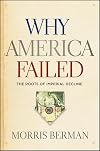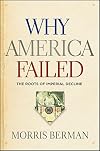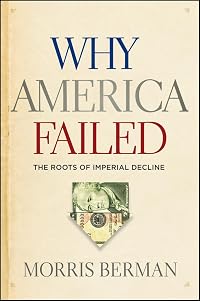
Why America Failed: The Roots of Imperial Decline
by Morris Berman
On This Page
Description
Why America Failed shows how, from its birth as a nation of "hustlers" to its collapse as an empire, the tools of the country's expansion proved to be the instruments of its demise Why America Failed is the third and most engaging volume of Morris Berman's trilogy on the decline of the American empire. In The Twilight of American Culture, Berman examined the internal factors of that decline, showing that they were identical to those of Rome in its late-empire phase. In Dark Ages America, he show more explored the external factors-e.g., the fact that both empires were ultimately attacked from the outside-and the relationship between the events of 9/11 and the history of U.S. foreign policy. In his most ambitious work to date, Berman looks at the "why" of it all Probes America's commitment to economic liberalism and free enterprise stretching back to the late sixteenth century, and shows how this ideology, along with that of technological progress, rendered any alternative marginal to American history Maintains, more than anything else, that this one-sided vision of the country's purpose finally did our nation in Why America Failed is a controversial work, one that will shock, anger, and transform its readers. The book is a stimulating and provocative explanation of how we managed to wind up in our current situation: economically weak, politically passe, socially divided, and culturally adrift. It is a tour de force, a powerful conclusion to Berman's study of American imperial decline. show lessTags
Recommendations
































Member Recommendations

BobNolin Wright's book gives a detailed description of the making of the American character--our feeling of exceptionalism, our over-comsumption, our need to be "number one." Berman is limited to his niche, cultural history, and an odd take on it, at that. Wright's work is solidly based on history, one you most likely are not familiar with. A much better book on how we became a failing empire.
Member Reviews
A continuation of his critique of our "hustle" society, Berman focuses on the historical development of the United States away from a republican (community) society toward one of hustlers and consumers who think only of getting theirs and screwing everyone else. Berman paints a grim, but realistic portrait of the fall of the American Empire--a house of cards built upon the externalization of social issues and the zealous belief that America is exceptional and will conquer any problem through technology.
This is not a Luddite treatise, however, but a critique of the religion that is America. Nowhere else but in America can a citizen be called "un-American" for his/her dissent--as if somehow it is heresy to speak one's truth if it is show more counter to the mythology.
The one area that I take issue with, however, is the fourth chapter in which Berman exalts the virtues of the ante-bellum South. Although I comprehend his thesis that the Civil War was more about a "clash of civilizations"--the North representing the bourgeois hustle society whereas the South maintained a more "republican", or community-oriented one--I cannot agree that "the agrarian South was of a life in which human beings existed serenely and harmoniously." (144) He waves his hands several times at the horrors of slavery, but seems to disregard that permeation of the same is what allowed landed white men to gentrify the South as new aristocrats. What about the patrols that kept slaves from gathering into groups to discuss, or the controls placed on women's advancement? Sure, the South might appear to have been a more ideal culture representing an idyllic, non-hustling society--but Berman dismisses the cost of that serenity and harmony where only one small group of individuals can take part in such a "utopia". As much as I might accept the premise that slavery was not initially the motive for war between the states, it cannot be excluded from the realities of that conflict. To elevate the culture of the South by dismissing the role of strict hierarchical structures in that culture is as much denial as is the fanatic pursuit of technological "fixes" to our social ills now.
That aside, I am in complete agreement with Berman in his identification of American culture as one of "permanent childhood." (166) Americans cannot conceptualize of themselves as anything less than representatives of a prophetic history--the City on the Hill--that somehow will guide the people of the world to salvation. It's a religious conviction that borders on fanaticism and would rival any radical Islamic sect for inherent violence. What is particularly frustrating, for Berman and for myself, is the failure of the typical American to recognize this. Whenever one proposes any critique of the "rightness" of American culture "the eyes glaze over. . . and they would change the subject." (167) I can understand why Berman might feel the only answer is to escape. I, too, have contemplated living as an ex-pat in a country where community matters and the "hustling" life is not regarded as a virtue. However, how can we hope to change if all those who "see" leave? Understandably, Berman gives no false hope that our culture will change, and I tend to concur with this assessment. As with any addiction, all must be lost before renewal can take place. Yet, without people remaining who can offer alternatives, hope is lost. I might not like what I see in this country as far as where it is going, but I can do what I can, and must, to perhaps plant a seed in others for a future time. My meaning is in this hope that I can play a role, however small, in something new, something better--even if it is long after I am gone. show less
This is not a Luddite treatise, however, but a critique of the religion that is America. Nowhere else but in America can a citizen be called "un-American" for his/her dissent--as if somehow it is heresy to speak one's truth if it is show more counter to the mythology.
The one area that I take issue with, however, is the fourth chapter in which Berman exalts the virtues of the ante-bellum South. Although I comprehend his thesis that the Civil War was more about a "clash of civilizations"--the North representing the bourgeois hustle society whereas the South maintained a more "republican", or community-oriented one--I cannot agree that "the agrarian South was of a life in which human beings existed serenely and harmoniously." (144) He waves his hands several times at the horrors of slavery, but seems to disregard that permeation of the same is what allowed landed white men to gentrify the South as new aristocrats. What about the patrols that kept slaves from gathering into groups to discuss, or the controls placed on women's advancement? Sure, the South might appear to have been a more ideal culture representing an idyllic, non-hustling society--but Berman dismisses the cost of that serenity and harmony where only one small group of individuals can take part in such a "utopia". As much as I might accept the premise that slavery was not initially the motive for war between the states, it cannot be excluded from the realities of that conflict. To elevate the culture of the South by dismissing the role of strict hierarchical structures in that culture is as much denial as is the fanatic pursuit of technological "fixes" to our social ills now.
That aside, I am in complete agreement with Berman in his identification of American culture as one of "permanent childhood." (166) Americans cannot conceptualize of themselves as anything less than representatives of a prophetic history--the City on the Hill--that somehow will guide the people of the world to salvation. It's a religious conviction that borders on fanaticism and would rival any radical Islamic sect for inherent violence. What is particularly frustrating, for Berman and for myself, is the failure of the typical American to recognize this. Whenever one proposes any critique of the "rightness" of American culture "the eyes glaze over. . . and they would change the subject." (167) I can understand why Berman might feel the only answer is to escape. I, too, have contemplated living as an ex-pat in a country where community matters and the "hustling" life is not regarded as a virtue. However, how can we hope to change if all those who "see" leave? Understandably, Berman gives no false hope that our culture will change, and I tend to concur with this assessment. As with any addiction, all must be lost before renewal can take place. Yet, without people remaining who can offer alternatives, hope is lost. I might not like what I see in this country as far as where it is going, but I can do what I can, and must, to perhaps plant a seed in others for a future time. My meaning is in this hope that I can play a role, however small, in something new, something better--even if it is long after I am gone. show less
Berman's view, in a nutshell, is that If only we'd remained a society like the Puritans, who he seems to idealize as a community for their values and lack of greed, America would not have failed. He spends some time trying to date when exactly we became a nation of "hustlers" (the denigrating term he uses throughout the book to describe the essential America character). History pretty clearly shows what happened, and the Puritans had very little to do with any of it. Europe was looking for a better trade route to China, and off Columbus went, thinking it was just over there, across the Atlantic. He found America, instead. And his first words were, "Nice country. Be a shame if something were to happen to it. Luigi, string a few of 'em up show more by those palm trees, show 'em we mean business. Okay, so where's your gold?"
The first "hustler" had arrived. It's just that simple. America has always been the land of promise, due to its hugeness, its resources, its being right there for the taking (once you wipe out these neolithic throw-backs). Think of the timing: Europe ready to expand, filled with, er, hustlers looking for deals. And BOOM, lookit here! Trees!! Iron!! This tobacco stuff and corn!! Chickens the size of turkeys! Oh, they ARE turkeys! The American Dream, as a phrase, is of recent coinage; but it began with its discovery, as a place where every man could make a life for himself. No more aristrocracy. Individualism was born.
The American Revolution, contra Berman, was the work of the rich landowners in America (the "founding fathers") fed up with shipping their wealth off to Britain and paying taxes on imports. So they seceded, so to speak, for the "freedom" to keep their own profits. That's how America began, as a country. But our character was determined long before by geography and history: the discovery of North and South America by Europeans. It's economics, not culture, which could be why Berman finds himself scratching his head so much in this book.
When we reached the end of the frontier in the late 19thC, we began to look for new places to keep expanding, and thus became an imperial power, with TR stealing land and calling it Panama, etc. Economic growth through expansion, begun with Don Columbus, just kept rollin' on.
Berman doesn't define what America should have become, really, other than "republican,", or "traditional." I get the feeling he thinks the "steady state", non-progessing Middle Ages was the good old days, which helps you understand how he ends up using the South (Chapter 4) as an example of how things ought to be. The South, says he, was all about "gemeinschaft" (community), and the North all about "gesellschaft" (hustling). As Berman says of another author at one point, it makes you wonder "what kind of high grade weed he's been smoking." If "the South minus slavery" is the best he can come up with as an example of an ideal community, I'd have to say this book is not very convincing or useful. To Berman, we are addicted to Progress (which ended the Plagues and slavery), and so he demonizes progress. It has turned us into a nation of lonely, sad, soul-less screen addicts. He prefers living in Mexico, of all places, to America. He may have been better off in some New England village, where the sense of community is strong. But the whole country (including you and me, folks) is nothing but hustlers. It's extreme all or nothing thinking coming from someone with personal issues hiding behind an academic cloak, seems to me.
America began to go downhill when the resource party finally began to peter out. We were once unique in our abundance, ingenuity, and scientific advancements. We had a few decades of post-WW2 dominance, which lead to the feeding frenzy Berman mentions. But Europe has rebuilt itself into something remarkable (though he still finds even there that the people have no souls). The global economy has ended our geographical uniqueness, begun in 1492. We're heading toward a feudalistic state (which should make Berman happy, I guess), with the Lords of the .001% surrounded by the Army in high-security enclaves, while the rest of us scrabble for scraps, living out of cars and in burnt-out buildings. When the oil runs out, things will change, and a long, painful transition will begin. Our great-grandchildren will live in a very different world.
Too much historical--and current day-- knowledge is missing from this book to make it very useful, I'm afraid. The author's limited perspective and personal grievances are to blame for that. Yes, America is failing, yes we're on a runaway train headed towards a cliff. But this book doesn't explain why, at least not completely. show less
The first "hustler" had arrived. It's just that simple. America has always been the land of promise, due to its hugeness, its resources, its being right there for the taking (once you wipe out these neolithic throw-backs). Think of the timing: Europe ready to expand, filled with, er, hustlers looking for deals. And BOOM, lookit here! Trees!! Iron!! This tobacco stuff and corn!! Chickens the size of turkeys! Oh, they ARE turkeys! The American Dream, as a phrase, is of recent coinage; but it began with its discovery, as a place where every man could make a life for himself. No more aristrocracy. Individualism was born.
The American Revolution, contra Berman, was the work of the rich landowners in America (the "founding fathers") fed up with shipping their wealth off to Britain and paying taxes on imports. So they seceded, so to speak, for the "freedom" to keep their own profits. That's how America began, as a country. But our character was determined long before by geography and history: the discovery of North and South America by Europeans. It's economics, not culture, which could be why Berman finds himself scratching his head so much in this book.
When we reached the end of the frontier in the late 19thC, we began to look for new places to keep expanding, and thus became an imperial power, with TR stealing land and calling it Panama, etc. Economic growth through expansion, begun with Don Columbus, just kept rollin' on.
Berman doesn't define what America should have become, really, other than "republican,", or "traditional." I get the feeling he thinks the "steady state", non-progessing Middle Ages was the good old days, which helps you understand how he ends up using the South (Chapter 4) as an example of how things ought to be. The South, says he, was all about "gemeinschaft" (community), and the North all about "gesellschaft" (hustling). As Berman says of another author at one point, it makes you wonder "what kind of high grade weed he's been smoking." If "the South minus slavery" is the best he can come up with as an example of an ideal community, I'd have to say this book is not very convincing or useful. To Berman, we are addicted to Progress (which ended the Plagues and slavery), and so he demonizes progress. It has turned us into a nation of lonely, sad, soul-less screen addicts. He prefers living in Mexico, of all places, to America. He may have been better off in some New England village, where the sense of community is strong. But the whole country (including you and me, folks) is nothing but hustlers. It's extreme all or nothing thinking coming from someone with personal issues hiding behind an academic cloak, seems to me.
America began to go downhill when the resource party finally began to peter out. We were once unique in our abundance, ingenuity, and scientific advancements. We had a few decades of post-WW2 dominance, which lead to the feeding frenzy Berman mentions. But Europe has rebuilt itself into something remarkable (though he still finds even there that the people have no souls). The global economy has ended our geographical uniqueness, begun in 1492. We're heading toward a feudalistic state (which should make Berman happy, I guess), with the Lords of the .001% surrounded by the Army in high-security enclaves, while the rest of us scrabble for scraps, living out of cars and in burnt-out buildings. When the oil runs out, things will change, and a long, painful transition will begin. Our great-grandchildren will live in a very different world.
Too much historical--and current day-- knowledge is missing from this book to make it very useful, I'm afraid. The author's limited perspective and personal grievances are to blame for that. Yes, America is failing, yes we're on a runaway train headed towards a cliff. But this book doesn't explain why, at least not completely. show less
I’m 60% through “Why America Failed” at the same time that I’m listening to a set of Teaching Company lectures entitled “Thinking About Capitalism”. Morris Berman frames the American Gestalt in what he terms a nation of hustlers and an ethos based on the hustling mentality. The lectures are congruent with this perspective, though the lecturer, Jerry Z. Muller, spends time tracing the evolution of the mindset of this mercantilism or industrialism. For as long as people have thought about it they have grappled witht the conflict of materialism and virtue, implicit within which is the nature and role of the state.
Adam Smith was the first and the preeminent advocate of free trade and the benefits of the division of labor, but it show more must be remembered that he was a moral philosopher and his overarching concern was the universal well-being of all people, which he thought would be served by a society organized around industrialism, but not without the careful supervision of a state that ensured that the self-interest that drives such a society was governed.
Hume, Smith’s contemporary, feared that the the secularization and atomization inherent in a mercantile society would break down the institutions that upheld the virtuous conduct of society. Rousseau feared that the emoluments of material wealth would lead to the degeneration of moral character. In America, Jefferson was more in the camp of Rousseau, favoring a nation of small farmers, while Hamilton was ardent in the promotion of an industrial society. Hamilton prevailed in the North and Jefferson’s temperament was prevalent in the south.
Berman makes the argument, well supported by scholarship, that the civil war was about this clash of cultures, the issue of slavery being the external fulcrum of that conflict. The south treasured a life centered around the cultivation of virtue and the glory of living in the moment, compared to the ethos of the north which was focused on the acquisition of wealth and position. The issue of whether new states would allow or prohibit slavery would determine which of these cultures would prevail. I’m reminded here of another Berman, Paul in whose book “Terror and Liberalism” he portrays the repugnance of the Muslim world at the godless materialism of Western materialistic culture in a similar vein. show less
Adam Smith was the first and the preeminent advocate of free trade and the benefits of the division of labor, but it show more must be remembered that he was a moral philosopher and his overarching concern was the universal well-being of all people, which he thought would be served by a society organized around industrialism, but not without the careful supervision of a state that ensured that the self-interest that drives such a society was governed.
Hume, Smith’s contemporary, feared that the the secularization and atomization inherent in a mercantile society would break down the institutions that upheld the virtuous conduct of society. Rousseau feared that the emoluments of material wealth would lead to the degeneration of moral character. In America, Jefferson was more in the camp of Rousseau, favoring a nation of small farmers, while Hamilton was ardent in the promotion of an industrial society. Hamilton prevailed in the North and Jefferson’s temperament was prevalent in the south.
Berman makes the argument, well supported by scholarship, that the civil war was about this clash of cultures, the issue of slavery being the external fulcrum of that conflict. The south treasured a life centered around the cultivation of virtue and the glory of living in the moment, compared to the ethos of the north which was focused on the acquisition of wealth and position. The issue of whether new states would allow or prohibit slavery would determine which of these cultures would prevail. I’m reminded here of another Berman, Paul in whose book “Terror and Liberalism” he portrays the repugnance of the Muslim world at the godless materialism of Western materialistic culture in a similar vein. show less
At Last, Someone Who Understands That America Has Failed
The Decline of the American Empire
http://www.counterpunch.org/2012/01/23/the-decline-of-the-american-empire-2/prin...
The Decline of the American Empire
http://www.counterpunch.org/2012/01/23/the-decline-of-the-american-empire-2/prin...
Ratings
Members
- Recently Added By
Author Information

23+ Works 1,521 Members
Morris Berman has held visiting professorships in the United States & abroad, most recently at Johns Hopkins University. He lives in Washington, D.C. (Publisher Provided)
Classifications
Statistics
- Members
- 96
- Popularity
- 334,012
- Reviews
- 4
- Rating
- (3.83)
- Languages
- English
- Media
- Paper, Ebook
- ISBNs
- 4
- ASINs
- 2