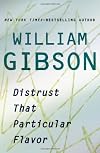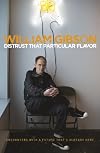
Distrust That Particular Flavor
by William Gibson
On This Page
Description
Known primarily as a novelist, Gibson has, over thirty years, been approached by different publication to share his insights into contemporary culture. The resulting essays are collected here for the first time.Tags
Recommendations











Member Recommendations
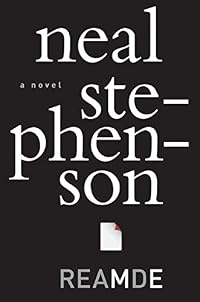
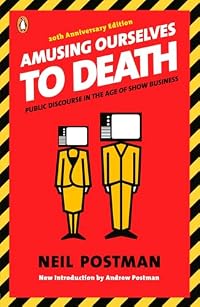
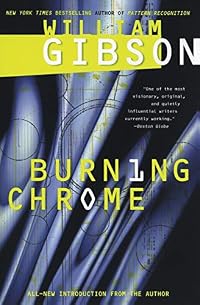
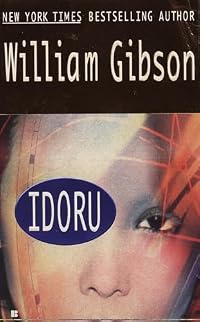
Jannes Rushkoff and Gibson are both commenters on the impact of technology on society and human culture, and both have a vaguely prophetic air to them. Rushkoff might, strangely enough, be a bit more farfetched than Gibson, but if you can stomach that he's really enjoyable to read, and as most people probably has approached Gibson through his fiction this won't be a big problem for them.
Member Reviews
In Distrust That Particular Flavor, William Gibson says that "reliance on broadcasting is the very definition of a technologically backward society."
Insightfully, he says this in The Road to Oceania, a 2003 article he wrote for the New York Times, reprinted in this book of articles and essays collected from various (nominally) nonfiction publications for which he has written over the years. It was insightful at the time in a very conventional sense in that, while reliance on broadcasting does not encompass the whole definition of a technologically backward society either when he wrote the article in 2003 or ten years later -- this year -- when I read it, it was inescapably true that any society whose formal maintenance required show more broadcast propaganda as the primary form of information dissemination was also a society that had not caught up to the postmodern information age in which we lived. In that age of the Internet, information moved in myriad directions, the power of publishing having become accessible to anyone with six hundred dollars to spend on a computer and another fifteen or more per month to an ISP. In 2003, it was not so long since ad-funded "free" Internet access had been popularly available in the United States, in fact, and that had only really gone away because Internet access had become such a ubiquituous requirement of contemporary life that everyone was willing to spend money on it. Now, free Internet access is back with a vengeance; it can even be had wirelessly at crummy fast food joints, and a failure to provide wireless Internet access is the very definition of a technologically backward fast food chain.
More than all that, however, it was insightful because we as a society were on the cusp of beginning to realize, on some not-strictly-conscious level where we take the fundamental facts of our lives for granted, that broadcasting itself was the mark of technological backwardness in this millennium, even in those very early single digit years. It is now a mere decade later, one fortieth the time that passed between the invention of the foundational tool of mass publication (movable type) in China in the eleventh century to the refinement of the technology (the Gutenberg press) to the point where it provided the ability to perform the task of mass publication in less than a week's time in the fifteenth century. In that decade, Gibson's perhaps accidental insight that we were about to enter an age where broadcasting itself was a mark of backwardness has gone from being insightful to banal, as much a fact of life as breathing and eating, as if the knowledge that broadcast technology is "over" is etched in the rhombencephalon -- the "primitive hindbrain" that controls the things we don't have to think about and on which the conscious thinking parts of our brains implicitly rely.
Ironically, he writes these words in 2003, roughly ten years after it became inevitably true due to a number of socially relevant factors including the appearance of the truly world wide web (then still called the World Wide Web), the appearance of open source software that would actually have a significant impact on the whole world instead of a tiny cabal of obsessed technologists (general purpose operating system software that could run acceptably on commodity hardware, including the post-Berkeley BSD Unix and Linux families of operating systems), and the introduction of arguably the world's first smartphone (the IBM Simon, a handheld touchscreen combination wireless mobile telephone and personal digital assistant -- yes, really, before Java). This puts him a decade behind when the future backwardness of broadcasting he identifies had already arrived, even if it was not yet well distributed.
More than all that, however, it was ironic because he has built his career as a writer of fixed-form books and short pieces for publication in fixed-form magazines. That is, he writes for publication, the carefully polished, cautiously curated, comprehensively broadcast dissemination of derivation-resistant works of authorship, in a form essentially unchanged since the fifteenth century even when distributed in (DRM-encumbered, copyright-protected) digital formats. Knowing what I imagine I know of Gibson, perhaps a hubristic conceit for someone who has never met the man except through his writings and photographs, I rather suspect he lives with a disquieting sense of the technological backwardness of his craft's current form pressing through the membrane between the subconscious and conscious parts of his mind, if it has not already crept into the light of day, blinking blearily at the dazzling strangeness of the world in which it has emerged. His most recent trilogy of novels (Pattern Recognition, Spook Country, and Zero History) reads, in some ways, like attempts to describe the underlying truths of the phenomenon of broadcasting's obsolescence to the recipients of his broadcast word without actually setting it down on paper for them to recognize and, perhaps, learn to transcend his published works before they even buy them. This would of course not be the attempt to run a moneymaking scam on his readers, in the tradition of fundamentally broadcast oriented media publishers like Random House and Universal Music, but rather as a means of buying time to adjust to the emerging reality.
"Publication", to make something public in a known and static form, has become hopelessly antiquated in principle in the world of distributed version control systems and BitTorrent. From the perspective of 2003, when Gibson wrote The Road to Oceania, the world will have fully woken up to this when we all have easy access to our textual culture in an intrinsically version controlled, arbitrarily editable form that makes it take an effort of conscious intent to avoid sharing with the world, via nothing more sophisticated than the devices we carry in our pockets, and we have stopped regarding it as a fringe curiosity or one-off niche tool the way we regard Wikipedia. In the meantime, when the insights of distant others are shared with us, they are largely delivered to us via the works of published authors such as William Gibson -- all of whose books (both collection and novel form) have delivered wisdom to this reader that would have otherwise been harder and longer in the finding -- and by random commentators shouting out their observations in the open-air agoras of the Internet. These are our standard options, and not quite up to the distributed, version controlled, automatically reshared standards of Wikipedia.
Spanning almost two decades of writings (or fully two decades, judging by publication dates, if you include the preface), Distrust That Particular Flavor is overflowing with trademark Gibsonian insight into the way our changing world interacts with our psyches, and vice versa, described in largely literal presentations of life arranged so that the picture that emerges is at once both hyperreal in its edgy clarity and flavored with the surreal. It serves the role of intellectually distributing some of the future that has already in fact permeated every fiber of our lives, as members of societies where something like this website has any meaning. As Gibson himself has reminded his readers more than once, he is no technologist, and he has even said he is no futurist, writing about today in the thinly applied makeup of tomorrow even when his settings are "the future". His genius as an author has been in recognizing many implications for our cultures and lives of the technologies already developing, when those implications have not yet fully revealed themselves to most of us, and gently conveying them to us in fictionalized form in a manner that somehow helps us weather the imminent futureshock with more savoir faire. This volume of collected nonfiction proves he can do the same without the fictionalizing soft-light filter over the lens through which he directs our attention, and as well as he ever did in his fiction. The Road to Oceania is also, after all, the essay in which he warned the politicians of the day of the yet-to-be implemented Wikileaks, starting with the words "It is becoming unprecedentedly difficult for anyone, anyone at all, to keep a secret."
If there is a flaw in this book, it is the final piece of writing, Googling the Cyborg. For all its insistence that much of science fiction and futurism is too literal about the metaphors that are developing, and shaping our lives, so that they often miss the fact the futures they describe have often already taken root and spread through the world, its value is in taking the important step of making the core of Gibson's overarching narrative purpose explicitly literal. Its weakness is in the way it comes across as more distracted and fumbling than any other piece of writing of his that I have encountered. It is not bad, nor even merely mediocre; it still inspires and offers insights. What it lacks is Gibson's typical atmospheric depth for me, at least, and what creeps into it unwelcomed is an inexpert sort of repetition, a clumsy sort of foreshadowing, and actual errors (i.e. the terms "electron" and "neuron" are both misused, and in the same paragraph). It is an essay he needed to write, but I can only conclude that when he wrote it for a lecture he would give at the University of British Columbia circa 2008 he was not ready. In his own terms, referring to the words of other science fiction writers, I think it was not yet "Steam Engine Time". Imperfect it may be, but this lecture in essay form is still worth reading, and measured by its subject matter it in some sense serves as the perfect coping stone for the book.
While I do, in fact, deeply distrust the particular "collected nonfiction articles individually available elsewhere" flavor of book in general, Distrust That Particular Flavor has turned out to be an informative, revealing look at the world in which I live through the eyes of William Gibson, broadening my perspective and whetting my apetite for whatever solutions its author may find to the problem of escaping the obsolescence of broadcast technologies. Read it, then build upon it. It isn't just broadcast any longer, y'know. show less
Insightfully, he says this in The Road to Oceania, a 2003 article he wrote for the New York Times, reprinted in this book of articles and essays collected from various (nominally) nonfiction publications for which he has written over the years. It was insightful at the time in a very conventional sense in that, while reliance on broadcasting does not encompass the whole definition of a technologically backward society either when he wrote the article in 2003 or ten years later -- this year -- when I read it, it was inescapably true that any society whose formal maintenance required show more broadcast propaganda as the primary form of information dissemination was also a society that had not caught up to the postmodern information age in which we lived. In that age of the Internet, information moved in myriad directions, the power of publishing having become accessible to anyone with six hundred dollars to spend on a computer and another fifteen or more per month to an ISP. In 2003, it was not so long since ad-funded "free" Internet access had been popularly available in the United States, in fact, and that had only really gone away because Internet access had become such a ubiquituous requirement of contemporary life that everyone was willing to spend money on it. Now, free Internet access is back with a vengeance; it can even be had wirelessly at crummy fast food joints, and a failure to provide wireless Internet access is the very definition of a technologically backward fast food chain.
More than all that, however, it was insightful because we as a society were on the cusp of beginning to realize, on some not-strictly-conscious level where we take the fundamental facts of our lives for granted, that broadcasting itself was the mark of technological backwardness in this millennium, even in those very early single digit years. It is now a mere decade later, one fortieth the time that passed between the invention of the foundational tool of mass publication (movable type) in China in the eleventh century to the refinement of the technology (the Gutenberg press) to the point where it provided the ability to perform the task of mass publication in less than a week's time in the fifteenth century. In that decade, Gibson's perhaps accidental insight that we were about to enter an age where broadcasting itself was a mark of backwardness has gone from being insightful to banal, as much a fact of life as breathing and eating, as if the knowledge that broadcast technology is "over" is etched in the rhombencephalon -- the "primitive hindbrain" that controls the things we don't have to think about and on which the conscious thinking parts of our brains implicitly rely.
Ironically, he writes these words in 2003, roughly ten years after it became inevitably true due to a number of socially relevant factors including the appearance of the truly world wide web (then still called the World Wide Web), the appearance of open source software that would actually have a significant impact on the whole world instead of a tiny cabal of obsessed technologists (general purpose operating system software that could run acceptably on commodity hardware, including the post-Berkeley BSD Unix and Linux families of operating systems), and the introduction of arguably the world's first smartphone (the IBM Simon, a handheld touchscreen combination wireless mobile telephone and personal digital assistant -- yes, really, before Java). This puts him a decade behind when the future backwardness of broadcasting he identifies had already arrived, even if it was not yet well distributed.
More than all that, however, it was ironic because he has built his career as a writer of fixed-form books and short pieces for publication in fixed-form magazines. That is, he writes for publication, the carefully polished, cautiously curated, comprehensively broadcast dissemination of derivation-resistant works of authorship, in a form essentially unchanged since the fifteenth century even when distributed in (DRM-encumbered, copyright-protected) digital formats. Knowing what I imagine I know of Gibson, perhaps a hubristic conceit for someone who has never met the man except through his writings and photographs, I rather suspect he lives with a disquieting sense of the technological backwardness of his craft's current form pressing through the membrane between the subconscious and conscious parts of his mind, if it has not already crept into the light of day, blinking blearily at the dazzling strangeness of the world in which it has emerged. His most recent trilogy of novels (Pattern Recognition, Spook Country, and Zero History) reads, in some ways, like attempts to describe the underlying truths of the phenomenon of broadcasting's obsolescence to the recipients of his broadcast word without actually setting it down on paper for them to recognize and, perhaps, learn to transcend his published works before they even buy them. This would of course not be the attempt to run a moneymaking scam on his readers, in the tradition of fundamentally broadcast oriented media publishers like Random House and Universal Music, but rather as a means of buying time to adjust to the emerging reality.
"Publication", to make something public in a known and static form, has become hopelessly antiquated in principle in the world of distributed version control systems and BitTorrent. From the perspective of 2003, when Gibson wrote The Road to Oceania, the world will have fully woken up to this when we all have easy access to our textual culture in an intrinsically version controlled, arbitrarily editable form that makes it take an effort of conscious intent to avoid sharing with the world, via nothing more sophisticated than the devices we carry in our pockets, and we have stopped regarding it as a fringe curiosity or one-off niche tool the way we regard Wikipedia. In the meantime, when the insights of distant others are shared with us, they are largely delivered to us via the works of published authors such as William Gibson -- all of whose books (both collection and novel form) have delivered wisdom to this reader that would have otherwise been harder and longer in the finding -- and by random commentators shouting out their observations in the open-air agoras of the Internet. These are our standard options, and not quite up to the distributed, version controlled, automatically reshared standards of Wikipedia.
Spanning almost two decades of writings (or fully two decades, judging by publication dates, if you include the preface), Distrust That Particular Flavor is overflowing with trademark Gibsonian insight into the way our changing world interacts with our psyches, and vice versa, described in largely literal presentations of life arranged so that the picture that emerges is at once both hyperreal in its edgy clarity and flavored with the surreal. It serves the role of intellectually distributing some of the future that has already in fact permeated every fiber of our lives, as members of societies where something like this website has any meaning. As Gibson himself has reminded his readers more than once, he is no technologist, and he has even said he is no futurist, writing about today in the thinly applied makeup of tomorrow even when his settings are "the future". His genius as an author has been in recognizing many implications for our cultures and lives of the technologies already developing, when those implications have not yet fully revealed themselves to most of us, and gently conveying them to us in fictionalized form in a manner that somehow helps us weather the imminent futureshock with more savoir faire. This volume of collected nonfiction proves he can do the same without the fictionalizing soft-light filter over the lens through which he directs our attention, and as well as he ever did in his fiction. The Road to Oceania is also, after all, the essay in which he warned the politicians of the day of the yet-to-be implemented Wikileaks, starting with the words "It is becoming unprecedentedly difficult for anyone, anyone at all, to keep a secret."
If there is a flaw in this book, it is the final piece of writing, Googling the Cyborg. For all its insistence that much of science fiction and futurism is too literal about the metaphors that are developing, and shaping our lives, so that they often miss the fact the futures they describe have often already taken root and spread through the world, its value is in taking the important step of making the core of Gibson's overarching narrative purpose explicitly literal. Its weakness is in the way it comes across as more distracted and fumbling than any other piece of writing of his that I have encountered. It is not bad, nor even merely mediocre; it still inspires and offers insights. What it lacks is Gibson's typical atmospheric depth for me, at least, and what creeps into it unwelcomed is an inexpert sort of repetition, a clumsy sort of foreshadowing, and actual errors (i.e. the terms "electron" and "neuron" are both misused, and in the same paragraph). It is an essay he needed to write, but I can only conclude that when he wrote it for a lecture he would give at the University of British Columbia circa 2008 he was not ready. In his own terms, referring to the words of other science fiction writers, I think it was not yet "Steam Engine Time". Imperfect it may be, but this lecture in essay form is still worth reading, and measured by its subject matter it in some sense serves as the perfect coping stone for the book.
While I do, in fact, deeply distrust the particular "collected nonfiction articles individually available elsewhere" flavor of book in general, Distrust That Particular Flavor has turned out to be an informative, revealing look at the world in which I live through the eyes of William Gibson, broadening my perspective and whetting my apetite for whatever solutions its author may find to the problem of escaping the obsolescence of broadcast technologies. Read it, then build upon it. It isn't just broadcast any longer, y'know. show less
Essays, with afterwords, on a pretty good range of topics. There are some fun ideas, but the best reason to read this collection is Gibson’s quirky and pleasing language. After reading this I’m more likely to re-read some of his post-Sprawl novels, many of which have struck me as similar to leafing through a Williams-Sonoma catalogue while waiting for a plot to arrive.
Gibson is the master of subtle melancholy and nostalgia. His non-fiction is idiosyncratic collection of book introductions, random musings, and half-aborted magazine articles. There are motifs here: memory, technology, Japan, and the place where writing comes from, but no theme. It's a melancholy and nostalgic collection, and Gibson himself comes off as a very strange and slightly sad man who managed to resonate to the fears of 1984 and produce Neuromancer, and since then has occasionally re-opened the door to that place, but not, mostly in this collection.
This is not an essential book, but it's an interesting piece of cyberpunk nostalgia, and nobody turns a phrase like William Gibson.
This is not an essential book, but it's an interesting piece of cyberpunk nostalgia, and nobody turns a phrase like William Gibson.
I like the way William Gibson writes and I like the way he seems to think, or at least the way presented through what he writes, about the present and the past and the future, about technology and culture and society. These are short, mostly sharp essays. One is flabby and too long, one is a rerun of another, which Gibson does draw attention to in his little afterwords. They're all really good about expressing the confluence of various impulses at any given moment in the world and hazarding some careful thoughts about where they will go next.
Gibson, known for thoughtful science fiction exploring the ways in which technology changes human culture in impossible-to-anticipate ways, here brings his considerable talents to bear on the undiscovered country—non-fiction. Gibson’s first collection of non-fiction draws from the last several decades of his writing career, with essays and articles featuring all the usual Gibsonian subjects—the rise of the Internet; the technology and culture of Japan; Gibson’s own past in small-town Virginia and early discovery of science fiction; and all the ways, both small and large, that human culture has already been irrevocably altered by technologies as commonplace as radio and as pervasive as cyberspace. Many, if not all, of the show more articles, are grounded in Gibson’s own life and experiences, adding a personal touch to a topic which could otherwise seem dry. A sly wit and a lively intelligence shine through the writing, and every article, regardless of whether its predictions have been borne out by reality, is fascinating without fail. show less
Essa coleção de textos não-ficcionais do grande Willaim Gibson é melhor apreciada, certamente, se você, assim como eu, adora alguns de seus outros livros. A introdução é incrível, em sua honesta e simpática mensagem sobre como escrever ficção - escrevendo, muito embora exista nisso um pouco de desapontamento. Há o famoso texto sobre os horrores do autoritarismo bom-capitalista de Singapura, a tese de que ficção científica futurista acaba sendo sempre sobre o presente, e um fragmento bibliográfico incrível sobre a como o e-bay finalmente capturou o interesse do escritor na internet existente (e seu desdobramento em uma intensa jornada relacionada a relógios analógicos). Há algumas outras coisas interessantes mas um show more tanto alusivas sobre o futurismo japonês (um povo que realmente se abriria ao futuro como estratégia sócio-política), e outras tantas circunstanciais - interesse em certos personagens, roupas, cinema, música. No todo, a alta qualidade de alguns dos textos se equilibra com o caráter mais "para fãs" de outros. Mesmo assim, fico com um pé atrás para recomendar para quem nunca leu a triologia blue ant e a do sprawl. show less
A collection of essays and articles by science fiction author William Gibson, spanning a period from 1989 to 2011 and taken from a wide variety of places, including magazines, book introductions, and even the biography page on Gibson's personal website. Some of the topics are about what you'd expect from Gibson (technology, science fiction, his longstanding fascination with Japan), while others are surprisingly random (a review of a Steely Dan album, a rambling piece about shopping for vintage watches on eBay).
Gibson's a good writer, and has a lot of interesting thoughts about technology and modern society, but I have to say, overall I found this collection a little disappointing. Not bad, mind you, but not nearly as good as I was show more expecting. There are a handful of really good essays, and even the ones I was more indifferent to often often featured a vivid turn of phrase or an interesting insight here and there. But as a whole, it feels oddly disjointed, and these pieces, perhaps because they were written for fairly specific audiences, often feel weirdly devoid of some important sense of context. Some of them also get a little repetitive, as he addresses some of the same topics and even uses some of the same turns of phrase more than once. The little afternotes in which Gibson repeatedly apologizes for not really being a non-fiction writer and frequently offers up the opinion that he didn't actually know what he was talking about when he wrote the piece in question don't really help, either.
Mind you, I'm not sorry I read this. It was probably worth it just for the two or three best essays. But Gibson's probably right; you're better off reading his novels. show less
Gibson's a good writer, and has a lot of interesting thoughts about technology and modern society, but I have to say, overall I found this collection a little disappointing. Not bad, mind you, but not nearly as good as I was show more expecting. There are a handful of really good essays, and even the ones I was more indifferent to often often featured a vivid turn of phrase or an interesting insight here and there. But as a whole, it feels oddly disjointed, and these pieces, perhaps because they were written for fairly specific audiences, often feel weirdly devoid of some important sense of context. Some of them also get a little repetitive, as he addresses some of the same topics and even uses some of the same turns of phrase more than once. The little afternotes in which Gibson repeatedly apologizes for not really being a non-fiction writer and frequently offers up the opinion that he didn't actually know what he was talking about when he wrote the piece in question don't really help, either.
Mind you, I'm not sorry I read this. It was probably worth it just for the two or three best essays. But Gibson's probably right; you're better off reading his novels. show less
Members
- Recently Added By
Author Information

82+ Works 95,912 Members
William Gibson was born on March 17, 1948 in Conway, South Carolina. He dropped out of high school and moved to Canada, where he eventually graduated from the University of British Columbia in 1977. He is the author of Mona Lisa Overdrive, The Peripheral, and Neuromancer, which won the Phillip K. Dick Award, the Hugo Award, and the Nebula Award. show more He also wrote the screenplay for the film Johnny Mnemonic. (Bowker Author Biography) show less
Some Editions
Awards and Honors
Awards
Notable Lists
Work Relationships
Is contained in
Common Knowledge
- Canonical title
- Distrust That Particular Flavor
- Original publication date
- 2012-01-03
- People/Characters
- William Gibson; Stelarc
- Important places
- Tokyo, Japan; Singapore; Chateau Marmont Hotel, Los Angeles, California, USA
Classifications
Statistics
- Members
- 797
- Popularity
- 34,617
- Reviews
- 41
- Rating
- (3.71)
- Languages
- English, German
- Media
- Paper, Audiobook, Ebook
- ISBNs
- 18
- ASINs
- 8