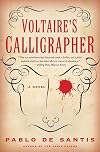
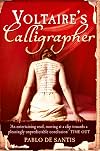
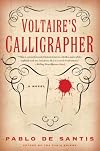
Voltaire's Calligrapher
by Pablo De Santis
On This Page
Description
As calligrapher for the great Voltaire, Dalessius becomes witness to many wonders-- and finds himself in the middle of a secret battle between the malevolent remnants of the all-but-dead Dark Ages and the progressive elements of the modern age.Tags
Recommendations




















Member Reviews
A postmodern historical novel, set in Enlightenment France and full of playful reflections on philosophy, history, and aesthetics, this is the sort of thing I normally really enjoy, but somehow it never really clicked for me. Maybe it was the translation, which felt a little bit flat and lacking in linguistic bounce, maybe it was the rather over-busy plot, which seemed to be bursting out of the slim, novella-length package in all directions, not giving the characters any real chance to develop and solidify. I believe De Santis is a major figure in graphic-novel circles, and perhaps that has something do with it: the story often felt as though it would have benefited from pictures. A graphic novel format might also have fitted in better show more with the way the border between history and fantasy is about 90% of the way over to the fantasy side.
The general idea is that the narrator, Dalessius, trained in calligraphy and employed as a copyist by the Sage of Ferney, finds himself acting as a kind of secret agent in a power-struggle between his boss and the Dominicans, who are (of course) plotting world-domination. There are also exploding sexbots, poison-pens, time-delay inks, a program-controlled bishop, and an overnight corpse delivery service involved in the story, inter alia.
A silly quibble that disturbed me throughout was the use of the word "calligrapher" as job-description for Dalessius. This word first appeared in English in the mid-18th century in line with the rise of interest in orientalism, and it was initially only used to describe artists producing decorative versions of handwritten texts for religious or display purposes in Islamic and Far Eastern cultures. The same applies to French calligraphe — unfortunately I haven't got a historical dictionary of Spanish to hand to check the history of calígrafo, but I assume it will be similar to French. The term calligraphy goes back about a century earlier.
The main action of the book is set between the Jean Calas case in 1762 and Voltaire's death in 1778. At that time, someone like Dalessius, whose job was the old-established one of making accurate, high-quality copies of legal and business manuscripts, would have used a term like clerk, copyist (both early-renaissance), scribe or scrivener (medieval). Obviously, there's no law against using an anachronistic word in a historical novel, particularly a non-realist one, but I find it odd when a writer — who presumably knows what he's doing — puts a word like that in the centre of the foreground and doesn't trouble to tell us why he is doing so. show less
The general idea is that the narrator, Dalessius, trained in calligraphy and employed as a copyist by the Sage of Ferney, finds himself acting as a kind of secret agent in a power-struggle between his boss and the Dominicans, who are (of course) plotting world-domination. There are also exploding sexbots, poison-pens, time-delay inks, a program-controlled bishop, and an overnight corpse delivery service involved in the story, inter alia.
A silly quibble that disturbed me throughout was the use of the word "calligrapher" as job-description for Dalessius. This word first appeared in English in the mid-18th century in line with the rise of interest in orientalism, and it was initially only used to describe artists producing decorative versions of handwritten texts for religious or display purposes in Islamic and Far Eastern cultures. The same applies to French calligraphe — unfortunately I haven't got a historical dictionary of Spanish to hand to check the history of calígrafo, but I assume it will be similar to French. The term calligraphy goes back about a century earlier.
The main action of the book is set between the Jean Calas case in 1762 and Voltaire's death in 1778. At that time, someone like Dalessius, whose job was the old-established one of making accurate, high-quality copies of legal and business manuscripts, would have used a term like clerk, copyist (both early-renaissance), scribe or scrivener (medieval). Obviously, there's no law against using an anachronistic word in a historical novel, particularly a non-realist one, but I find it odd when a writer — who presumably knows what he's doing — puts a word like that in the centre of the foreground and doesn't trouble to tell us why he is doing so. show less
Pablo De Santis' Voltaire's Calligrapher (Harper Perennial, 2010) reminded me a bit of some of Voltaire's stories (which is, I hope, what De Santis intended). The title character, young Dalessius, tells the story of how he came to be employed by Voltaire - as calligrapher, but also charged with much graver tasks as the great philosophe faces off against the anti-Enlightenment forces strongly aligned against him.
De Santis' writing makes for good reading out loud, with its long, luscious descriptions of the calligrapher's craft, of bookstores and auctions, of strange characters who we may meet only briefly but whom I found myself thinking about long after I'd closed the book for the night. The plot meanders about, filled with twists and show more turns and dead ends, and the reader has no choice but to follow along, enjoying the journey.
A short book, at under 150 pages, but one which rewards a close, lingering read. There's a tremendous amount of material hidden in each careful word.
http://philobiblos.blogspot.com/2012/03/book-review-voltaires-calligrapher.html show less
De Santis' writing makes for good reading out loud, with its long, luscious descriptions of the calligrapher's craft, of bookstores and auctions, of strange characters who we may meet only briefly but whom I found myself thinking about long after I'd closed the book for the night. The plot meanders about, filled with twists and show more turns and dead ends, and the reader has no choice but to follow along, enjoying the journey.
A short book, at under 150 pages, but one which rewards a close, lingering read. There's a tremendous amount of material hidden in each careful word.
http://philobiblos.blogspot.com/2012/03/book-review-voltaires-calligrapher.html show less
Dalessius is a 20-year-old calligrapher who ends up working for the philosopher Voltaire in France during the Enlightenment. Interesting enough premise, but the plot never found its pace for me. It felt disjointed and confusing. There are automatons, secret messages written on naked women, a heart in a jar and other intriguing concepts, but they never mesh into a cohesive story.
The book is only 150 pages and yet it felt like it was much longer. I found myself never wanting to pick it up and I can’t help but wonder if something was lost in translation. Maybe the plot makes more sense in its native language.
I did really enjoy some of Santis’ descriptions of the people Dalessius meets on his journeys. Here’s one description of a show more watchmaker…
“Her many years around clocks had given her words a regular beat, as if each syllable corresponded exactly to a fraction of time.” show less
The book is only 150 pages and yet it felt like it was much longer. I found myself never wanting to pick it up and I can’t help but wonder if something was lost in translation. Maybe the plot makes more sense in its native language.
I did really enjoy some of Santis’ descriptions of the people Dalessius meets on his journeys. Here’s one description of a show more watchmaker…
“Her many years around clocks had given her words a regular beat, as if each syllable corresponded exactly to a fraction of time.” show less
I wouldn't recommend it as the most fetching book of its kind, but you can find some interesting stuff here and there, if you look hard enough.
For example I enjoyed the references to the antinomy between the old and the new, the caligraphy becoming obsolete and the modern, practical printed word.
All in all I did not enjoy the tone and atmosphere of the book - where it should have been mysterious, it seemed to me just weird.
I realized Voltaire was totally disposable for me in the book. I'm sure there were some cultural references somewhere but I missed them completely.
For example I enjoyed the references to the antinomy between the old and the new, the caligraphy becoming obsolete and the modern, practical printed word.
All in all I did not enjoy the tone and atmosphere of the book - where it should have been mysterious, it seemed to me just weird.
I realized Voltaire was totally disposable for me in the book. I'm sure there were some cultural references somewhere but I missed them completely.
Ratings
Members
- Recently Added By
Lists

Authors from Argentina
5 works; 1 member
Author Information

53+ Works 918 Members
Series
Belongs to Publisher Series
Áncora y Delfín (938)
Common Knowledge
- Canonical title
- Voltaire's Calligrapher
- Original title
- El Calígrafo de Voltaire
- Original publication date
- 2001
- People/Characters
- Dalessius; Clarissa von Knepper; Voltaire "François-Marie Arouet", 1694-1778; Von Knepper; Kolm; Mathilde (show all 12); Silas Darel; Cesare Beccaria; Alessandro Verri; Aristides Siccard; Jacobo Fabres; Abad Mazy
- Important places
- Toulouse, Haute-Garonne, Occitanie, France; Paris, Île-de-France, France; France
- First words
- "Cheguei a este porto com pouca bagagem: quatro camisas, meus instrumentos de caligrafia e um coração em um frasco de vidro. As camisas estavam remendadas e manchadas de tinta. Minhas plumas haviam sido arruinadas pela mare... (show all)sia. Já o coração luzia intacto, indiferente à viagem, às tormentas, à umidade do camarote. Os corações só se gastam durante a vida; depois, nada mais lhes causa dano."
- Last words
- (Click to show. Warning: May contain spoilers.)"Trepou na borda da ponte com uma familiaridade que afastava qualquer idéia de perigo. Antes de confirmar que o nó que atava sua bolsa ao seu pescoço estava firme, olhou a cabeça de mármore pela última vez. Corri para detê-lo: eu também queria beijar os lábios gelados. Não me deu tempo. Mattioli abraçou a cabeça e pulou nas águas escuras. A última imagem de Clarissa se afogou com ele."
- Original language
- Spanish
Classifications
- Genres
- Fiction and Literature, Historical Fiction, General Fiction, Mystery, Suspense & Thriller
- DDC/MDS
- 863.64 — Literature & rhetoric Spanish Literature Spanish fiction 20th Century 1945-2000
- LCC
- PQ7798.29 .A616 .C3513 — Language and Literature French, Italian, Spanish and Portuguese literatures Spanish literature Provincial, local, colonial, etc. Spanish America
- BISAC
Statistics
- Members
- 148
- Popularity
- 221,722
- Reviews
- 4
- Rating
- (2.78)
- Languages
- 7 — English, German, Hebrew, Italian, Polish, Portuguese, Spanish
- Media
- Paper, Audiobook, Ebook
- ISBNs
- 17
- ASINs
- 5