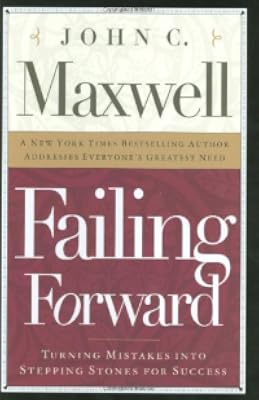
Failing Forward: Turning Mistakes into Stepping Stones for Success
by John C. Maxwell
On This Page
Description
Are some people born to achieve anything they want while others struggle? Call them lucky, blessed, or possessors of the Midas touch. What is the real reason for their success? Is it family background, wealth, greater opportunities, high morals, an easy childhood? New York Times best-selling author John C. Maxwell has the answer: The difference between average people and achieving people is their perception of and response to failure. Most people are never prepared to deal with failure. show more Maxwell says that if you are like him, coming out of school, you feared it, misunderstood it, and ran away from it. But Maxwell has learned to make failure his friend, and he can teach you to do the same. "I want to help you learn how to confidently look the prospect of failure in the eye and move forward anyway," says Maxwell. "Because in life, the question is not if you will have problems, but how you are going to deal with them. Stop failing backward and start failing forward!". show lessTags
Recommendations

















Member Reviews
I expected a lot from this book but it turned out to be quite repetitive and obvious. The message that you must not give up under any circumstances (except when you realize that you are doing something you weren't meant to do by God?) was repeated throughout the book, and after this claim you will read some story about someone who has succeeded in life and succeeded after failing repeatedly. Towards the end these anecdotes started feeling quite repetitive as well, although some of them were somewhat interesting.
What this book does not tell are those stories where people tried throughout their lives and never succeeded in spite of embracing the teachings of this book. Actually, this book claims that such a scenario is not possible, but show more I assure you that it is.
The book also seems to claim that there is this small elite of successful people who are successful because they are persistent and never give up. And then there are the rest, who just lie in their misery, blame others of not being successful themselves, whine all the time about the circumstances and do not take responsibility of their actions. I know there are people who are like that, but they are definitely a minority. Most adults who could be considered as "mediocre" are not like that. There are many other similar questionable claims in this book that are not backed by any data, and some claims that are just not true even though they might be inspirational to someone.
I'm not saying that the basic message of the book about learning to embrace failures, learning to analyze the reasons of your failures, taking responsibility and reflecting your own attitudes etc. is wrong, but these are age old teachings that this book makes sound so shallow and naive because of the mediocre writing and repetitiveness that reminds me of some trance-like religious convention. The book was also a very fast and easy read, and many times I found myself thinking if this book was actually written just to make some easy money for the writer, for it has so little of anything actually new or insightful to offer.
Maybe this book is useful, if you are really quite unsure of yourself and need a lot of positive reinforcement, or if you feel like you cannot handle failure at all. But it should not be read as a realistic description about how life actually works. In the end life and success is way more complex than Maxwell claims. show less
What this book does not tell are those stories where people tried throughout their lives and never succeeded in spite of embracing the teachings of this book. Actually, this book claims that such a scenario is not possible, but show more I assure you that it is.
The book also seems to claim that there is this small elite of successful people who are successful because they are persistent and never give up. And then there are the rest, who just lie in their misery, blame others of not being successful themselves, whine all the time about the circumstances and do not take responsibility of their actions. I know there are people who are like that, but they are definitely a minority. Most adults who could be considered as "mediocre" are not like that. There are many other similar questionable claims in this book that are not backed by any data, and some claims that are just not true even though they might be inspirational to someone.
I'm not saying that the basic message of the book about learning to embrace failures, learning to analyze the reasons of your failures, taking responsibility and reflecting your own attitudes etc. is wrong, but these are age old teachings that this book makes sound so shallow and naive because of the mediocre writing and repetitiveness that reminds me of some trance-like religious convention. The book was also a very fast and easy read, and many times I found myself thinking if this book was actually written just to make some easy money for the writer, for it has so little of anything actually new or insightful to offer.
Maybe this book is useful, if you are really quite unsure of yourself and need a lot of positive reinforcement, or if you feel like you cannot handle failure at all. But it should not be read as a realistic description about how life actually works. In the end life and success is way more complex than Maxwell claims. show less
Don't get me wrong. Maxwell's book contains a wealth of helpful information. But the fact is, very little of the material was new to me. That's probably because I've read more than a dozen books that focus on achieving success and coping with setbacks. "Failing Forward" served as more of a reminder about some of the lynchpins of success. The biggest takeaway, of course, involves the reality that success hinges more on how we play our proverbial cards and less about the cards we're dealt. The book includes dozens of enlightening anecdotes that reinforce Maxwell's themes -- a few too many anecdotes for my liking. My recommendation: if you've only read a few books that focus on success strategies, this tome will be insightful.
有些人似乎總是一帆風順、凡事亨通,別人會說他們蒙受幸運之神特別的眷顧。到底這些人成功的真正原因為何?是家庭背景?財富?更高的機會?高尚的品德?美好的童年?紐約時報暢銷書作者約翰.麥斯威爾(John C. Maxwell)如此說道:「佼佼者與泛泛者之間的差別在於他們如何看待失敗,以及他們的因應之道。」他以一貫的熱情、幽默明示了簡單易行的致勝原則,包括了15項可行的步驟幫助你達成目標。
I believe it was Edison that was asked after 1000 failed attempts to make a working light bulb if he was discouraged. His response - (paraphrase) "no, I now know 1000 ways that it wont work". It is a good book for keeping your head up and learning from your mistakes. Life is often more about how we respond to what happens then what actually happens. Filled with good stories of "overcomers" from all walks of life.
Easy read. Inspirational. I got some good ideas from it.
Some of my favorite quotes:
“People are training for success when they should be training for failure. Failure is far more common than success; poverty is more prevalent than wealth; and disappointment more normal than arrival.” J. Wallace Hamilton
“Many of life's failures are people who did not realize how close they were to success when they gave up.“ Thomas A. Edison
To achieve your dreams, you must embrace adversity and make failure a part of your life. If you are not failing, you are probably not moving forward.
“Don't let your learning lead to knowledge. Let your learning lead to action.” Jim Rohn
“By failing to prepare, you are preparing to fail.” Benjamin Franklin
“Highly successful leaders ignore conventional wisdom show more and take chances. Their stories inevitably include a defining moment or key decision when they took a significant risk and thereby experienced a breakthrough.” Larry Osborne show less
“People are training for success when they should be training for failure. Failure is far more common than success; poverty is more prevalent than wealth; and disappointment more normal than arrival.” J. Wallace Hamilton
“Many of life's failures are people who did not realize how close they were to success when they gave up.“ Thomas A. Edison
To achieve your dreams, you must embrace adversity and make failure a part of your life. If you are not failing, you are probably not moving forward.
“Don't let your learning lead to knowledge. Let your learning lead to action.” Jim Rohn
“By failing to prepare, you are preparing to fail.” Benjamin Franklin
“Highly successful leaders ignore conventional wisdom show more and take chances. Their stories inevitably include a defining moment or key decision when they took a significant risk and thereby experienced a breakthrough.” Larry Osborne show less
Outstanding book on overcoming adversity. A must read.
Members
- Recently Added By
Lists

r/GetMotivated's Recommended Books
27 works; 1 member

Men's healing resources
754 works; 1 member
Author Information

446+ Works 40,174 Members
John Calvin Maxwell an author, speaker, and pastor who has written many books, primarily focusing on leadership. He received a bachelor's degree at Ohio Christian University in 1969, a Master of Divinity degree at Azusa Pacific University, and a Doctor of Ministry degree at Fuller Theological Seminary. Maxwell's titles include The 21 Irrefutable show more Laws of Leadership, The 21 Indispensable Qualities of a Leader: Becoming the Person Others Will Want to Follow, There's No Such Thing as Business Ethics (There's Only ONE RULE for Making Decisions), The 15 Invaluable Laws of Growth, The 360° Leader and numerous others. His books have sold millions of copies, with some like The Five Levels of Leadership making the New York Times Best Seller List. (Bowker Author Biography) show less
Work Relationships
Classifications
Statistics
- Members
- 1,407
- Popularity
- 16,861
- Reviews
- 9
- Rating
- (3.90)
- Languages
- 7 — Chinese, English, Finnish, Hungarian, Portuguese, Romanian, Spanish
- Media
- Paper, Audiobook, Ebook
- ISBNs
- 30
- UPCs
- 4
- ASINs
- 14