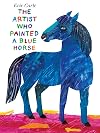
The Artist Who Painted a Blue Horse
by Eric Carle
On This Page
Description
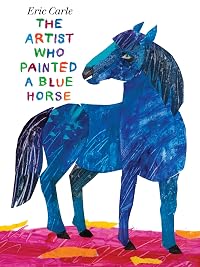
Rather than use the same old colors, a child paints animals and objects in a variety of different hues. Includes biographical information about the German painter Franz Marc, who created unconventional animal paintings in the early 1900s.Tags
Recommendations




Member Reviews
Apparently intended as a tribute to expressionist painter Marc Franz, to whose work Eric Carle was secretly introduced as a young boy living in Nazi Germany - Franz's artwork was considered "degenerate" by the Nazis, and was forbidden, but Carle's teacher took a great risk, and showed it to him anyway - The Artist Who Painted a Blue Horse follows a young artist as he creates a series of animals in vivid colors. Unconcerned with finding the "right" color, he creates a blue horse, a red crocodile, and a polka-dotted donkey, demonstrating that, in art, there are no wrong choices.
Chosen as one of our January selections over in The Picture-Book Club to which I belong, where our theme was "Books About Artists" (I'm running a little behind in show more my reading schedule), this visually striking title imparts an important message about the creative process - that we should follow our own course, and work from our own impressions, rather than trying to do things "properly," according to someone else's standard - without ever becoming didactic. A brief afterword gives more details about Marc Franz, but this isn't a biography, or even a non-fiction treatment of art, it's really more of a concept book about colors, animals, and the creative process, and can be read on a variety of levels. Toddlers, I imagine, will just be drawn to the bright colors and simple design, while slightly older children will also appreciate the ideas presented. show less
Chosen as one of our January selections over in The Picture-Book Club to which I belong, where our theme was "Books About Artists" (I'm running a little behind in show more my reading schedule), this visually striking title imparts an important message about the creative process - that we should follow our own course, and work from our own impressions, rather than trying to do things "properly," according to someone else's standard - without ever becoming didactic. A brief afterword gives more details about Marc Franz, but this isn't a biography, or even a non-fiction treatment of art, it's really more of a concept book about colors, animals, and the creative process, and can be read on a variety of levels. Toddlers, I imagine, will just be drawn to the bright colors and simple design, while slightly older children will also appreciate the ideas presented. show less
Over the last year, my daughter and I have spent much of our time reading mass amounts of books. She just turned two, and she's beginning to discover more than just a book's illustrations. It's amazing to watch her brain develop, and the things she's able to understand absolutely blow me away. We read all sorts of picture storybooks, but she definitely enjoys Carle's works more than anything else. We probably have a copy of Brown Bear in every room of the house, as it really is that important! I've come to enjoy his books almost as much as she has in this time, and I think that The Artist Who Painted a Blue Horse is my favorite. I gave this one too her as a Christmas gift this year, and it sends a message to her that will last a show more lifetime. In the story, our artist paints pictures of animals, but colors them in a rather, well, unorthodox manner. The book goes through a series of animals, ending with the most powerful line in any children's book that I've read, "I am a good artist." Such a powerful, confident declaration by our artist, one that must be instilled into children. I wrote a note on the endpage to her that reads, "Paint the world as you see fit, even when no one seems to understand." Thank you, Eric Carle, for inspiring millions of minds, regardless of age. show less
A very simple beginner's homage to, really, any unconventional artist. A springboard to the notes for slightly older children, which are themselves a springboard to more in-depth discussions of Marc and other artists labeled degenerate, and then to the whole WWII tragedies.
An artist paints a blue horse and then continues on to complete several canvases full of animals in unusual colors.
This book by Eric Carle has a barely existent plotline; rather, it is more a loose collection of pictures of animals. Nevertheless, when I shared this book with my niece, she seemed to enjoy it. (Of course, this book reminded me a bit of Carle's illustrations to Brown Bear, Brown Bear, What Do You See?, which was my niece's favorite book as an infant/toddler.)
For myself, I was a little disappointed the book didn't have more substance. That is, until I read the book's supplementary materials noting this book is a homage to the expressionistic artist Franz Marc and discussing Carle's experiences growing up in Nazi Germany show more where imaginative, unrealistic art was banned. With this in mind, I had greater appreciation for what this book is trying to do -- tell children it's okay to think outside the box and express themselves in whatever creative way is best. show less
This book by Eric Carle has a barely existent plotline; rather, it is more a loose collection of pictures of animals. Nevertheless, when I shared this book with my niece, she seemed to enjoy it. (Of course, this book reminded me a bit of Carle's illustrations to Brown Bear, Brown Bear, What Do You See?, which was my niece's favorite book as an infant/toddler.)
For myself, I was a little disappointed the book didn't have more substance. That is, until I read the book's supplementary materials noting this book is a homage to the expressionistic artist Franz Marc and discussing Carle's experiences growing up in Nazi Germany show more where imaginative, unrealistic art was banned. With this in mind, I had greater appreciation for what this book is trying to do -- tell children it's okay to think outside the box and express themselves in whatever creative way is best. show less
I have to say that I am a little disappointed with and by this book. I have always loved Eric Carle's artwork, and the illustrations are lovely, evocative, exuberant, pure Eric Carle magic. But I don't really find the narrative all that interesting and engaging (and I also do not see exactly how the text is or can be regarded as an homage to Franz Marc, the illustrations, definitely, but the text, not so much). If Eric Carle had wanted to have both the text and the illustrations appear as an homage to Franz Marc, why did he not simply make his artist figure into Franz Marc? It still would be a rather simple narrative, but it would be a text which actually has some meaning and some connection to Franz Marc, to the artist himself.
I really show more appreciate the additional information about Eric Carle's childhood in Germany (wonderful and informative, but also thought-provoking). Although this is not mentioned in the author's note itself, the fact that Eric's art teacher, Herr Krauss, secretly showed him expressionist art, and mentioned to him not only that the Nazis had no appreciation for art, but that they were charlatans, was both incredibly brave and extremely risky (the Nazis often relied on rumor and innuendo, and if Eric had either intentionally or even unintentionally mentioned his talk with the art teacher, and the authorities had somehow gotten wind of this, Herr Krauss could easily have faced very, very serious consequences).
The biographical information regarding Franz Marc is basically adequate, but one important and supremely tragic aspect of Franz Marc's life has not been mentioned. Like many European expressionists (both writers and artists), Franz Marc originally welcomed WWI as some sort of futuristic dream, a strong, willful current to clean and beautify a decadent society. And like so many European expressionist authors and artists who had voluntarily enlisted in their respective armies, Franz Marc realised much too late that war was never a positive, but a philosophy, a way of thinking that begat only death and destruction (not only his own death, but the deaths of thousands and thousands, among them many of the brightest and most promising literary and artistic lights of their age). Now I know that a detailed analysis of expressionism and the attitude of the expressionists to WWI would most definitely have been above and beyond the scope of this book (it would simply have been too much information for a picture book, for most non academic literature, in fact). However, I do think the fact that Franz Marc had originally and quite strongly supported the Great War should have at least been mentioned in the author's note, as this is not only an important aspect of Franz Marc's biography, his very being, it also underlines not only the futility of war, but that war can and does have the destructive power to influence and negatively enchant.
I would recommend the text of [b:The Artist Who Painted a Blue Horse|10585755|The Artist Who Painted a Blue Horse|Eric Carle|http://photo.goodreads.com/books/1348639432s/10585755.jpg|15493064] for younger children (ages two to maybe about five). The author's notes, however, would be more suitable for older children, as younger children would not only likely have trouble understanding, grasping the presented materials, the information might also be somewhat frightening (such as the fact that Franz Marc was killed in WWI, or that during the Nazi era, art and artists not in line with the authorities were often deemed to be degenerate). show less
I really show more appreciate the additional information about Eric Carle's childhood in Germany (wonderful and informative, but also thought-provoking). Although this is not mentioned in the author's note itself, the fact that Eric's art teacher, Herr Krauss, secretly showed him expressionist art, and mentioned to him not only that the Nazis had no appreciation for art, but that they were charlatans, was both incredibly brave and extremely risky (the Nazis often relied on rumor and innuendo, and if Eric had either intentionally or even unintentionally mentioned his talk with the art teacher, and the authorities had somehow gotten wind of this, Herr Krauss could easily have faced very, very serious consequences).
The biographical information regarding Franz Marc is basically adequate, but one important and supremely tragic aspect of Franz Marc's life has not been mentioned. Like many European expressionists (both writers and artists), Franz Marc originally welcomed WWI as some sort of futuristic dream, a strong, willful current to clean and beautify a decadent society. And like so many European expressionist authors and artists who had voluntarily enlisted in their respective armies, Franz Marc realised much too late that war was never a positive, but a philosophy, a way of thinking that begat only death and destruction (not only his own death, but the deaths of thousands and thousands, among them many of the brightest and most promising literary and artistic lights of their age). Now I know that a detailed analysis of expressionism and the attitude of the expressionists to WWI would most definitely have been above and beyond the scope of this book (it would simply have been too much information for a picture book, for most non academic literature, in fact). However, I do think the fact that Franz Marc had originally and quite strongly supported the Great War should have at least been mentioned in the author's note, as this is not only an important aspect of Franz Marc's biography, his very being, it also underlines not only the futility of war, but that war can and does have the destructive power to influence and negatively enchant.
I would recommend the text of [b:The Artist Who Painted a Blue Horse|10585755|The Artist Who Painted a Blue Horse|Eric Carle|http://photo.goodreads.com/books/1348639432s/10585755.jpg|15493064] for younger children (ages two to maybe about five). The author's notes, however, would be more suitable for older children, as younger children would not only likely have trouble understanding, grasping the presented materials, the information might also be somewhat frightening (such as the fact that Franz Marc was killed in WWI, or that during the Nazi era, art and artists not in line with the authorities were often deemed to be degenerate). show less
I love what Carle did here, that being he is teaching kids to use their imagination. It is not normal to have a blue horse, a yellow cow, or a pink rabbit but through writing and drawing you can have whatever you want. I think this one has been one of my favorites thus far. Especially, the self reassurance and acceptance at the end of the book when the artist notes that he is a good one even though what he paints isn't "normal".
This picture book was so cute and strives for children to continue to use their imagination! The book uses words to explain the animal and color it is and that's it. The pictures take up most of the space and it is so wonderful how each animal is a different color than we would imagine. It helps to teach children that art can be anything we imagine and isn't confined to what makes sense to others. I think teacher would love to use this before activities asking for creativity.
Members
- Recently Added By
Lists

Written and Illustrated By
805 works; 1 member
Author Information

585+ Works 194,354 Members
Eric Carle is an award-winning, children's picture book author and illustrator whose most recognized work is The Very Hungry Caterpillar Board Book. Carle was born to German parents in 1929 in Syracuse, New York. The family returned to Germany in 1935, moving to a suburb of Stuttgart. Carle disliked high school, quitting at the age of 16 before show more graduation. He was admitted as the youngest student to the Akademie der bildenden Kunste, an art school. After finishing at the Akademie, he worked as a poster designer for the U.S. Information Center in Germany until 1952, when he moved back to New York City. He was a graphic designer at the New York Times and later worked as an art director at L.W. Frohlich & Co. In 1963, Bill Martin, Jr. saw a poster of a red lobster that Carle had designed and asked him to illustrate Brown Bear, Brown Bear, What Do You See?, thus launching his freelance career. Among his many children's books are Dream Snow, Hello, Red Fox, The Very Clumsy Click Beetle, and Pancakes, Pancakes! His title The Artist Who Painted a Blue Horse made Publisher's Weekly Best Seller List for 2011. His title Brown Bear Brown Bear What to You See? made The New York Times Best Seller List for 2012. In 2015 he made The New Zealand Best Seller List with Love from the Very Hungry Caterpillar. Eric Carle, beloved children's book author and illustrator, died on May 23, 2021. He was 91. (Bowker Author Biography) show less
Awards and Honors
Classifications
Statistics
- Members
- 945
- Popularity
- 28,018
- Reviews
- 38
- Rating
- (4.19)
- Languages
- 7 — Chinese, Dutch, English, German, Japanese, Portuguese, Spanish
- Media
- Paper, Ebook
- ISBNs
- 23
- ASINs
- 6