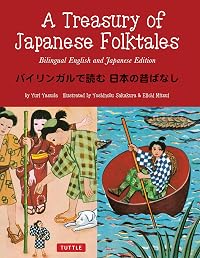
A Treasury of Japanese Folk Tales: Bilingual English and Japanese Edition
by Yuri Yasuda
On This Page
Description
Collection of Japanese folktales, presented in both English and basic kanji accompanied by furigana.Tags
Recommendations






Member Reviews
Culturally focused, this treasury of Japanese folktales is astounding. The stories are put on each page both in Japanese and English while including illustrations. Some of the illustrations don't match up with what is being said on the page which makes it difficult for people who are more familiar with western picture books and western tales to understand. The illustrations were clearly drawn and use firm lines and color to create patterns and movement. Most of the tales are told from an "I" perspective which can be difficult to discern at first but slowly begins to "make sense". At the end of the treasury is a play that highlights Japan's very large theatre culture especially when discussing folktales. Part of the stories throughout show more the book have creatures that repeat phrases related to them (much like the cries of Pokemon) which create a rhythm for the story and for the characters. Overall the stories are moral-based and typically carry a message of "do good and you will have good fortune, do bad and you will have bad fortune". Some of this is shown in sharp relief such as the story of the man who saves a sparrow and whose wife, cuts out its tongue. He is awarded with riches, she is given a box of snakes and spiders. show less
Nice collection of Japanese fairytales/folklore, nicely illustrated. Stories included are: Shitakiri Suzume (Tongue cut Sparrow); Kintaro (Strong Boy); Nezumi no Yomeiri (Marriage of a Mouse); Urashima Taro (Fisherman and the Tortoise); Kaguya Hime (Luminous Princess); Momotaro (Peach Boy); Kachi Kachi Yama (Kachi Kachi Mountain); Kobutori Jiisan (Old Men with Wens); Hanasaka Jijii (old Man Who Made Trees Blossom); Issunboshi (One Inch Boy); Bunbuku Chagama (Lucky Cauldron); and Sarukani Kassen (Monkey and Crab Fight.) Anyone watching anime, reading manga or reading books by Japanese writers will see correlations to a number of the stories as they are all ingrained in Japanese culture.
The bilingual aspect would be helpful for learners show more of Japanese - the kanji are marked with their furigana for easier reading, and are generally fairly easy to follow. My only issue would be that I would have preferred a side by side comparison or line by line - as it is, the English is mainly in the upper half of the page, and the Japanese is below in a solid block. I can understand why they would do this - but I think that it would have been better as a side by side/facing page. Other than this small quibble, this is a excellent resource for early students or people interested in learning more about Japan's culture and lore. (As a side note, I finally learned about the little "capes" on some of the religious statues which had stumped me when I visited a few years ago. A mystery solved! Ans.: not capes, bibs put on Ojizo-san, a deity associated with the protection of babies.) show less
The bilingual aspect would be helpful for learners show more of Japanese - the kanji are marked with their furigana for easier reading, and are generally fairly easy to follow. My only issue would be that I would have preferred a side by side comparison or line by line - as it is, the English is mainly in the upper half of the page, and the Japanese is below in a solid block. I can understand why they would do this - but I think that it would have been better as a side by side/facing page. Other than this small quibble, this is a excellent resource for early students or people interested in learning more about Japan's culture and lore. (As a side note, I finally learned about the little "capes" on some of the religious statues which had stumped me when I visited a few years ago. A mystery solved! Ans.: not capes, bibs put on Ojizo-san, a deity associated with the protection of babies.) show less
*The Old Men with Wens*
A story of two old men, one nice and one mean. Both have a wen ( a large lump) hanging from their faces. One day on the way home from work the nice old man found himself in a thunderstorm, so he hid in a tree truck and accidentally fell asleep. When he woke he found goblins drinking/dancing. He began to dance as well and the goblins liked it so much that they took his wen away in hopes that he would come back tomorrow. When the mean old man saw this he wanted to get rid of his wen as well. He went to the goblins but could not dance as well as the nice old man so instead they stuck the other wen on his face.
A story of two old men, one nice and one mean. Both have a wen ( a large lump) hanging from their faces. One day on the way home from work the nice old man found himself in a thunderstorm, so he hid in a tree truck and accidentally fell asleep. When he woke he found goblins drinking/dancing. He began to dance as well and the goblins liked it so much that they took his wen away in hopes that he would come back tomorrow. When the mean old man saw this he wanted to get rid of his wen as well. He went to the goblins but could not dance as well as the nice old man so instead they stuck the other wen on his face.
My edition ?ádifferent cover but same ISBN.
Neat to see the Japanese characters. ?á
Some illustrations are lovely, some too cartoony for my taste. ?áMost of the tales instantly forgettable, in *my* opinion, but probably just fine for a folklore unit in school. ?áBrief notes about the collection, but none about the stories: no context, no history. ?áSome of the language a little precious. ?áGood resource for teachers and parents determined to somehow teach their children about the fact that our world is both larger and smaller than we normally think of it being.
Neat to see the Japanese characters. ?á
Some illustrations are lovely, some too cartoony for my taste. ?áMost of the tales instantly forgettable, in *my* opinion, but probably just fine for a folklore unit in school. ?áBrief notes about the collection, but none about the stories: no context, no history. ?áSome of the language a little precious. ?áGood resource for teachers and parents determined to somehow teach their children about the fact that our world is both larger and smaller than we normally think of it being.
Ratings
Members
- Recently Added By
Lists

Nice Anthologies for Kids
66 works; 3 members
Author Information
10 Works 145 Members
Classifications
- Genres
- Children's Books, Picture Books
- DDC/MDS
- 398.20952 — Society, government, & culture Customs, etiquette & folklore Folklore & Folktales Folk literature History, geographic treatment, biography Asian folktales Japanese folklore
- LCC
- PZ49.41 .Y37 — Language and Literature Fiction and juvenile belles lettres Fiction and juvenile belles lettres Juvenile belles lettres
- BISAC
Statistics
- Members
- 62
- Popularity
- 501,533
- Reviews
- 4
- Rating
- (4.08)
- Languages
- English
- Media
- Paper, Ebook
- ISBNs
- 3
- ASINs
- 1