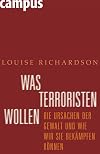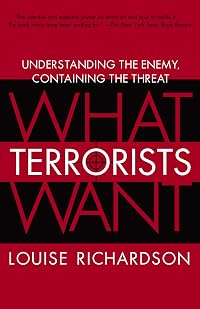
What Terrorists Want: Understanding the Enemy, Containing the Threat
by Louise Richardson
On This Page
Description
"After defining - once and for all - what terrorism is, Richardson explores its origins, its goals, what's to come, and what is to be done about it. Richardson understands that terrorists are neither insane nor amoral. Rather, they are rational political actors who often deploy carefully calibrated tactics in a measured and reasoned way. What is more, they invariably go to great lengths to justify their actions to themselves, their followers, and, often, the world." "Richardson shows that show more the nature of terrorism did not change after the attacks of September 11, 2001; what changed was our response. She argues that the Bush administration's "global war on terror" was doomed to fail because of an ignorance of history, a refusal to learn from the experience of other governments, and a fundamental misconception about how and why terrorists act. As an alternative, Richardson offers a feasible strategy for containing the terrorist threat and cutting off its grassroots support."--BOOK JACKET. show lessTags
Recommendations












Member Reviews
"What Terrorists Want" provides a valuable academic perspective on the history and anatomy of terrorism as a social, political and military phenomenon. Relatively free of ideological posturing, Louise Richardson's analysis cites examples of terrorists movements from the middle ages through the Iraq War, across a variety of religious (and secular) traditions, and draws thereby a host of salient conclusions about the prominent motivations behind terrorist action. Along the way, she handily refutes the most common (and durable) misconceptions about terrorism generally; i.e., that it is a symptom of psychological disfunction, religious indoctrination, or the verities of disaffection, poverty or naïveté.
The latter part of the book tends to show more get sidetracked by the political issues and controversies of the Iraq War and the policies of George W. Bush. As the first edition was published in 2006, this is perhaps excusable to some degree, but it tends to diminish the timelessness of her central points. (It can be reasonably argued that U.S. foreign policy is subject to a cornucopia of non-counterterrorism-related influences, and any serious critique of same should at least make an attempt to acknowledge this.) The essential correctness, however, of her central thesis about terrorism is well able to withstand scrutiny. In the final analysis, Richardson gives a clear, focused and infuriating account of why terrorism is adopted as a tactic of psychological warfare and how the inability or unwillingness to acknowledge its underlying social mechanics threatens us all. show less
The latter part of the book tends to show more get sidetracked by the political issues and controversies of the Iraq War and the policies of George W. Bush. As the first edition was published in 2006, this is perhaps excusable to some degree, but it tends to diminish the timelessness of her central points. (It can be reasonably argued that U.S. foreign policy is subject to a cornucopia of non-counterterrorism-related influences, and any serious critique of same should at least make an attempt to acknowledge this.) The essential correctness, however, of her central thesis about terrorism is well able to withstand scrutiny. In the final analysis, Richardson gives a clear, focused and infuriating account of why terrorism is adopted as a tactic of psychological warfare and how the inability or unwillingness to acknowledge its underlying social mechanics threatens us all. show less
This amazingly brief compendium of what we know about terrorists and terrorism ends with a to my mind very accurate critique of U.S. policies and actions to address terrorism since September 2001 and then a set of six rules and suggestions to more effectively handle terrorism. Dr. Richardson writes in a fluent style, has been researching and analyzing terrorism for a long time, and is clear about her biases. Highly recommended.
Er is een enorme inflatie in het begrip terrorisme ontstaan. Een paar vervelende hangjongeren zijn tegenwoordig al ‘straatterroristen’. Het is tijd voor ontnuchtering en verheldering. Richardson probeert redelijkheid terug te krijgen in het debat over terrorisme. Lees verder....
Mar 28, 2009Dutch
Ratings
Members
- Recently Added By
Series
Belongs to Publisher Series
Classifications
- Genres
- Nonfiction, General Nonfiction, History
- DDC/MDS
- 363.325 — Society, government, & culture Social problems and social services Public Safety - Police, Crime Investigation Terrorism, Disasters, Civil Defense Social conflict Terrorism
- LCC
- HV6431 .R53 — Social sciences Social pathology. Social and public welfare. Criminology Social pathology. Social and public welfare. Criminology Crimes and offenses
- BISAC
Statistics
- Members
- 206
- Popularity
- 158,218
- Reviews
- 3
- Rating
- (3.90)
- Languages
- Dutch, English, German
- Media
- Paper, Ebook
- ISBNs
- 10
- ASINs
- 1