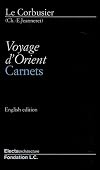
Journey to the East
by Le Corbusier
On This Page
Description
This is the legendary travel diary that the 24-year-old Charles-Edouard Jeanneret (Le Corbusier) kept during his first journey through central and eastern Europe. In a flood of highly personal impressions and visual notations, it records his first contact with the vernacular architecture that would preoccupy him for the rest of his life and with the monuments he most admired, the mosque complexes, the Acropolis, and the Parthenon. "'Very often, I left the Acropolis burdened by a heavy show more premonition, not daring to imagine that one day I would have to create.' Such words, are moving from any aspiring architect; from Le Corbusier they are an inspiration." -- Progessive Architecture An this centenary year [1987] of his birth, many books are being published about Le Corbusier but none offers more insight into his character than this book from his own hand ... Every designer speculates at one time or another just what attributes other than talent are needed for success. In the case of the young Le Corbusier this travel journal reveals... extraordinary ego, energy, curiosity, and passion." -- Interior Design Ivan Zaknic, the editor and translator, is Associate Professor of Architecture at Lehigh University. show lessTags
Recommendations



















Member Reviews
Members
- Recently Added By
Lists

Le Corbusier
11 works; 1 member
Author Information

204+ Works 3,696 Members
Le Corbusier is considered by many to be the leading architect of modern architecture. Born of Swiss parentage near Geneva, but a lifelong Parisian by choice, he started his practice in 1922. In 1923 he published his startling manifesto of what he called "the aesthetics of modern life," Vers une architecture (Towards a New Architecture). Le show more Corbusier worked first at simplifying and liberating house design through the revolutionary use of new materials---particularly, reinforced concrete---and new technical ideas for mass production, which he applied in the so-called Dom-Ino and the Citrohan House. In his widely influential book La Ville Radieuse (The Radiant City) (1935), he laid down his urban planning ideas:a city of high-rise buildings set among trees and grass. His designs for large building groups proved to be as influential as his domestic designs had been. These include the famous housing project in Marseilles (the Unite d'Habitation), his League of Nations project in Geneva (unexecuted), and, toward the end of his life, the startling designs for the capital city of Punjab, Chandigarh. He also participated---controversially---in the designs for the U.N. headquarters in New York. In his last years, Le Corbusier turned away from the geometry and pure logic of his first designs and adopted sculptural and dramatic forms, as in Chandigarh. The almost mystical complexities of Le Corbusier's Pilgrim Church of Ronchamps in the French Jura opened another chapter in the history of twentieth-century architecture. (Bowker Author Biography) show less
Awards and Honors
Classifications
Statistics
- Members
- 110
- Popularity
- 293,504
- Rating
- (4.30)
- Languages
- 6 — English, French, Italian, Portuguese, Spanish, Turkish
- Media
- Paper
- ISBNs
- 15