Media Virus!
by Douglas Rushkoff
On This Page
Description
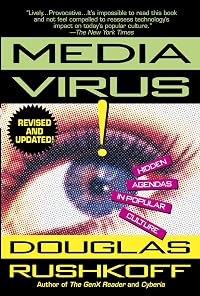
Finally, there is a way to understand the bizarre relationship we Americans have with our information technology: the media is alive. Welcome to the "datasphere," also known as the late twentieth century. Here, good news, bad news, any news, travels in the blink of an eye. And not just news, but information: ideas, images, and icons; fads, fashions, and fantasies; truths, lies, and propaganda. While cable television, fiber-optic telecommunications, satellite dishes, computer modems, show more camcorders, fax machines, and videocassettes form the crisscrossed arteries of a vast "information superhighway," we must ask ourselves: What sort of messages are these brave new medias carrying into our culture? Bold, daring, and provocative, Media Virus! examines the intricate ways in which popular media both manipulates and is manipulated by those who know how to tap into its power. And it considers - with something between amusement and mild alarm - the ever-widening ripple effect of the successful "media virus." As culture critic for our wild times, Douglas Rushkoff shows that where there's a wavelength, there's a way to "infect" those on it - from the subtly, but intentionally, subversive signals broadcast by shows like "The Simpsons," to the odd serendipity of a classic New York-style sex 'n' family values scandal (a la Woody and Mia) exploited by the Republicans during their convention. What does it all mean? Unless you've been living in a cave that isn't cable-ready, you're already infected with the media virus. But don't worry, it won't make you sick. It will make you think ... show lessTags
Recommendations





















Member Reviews
Мы живем в эпоху, когда ценность данных, образов и идеологий превосходит ценность материальных приобретений и физического пространства. Прошли те времена, когда социальный статус человека измерялся расстоянием, которое он должен был пройти, чтобы увидеть дым соседского бивачного костра. В конечном итоге мы достигли наших пределов; мы увидели Землю из космоса. Иллюзия безграничности незавоеванных show more территорий разрушена навсегда. Свободного пространства попросту больше нет, колонизировать больше нечего.
Единственная среда, в которой наша цивилизация еще может расширяться, наш единственный настоящий фронтир - это эфир, иными словами - медиа. Власть, которой сегодня обладает тот или иной человек, определяется уже не количеством собственности, находящейся в его распоряжении, а тем, сколько минут прайм-тайма на телевидении или страниц ново-стной печати он может заполучить. Наша новая среда обитания называется ИНФОСФЕРОЙ. show less
Единственная среда, в которой наша цивилизация еще может расширяться, наш единственный настоящий фронтир - это эфир, иными словами - медиа. Власть, которой сегодня обладает тот или иной человек, определяется уже не количеством собственности, находящейся в его распоряжении, а тем, сколько минут прайм-тайма на телевидении или страниц ново-стной печати он может заполучить. Наша новая среда обитания называется ИНФОСФЕРОЙ. show less
http://lampbane.livejournal.com/438312.html
"It was written in 1994, so of course, many of the passages really are outdated. But so much is still so true, especially in the chapter about the 1992 election. The principal characters are similiar - back then we had a Bush and a Clinton, and now we have a Bush and a Clinton, though the roles have changed and it's not the same exact people involved. That section talked about how Clinton and Perot used new techniques to reach people through the media - participatory media like talk shows and town forum meetings. It's really not all that different from YouTube contests, when you think about it."
"It was written in 1994, so of course, many of the passages really are outdated. But so much is still so true, especially in the chapter about the 1992 election. The principal characters are similiar - back then we had a Bush and a Clinton, and now we have a Bush and a Clinton, though the roles have changed and it's not the same exact people involved. That section talked about how Clinton and Perot used new techniques to reach people through the media - participatory media like talk shows and town forum meetings. It's really not all that different from YouTube contests, when you think about it."
Ratings
Members
- Recently Added By
Author Information

61+ Works 4,256 Members
Douglas Rushkoff was born on February 18, 1961. After graduating from Princeton University he received an MFA in Directing from California Institute of the Arts. He has written numerous magazine columns on topics including cyberculture and has been aired on CBS Sunday Morning and NPR's All Things Considered and published in The New York Times and show more Time magazine. Rushkoff has taught at the MaybeLogic Academy, NYU's Interactive Telecommunications Program, and the Esalen Institute, and he teaches media studies at the New School University. Rushkoff lectures around the world about media, art, society, and change at conferences and universities. He consults to museums, governments, synagogues, churches, universities, and companies on new media arts and ethics. Rushkoff won the first Neil Postman award for Career Achievement in Public Intellectual Activity. He is on the Boards of the Media Ecology Association, The Center for Cognitive Liberty and Ethics, Technorealism, The National Association for Media Literacy Education, MeetUp.com, and Hyperwords. His bestselling books include graphic novels, Cyberia, Media Virus, Playing the Future, Nothing Sacred: The Truth about Judaism, Get Back in the Box: Innovation from the Inside Out, Coercion, and Life Inc. (Bowker Author Biography) show less
Awards and Honors
Notable Lists
Classifications
- Genres
- Nonfiction, General Nonfiction, Technology
- DDC/MDS
- 302.23 — Society, government, & culture Social sciences, sociology & anthropology Mass Communication & Media Communication Media (Means of communication)
- LCC
- P94.65 .U6 .R87 — Language and Literature Philology. Linguistics Communication. Mass media
- BISAC
Statistics
- Members
- 253
- Popularity
- 128,240
- Reviews
- 2
- Rating
- (3.69)
- Languages
- English, German, Russian
- Media
- Paper, Ebook
- ISBNs
- 6
- ASINs
- 1