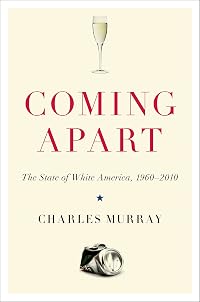
Coming Apart
by Charles Murray
On This Page
Description
A critique of the white American class structure argues that the paths of social mobility that once advanced the nation are now serving to further isolate an elite upper class while enforcing a growing and resentful white underclass.Tags
Recommendations











Member Reviews
As a time travel thriller, Stephen King’s “11/22/63” draws a lot of contrasts between America just before the Kennedy assassination and America of the early 2010s. King doesn’t whitewash problems of the era such as endemic racism; but his novel left me feeling that, in the half century following Kennedy’s death, the country lost something deeply good in terms of social cohesion and community.
The year after King published his tribute to the past, Charles Murray published his sociological work on the same conceit: that between 1960 and 2010, American social cohesion disintegrated at an alarming pace. Murray even uses the fixed point of November 21, 1963 to describe the nation’s social landscape just before the Texas School show more Book Depository became the most infamous warehouse in the world.
The Gen X in me wants to crack a joke about Boomer nostalgia. However, it’s worth acknowledging that two ideologically divergent authors who lived through these decades do converge on a consensus that something has changed, and not for the better. No doubt this is where their agreement ends, but for Murray that something is the gutting of four civic virtues that the American experiment needs to survive.
His thesis is that America requires a specific set of virtues to survive as the Founders intended: marriage, industriousness, honesty, and religion. He attempts through survey data, census records, and longitudinal studies to demonstrate that these virtues are increasingly concentrated in self-selected upper-class ghettos and increasingly gone from lower-class wastelands.
In affluent enclaves of privilege and power, elites still enjoy strong marriages, work incredibly hard, and trust each other. Outside these walls, families are shattered, young and able men drift from welfare check to welfare check, and rampant crime destroys trust. (Interestingly enough, Murray charts comparable declines in religiosity regardless of class. Church just ain’t what it used to be.)
He attributes this to two primary drivers: the dual-action sorting machine of the knowledge economy and university system, and the rise of the welfare state. For elites, the sorting machine privileges the creation of a small but dominant class of affluent elites, who cluster in cultural cocoons from which emerge next-generation butterflies utterly detached from the other 90+ percent of America.
For the lower class, the welfare state kneecaps the four virtues by making life too easy. If you aren’t incentivized by adversity to roll up your sleeves and get to work, you won’t be incentivized toward the kind of self-discipline that produces the virtues. This gap between an out-of-touch ruling class and an eviscerated lower class will destroy the American experiment if it keeps widening.
Murray’s book generated enormous controversy, and I don’t know how much of it I agree with. I’m not a social scientist, but I’m always cautious with sociological work. Human dynamics are so complex that it’s easy to cherry-pick data, even for the most self-aware sociologist who tries really hard to control the variables. We don’t reduce easily to graphs.
I’m also not sure what solution he offers. He clearly thinks the welfare state should be replaced by a universal basic income, but it’s not clear to me how that solves his problem. He also thinks the last bastion of traditional American civic virtues (the rich upper class) need to get off its postmodern horse and, in his words, preach what they practice. Even if Murray were completely and totally right, I don’t believe educated elites are going to start shaming those who transgress traditional morality.
I do think Murray’s book is valuable in that it requires you to think about his data and conclusions. Even if you agree with the Southern Poverty Law Center and believe he’s a racist pig, you should grapple with his charts of lower-class decline. Even if you bristle at his agnostic shoulder shrugging about religion and at his portrait of a virtuous elite, you should wrestle with his stats on upper-class stability.
That America is coming apart at the level of class feels intuitively correct. Why it’s coming apart or whether it’s unstoppable is up to you to decide. Murray offers one possible perspective, perhaps partially right and partially wrong. We won’t know if we never think about it, and I’m glad he made me think about it. show less
The year after King published his tribute to the past, Charles Murray published his sociological work on the same conceit: that between 1960 and 2010, American social cohesion disintegrated at an alarming pace. Murray even uses the fixed point of November 21, 1963 to describe the nation’s social landscape just before the Texas School show more Book Depository became the most infamous warehouse in the world.
The Gen X in me wants to crack a joke about Boomer nostalgia. However, it’s worth acknowledging that two ideologically divergent authors who lived through these decades do converge on a consensus that something has changed, and not for the better. No doubt this is where their agreement ends, but for Murray that something is the gutting of four civic virtues that the American experiment needs to survive.
His thesis is that America requires a specific set of virtues to survive as the Founders intended: marriage, industriousness, honesty, and religion. He attempts through survey data, census records, and longitudinal studies to demonstrate that these virtues are increasingly concentrated in self-selected upper-class ghettos and increasingly gone from lower-class wastelands.
In affluent enclaves of privilege and power, elites still enjoy strong marriages, work incredibly hard, and trust each other. Outside these walls, families are shattered, young and able men drift from welfare check to welfare check, and rampant crime destroys trust. (Interestingly enough, Murray charts comparable declines in religiosity regardless of class. Church just ain’t what it used to be.)
He attributes this to two primary drivers: the dual-action sorting machine of the knowledge economy and university system, and the rise of the welfare state. For elites, the sorting machine privileges the creation of a small but dominant class of affluent elites, who cluster in cultural cocoons from which emerge next-generation butterflies utterly detached from the other 90+ percent of America.
For the lower class, the welfare state kneecaps the four virtues by making life too easy. If you aren’t incentivized by adversity to roll up your sleeves and get to work, you won’t be incentivized toward the kind of self-discipline that produces the virtues. This gap between an out-of-touch ruling class and an eviscerated lower class will destroy the American experiment if it keeps widening.
Murray’s book generated enormous controversy, and I don’t know how much of it I agree with. I’m not a social scientist, but I’m always cautious with sociological work. Human dynamics are so complex that it’s easy to cherry-pick data, even for the most self-aware sociologist who tries really hard to control the variables. We don’t reduce easily to graphs.
I’m also not sure what solution he offers. He clearly thinks the welfare state should be replaced by a universal basic income, but it’s not clear to me how that solves his problem. He also thinks the last bastion of traditional American civic virtues (the rich upper class) need to get off its postmodern horse and, in his words, preach what they practice. Even if Murray were completely and totally right, I don’t believe educated elites are going to start shaming those who transgress traditional morality.
I do think Murray’s book is valuable in that it requires you to think about his data and conclusions. Even if you agree with the Southern Poverty Law Center and believe he’s a racist pig, you should grapple with his charts of lower-class decline. Even if you bristle at his agnostic shoulder shrugging about religion and at his portrait of a virtuous elite, you should wrestle with his stats on upper-class stability.
That America is coming apart at the level of class feels intuitively correct. Why it’s coming apart or whether it’s unstoppable is up to you to decide. Murray offers one possible perspective, perhaps partially right and partially wrong. We won’t know if we never think about it, and I’m glad he made me think about it. show less
Charles Murray could have spared writing this book simply by reading Elizabeth Warren's Two-income Trap, as it answers all the questions Murray should have asked if he had an open mind. His previous explanation that all of America's ills were caused by its supposedly less intelligent but pigment-rich co-citizens having obviously failed, he explores two new ideas, this time simply among white people (in its extended inclusion of formerly non-white whites). Murray's first explanation is eugenics: In Brave New World terms, it is about those damn Alphas unwilling to breed with Gammas and Deltas. Thank God for John Edwards impregnating his campaign worker. His action truly helps keeping up the non-Alpha gene pool.
Murray's second explanation show more is the loss of 1960s morals. Murray has found a mostly white trash neighborhood in Philadelphia, the Dickensian Fishtown with terrible social statistics. Out of touch, Murray fails to connect Fishtown to the hit comedy series "It's always sunny in Philadelphia" with its loutish characters (while otherwise judging America by its TV representations). The poor whites in Fishtown have started acting like Murray's despised black folks. The baby-daddy no longer marrying the mother. The true cause of this change is not, as Murray claims, a morale decline but the economic devastation endured by blue collar workers in the US. Their real incomes have declined since the 1970s. Marrying a working class male has become a losing proposition in the US. The public's decisions are relatively rational under those odious socio-economic constraints.
America's filthy rich, concentrated and segregated in a few Super-ZIPs, have looted the country's future, transferring more and more risk to the individual while socializing the losses of the rich. Murray, who lives among them, at least acknowledges the problematic nature of those Super-ZIPs but fails to discuss the obvious and simple solution: Tax the rich. Instead, he launches an unhelpful culture war petard.
An honest assessment was not to be expected of a paid pied piper of the 1%. Hopefully, this will be his last tune. The US desperately needs a new melody. Instead of this book, read Warren's Two-income Trap. She is a true conservative with a vision for the US. show less
Murray's second explanation show more is the loss of 1960s morals. Murray has found a mostly white trash neighborhood in Philadelphia, the Dickensian Fishtown with terrible social statistics. Out of touch, Murray fails to connect Fishtown to the hit comedy series "It's always sunny in Philadelphia" with its loutish characters (while otherwise judging America by its TV representations). The poor whites in Fishtown have started acting like Murray's despised black folks. The baby-daddy no longer marrying the mother. The true cause of this change is not, as Murray claims, a morale decline but the economic devastation endured by blue collar workers in the US. Their real incomes have declined since the 1970s. Marrying a working class male has become a losing proposition in the US. The public's decisions are relatively rational under those odious socio-economic constraints.
America's filthy rich, concentrated and segregated in a few Super-ZIPs, have looted the country's future, transferring more and more risk to the individual while socializing the losses of the rich. Murray, who lives among them, at least acknowledges the problematic nature of those Super-ZIPs but fails to discuss the obvious and simple solution: Tax the rich. Instead, he launches an unhelpful culture war petard.
An honest assessment was not to be expected of a paid pied piper of the 1%. Hopefully, this will be his last tune. The US desperately needs a new melody. Instead of this book, read Warren's Two-income Trap. She is a true conservative with a vision for the US. show less
I have friends who remind me, regularly, that wealth is becoming more and more concentrated among the wealthy. Further, the "not rich" are making less than they used to, relative to the wealthy. In other words, the rich are getting richer and the poor are getting poorer.
There is a divide growing in America, argues Charles Murray in his book "Coming Apart: The State of White America, 1960 - 2010" but it isn't necessarily just over money. In fact, the divide may be greater because it is cultural, not just economic.
Displaying a dizzying array of statistics, studies, and research, Murray shows an America that is watching the rise of what seems, to me, to be a new ruling class, a group of elites that are well educated ("overeducated elitist show more snobs"), well connected, and with a set of values and interests different from much of modern America. The self-segregation is not malicious, but, largely a result of people being attracted to others like them. As a result, their children grow up with a different set of values, more educated, and in turn marry people like them, further segregating themselves.
It works both ways, though, and Murray sets up as a comparison a hypothetical city on the upper ("Belmont") and on the lower ("Fishtown") ends of the spectrum to compare them. In his analysis, people in Belmont are better educated, less likely to get divorced (if at all), more involved in their community, work longer hours, are more honest, and are more religious. On the other hand, vital statistics in all of these areas for Fishmont show a gradual falling off over the last fifty years.
Why is this problematic? One reason is that it has resulted in a culture for the upper class that is completely out of touch with most of America. They watch different movies, participate in different social activities, drink different beers, and read different books. Their interests are not the same, and yet they are a select group that sets policy and opinion, controls wealth and power, for America.
Another problem is that the degradation of values in lower class America over the last fifty years is leading to a collapse of "American civic life," something exceptional about America. At this juncture in the book, Murray, a confessed libertarian, recaps the roots and history of American civic culture and its uniqueness in the world. Neighborliness, vibrant civic engagement in solving local problems, voluntary associations, and so on. All hallmarks of America up to as recently as the 1960s, the members of lower and upper classes shared through these civic association a culture together that connected them and their values.
Further, although the elite retain some values, they have failed to lead. The elite class is as "dysfunctional in its way as the new lower class is in its way. Personally and as families, its members are successful. But they have abdictated their responsibility to set and promulgate standards." Instead, its most successful members take advantage of the perks of position without regards to the "unseemliness" of that behavior, showing something of a new "gilded age."
Prognosis? "If the case I have just made for a hollow elite is completely correct, all is lost," says Murray on page 294. The lower class is only barely able to care for itself by 2020, while the upper classes enter yet another generation separate from main stream America and further out of touch with the "real world." Insightfully, then, Murray says that "new laws and regulations steadily accrete, and America's governing regime is soon indistinguishable from that of an advanced European welfare state. The American project is dead."
Is all lost? Murray says that for things to turn around, America must see four predictions borne out: America must watch what happens in Europe (and if the turmoil of the last few months is any indication, this prediction is bearing out), science must undermine the moral underpinnings of the welfare state, it will become increasingly obvious that there is a simple, affordable way to replace the entire apparatus of the welfare state, and Americans' allegiance to the American project must be far greater that Murray's argument has acknowledged.
Could these be born out? Time will tell. In the meantime, it's a powerful argument for a retrospection of the great problems of our times and our country. show less
There is a divide growing in America, argues Charles Murray in his book "Coming Apart: The State of White America, 1960 - 2010" but it isn't necessarily just over money. In fact, the divide may be greater because it is cultural, not just economic.
Displaying a dizzying array of statistics, studies, and research, Murray shows an America that is watching the rise of what seems, to me, to be a new ruling class, a group of elites that are well educated ("overeducated elitist show more snobs"), well connected, and with a set of values and interests different from much of modern America. The self-segregation is not malicious, but, largely a result of people being attracted to others like them. As a result, their children grow up with a different set of values, more educated, and in turn marry people like them, further segregating themselves.
It works both ways, though, and Murray sets up as a comparison a hypothetical city on the upper ("Belmont") and on the lower ("Fishtown") ends of the spectrum to compare them. In his analysis, people in Belmont are better educated, less likely to get divorced (if at all), more involved in their community, work longer hours, are more honest, and are more religious. On the other hand, vital statistics in all of these areas for Fishmont show a gradual falling off over the last fifty years.
Why is this problematic? One reason is that it has resulted in a culture for the upper class that is completely out of touch with most of America. They watch different movies, participate in different social activities, drink different beers, and read different books. Their interests are not the same, and yet they are a select group that sets policy and opinion, controls wealth and power, for America.
Another problem is that the degradation of values in lower class America over the last fifty years is leading to a collapse of "American civic life," something exceptional about America. At this juncture in the book, Murray, a confessed libertarian, recaps the roots and history of American civic culture and its uniqueness in the world. Neighborliness, vibrant civic engagement in solving local problems, voluntary associations, and so on. All hallmarks of America up to as recently as the 1960s, the members of lower and upper classes shared through these civic association a culture together that connected them and their values.
Further, although the elite retain some values, they have failed to lead. The elite class is as "dysfunctional in its way as the new lower class is in its way. Personally and as families, its members are successful. But they have abdictated their responsibility to set and promulgate standards." Instead, its most successful members take advantage of the perks of position without regards to the "unseemliness" of that behavior, showing something of a new "gilded age."
Prognosis? "If the case I have just made for a hollow elite is completely correct, all is lost," says Murray on page 294. The lower class is only barely able to care for itself by 2020, while the upper classes enter yet another generation separate from main stream America and further out of touch with the "real world." Insightfully, then, Murray says that "new laws and regulations steadily accrete, and America's governing regime is soon indistinguishable from that of an advanced European welfare state. The American project is dead."
Is all lost? Murray says that for things to turn around, America must see four predictions borne out: America must watch what happens in Europe (and if the turmoil of the last few months is any indication, this prediction is bearing out), science must undermine the moral underpinnings of the welfare state, it will become increasingly obvious that there is a simple, affordable way to replace the entire apparatus of the welfare state, and Americans' allegiance to the American project must be far greater that Murray's argument has acknowledged.
Could these be born out? Time will tell. In the meantime, it's a powerful argument for a retrospection of the great problems of our times and our country. show less
This was an incredibly frustrating book.
It starts off with a statistical analysis on income disparity and social segregation. The basic topics are well-established in American discourse. However, he ascribes an unusual cause - the rise of liberal technical classes, and the lack of the 'moral character' of the poor. The elites are sorted out due to technical skill and intelligence, so he says, and place themselves in nice little ritzy neighborhoods and thus refuse to enact meaningful social help for the proles.
To be fair, it is possible for those with technical education to move away from their rural hometowns and live in nicer areas. That's social mobility, especially possible for those with technological or knowledge-based occupations. show more His later discussion of community-based thinking is a position that is treasured by both left and right. Communities bring people together. But as he turns to the discussion of the poor, the analogy starts to fall apart.
The leftist policies which the 'liberal elite' espouses at least attempt to address some of the worst effects of income discrepancies. Welfare reform, health care reform, education reform, etc. If he wanted to get into the idea of elites, it would only be fair to bring up Super-PACs and how single plutocrat individuals are able to keep political campaigns afloat far more than the average prole.
It is a myopic view of history, claiming that the social policies of the Great Society in the 1960s were responsible for the moral decay of the American public. Why didn't the New Deal and the subsequent 'Moral Decay' afterwards, of World War 2 and the 1950s? Or is that contradiction too inconvenient for this hypothesis?
And what of western Europe and Scandinavia, with its social democracy? Granted, they have their own share of economic problems, but the larger industrial powers aren't as bad off as we are. Why aren't these heathen nations suffering, with their laziness and atheism?
And why are the lower classes down on their luck? Is it because of outsourced jobs, a judiciary which defines corporations as people and allows the free reign of lobbyists to spread plutocratic interests? A truly indolent legislature? The collapse of the union system? The dismantling of the welfare system, heralded by libertarians and social conservatives, with pseudo-racist rhetoric on mythical welfare queens? A minimum wage which has fallen behind a living wage standard?
Of course not! Instead, the poor are such because they are Lazy and Indolent and Immoral and will Never Amount to Anything Unless They Do As I Say. They will 'pull themselves up by their own bootstraps', but the bootstraps are gone, and only 'I told you so' rhetoric will save them. An idealized Libertarian version of the Founding Fathers is described (to say nothing of the fact that 1) they were not a homogenous political group to begin with, and 2) some advocated a form of proto-social security for the common good), as well as conservative legislation which will claim to be in support of Families, while directly hindering them (women's reproductive rights, gay marriage rights, etc.)
Even worse than The Bell Curve. show less
It starts off with a statistical analysis on income disparity and social segregation. The basic topics are well-established in American discourse. However, he ascribes an unusual cause - the rise of liberal technical classes, and the lack of the 'moral character' of the poor. The elites are sorted out due to technical skill and intelligence, so he says, and place themselves in nice little ritzy neighborhoods and thus refuse to enact meaningful social help for the proles.
To be fair, it is possible for those with technical education to move away from their rural hometowns and live in nicer areas. That's social mobility, especially possible for those with technological or knowledge-based occupations. show more His later discussion of community-based thinking is a position that is treasured by both left and right. Communities bring people together. But as he turns to the discussion of the poor, the analogy starts to fall apart.
The leftist policies which the 'liberal elite' espouses at least attempt to address some of the worst effects of income discrepancies. Welfare reform, health care reform, education reform, etc. If he wanted to get into the idea of elites, it would only be fair to bring up Super-PACs and how single plutocrat individuals are able to keep political campaigns afloat far more than the average prole.
It is a myopic view of history, claiming that the social policies of the Great Society in the 1960s were responsible for the moral decay of the American public. Why didn't the New Deal and the subsequent 'Moral Decay' afterwards, of World War 2 and the 1950s? Or is that contradiction too inconvenient for this hypothesis?
And what of western Europe and Scandinavia, with its social democracy? Granted, they have their own share of economic problems, but the larger industrial powers aren't as bad off as we are. Why aren't these heathen nations suffering, with their laziness and atheism?
And why are the lower classes down on their luck? Is it because of outsourced jobs, a judiciary which defines corporations as people and allows the free reign of lobbyists to spread plutocratic interests? A truly indolent legislature? The collapse of the union system? The dismantling of the welfare system, heralded by libertarians and social conservatives, with pseudo-racist rhetoric on mythical welfare queens? A minimum wage which has fallen behind a living wage standard?
Of course not! Instead, the poor are such because they are Lazy and Indolent and Immoral and will Never Amount to Anything Unless They Do As I Say. They will 'pull themselves up by their own bootstraps', but the bootstraps are gone, and only 'I told you so' rhetoric will save them. An idealized Libertarian version of the Founding Fathers is described (to say nothing of the fact that 1) they were not a homogenous political group to begin with, and 2) some advocated a form of proto-social security for the common good), as well as conservative legislation which will claim to be in support of Families, while directly hindering them (women's reproductive rights, gay marriage rights, etc.)
Even worse than The Bell Curve. show less
I have extremely mixed feelings about this book. On the one hand, Murray has done a great service by marshaling an abundance of data documenting the radical economic bifurcation that has direly afflicted the United States over the last fifty years. Although, as someone trained as a demographer, I can pick nits with some of Murray's analysis, on the whole it paints a very clear picture of the consequences of growing first world economic inequality. On the other hand, Murray combines a doctrinaire libertarian viewpoint with his longstanding penchant for naive social Darwinism to effectively reverse the glaringly obvious causality in the data he presents.
To put it simply, Murray's presentation reflects two well known trends over the last show more fifty years in the US- a huge increase in economic inequality and a huge decrease in social mobility. At the start of the time period of Murray's analysis, the Gini inequality index for the US was in the 30's, roughly equivalent to Canada's today. Currently it is in the mid to upper 40's - equivalent to many third world countries. Likewise, social mobility indices at the beginning of the period were well above those of many European countries and are now well below those of the same countries.
Such huge changes have to have had social effects and Murray clearly shows that they have. In concrete terms, for example, a Fishtown youth in 1965 might have entertained hopes of going to college and moving up in the world - according to a March 2012 Newsweek the cost of a year of college in that year was only $1,560 in constant 2010 dollars. Now, that same youth faces a cost of $24,000 according to that same Newsweek article, yet has virtually the same or even fewer economic resources to entertain his or her aspirations. This, rather than genetic differences or learned dependence on the nanny state seems to me to be more likely to be at the root of the kinds of social problems that Murray so clearly presents. In other words, Murray was right on in presenting the problem and totally off base in attributing the cause - four stars for the analysis, one star for the theory. Averaging the two gives the book an overall two star rating. show less
To put it simply, Murray's presentation reflects two well known trends over the last show more fifty years in the US- a huge increase in economic inequality and a huge decrease in social mobility. At the start of the time period of Murray's analysis, the Gini inequality index for the US was in the 30's, roughly equivalent to Canada's today. Currently it is in the mid to upper 40's - equivalent to many third world countries. Likewise, social mobility indices at the beginning of the period were well above those of many European countries and are now well below those of the same countries.
Such huge changes have to have had social effects and Murray clearly shows that they have. In concrete terms, for example, a Fishtown youth in 1965 might have entertained hopes of going to college and moving up in the world - according to a March 2012 Newsweek the cost of a year of college in that year was only $1,560 in constant 2010 dollars. Now, that same youth faces a cost of $24,000 according to that same Newsweek article, yet has virtually the same or even fewer economic resources to entertain his or her aspirations. This, rather than genetic differences or learned dependence on the nanny state seems to me to be more likely to be at the root of the kinds of social problems that Murray so clearly presents. In other words, Murray was right on in presenting the problem and totally off base in attributing the cause - four stars for the analysis, one star for the theory. Averaging the two gives the book an overall two star rating. show less
Aвторът прави пътешествие през статистиките на населението (на САЩ) и показва, описва и обяснява една особено тревожна тенденция, която всеки, който се интересува от американска политика и начин на живот е забелязал - все по-голямото разделение на американското общество - разделение културно, имотно и даже физическо.
Въпреки много модерните напоследък приказки за мултикултурализъм, да живеем заедно, show more расата няма значение и т.н. американските училища в момента са много по-строго разделени на бели и черни, отколкото са били през 60-те години.
Хората с висок социален и икономически статус се групират да живеят заедно, женят се помежду си, ходят в определени колежи и работят на определени места. Пускат туитър статуси в подкрепа на Black Lives Matter и Defund the Police, но живеят в милионна къща в изцяло бяло gated community с частна охрана. В едно безкласово до скоро общество, преминаването на класовите бариери става все по-трудно. show less
Въпреки много модерните напоследък приказки за мултикултурализъм, да живеем заедно, show more расата няма значение и т.н. американските училища в момента са много по-строго разделени на бели и черни, отколкото са били през 60-те години.
Хората с висок социален и икономически статус се групират да живеят заедно, женят се помежду си, ходят в определени колежи и работят на определени места. Пускат туитър статуси в подкрепа на Black Lives Matter и Defund the Police, но живеят в милионна къща в изцяло бяло gated community с частна охрана. В едно безкласово до скоро общество, преминаването на класовите бариери става все по-трудно. show less
This was an interesting book for the point of view, which I do not wholly agree with. Then again, that is one reason I picked it up.
Murray has a steep hill to climb, and I do not think he is successful: he puts all his faith in culture/society being able to solve problems, taking a dim view on the effect of economics or the beneficial effect of government. This, together with his apparent view that if we were all just 'better' people then things would be better, makes this hard to believe.
To be sure, he points out some things that I think are worthy of looking at: many, many people are increasingly isolated, we are all strangers, and this fraying of social structure makes life more uncertain, higher risk, and increases unfairness and show more inequality because social bonds between what would be (or are) different classes are broken.
He makes some uncomfortable assertions that one has to at least consider: if wealth and privileged is (socially) heritable, then so must be poverty and disadvantage; and that -at least in part- is self-perpetuating. A central theme for him is that poor, uneducated people make more poor, uneducated people, without any 'help' from e.g. oppression. Uncomfortable... but reasonable... to an extent. (He *repeatedly* waves off economic causes for just about everything, while once and a while giving it a little nod as something that might have some effect sometimes.)
And then he just skips over things. He discusses falling real earnings, increasing part-time work, decreasing full-time work, dissatisfaction, etc. all within, for the most part, a few tens of pages. But he steadfastly refuses to consider any link between these other than a decay of culture.
I still give it three stars because I do feel like, without being the first, he points out many issues. I read this, to a certain extent, as an antidote to always seeing economics, income disparity, etc. pointed to as the root of all evils. While Murray has not convinced me in the least that society (or a lack of a certain kind of society) is the root of all evil, he does remind me that complex problems have complex causes. show less
Murray has a steep hill to climb, and I do not think he is successful: he puts all his faith in culture/society being able to solve problems, taking a dim view on the effect of economics or the beneficial effect of government. This, together with his apparent view that if we were all just 'better' people then things would be better, makes this hard to believe.
To be sure, he points out some things that I think are worthy of looking at: many, many people are increasingly isolated, we are all strangers, and this fraying of social structure makes life more uncertain, higher risk, and increases unfairness and show more inequality because social bonds between what would be (or are) different classes are broken.
He makes some uncomfortable assertions that one has to at least consider: if wealth and privileged is (socially) heritable, then so must be poverty and disadvantage; and that -at least in part- is self-perpetuating. A central theme for him is that poor, uneducated people make more poor, uneducated people, without any 'help' from e.g. oppression. Uncomfortable... but reasonable... to an extent. (He *repeatedly* waves off economic causes for just about everything, while once and a while giving it a little nod as something that might have some effect sometimes.)
And then he just skips over things. He discusses falling real earnings, increasing part-time work, decreasing full-time work, dissatisfaction, etc. all within, for the most part, a few tens of pages. But he steadfastly refuses to consider any link between these other than a decay of culture.
I still give it three stars because I do feel like, without being the first, he points out many issues. I read this, to a certain extent, as an antidote to always seeing economics, income disparity, etc. pointed to as the root of all evils. While Murray has not convinced me in the least that society (or a lack of a certain kind of society) is the root of all evil, he does remind me that complex problems have complex causes. show less
Members
- Recently Added By
Published Reviews
In "Coming Apart," Murray seems to have learned a little bit from the racial controversies that greeted his earlier work. Now he sets out to show how similar forces are at work among white people. But his premise and arguments in this book are no less skewed or more persuasive.
added by lquilter
Author Information

29+ Works 5,555 Members
Awards and Honors
Common Knowledge
- Canonical title
- Coming Apart
- Original publication date
- 2012
- Original language
- English
- Canonical DDC/MDS
- 305.800973
- Canonical LCC
- E184.A1
Classifications
- Genres
- Sociology, Nonfiction, Economics, General Nonfiction, History, Politics and Government
- DDC/MDS
- 305.800973 — Society, government, & culture Social sciences, sociology & anthropology Social group - Age, Gender, Ethnicity Ethnic and national groups standard subdivisions / Ethnic and national groups with ethnic origins from more than one continent, of European descent standard subdivisions Biography And History North America United States
- LCC
- E184 .A1 — History of the United States United States Elements in the population Afro-Americans
- BISAC
Statistics
- Members
- 943
- Popularity
- 28,369
- Reviews
- 28
- Rating
- (3.78)
- Languages
- English
- Media
- Paper, Audiobook, Ebook
- ISBNs
- 9
- ASINs
- 6