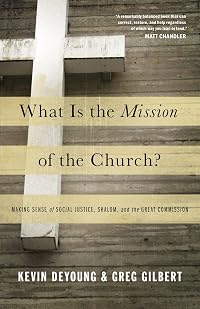
What Is the Mission of the Church?: Making Sense of Social Justice, Shalom, and the Great Commission
by Kevin DeYoung, Greg Gilbert
On This Page
Description
Addressing mission, evangelism and social justice, two pastors draw readers to the Bible's teaching on some contentious matters. Readers in all spheres of ministry will grow in their understanding of the mission of the church and gain a renewed sense of urgency for Jesus' call to preach the Word and make disciples.Tags
Recommendations








Member Reviews
In a day when so much is being said about “missions,” and “being missional,” it’s helpful to get back to the basics (the Bible, our rule of faith and practice) and to inductively discover what the church is to be doing in the world. I found the writing to be lucid, practical and well founded. While the authors alternate between expositional commentary of passages and philosophical/methodological/practical suggestions and musings, they keep a clear distinction between the two. I think the reader will find a lot of help in “making sense of social justice, shalom, and the Great Commission.”
A surprisingly deep exegesis into the real mission of the church. Very interesting and thought-provoking.
I found the first 3 chapters boring and not really on topic. It got better from there. However, the authors tend to wander around a bit, and some of their points didn't seem to stand solidly on the foundation they built. I found the epilogue to easily be the best part of the books. There is some good stuff in here, but not enough to make it an exciting or compelling read (for me).
Overall, this book does have helpful contributions to the discussion on church and mission; the review by Kratz on 10/8/2011 is a good overview of these elements. I thought it might be useful, though, to mention a few observations, especially in light of some of the critical discussion which has occurred on various blogs and websites since it came out.
1. The authors needed to better clarify at the outset that, when they write of "the mission of the church," they are discussing the church's calling on an organizational level, and not the broader calling of worshipers to live faithfully in all aspects of their lives. More time discussing (and exegeting) the distinction between "the church gathered" and "the church dispersed" would have show more been very helpful and headed off much of the criticism. This is the big one, in my mind.
2. The discussion which most directly addresses issues related to item #1 occurs well after page 200, which is too late to be useful.
3. Some authors are quoted but not really interacted with in their broader contexts, making them seem like straw men, whether or not that is the case. (I would have liked to see more detailed interaction with some of Christopher Wright's work, for example.) I know that this isn't a high priority for a pastorally-focused book, but when you quote someone as a negative example, it's important to give whatever background is necessary.
Unfortunately, the items I mention above keep this from being a book I could unreservedly recommend, at least without an accompanying preface on my part. The points made are important, however, so I'm hoping for a revised/expanded edition at some point. show less
1. The authors needed to better clarify at the outset that, when they write of "the mission of the church," they are discussing the church's calling on an organizational level, and not the broader calling of worshipers to live faithfully in all aspects of their lives. More time discussing (and exegeting) the distinction between "the church gathered" and "the church dispersed" would have show more been very helpful and headed off much of the criticism. This is the big one, in my mind.
2. The discussion which most directly addresses issues related to item #1 occurs well after page 200, which is too late to be useful.
3. Some authors are quoted but not really interacted with in their broader contexts, making them seem like straw men, whether or not that is the case. (I would have liked to see more detailed interaction with some of Christopher Wright's work, for example.) I know that this isn't a high priority for a pastorally-focused book, but when you quote someone as a negative example, it's important to give whatever background is necessary.
Unfortunately, the items I mention above keep this from being a book I could unreservedly recommend, at least without an accompanying preface on my part. The points made are important, however, so I'm hoping for a revised/expanded edition at some point. show less
A very biblically-based look at what the church is and what she is supposed to do. This book is much needed in today's culture, where everyone is trying to wield the church like a sword in their own personal causes. DeYoung and Gilbert carefully explain what the church should do, can do, and should not do. Very timely and helpful.
"Mission creep" is a topic primarily discussed in military operations, but very applicable for the battle that the Church is called to undertake (1 Tim. 1:18). There are many things that the Church can do. There are many things that the Church should do. For centuries, often heated debates have dealt with doctrines like the Gospel, Kingdom, Church, Mission and a myriad of other topics applied to a such diverse fields as evangelism, discipleship, community, politics, and requests for assistance. In the midst of a debate that has often generated more heat than light, Kevin DeYoung and Greg Gilbert have done some careful examination of the central mission of the Church with remarkable Biblical clarity in their new book, What Is the Mission show more of the Church?
The book is divided into three parts: “Understanding Our Mission,” “Understanding Our Categories,” and “Understanding What We Do And Why We Do It,” with part two being the bulk of the book.
Understanding Our Mission
DeYoung and Gilbert make the reasonable assumption that their present audience is primarily Christian (p. 15) and begin with the central question of: “What is the mission of the church?” Acknowledging that this is not strictly a biblical word as a noun (p. 17), yet a verb of dealing with one being sent. It implies that one is specifically sent to do something and therefore, not everything. That this is a particular assignment is an important distinction for it frames the terms of reference in the arguments to come. With a prayer for humility, understanding and pastoral approach, the authors present their thesis at the end of chapter one, stating, “We will argue that the mission of the church is summarized in the Great Commission passages…We believe the church is sent into the world to witness to Jesus by proclaiming the gospel and making disciples of all nations” (26).
In chapter two, the authors begin their exegetical treatment of various biblical texts dealing with commission. In this examination they critique other views that take certain passages as paradigmatic for our understanding of the church’s mission, which certain other authors have taken above all others and unnaturally limited the mission. Putting it all together with questions of who, why, what, where, how, when and to whom? (p.. 59), DeYoung and Gilbert show how we must ask these important questions of biblical texts in order to understand exactly what the mission is.
Understanding Our Categories
Section two begins with chapter three showing how the topics of creation, fall, redemption, and consummation relate to mission. Chapter four highlights how those who take either a too "narrow" or too "wide" consideration of Gospel, have muddied the understanding of mission (p.93) through either dilution or reduction (p.111). Chapter five discusses how the kingdom of God relates to mission. Periodically, DeYoung and Gilbert summarize their argument combining their various examinations. Here they summarize what they examined in this section by saying that the kingdom of God is "God's redemptive reign, in the person of his Son, Jesus Messiah, which has broken into the present evil age and is now visible in the church" (p. 127). They explain how the kingdom will be finally and fully established, and how one gets into the kingdom. Section two concludes with an discussion of social justice, dealing with various passages that touch on loving one's neighbour, sin, responsibility, justice, kindness, humility, generosity, and faith shown through works. Always applying what is discussed, chapter seven ties all these complexities of determining a biblical theology of wealth, poverty, and material possession to what the authors admit they have yet to specifically define in "social justice" to such obvious yet political incorrect moral obligations of proximity priority (p. 183). Chapter eight concludes with a discussion of the New Heavens and the New Earth with the "cultural Mandate" (p. 208). The terms of reference are brilliant in any discussion of continuity/discontinuity.
Understanding What We Do and Why We Do It
Part three sums up the book as the authors helpfully discuss important distinctions such as duties of individual Christians versus duties of the institutional church looking at why and how we do good. What then is our responsibility? DeYoung and Gilbert present a quote from Gilbert J. Gresham Machen:
"The responsibility of the church in the new age is the same as its responsibility in every age. It is to testify that this world is lost in sin; that the span of human life—no, all the length of human history—is an infinitesimal island in the awful depths of eternity; that there is a mysterious, holy, living God, Creator of all, Upholder of all, infinitely beyond all; that he has revealed himself to us in his Word and offered us communion with himself through Jesus Christ the Lord; that there is no other salvation, for individuals or for nations, save this, but that this salvation is full and free, and that whoever possesses it has for himself and for all others to whom he may be the instrument of bringing it a treasure compared with which all the kingdoms of the earth—no, all the wonders of the starry heavens—are as the dust of the street. An unpopular message it is—an impractical message, we are told. But it is the message of the Christian church. Neglect it, and you will have destruction; heed it, and you will have life." (p.248).
DeYoung and Gilbert follow-up Machen's quote with these words: "It is not the church’s responsibility to right every wrong or to meet every need, though we have biblical motivation to do some of both. It is our responsibility, however—our unique mission and plain priority—that this unpopular, impractical gospel message gets told, that neighbors and nations may know that Jesus is the Christ, the Son of God, and that by believing, they may have life in his name." (p. 249).
This summary and the epilogue are worth the price of the book itself. When the "floodgates open" in a dialogue between a seasoned Pastor and typical "missional" concerns, DeYoung and Gilbert effectively wrap up their previous theological considerations in helpful pastoral concerns. If all this was not helpful enough, the general and scriptural index enable this work to be a reference that will bode well in any consideration of mission.
Summary
Kevin DeYoung and Greg Gilbert provide a careful, practical, biblical exegetical treatment of social justice, peace and the great commission in a consideration of what is the mission of the church.
*A copy of this book has been graciously provided by Crossway to enable this review. show less
The book is divided into three parts: “Understanding Our Mission,” “Understanding Our Categories,” and “Understanding What We Do And Why We Do It,” with part two being the bulk of the book.
Understanding Our Mission
DeYoung and Gilbert make the reasonable assumption that their present audience is primarily Christian (p. 15) and begin with the central question of: “What is the mission of the church?” Acknowledging that this is not strictly a biblical word as a noun (p. 17), yet a verb of dealing with one being sent. It implies that one is specifically sent to do something and therefore, not everything. That this is a particular assignment is an important distinction for it frames the terms of reference in the arguments to come. With a prayer for humility, understanding and pastoral approach, the authors present their thesis at the end of chapter one, stating, “We will argue that the mission of the church is summarized in the Great Commission passages…We believe the church is sent into the world to witness to Jesus by proclaiming the gospel and making disciples of all nations” (26).
In chapter two, the authors begin their exegetical treatment of various biblical texts dealing with commission. In this examination they critique other views that take certain passages as paradigmatic for our understanding of the church’s mission, which certain other authors have taken above all others and unnaturally limited the mission. Putting it all together with questions of who, why, what, where, how, when and to whom? (p.. 59), DeYoung and Gilbert show how we must ask these important questions of biblical texts in order to understand exactly what the mission is.
Understanding Our Categories
Section two begins with chapter three showing how the topics of creation, fall, redemption, and consummation relate to mission. Chapter four highlights how those who take either a too "narrow" or too "wide" consideration of Gospel, have muddied the understanding of mission (p.93) through either dilution or reduction (p.111). Chapter five discusses how the kingdom of God relates to mission. Periodically, DeYoung and Gilbert summarize their argument combining their various examinations. Here they summarize what they examined in this section by saying that the kingdom of God is "God's redemptive reign, in the person of his Son, Jesus Messiah, which has broken into the present evil age and is now visible in the church" (p. 127). They explain how the kingdom will be finally and fully established, and how one gets into the kingdom. Section two concludes with an discussion of social justice, dealing with various passages that touch on loving one's neighbour, sin, responsibility, justice, kindness, humility, generosity, and faith shown through works. Always applying what is discussed, chapter seven ties all these complexities of determining a biblical theology of wealth, poverty, and material possession to what the authors admit they have yet to specifically define in "social justice" to such obvious yet political incorrect moral obligations of proximity priority (p. 183). Chapter eight concludes with a discussion of the New Heavens and the New Earth with the "cultural Mandate" (p. 208). The terms of reference are brilliant in any discussion of continuity/discontinuity.
Understanding What We Do and Why We Do It
Part three sums up the book as the authors helpfully discuss important distinctions such as duties of individual Christians versus duties of the institutional church looking at why and how we do good. What then is our responsibility? DeYoung and Gilbert present a quote from Gilbert J. Gresham Machen:
"The responsibility of the church in the new age is the same as its responsibility in every age. It is to testify that this world is lost in sin; that the span of human life—no, all the length of human history—is an infinitesimal island in the awful depths of eternity; that there is a mysterious, holy, living God, Creator of all, Upholder of all, infinitely beyond all; that he has revealed himself to us in his Word and offered us communion with himself through Jesus Christ the Lord; that there is no other salvation, for individuals or for nations, save this, but that this salvation is full and free, and that whoever possesses it has for himself and for all others to whom he may be the instrument of bringing it a treasure compared with which all the kingdoms of the earth—no, all the wonders of the starry heavens—are as the dust of the street. An unpopular message it is—an impractical message, we are told. But it is the message of the Christian church. Neglect it, and you will have destruction; heed it, and you will have life." (p.248).
DeYoung and Gilbert follow-up Machen's quote with these words: "It is not the church’s responsibility to right every wrong or to meet every need, though we have biblical motivation to do some of both. It is our responsibility, however—our unique mission and plain priority—that this unpopular, impractical gospel message gets told, that neighbors and nations may know that Jesus is the Christ, the Son of God, and that by believing, they may have life in his name." (p. 249).
This summary and the epilogue are worth the price of the book itself. When the "floodgates open" in a dialogue between a seasoned Pastor and typical "missional" concerns, DeYoung and Gilbert effectively wrap up their previous theological considerations in helpful pastoral concerns. If all this was not helpful enough, the general and scriptural index enable this work to be a reference that will bode well in any consideration of mission.
Summary
Kevin DeYoung and Greg Gilbert provide a careful, practical, biblical exegetical treatment of social justice, peace and the great commission in a consideration of what is the mission of the church.
*A copy of this book has been graciously provided by Crossway to enable this review. show less
Good distinction between the mission of the Church and good works of believers. Simply, The Great Commission is the mission of the Church. DeYoung and Gilbert do not minimize the need for good deeds and loving our neighbor, but want it in its proper, biblical perspective. Helpful work.
Members
- Recently Added By
Lists

Sycamore Baptist Church Book Study Reading List
156 works; 5 members
Author Information

80+ Works 17,570 Members
Kevin DeYoung (PhD, University of Leicester) is the senior pastor at Christ Covenant Church in Matthews, North Carolina, and assistant professor of systematic theology at Reformed Theological Seminary, Charlotte. He serves as board chairman of the Gospel Coalition and blogs at DeYoung, Restless, and Reformed He is the author of several books, show more including Just Do Something; Crazy Busy; and The Biggest Story. Kevin and his wife, Trisha, have nine children. show less

14 Works 5,647 Members
Greg Gilbert (MDiv, Southern Seminary) is the author of Favor and What Is the Gospel? The senior pastor of Third Avenue Baptist Church in Louisville, Kentucky, he lives with his wife, Moriah, and their three children in Kentucky, where he enjoys basketball, coffee, and Thai food.
Common Knowledge
- Epigraph
- If everything is mission, nothing is mission.
--STEPHEN NEILL - Dedication
- To Collin, Josh, Justin, and Tullian--
thanks for sharpening us, laughing with us,
and sharing your Crazy Bread. - First words
- If you are reading this book, you're probably a Christian. And if a Christian, you probably take some kind of interest in the church. And if you've been involved in a church, you've probably wondered from time to time, "Wha... (show all)t are we trying to accomplish anyway?"
[Epilogue] Meet Pastor Chris. - Last words
- (Click to show. Warning: May contain spoilers.)It is not the church's responsibility to right every wrong or to meet every need, though we have biblical motivation to do some of both. It is our responsibility, however--our unique mission and plain priority--that this unpopular, impractical gospel message gets told, that neighbors and nations may know that Jesus is the Christ, The Son of God, and that by believing, they may have life in his name.
(Click to show. Warning: May contain spoilers.)[Epilogue] "That'd be great. I think I can learn a lot from you."
"And I'm sure there are more than a few things I could learn from you too."
Classifications
Statistics
- Members
- 1,469
- Popularity
- 15,882
- Reviews
- 8
- Rating
- (4.20)
- Languages
- English, French, German, Spanish
- Media
- Paper, Audiobook, Ebook
- ISBNs
- 11
- ASINs
- 7