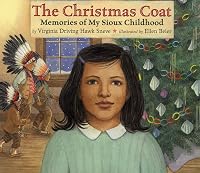
The Christmas Coat: Memories of My Sioux Childhood
by Virginia Driving Hawk Sneve
On This Page
Description
Virginia and her brother are never allowed to pick first from the donation boxes at church because their father is the priest, and she is heartbroken when another girl gets the beautiful coat that she covets. Based on the author's memories of life on the Rosebud Reservation in South Dakota.Tags
Recommendations

Member Reviews
Lakota Sioux children's author Virginia Driving Hawk Sneve, whose work ranges from informational picture-books like The Nez Perce and The Seminoles, to works of fiction like High Elk's Treasure and The Trickster and the Troll, turns to her own childhood in this new picture-book, producing a poignant holiday story that emphasizes the truly important aspects of Christmas. As the daughter of the Episcopal minister on the Rosebud Sioux Reservation, Virginia frequently goes without, because others in the community have greater need, and her parents expect her to sacrifice. When the winter "Theast" boxes - boxes from New England churches in "the east" - arrive, Virginia hopes that there will be a coat inside for her, as her current one is too show more small, and doesn't cover her wrists. Instead she finds that she must, once again, let others go first. Will she ever have the coat of her dreams...?
It's not much of a surprise, given the title, when the answer to this question turns out to be a resounding "yes," but watching Virginia get to that happy ending is still a pleasure. As a PK myself (that's Preacher's Kid to you!), I really identified with Virginia, and her sense of disappointment, as she is asked to let the nicer things go to others. Of course, I did not grow up on a reservation, nor did I belong, as a young girl, to a church community that needed donated clothing. But my own family were often the beneficiaries of wealthier relatives and friends, who sent hand-me-down clothing for us children, and I do remember that feeling of being set apart from others, because I was a minister's daughter. The scene in the story, when Virginia's mother and the other women sort through Theast boxes, just brought back such strong memories for me, of my own mother sorting through similar boxes!
In any case, Virginia's need is much greater than mine ever was, and so her disappointment is keener, something the author captures very well in the story. The eventual granting of her wish, through a special gift, is therefore all the more satisfying, particularly as she had behaved so well (much better than I would have done, I think). The idea that our blessings are more welcome, and mean the most to us, when we have been generous ourselves, is implicit in the story, without ever being the object of any moralizing passage, and was something I really appreciated. I also liked many of the little details in the story - the funny moment when Virginia and her father, holding a corset that had been sent in Theast boxes, dance around the room; the crowd's reaction to the Three Wise Men in the children's Christmas pageant appearing in Plains-style headdresses - and thought they made the narrative all the richer. A lovely picture-book memoir, one with a strong narrative voice, a good message, and beautifully expressive artwork, The Christmas Coat is a holiday book I recommend to anyone looking for Christmas tales with a little more substance. show less
It's not much of a surprise, given the title, when the answer to this question turns out to be a resounding "yes," but watching Virginia get to that happy ending is still a pleasure. As a PK myself (that's Preacher's Kid to you!), I really identified with Virginia, and her sense of disappointment, as she is asked to let the nicer things go to others. Of course, I did not grow up on a reservation, nor did I belong, as a young girl, to a church community that needed donated clothing. But my own family were often the beneficiaries of wealthier relatives and friends, who sent hand-me-down clothing for us children, and I do remember that feeling of being set apart from others, because I was a minister's daughter. The scene in the story, when Virginia's mother and the other women sort through Theast boxes, just brought back such strong memories for me, of my own mother sorting through similar boxes!
In any case, Virginia's need is much greater than mine ever was, and so her disappointment is keener, something the author captures very well in the story. The eventual granting of her wish, through a special gift, is therefore all the more satisfying, particularly as she had behaved so well (much better than I would have done, I think). The idea that our blessings are more welcome, and mean the most to us, when we have been generous ourselves, is implicit in the story, without ever being the object of any moralizing passage, and was something I really appreciated. I also liked many of the little details in the story - the funny moment when Virginia and her father, holding a corset that had been sent in Theast boxes, dance around the room; the crowd's reaction to the Three Wise Men in the children's Christmas pageant appearing in Plains-style headdresses - and thought they made the narrative all the richer. A lovely picture-book memoir, one with a strong narrative voice, a good message, and beautifully expressive artwork, The Christmas Coat is a holiday book I recommend to anyone looking for Christmas tales with a little more substance. show less
The author, the daughter of an Episcopal priest and a Lakota Sioux mother, grew up on the Rosebud Reservation in South Dakota. In this book, set in the winter of 1945, she writes of her own experience during her 12th Christmas. She had outgrown her old winter coat, and was looking forward to the arrival of donated used clothes that came yearly from congregations in the Eastern U.S. When a box finally arrives, however, Virginia must obey the family rule of putting the needs of the rest of the congregation above their own. She struggles to deal with her disappointment and jealousy after a rival girl takes the coat she wants.
It all turns out well in the end, however, when, on Christmas Eve, two additional boxes arrive that were sent show more specifically for the priest’s children. One contains a beautiful red coat for Virginia, and the other has cowboy boots perfect for her little brother.
The illustrator, Ellen Beier, immersed herself in the history of the Lakota Sioux in her preparations for creating the lovely paintings for the book, which are done in watercolor and gouache.
Discussion: The author said in an interview that she had trouble getting her contemporary stories about Native Americans published, because “publishers think that their readers still want Indians riding horses, hunting buffalo and living in tipis.” One of Virginia Driving Hawk Sneve’s goals has been to dispel such stereotypes, especially after finding her own children being influenced by them.
Sneve succeeds in showing that Native American children wear regular clothes, attend school, interact just like other kids do, and don’t spend all day hunting buffalos. However, I thought the book could have included more information (in a Parent/Teachers section, perhaps) on why the people on the Rosebud Reservation were (and remain) so poor, so that they had to rely on charity to weather the harsh South Dakota winters. I can imagine kids asking about this part of the story.
Evaluation: This story about the virtue of putting the needs of others above your own for the good of the community is especially appropriate during the Christmas season. It might also open the way to discussions with children about the disparities in wealth among people, and the uses to which such knowledge might be put.
Product Details
Reading level: Ages 5 and up
Language: English
ISBN-10: 0823421341
ISBN-13: 978-0823421343 show less
It all turns out well in the end, however, when, on Christmas Eve, two additional boxes arrive that were sent show more specifically for the priest’s children. One contains a beautiful red coat for Virginia, and the other has cowboy boots perfect for her little brother.
The illustrator, Ellen Beier, immersed herself in the history of the Lakota Sioux in her preparations for creating the lovely paintings for the book, which are done in watercolor and gouache.
Discussion: The author said in an interview that she had trouble getting her contemporary stories about Native Americans published, because “publishers think that their readers still want Indians riding horses, hunting buffalo and living in tipis.” One of Virginia Driving Hawk Sneve’s goals has been to dispel such stereotypes, especially after finding her own children being influenced by them.
Sneve succeeds in showing that Native American children wear regular clothes, attend school, interact just like other kids do, and don’t spend all day hunting buffalos. However, I thought the book could have included more information (in a Parent/Teachers section, perhaps) on why the people on the Rosebud Reservation were (and remain) so poor, so that they had to rely on charity to weather the harsh South Dakota winters. I can imagine kids asking about this part of the story.
Evaluation: This story about the virtue of putting the needs of others above your own for the good of the community is especially appropriate during the Christmas season. It might also open the way to discussions with children about the disparities in wealth among people, and the uses to which such knowledge might be put.
Product Details
Reading level: Ages 5 and up
Language: English
ISBN-10: 0823421341
ISBN-13: 978-0823421343 show less
I was surprised when I found out this picture book was published in 2011. I thought it was the early 1990's, and really earlier than that. The illustrative style feels old fashioned but not in a good way. I'm reminded of the style of Little House on the Prairie, which considering how racist that series is to American Indians, is not the image I imagine the illustrator wanted to portray. The narrative is sweet and heart-felt, although I'm not sure how much of the story is true and how much is imagined. Since it is based on the childhood of the author I would like to know more about the distinction and why it has ultimately been considered fiction, and or why it became written that way. I like how the Sioux Christmas is shown and how it show more depicts the similarities and differences during this popular holiday. show less
This picture book is a story from the author's own life about a christmas when she was a child. Her family had taught her to put others needs before her own and as a child it can be really hard to see that. I think that this book would be good to have in primary classrooms as it teaches empathy towards others. in addition to the story, the illustrations can help break down negative stereotypes about indigenous people and their experiences
Virginia recounts her childhood memories and the irony of Christmas wishes. This book brings together multiple cultures and traditions: life on the Reservation, Santa Claus, holiday generosity with family and religious expectations. Virginia's father is the priest, but she'd love to have the fur coat in the donation box. A Christmas twist brings a different coat to her.
Growing up on a South Dakota reservation wasn't easy, but twice a year the children eagerly awaited the arrival of the Theast boxes. Theast boxes were packages of donations from "The East;" the boxes contained much needed clothing for the community. Virginia, the daughter of an Episcopalian priest, desperately hopes that one of the boxes will contain a coat just her size as the one she received last year has become too short and tight.
When the boxes arrive, Virginia spots a coat that would be just perfect; however, all the other families get to choose first. By the time everyone else has chosen clothing, the coat is gone. The congregation moves forward with preparations for Christmas, but Virginia's heart just isn't in it. Then just show more before heading off to Christmas Eve services, Virginia's mother pulls out two more boxes - one for Virginia and one for her brother. To their surprise, both contain unexpected Christmas joy.
The Bottom Line: This picture book biography is based on an event in the author's childhood. It's a touching story of learning to put the needs of others before one's own; however, it might have been more compelling if told in the first person rather than the third person. Beier's watercolor and gouache illustrations are realistic and nicely done. The story is a bit long for the little ones; thus it's recommended for older kids in Grades 3 - 5.
This review also appears at The Mini Book Bytes Book Review Blog: http://minibookbytes.blogspot.com/ show less
When the boxes arrive, Virginia spots a coat that would be just perfect; however, all the other families get to choose first. By the time everyone else has chosen clothing, the coat is gone. The congregation moves forward with preparations for Christmas, but Virginia's heart just isn't in it. Then just show more before heading off to Christmas Eve services, Virginia's mother pulls out two more boxes - one for Virginia and one for her brother. To their surprise, both contain unexpected Christmas joy.
The Bottom Line: This picture book biography is based on an event in the author's childhood. It's a touching story of learning to put the needs of others before one's own; however, it might have been more compelling if told in the first person rather than the third person. Beier's watercolor and gouache illustrations are realistic and nicely done. The story is a bit long for the little ones; thus it's recommended for older kids in Grades 3 - 5.
This review also appears at The Mini Book Bytes Book Review Blog: http://minibookbytes.blogspot.com/ show less
I would put this in primary grade levels specifically kinder through second grade. This book is about a little girl who is excited for Christmas but her parents are struggling financially. The term that I picked was relevance because I feel as though some kids are very privilege when it comes to Christmas and dont think how others might not have the luxury of getting gifts around Christmas time. This is a great example of showing diversity but also realistic situations especially around Christmas time.
Members
- Recently Added By
Lists

Top 100 books by Indigenous Masters
134 works; 7 members
Author Information

44+ Works 1,690 Members
All Editions
Awards and Honors
Awards
Common Knowledge
- Important places
- South Dakota, USA
- Dedication
- To Rose, my mother, who taught me to think of others who needed more than I V. D. H. S.
For Charles and Samuel E. B.
Classifications
Statistics
- Members
- 130
- Popularity
- 248,221
- Reviews
- 23
- Rating
- (3.77)
- Languages
- English
- Media
- Paper
- ISBNs
- 4
- ASINs
- 1