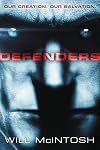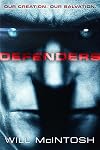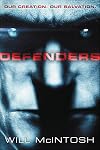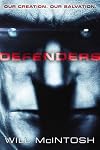
Defenders
by Will McIntosh
On This Page
Description
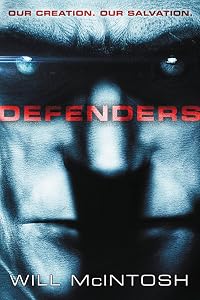
"When Earth is invaded by telepathic aliens, humanity responds by creating the defenders. They are the perfect warriors--seventeen feet tall, knowing and loving nothing but war, their minds closed to the aliens. The question is, what do you do with millions of genetically-engineered warriors once the war is won? A novel of power, alliances, violence, redemption, sacrifice, and yearning for connection, DEFENDERS presents a revolutionary story of invasion, occupation, and resistance"--Tags
Recommendations




Member Reviews
No one element of this story is original—the earth is overrun by hostile aliens; humans invent a secret weapon to overthrow the aliens; will the secret weapon turn against the humans? But as a whole the story is incredibly original and exciting and thought-provoking.
Really fascinating and really ambitious. I'm giving this a 4.5 stars for a few weird moments but the rest was like War of the Worlds. Times three.
I mean, it starts out pretty awesome as a beleaguered humanity is dying from a starfish invasion. They have excellent telepathy and they use it against us perfectly. The action and multiple viewpoints work very well. It's not an easy situation. They are herding us into the cities and several billion have died by the time we MAKE our defenders. Giant, genetically modified humans without serotonin, three robot legs, and they're all sociopaths, much smarter than us, and they were made to destroy.
OF COURSE, NO ONE ASKS IF THIS WAS A GOOD IDEA.
At least the cheering and the parades were nice. The show more Defenders couldn't be read by the starfish, but now that humanity won? Oh, they didn't want to be integrated into our society. lol But since several billion people died, why not give them Australia?
Yes, the key idea is clear and it should come to no surprise that the Defenders, knowing nothing but war and broken on the inside, unable to procreate, but definitely able to build up a huge arsenal and adapt the alien starfish technology, brutal enough to take all the treaty-survivor aliens to turn them all into slaves, it was only a matter of time before they asked for something the rest of the weakened humanity couldn't give. Large tracts of land, integration on the Defenders' terms, and the labs that made them.
Uh, oh.
No spoilers, but THREE more wars later, or four total over 20 years, and we've got one hell of a MilSF epic on our hands.
And strangely enough, it actually has a really well-done theme. :) Is it EVEN POSSIBLE to communicate with the Other? I mean, the telepathic aliens KNEW we wouldn't take them in as refugees. The Defenders are slightly more alien than the aliens, and we MADE them.
Very cool book. Will McIntosh continues to amaze me with the style and variety and hardcore stories. :) show less
I mean, it starts out pretty awesome as a beleaguered humanity is dying from a starfish invasion. They have excellent telepathy and they use it against us perfectly. The action and multiple viewpoints work very well. It's not an easy situation. They are herding us into the cities and several billion have died by the time we MAKE our defenders. Giant, genetically modified humans without serotonin, three robot legs, and they're all sociopaths, much smarter than us, and they were made to destroy.
OF COURSE, NO ONE ASKS IF THIS WAS A GOOD IDEA.
At least the cheering and the parades were nice. The show more Defenders couldn't be read by the starfish, but now that humanity won? Oh, they didn't want to be integrated into our society. lol But since several billion people died, why not give them Australia?
Yes, the key idea is clear and it should come to no surprise that the Defenders, knowing nothing but war and broken on the inside, unable to procreate, but definitely able to build up a huge arsenal and adapt the alien starfish technology, brutal enough to take all the treaty-survivor aliens to turn them all into slaves, it was only a matter of time before they asked for something the rest of the weakened humanity couldn't give. Large tracts of land, integration on the Defenders' terms, and the labs that made them.
Uh, oh.
No spoilers, but THREE more wars later, or four total over 20 years, and we've got one hell of a MilSF epic on our hands.
And strangely enough, it actually has a really well-done theme. :) Is it EVEN POSSIBLE to communicate with the Other? I mean, the telepathic aliens KNEW we wouldn't take them in as refugees. The Defenders are slightly more alien than the aliens, and we MADE them.
Very cool book. Will McIntosh continues to amaze me with the style and variety and hardcore stories. :) show less
I really enjoyed this one. This is the third book by Will McIntosh that I've read and he's quickly becoming a favorite author of mine. I'm the one who always wondered what the hell the Republic was going to do with all those clones should they win. The humans in Battlestar Galactica got far more than they bargained for when they created the Cylons. Jurassic Park was less exciting and fun for humans once the exhibits sought to dine on the visitors. The scientists in the show Manhattan are racing Heisenberg in creation of an atomic weapon in hopes of ending war but having no idea of the actual consequences & impact on humanity it will make long after they're gone. I love stories where humans set out to create something and are faced with show more realizing that they never had control of their creations to begin with and now have to devise a way to deal with the consequences or more simply, survive them. Defenders was a great story that delved deeply into that and turned on its head the idea of friend, ally, foe and enemy. In the resolution none are wholly good or evil and there's a good measure of fear and distrust held by Luyten and human. I'd recommend this to fans of such scifi stories and fans of McIntosh. I'll surely read his next offering. show less
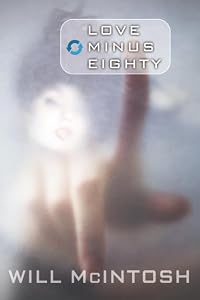
Last year, I was incredibly moved by a book called Love Minus Eighty. As I closed the cover on the last page and settled back with a roiling mind and warmed heart, I knew right then and there any future novels written by Will McIntosh will be going straight onto my to-read list. A writer who can craft such a magnificent story (and give me all these feels) certainly deserves to be one of my favorite authors. And so that is how I came to leap enthusiastically into the world of Defenders.
On the surface, the two books could not be any more different. Love Minus Eighty explores love in a future muddled by the tangled web created by the new wave of digital information and social media. Defenders, on the other hand, is about war and an alien show more invasion. Taking place over a period of twenty years, the book is divided into three parts: first it details humanity’s losing battle against the Luyten, a race of giant, starfish-like aliens whose greatest advantage over their enemies is their species’ telepathic ability. How can anyone win against a foe who can read your every thought and knows how you are going to act even before you do?
Enter the defenders, humanity’s answer to that question. Tactically-minded and highly intelligent, this new race of warriors was also genetically engineered to be immune to Luyten mind-reading. Needless to say, they summarily wiped the floor with the dastardly starfish. But what happens now that the war is won? What on earth do you do with millions of seventeen-foot tall, three-legged extraordinary warriors now that there are no more aliens to fight? They were our saviors, our own beloved creations, and yet they might as well be as foreign to us as the Luyten. The rest of the book covers the tumultuous two decades that follow, exploring the idea of sharing the world with the defenders.
Like I said, superficially there appears to be very little in common between Love Minus Eighty and Defenders. But dig a little deeper, and a couple similarities come to light.
For one thing, thematically different as they are, both novels pack a powerful punch. Will McIntosh has a remarkable ability to write stories that reach deep into your mind and heart, raising questions about ourselves both individually and as a society. I enjoy his tightly woven plots and multiple narratives, but it’s the message in them that transcends the content and that ultimately makes reading his work so rewarding.
When you read Defenders, look for the forest, not the trees. Just as you weren’t supposed to pick apart the minutiae of cryogenics in Love Minus Eighty, I realized very early on that I shouldn’t get too hung up on the logistics of an alien invasion or the ins-and-outs of bio-engineering a whole new warrior race. This science fiction novel isn’t so much about the “science” than it is a thought-provoking social fiction piece exploring how humanity might approach an “us vs. them” situation. Needless to say, if you enjoy “what if” stories, this would be the ideal book for you. But even in the face of implausible circumstances, Defenders was an enthralling and sometimes terrifying read given how any and all speculation always remained grounded in human nature. Humans have created living, breathing killing machines with only a swift and decisive victory against the Luyten in mind, and now they must live with the consequences of their actions.
As ever, the scenarios in McIntosh’s stories are enhanced by his characters; it’s they who help expand our understanding of the dire things happening in their world, very important in books such as these. And in Defenders, that’s no exception. Through the narratives of only a handful of characters – Oliver, Kai, Lila and Dominque – we are able to get a well-rounded sense of the culture and climate of the situation. It’s interesting to watch their relationships evolve over the years, and to see how the events of the war has influenced their individual beliefs and perspectives.
Of the two novels from McIntosh I have read now, I think Love Minus Eighty still remains closer to my heart, but Defenders isn’t far behind. Both are eye-opening works, and are simply excellent. I’ve said it many times and I’m just going to keep saying it: this author deserves A LOT more attention. show less
On the surface, the two books could not be any more different. Love Minus Eighty explores love in a future muddled by the tangled web created by the new wave of digital information and social media. Defenders, on the other hand, is about war and an alien show more invasion. Taking place over a period of twenty years, the book is divided into three parts: first it details humanity’s losing battle against the Luyten, a race of giant, starfish-like aliens whose greatest advantage over their enemies is their species’ telepathic ability. How can anyone win against a foe who can read your every thought and knows how you are going to act even before you do?
Enter the defenders, humanity’s answer to that question. Tactically-minded and highly intelligent, this new race of warriors was also genetically engineered to be immune to Luyten mind-reading. Needless to say, they summarily wiped the floor with the dastardly starfish. But what happens now that the war is won? What on earth do you do with millions of seventeen-foot tall, three-legged extraordinary warriors now that there are no more aliens to fight? They were our saviors, our own beloved creations, and yet they might as well be as foreign to us as the Luyten. The rest of the book covers the tumultuous two decades that follow, exploring the idea of sharing the world with the defenders.
Like I said, superficially there appears to be very little in common between Love Minus Eighty and Defenders. But dig a little deeper, and a couple similarities come to light.
For one thing, thematically different as they are, both novels pack a powerful punch. Will McIntosh has a remarkable ability to write stories that reach deep into your mind and heart, raising questions about ourselves both individually and as a society. I enjoy his tightly woven plots and multiple narratives, but it’s the message in them that transcends the content and that ultimately makes reading his work so rewarding.
When you read Defenders, look for the forest, not the trees. Just as you weren’t supposed to pick apart the minutiae of cryogenics in Love Minus Eighty, I realized very early on that I shouldn’t get too hung up on the logistics of an alien invasion or the ins-and-outs of bio-engineering a whole new warrior race. This science fiction novel isn’t so much about the “science” than it is a thought-provoking social fiction piece exploring how humanity might approach an “us vs. them” situation. Needless to say, if you enjoy “what if” stories, this would be the ideal book for you. But even in the face of implausible circumstances, Defenders was an enthralling and sometimes terrifying read given how any and all speculation always remained grounded in human nature. Humans have created living, breathing killing machines with only a swift and decisive victory against the Luyten in mind, and now they must live with the consequences of their actions.
As ever, the scenarios in McIntosh’s stories are enhanced by his characters; it’s they who help expand our understanding of the dire things happening in their world, very important in books such as these. And in Defenders, that’s no exception. Through the narratives of only a handful of characters – Oliver, Kai, Lila and Dominque – we are able to get a well-rounded sense of the culture and climate of the situation. It’s interesting to watch their relationships evolve over the years, and to see how the events of the war has influenced their individual beliefs and perspectives.
Of the two novels from McIntosh I have read now, I think Love Minus Eighty still remains closer to my heart, but Defenders isn’t far behind. Both are eye-opening works, and are simply excellent. I’ve said it many times and I’m just going to keep saying it: this author deserves A LOT more attention. show less
What happens when telepathic aliens invade the Earth and can predict your every move before you make it? You genetically engineer super soldiers resistant to telepathy to fight them. What happens when the war is over? Do you give vocational training to your super soldiers who literally know nothing but war? Neat thought experiment about the levels to which you may not want to go to win.
This quick-paced alien invasion story makes a great summer read; the chapters (all 90) are short and punchy, and while the science and logistics of various alien armies bouncing around the world are glossed over, the tension is maintained throughout, and the four protagonists are easy to identify with. Themes of forgiveness and redemption build in parallel to a separate theme of how hastily awarded trust sours into contempt. It’s got some very thought-provoking passages on the consequences of fully transparent telepathy, and acknowledged nods to Mary Shelley’s ‘Frankenstein’. I wish there was more frequent instances of sympathetic scenes with the Defender creatures, as these scenes were all enjoyable for me. The story didn’t show more hold any huge surprises, but was very cinematic, and I can see it translating well to film. show less
The premise was certainly interesting and I quite enjoyed the long-term implications of the novel, but found the characterizations so minimal as to be nonexistent. I didn't particularly care if anyone lived or died, with the exception of one or two characters. Every time a character started becoming real to me, the action took over. So I didn't get any of their motivations beyond the most obvious.
So, obvs, an alien invasion would totally suck, and then creating a weapon to repel the alien invasion only to have that weapon turn on you would likewise suck. And some people would die and some people would live and the people who lived would be sad about the people who died, and Earth would be changed forever and stuff. That's basically the show more whole novel with about the same level of emotional attachment I felt. This is not to say it wasn't entertaining, because it was, but it was the book equivalent of a popcorn movie. show less
So, obvs, an alien invasion would totally suck, and then creating a weapon to repel the alien invasion only to have that weapon turn on you would likewise suck. And some people would die and some people would live and the people who lived would be sad about the people who died, and Earth would be changed forever and stuff. That's basically the show more whole novel with about the same level of emotional attachment I felt. This is not to say it wasn't entertaining, because it was, but it was the book equivalent of a popcorn movie. show less
Members
- Recently Added By
Lists

Kirkus Reviews Best Fiction of 2014
100 works; 7 members
Author Information

55+ Works 1,614 Members
Some Editions
Awards and Honors
Work Relationships
Is contained in
Common Knowledge
- Original publication date
- 2014-05
- Dedication
- To James Pugh
Classifications
Statistics
- Members
- 164
- Popularity
- 199,801
- Reviews
- 11
- Rating
- (3.41)
- Languages
- English
- Media
- Paper, Ebook
- ISBNs
- 5
- ASINs
- 2