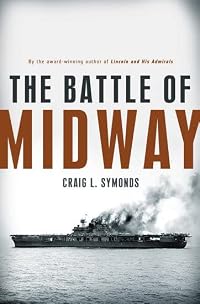
The Battle of Midway
by Craig L. Symonds
On This Page
Description
There are few moments in American history in which the course of events tipped so suddenly and so dramatically as at the Battle of Midway. At dawn of June 4, 1942, a rampaging Japanese navy ruled the Pacific. By sunset, their vaunted carrier force (the Kido Butai) had been sunk and their grip on the Pacific had been loosened forever. In this absolutely riveting account of a key moment in the history of World War II, one of America's leading naval historians, Craig L. Symonds paints an show more unforgettable portrait of ingenuity, courage, and sacrifice. Symonds begins with the arrival of Admiral Cheste show lessTags
Recommendations









Member Recommendations
Member Reviews
When considering the truly pivotal events in American history, it is difficult to find many that are as significant as the battle of Midway. As Craig Symonds notes in his introduction, “there are few moments in American history in which the course of events tipped so suddenly and so dramatically as it did on June 4, 1942.” For it was on that day that the United States Navy succeeded in smashing the heart of the Japanese carrier force that had so completely dominated the Pacific Ocean during the first six months of the war there, scoring a victory that changed the course of World War II. Symonds’s book provides an account of this dramatic battle, as well as an understanding of the chain of events that led up to the clash between show more the American and Japanese fleets.
One of the key factors he identifies early on is the growing presence of the “victory disease” infecting the thinking of Japanese naval officers. An increasing assumption of victory was perhaps understandable, though, given the successes Japanese forces enjoyed at the start of the war. Much of this success was the consequence of the quality of Japanese equipment, as well as the demanding levels of training and previous combat experience of Japanese forces. Yet these advantages would prove to be temporary the longer the war wore on, as they were products of a system ill capable of replacing losses at the pace necessary. In the short term, though, Japan went from triumph to triumph, conquering southeast Asia and dominating Allied forces in the naval battles waged.
Yet American commanders were determined to punch back. Symonds’ account of the war in the early months of 1942 is one of the great strengths of his book, as he shows how a seemingly minor series of carrier strikes against Japanese forces in the Pacific influenced subsequent events. Faced with a number of options, Admiral Yamamoto Isoroku ultimately resolved to attack Midway as a means of drawing out the American carrier forces and forcing the “decisive battle” called for by Japanese doctrine. The overly complicated plan was compromised almost from that start, though, as American codebreakers quickly uncovered some of its basic details. Armed with this information, the American commander of Pacific forces, Chester Nimitz, set a trap of his own, using all of his available carriers in a bid to cripple the Kido Butai, the carrier strike force that was the core of the Imperial Japanese Navy’s offensive power.
The outcome was devastating for the Japanese. Symonds relies upon a mixture of published accounts and interviews to reconstruct events, using them to address the myths and misconceptions that have emerged about the battle. Among the participants whose role he highlights is that of Frank Jack Fletcher, the commander of American forces in the battle. Long overshadowed by other figures, Symonds credits his cool and experienced judgment for much of the outcome. The pilots are also prominently featured in his account, and he makes clear just how devastating a toll the battle took among the ranks of American flyers as well as the Japanese forces. Yet he demonstrates how their sacrifice contributed to the American victory, which permanently shifted the balance of power of the Pacific and forced the Japanese to adopt a defensive strategy that could only delay their eventual defeat.
Clearly written and supplemented with a helpful collection of maps and photographs, Symonds’ book provides an excellent introduction to the battle. Though not as detailed as Gordon Prange’s classic [b:Miracle at Midway|700143|Miracle at Midway|Gordon W. Prange|https://images.gr-assets.com/books/1334770249s/700143.jpg|686454], it benefits from the insights of more recent studies such as Jonathan Parshall and Anthony Tully's [b:Shattered Sword|34658|Shattered Sword The Untold Story of the Battle of Midway|Jonathan Parshall|https://images.gr-assets.com/books/1328660958s/34658.jpg|34629], while the extensive coverage of the context of the battle offers a perspective lacking in most other accounts. With this book, Symonds has set the standard by which other histories of the battle are judged, one that is unlikely to be surpassed anytime soon. show less
One of the key factors he identifies early on is the growing presence of the “victory disease” infecting the thinking of Japanese naval officers. An increasing assumption of victory was perhaps understandable, though, given the successes Japanese forces enjoyed at the start of the war. Much of this success was the consequence of the quality of Japanese equipment, as well as the demanding levels of training and previous combat experience of Japanese forces. Yet these advantages would prove to be temporary the longer the war wore on, as they were products of a system ill capable of replacing losses at the pace necessary. In the short term, though, Japan went from triumph to triumph, conquering southeast Asia and dominating Allied forces in the naval battles waged.
Yet American commanders were determined to punch back. Symonds’ account of the war in the early months of 1942 is one of the great strengths of his book, as he shows how a seemingly minor series of carrier strikes against Japanese forces in the Pacific influenced subsequent events. Faced with a number of options, Admiral Yamamoto Isoroku ultimately resolved to attack Midway as a means of drawing out the American carrier forces and forcing the “decisive battle” called for by Japanese doctrine. The overly complicated plan was compromised almost from that start, though, as American codebreakers quickly uncovered some of its basic details. Armed with this information, the American commander of Pacific forces, Chester Nimitz, set a trap of his own, using all of his available carriers in a bid to cripple the Kido Butai, the carrier strike force that was the core of the Imperial Japanese Navy’s offensive power.
The outcome was devastating for the Japanese. Symonds relies upon a mixture of published accounts and interviews to reconstruct events, using them to address the myths and misconceptions that have emerged about the battle. Among the participants whose role he highlights is that of Frank Jack Fletcher, the commander of American forces in the battle. Long overshadowed by other figures, Symonds credits his cool and experienced judgment for much of the outcome. The pilots are also prominently featured in his account, and he makes clear just how devastating a toll the battle took among the ranks of American flyers as well as the Japanese forces. Yet he demonstrates how their sacrifice contributed to the American victory, which permanently shifted the balance of power of the Pacific and forced the Japanese to adopt a defensive strategy that could only delay their eventual defeat.
Clearly written and supplemented with a helpful collection of maps and photographs, Symonds’ book provides an excellent introduction to the battle. Though not as detailed as Gordon Prange’s classic [b:Miracle at Midway|700143|Miracle at Midway|Gordon W. Prange|https://images.gr-assets.com/books/1334770249s/700143.jpg|686454], it benefits from the insights of more recent studies such as Jonathan Parshall and Anthony Tully's [b:Shattered Sword|34658|Shattered Sword The Untold Story of the Battle of Midway|Jonathan Parshall|https://images.gr-assets.com/books/1328660958s/34658.jpg|34629], while the extensive coverage of the context of the battle offers a perspective lacking in most other accounts. With this book, Symonds has set the standard by which other histories of the battle are judged, one that is unlikely to be surpassed anytime soon. show less
There are few moments in American history in which the course of events tipped so suddenly and so dramatically as at the Battle of Midway. 4 day long war in 1942 changes everything at Japanese end, At dawn of June 4, 1942, a rampaging Japanese navy ruled the Pacific dominating other countries of Asia. By sunset, their vaunted carrier force (the Kido Butai) had been sunk and their grip on the Pacific had been loosened forever.
In the history of World War II, one of America's leading naval historians, Craig L. Symonds paints an unforgettable portrait of ingenuity, courage, and sacrifice. Symonds begins with the arrival of Admiral Chester A. Nimitz at Pearl Harbor after the devastating Japanese attack killing many soldiers and destruction show more of fleet crafts, and describes the key events leading to the climactic battle, including both Coral Sea--the first battle in history against opposing carrier forces--and Jimmy Doolittle's daring raid of Tokyo. He focuses throughout on the people involved, offering telling portraits of Admirals Nimitz, Halsey, Spruance and numerous other Americans, as well as the leading Japanese figures, including the poker-loving Admiral Yamamoto. such as their single-minded devotion to combat, which led to poorly armored planes and inadequate fire-safety measures on their ships--that contributed to their defeat. The author's account of the battle itself is masterful, weaving together the many disparate threads of attack--attacks which failed in the early going--that ultimately created a five-minute window in which three of the four Japanese carriers were mortally wounded, changing the course of the Pacific war in an eye-blink.
Symonds is the first historian to argue that the victory at Midway was not simply a matter of luck, pointing out that Nimitz had equal forces, superior intelligence, and the element of surprise. Nimitz had a strong hand, Symonds concludes, and he rightly expected to win. show less
In the history of World War II, one of America's leading naval historians, Craig L. Symonds paints an unforgettable portrait of ingenuity, courage, and sacrifice. Symonds begins with the arrival of Admiral Chester A. Nimitz at Pearl Harbor after the devastating Japanese attack killing many soldiers and destruction show more of fleet crafts, and describes the key events leading to the climactic battle, including both Coral Sea--the first battle in history against opposing carrier forces--and Jimmy Doolittle's daring raid of Tokyo. He focuses throughout on the people involved, offering telling portraits of Admirals Nimitz, Halsey, Spruance and numerous other Americans, as well as the leading Japanese figures, including the poker-loving Admiral Yamamoto. such as their single-minded devotion to combat, which led to poorly armored planes and inadequate fire-safety measures on their ships--that contributed to their defeat. The author's account of the battle itself is masterful, weaving together the many disparate threads of attack--attacks which failed in the early going--that ultimately created a five-minute window in which three of the four Japanese carriers were mortally wounded, changing the course of the Pacific war in an eye-blink.
Symonds is the first historian to argue that the victory at Midway was not simply a matter of luck, pointing out that Nimitz had equal forces, superior intelligence, and the element of surprise. Nimitz had a strong hand, Symonds concludes, and he rightly expected to win. show less
The battle of Midway was a turning point in World War II for the U.S. Mr. Symonds goes into great detail with the lead up and actual battle that provides great insight. It is often called the 'miracle victory' and it is apparent in this book of how the U.S. have a lot of luck on it's side that led to the sinking of 4 Japanese carriers. When I say luck, I don't mean to imply that there was no sacrifice or skill on both sides. It's that just the right circumstances led to this not only being a victory but quite the reverse. For example, all of the bombing flights from the Midway airfield did little to no damage on the Japanese fleet but they played a role of distracting the attention of the Japanese commanders. Even the air attacks from show more the Yorktown and Enterprise did little damage at first. The Hornet was a non factor with it's air launches until late in the battle. All these events give credence to the potential that this could have easily gone against the U.S. force. But in the end, 4 Japanese carriers were sunk and the Japanese Navy was never able to fully recover from the loss of 4 capital ships (carriers).
Well written, with the battle order well documented. I also appreciated the way that the CAPT Browning issue was addressed. There has been a controversy about how much of a roll Browning played in making the decision to launch the air strikes. Some historians credit him with talking RADM Spruance (rank at the time) out of launching the strike earlier than Spruance wanted to. This has been later (correctly, in my opinion) been explained as incorrect because of the time zone setting that the battle fleet was using. Once this is taken into account, it is discovered that Spruance wanted to launch precisely when he was supposed to and that Browning had very little to do with the decision.
Overall, a good accounting of the battle of Midway for all WWII students and historians. show less
Well written, with the battle order well documented. I also appreciated the way that the CAPT Browning issue was addressed. There has been a controversy about how much of a roll Browning played in making the decision to launch the air strikes. Some historians credit him with talking RADM Spruance (rank at the time) out of launching the strike earlier than Spruance wanted to. This has been later (correctly, in my opinion) been explained as incorrect because of the time zone setting that the battle fleet was using. Once this is taken into account, it is discovered that Spruance wanted to launch precisely when he was supposed to and that Browning had very little to do with the decision.
Overall, a good accounting of the battle of Midway for all WWII students and historians. show less
An excellent first book to review and enlighten history buffs about the battle that was the beginning of the end for the Japanese Empire in WW2. Sufficient personal insights to make it a pleasant read rather than a statistical slog. It benefits from newer research tools, such as time /motion studies, to place people and events in their proper perspective. The US benefited from dogged persistence and frequently heroic actions by its fliers combined with a little bit of luck to overcome some really bad decisions by senior flight commanders; like Walden, Ring and Browning. His appendices E and F as well as his note on sources reflect the frequent dilemmas faced by historians as they confront conflicting evidence in their pursuit of an show more accurate portrayal of a significant event from the past. show less
Excellent hour-by-hour description of the Midway battle. He also does a great job of describing the events leading up to the battle and the contributions of support persons-- particularly Rochefort and his codebreakers. I've read several books about Midway. This is one of the best.
Fantastic book. The Battle of Midway is just a fantastic story with great characters. The battle itself is quite dramatic and it shows through naturally without the author overdramatizing the action. This book is good, naturally entertaining history.
Great book. This author give you a firm picture of the Pacific war in the early years of WWII. Well told with lots of interesting information. No dry history here.
Members
- Recently Added By
Author Information

26+ Works 2,809 Members
Craig L. Symonds is Professor Emeritus at the United States Naval Academy, where he taught naval history and Civil War History for thirty years. He is the author of a host of award-winning titles, including most recently World War II at Sea (Oxford U. Press, 2018).
Awards and Honors
Awards
Series
Belongs to Publisher Series
Common Knowledge
- Canonical title
- The Battle of Midway
- Original publication date
- 2011
- People/Characters
- William F. Halsey Jr.; Chester W. Nimitz; Raymond A. Spruance; Isoroku Yamamoto
- Important places
- Midway Atoll; North Pacific Ocean; Pacific Ocean
- Important events
- Battle of Midway (1942-06-04 | 1942-06-07); World War II (1939 | 1945); World War II, Pacific Theater (1941-12-07 | 1945-09-02)
Classifications
Statistics
- Members
- 430
- Popularity
- 71,358
- Reviews
- 8
- Rating
- (4.31)
- Languages
- English
- Media
- Paper, Audiobook, Ebook
- ISBNs
- 8
- ASINs
- 4