The People Shall Continue
by Simon J. Ortiz
On This Page
Description
Traces the progress of the Indians of North America from the time of the Creation to the present.Tags
Recommendations




Member Reviews
Told in the rhythms of traditional oral narrative, this powerful telling of the history of the Native/Indigenous peoples of North America recounts their story from Creation to the invasion and usurpation of Native lands. As more and more people arrived, The People saw that the new men did not respect the land. The People witnessed the destruction of their Nations and the enslavement of their people. The People fought hard, but eventually agreed to stop fighting and signed treaties.
Many things changed and became more difficult, but The People continued to farm and create crafts. They remembered and told their children, "You are Shawnee. You are Lakota. You are Pima. You Acoma. . . . You are all these Nations of the People." The People show more held onto their beliefs and customs and found solidarity with other oppressed people. And despite struggles against greed, destruction of their lands, and oppression, The People persisted. show less
Many things changed and became more difficult, but The People continued to farm and create crafts. They remembered and told their children, "You are Shawnee. You are Lakota. You are Pima. You Acoma. . . . You are all these Nations of the People." The People show more held onto their beliefs and customs and found solidarity with other oppressed people. And despite struggles against greed, destruction of their lands, and oppression, The People persisted. show less
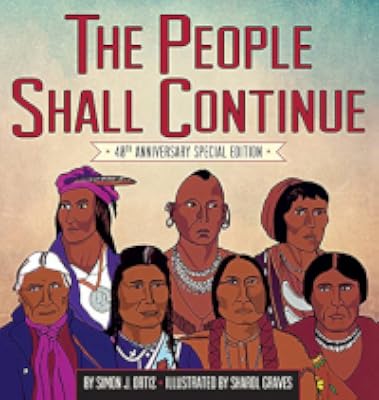
An indigenous view of the story of North America, with text by Acoma Pueblo scholar and poet Simon J. Ortiz, and illustrations by Shawnee, Ojibwe and Dakota artist Sharol Graves, The People Shall Continue begins with Creation, as understood by a variety of Native American peoples, introduces the diversity of cultures to be found on the continent, and then chronicles the coming of European conquerors and settlers, and the long and (mostly) unsuccessful struggle of the indigenous peoples to maintain their lands and independence. The book concludes with an examination of (then) contemporary native peoples, spread between reservations and cities, and the continuing importance of their diverse heritages, going forward.
Originally a poem, The show more People Shall Continue was first published in picture-book form in 1977, and has both strengths and weaknesses. Or, put another way, it is well suited to certain purposes, and not to others. As an encapsulation of Native views of the last five hundred years - the process of encroachment upon and theft of native lands, the brutality of the conquerors and settlers, the importance of tradition, as the People(s) go forward - it is top-notch, and communicates its message clearly and eloquently. If you're an American, or interested in American history, and want the children in your life to have a good understanding of the topic, this book is an important addition to your library. It has a leftward bent, and touches on issues of environmental stewardship and economic oppression, so some readers might find certain passages problematic, even if they don't contest the history. For my part, I appreciated the message, and the fact that Ortiz incorporated other groups (Latinos, African-Americans, poor whites) into his definition of "The People."
All that said, despite its virtues, I'm troubled by those who have billed this as a "history" of North America for children, as I don't think it's anything of the sort. It's one strand of that history, of course - well, really, one poet's view of that one strand - and a significant one at that, but although I think it works as an expression of feeling - perfectly legitimate feeling, in light of the events in question - it isn't what I would consider a work of history itself. Although I can understand why the pre-Columbian world would be seen in such a rosy light - the Peoples in Ortiz's vision all meet in peace, each bringing their own goods and stories, and when misunderstandings arise amongst them, wise leaders shepherd them away from war - and while there's no question in my mind that "discovery" by Europeans was a catastrophe for the native peoples of North America, I'm not comfortable with the implication that everything was a paradise before 1492, with little or no conflict between the peoples already here, since... well, I don't think that is actually true.
Ortiz described The People Shall Continue as a "teaching story," and I'm comfortable with that. Sometimes, in such stories - folktales spring to mind, in this respect - complicated realities are "simplified" to make a point. That's perfectly legitimate, as long as one doesn't confuse the simplified tale with an historical account, as some reviewers (quoted on the back of my copy of the book) seem to have done. For the study of history, even for an "overview" (a description also applied to this book), one would need considerably more information. show less
Originally a poem, The show more People Shall Continue was first published in picture-book form in 1977, and has both strengths and weaknesses. Or, put another way, it is well suited to certain purposes, and not to others. As an encapsulation of Native views of the last five hundred years - the process of encroachment upon and theft of native lands, the brutality of the conquerors and settlers, the importance of tradition, as the People(s) go forward - it is top-notch, and communicates its message clearly and eloquently. If you're an American, or interested in American history, and want the children in your life to have a good understanding of the topic, this book is an important addition to your library. It has a leftward bent, and touches on issues of environmental stewardship and economic oppression, so some readers might find certain passages problematic, even if they don't contest the history. For my part, I appreciated the message, and the fact that Ortiz incorporated other groups (Latinos, African-Americans, poor whites) into his definition of "The People."
All that said, despite its virtues, I'm troubled by those who have billed this as a "history" of North America for children, as I don't think it's anything of the sort. It's one strand of that history, of course - well, really, one poet's view of that one strand - and a significant one at that, but although I think it works as an expression of feeling - perfectly legitimate feeling, in light of the events in question - it isn't what I would consider a work of history itself. Although I can understand why the pre-Columbian world would be seen in such a rosy light - the Peoples in Ortiz's vision all meet in peace, each bringing their own goods and stories, and when misunderstandings arise amongst them, wise leaders shepherd them away from war - and while there's no question in my mind that "discovery" by Europeans was a catastrophe for the native peoples of North America, I'm not comfortable with the implication that everything was a paradise before 1492, with little or no conflict between the peoples already here, since... well, I don't think that is actually true.
Ortiz described The People Shall Continue as a "teaching story," and I'm comfortable with that. Sometimes, in such stories - folktales spring to mind, in this respect - complicated realities are "simplified" to make a point. That's perfectly legitimate, as long as one doesn't confuse the simplified tale with an historical account, as some reviewers (quoted on the back of my copy of the book) seem to have done. For the study of history, even for an "overview" (a description also applied to this book), one would need considerably more information. show less
I liked this book but at the same time I did not like it. I did not like how wordy it was on each page, it would make it very hard to keep a childs attention and would take up a lot of time during the day to read this aloud. I did like how it brought up the struggles of the Native Americans but they skipped right to Natives being put on reservations but there was no mention of the trail of tears. I also liked how it brought up a sense of comradery between the group of minorities.
The book starts off saying that nature is connect to people and that people are basically connected to nature. They talked about how as different tribes work to resolve issues peacfully and how they respected the land. White and Spanish settlers started to close show more in and move to the Americas causing the whites having to sign treaties saying what are Native Americans could have but not what they could do do. Then the white men said the Natives could not have their land or culture and forced them onto small regions of smaller areas of land called reservation. It talks about how they felt a sense of unity for people who were also minorites show less
The book starts off saying that nature is connect to people and that people are basically connected to nature. They talked about how as different tribes work to resolve issues peacfully and how they respected the land. White and Spanish settlers started to close show more in and move to the Americas causing the whites having to sign treaties saying what are Native Americans could have but not what they could do do. Then the white men said the Natives could not have their land or culture and forced them onto small regions of smaller areas of land called reservation. It talks about how they felt a sense of unity for people who were also minorites show less
This book should be read in every American History class. It is so well written and gives a personal understanding of The People and their rich history.
Curricular Connections:
*5th grade American History/ Read along with Encounter by Jane Yolan
*Perspective study
Curricular Connections:
*5th grade American History/ Read along with Encounter by Jane Yolan
*Perspective study
From the Author's Note:
Originally published in 1977, The People Shall Continue is a story of Indigenous peoples of the Americas, specifically in the US, as they continue to try to live on lands they have known to be their traditional homelands from time immemorial.
From the back cover: Written in the rhythms of traditional oral narrative, this is an epic story of Native American People.
From creation to the near-present, The People Shall Continue tells the story of the People living in the Americas long before white settler/colonialists arrived.
"All this time, the People remembered.
Parents told their children,
'You are Shawnee. You are Lakota.
You are Pima. You are Acoma.
You are Tlingit. You are Mohawk.
You are all these Nations of the show more People.'"
Illustrations are in pencil and ink, digitally enhanced. Native people are in rich brown; white people are literally white (as paper, not as skin). Different landscapes, dwellings, and clothing are depicted. show less
Originally published in 1977, The People Shall Continue is a story of Indigenous peoples of the Americas, specifically in the US, as they continue to try to live on lands they have known to be their traditional homelands from time immemorial.
From the back cover: Written in the rhythms of traditional oral narrative, this is an epic story of Native American People.
From creation to the near-present, The People Shall Continue tells the story of the People living in the Americas long before white settler/colonialists arrived.
"All this time, the People remembered.
Parents told their children,
'You are Shawnee. You are Lakota.
You are Pima. You are Acoma.
You are Tlingit. You are Mohawk.
You are all these Nations of the show more People.'"
Illustrations are in pencil and ink, digitally enhanced. Native people are in rich brown; white people are literally white (as paper, not as skin). Different landscapes, dwellings, and clothing are depicted. show less
Reprint of 1977 and 1988 editions. Author's note updates to current events, including Water Protectors at Standing Rock.
Members
- Recently Added By
Lists

Top 100 books by Indigenous Masters
134 works; 7 members
Author Information

35+ Works 980 Members
Simon J. Ortiz is a Professor in the Department of English at the University of Toronto.
All Editions
Awards and Honors
Awards
Common Knowledge
- Original publication date
- 1977 (original edition) (original edition); 1988 (revised edition) (revised edition)
Classifications
Statistics
- Members
- 327
- Popularity
- 97,272
- Reviews
- 7
- Rating
- (4.14)
- Languages
- English
- Media
- Paper, Ebook
- ISBNs
- 10