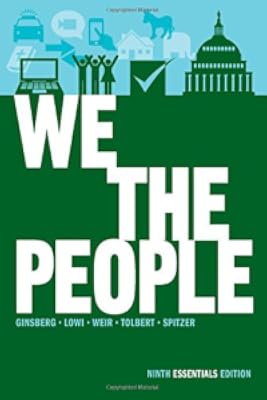
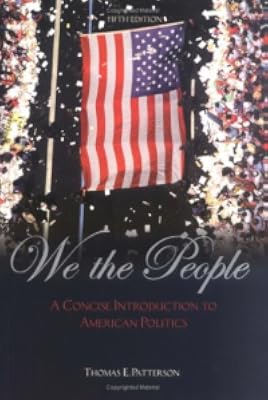
We the People: An Introduction to American Politics [full]
by Benjamin Ginsberg, Andrea Campbell, John Forshee, Theodore J. Lowi, Robert J. Spitzer, Caroline J. Tolbert, Margaret Weir
On This Page
Description
We the People, Eleventh Edition, sets a new standard for showing how government affects students lives and why it matters who participates. The Who Are Americans? theme has been expanded to highlight how Americans from different backgrounds experience politics, and new Who Participates? infographics get students thinking critically about who shapes American politics. The textbook, InQuizitive course, and free coursepack are organized around chapter learning goals to ensure students learn the show more nuts and bolts of American government. show lessTags
Recommendations











Member Reviews
Standard College level textbook - an introduction into American Politics. I bought it mainly as a reference book which it does an adequate job.
It's compact size is perfect for desktop reference and review. In addition to having copies of the Declaration of Independence and Constitution, the textbook also has review questions for the reader to challenge themselves.
It extensively covers:
** Citizenship and Government - how government affects our lives, our identities, our ideals
** Our Founding and the Constitution - How Political conflicts shaped the first founding, how the failure of the articles attributed to the second founding, what the Constitution created, and how difficult ratification was
** Federalism - How it shaped American show more politics and how the definition changed radically over time
** Civil Liberties and Civil Rights - Students will be surprised to learn that those who opposed the Constitution paved the way for the Bill of Rights. This section also provides coverage of the first amendment, how the second amendment protects gun owners, how criminals are afforded due process by the constitution, the right to privacy, Civil Rights protections and struggles, and online privacy is also covered.
** The Role of the Media in Society as well as social media
** Political Parties, Participation and Elections - how political parties rose from the electoral process, the two-party system, political participation in traditional and online forms, as well as explaining why political party loyalty is important
** Interest Groups - This section also covers pluralist and elitist views, the increase of special interest groups, as well as the strategies used
** Congress - how the congress represents the people, how it is shaped by party, explanation of how a bill becomes law, the factors that leads congress to their decisions, and the other roles that congress has
** The Presidency - where the President gets his/her powers, institutional resources
** Bureaucracy - how it improves efficiency, how the Executive Branch is organized, and who controls the bureaucracy
** Federal Courts - how the legal system settles disputes, the different courts and what cases they hear, the Supreme Court and its powers
** Domestic Policy - Public Policy = Government Coercion, how the techniques of making policy are control, social policy and welfare, poverty, and social spending is also explored.
** Foreign Policy - this section ends the book covering: security based on military strength, how American foreign policy is shaped by both Government and non-Government actors, the tools of American Foreign policy, and using technology to topple governments citing the Case of Egypt.
For pleasure reading - it is a boring read. However, for review and reference - it does the job it was written to do. show less
It's compact size is perfect for desktop reference and review. In addition to having copies of the Declaration of Independence and Constitution, the textbook also has review questions for the reader to challenge themselves.
It extensively covers:
** Citizenship and Government - how government affects our lives, our identities, our ideals
** Our Founding and the Constitution - How Political conflicts shaped the first founding, how the failure of the articles attributed to the second founding, what the Constitution created, and how difficult ratification was
** Federalism - How it shaped American show more politics and how the definition changed radically over time
** Civil Liberties and Civil Rights - Students will be surprised to learn that those who opposed the Constitution paved the way for the Bill of Rights. This section also provides coverage of the first amendment, how the second amendment protects gun owners, how criminals are afforded due process by the constitution, the right to privacy, Civil Rights protections and struggles, and online privacy is also covered.
** The Role of the Media in Society as well as social media
** Political Parties, Participation and Elections - how political parties rose from the electoral process, the two-party system, political participation in traditional and online forms, as well as explaining why political party loyalty is important
** Interest Groups - This section also covers pluralist and elitist views, the increase of special interest groups, as well as the strategies used
** Congress - how the congress represents the people, how it is shaped by party, explanation of how a bill becomes law, the factors that leads congress to their decisions, and the other roles that congress has
** The Presidency - where the President gets his/her powers, institutional resources
** Bureaucracy - how it improves efficiency, how the Executive Branch is organized, and who controls the bureaucracy
** Federal Courts - how the legal system settles disputes, the different courts and what cases they hear, the Supreme Court and its powers
** Domestic Policy - Public Policy = Government Coercion, how the techniques of making policy are control, social policy and welfare, poverty, and social spending is also explored.
** Foreign Policy - this section ends the book covering: security based on military strength, how American foreign policy is shaped by both Government and non-Government actors, the tools of American Foreign policy, and using technology to topple governments citing the Case of Egypt.
For pleasure reading - it is a boring read. However, for review and reference - it does the job it was written to do. show less
This is a great intro text for poli sci students. It covers every corner of American government in a basic way that has the potential to generate interest in political science.
To be fair, I do not believe there will be such a thing as a "good U.S. politics textbook." That said, it may be a passable textbook, but the entire field is rather bad. As texts go, its rather unremarkable, though it may be a satisfactory introduction to U.S. government.
The textbook for my American Political Systems class. A nicely written overview of the way American governmental systems have arisen, and how the system works.
Ratings
Members
- Recently Added By
Author Information

31+ Works 1,030 Members
Benjamin Ginsberg is David Bernstein Professor of Political Science and Chair of the Center for Advanced Governmental Studies at Johns Hopkins University.
14+ Works 371 Members
Andrea Campbell received her B.A. in English from University of Redlands and her M.A. in English Literature from Washington State University. She is currently completing her doctoral work at Washington State University with an emphasis in ecofeminist literary criticism and women writers.
27+ Works 931 Members
Theodore Jay Lowi was born in Gadsden, Alabama on July 9, 1931. He received a bachelor's degree from Michigan State University and a master's degree and a doctorate in political science from Yale University. He taught at Cornell University from 1959 to 1965, returned in 1972 and remained the John L. Senior professor of American institutions until show more he was granted emeritus status in 2015. He was a political scientist who wrote numerous books including The End of Liberalism: The Second Republic of the United States, The Politics of Disorder, American Government: Incomplete Conquest, The Personal President, and Hyperpolitics: An Interactive Dictionary of Political Science written with Mauro Calise. He also edited The Pursuit of Justice by Robert F. Kennedy. He died on February 17, 2017 at the age of 85. (Bowker Author Biography) show less

14 Works 1,125 Members
2 Works 14 Members
7 Works 340 Members
Work Relationships
Common Knowledge
- Canonical title
- We the People: An Introduction to American Politics [full]
Classifications
- Genres
- Politics and Government, Nonfiction
- DDC/MDS
- 320.473 — Society, government, & culture Political science Types of Government Democracy; Structure and functions of government North America United States
- LCC
- JK276 .G55 — Political Science Political institutions and public administration (United States) Political institutions and public administration United States
- BISAC
Statistics
- Members
- 265
- Popularity
- 121,741
- Reviews
- 5
- Rating
- (3.36)
- Languages
- English
- Media
- Paper, Ebook
- ISBNs
- 64
- ASINs
- 3