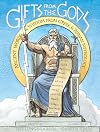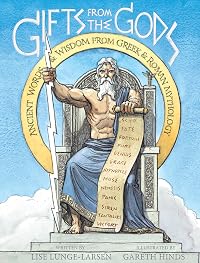
Gifts from the Gods: Ancient Words and Wisdom from Greek and Roman Mythology
by Lise Lunge-Larsen
On This Page
Description
"Did you know that museums were initially temples built to worship the nine muses, the goddesses of the arts? That Janus was the god of the doorways and hallways, and we have named our janitors after him? Where did these words--and other words, such as chaos, genius, nemesis, panic, echo, and narcissus--come from? From the ancient stories of the Greeks--stories that rang so true and wise that the names of the characters have survived for centuries as words we use every day. The brief stories show more here not only impart the subtle wisdom of these ancient tales, but make us understand the words, and our own world, more deeply."--Amazon.com. show lessTags
Recommendations














Member Reviews
Author Lise Lunge-Larsen and illustrator Gareth Hinds join forces for an educational and entertaining look at the etymological influence of Classical mythology in this wonderful collection. Each selection begins with a word or term, from Achilles Heel to Janitor, which is defined and used in a quotation from literature on the first page, then followed by the retelling of the Greek or Roman myth that inspired the word. Further words and terms derived from the myth are given on the final page of each section. The myths and words highlighted here include:
Achilles Heel and the story of Achilles and his eventual fate in the Trojan War.
Arachnid and the story of Arachne and her transformation into a spider at Athena's hand. Additional word: show more arachnophobia.
Echo and the story of the nymph Echo and the vain Narcissus. Additional words: narcissists and narcissism.
Fate and the story of the Three Fates: Clotho, Lachesis and Atropos. Additional words: stamina and stamen, as well as mortal, mortality and immortal from the Roman equivalent of Atropos, Morta.
Fortune and the story of Fortuna, the goddess of luck. Additional word: cornucopia, from the horn of plenty carried by Fortuna.
Fury and the story of the Furies, who punished wrongdoers. Additional words: infuriate, furious and furor.
Genius and the Roman belief in a personal spirit called a Genius. Additional word: demon, from the Greek word for Genius, Daemon.
Grace, and the story of the Three Graces. This word descends to us through Old French. Additional words: graceful and gracious. The Latin Gratia gives us grateful and gratitude.
Hypnotize and the story of Hypnos, the god of sleep. Additional words: hypnosis and insomnia from the Roman equivalent, Somnus.
Janitor and the story of the Roman god Janus. Additional word: January.
Muse and the story of the nine Muses. Additional words: museums, music and musical.
Nemesis and the story of Nemesis, the goddess of Justice, and how she punished King Croesus. Additional phrase: rich as Croesus.
Pandora's Box, and the story of Pandora, the first woman. Additional words: volcano, from the god Vulcan, the Roman equivalent of Hephaestus, who made Pandora.
Panic and the story of the god Pan and the fright he would give travelers. Additional word: pan flute.
Siren and the story of the Sirens and their envy of the Muses. Additional words: siren (when referring to a woman) and siren song.
Tantalize and the story of Tantalus and his punishment. Additional words: hubris, the Greek word for the pride of which Tantalus was guilty.
Victory and the story of the goddess Victory and her involvement in battles.
Following upon these myths and etymological explanations, Gifts from the Gods: Ancient Words and Wisdom from Greek and Roman Mythology closes with an author's note, a list of Greek and Roman gods, a bibliography, list of web sources, artist's note, and index.
The seventh book I have read from Lunge-Larsen and the first from Hinds, this was simply a marvelous collection! I have read many children's retellings of Classical mythology, and have my own favorites, when it comes to the actual storytelling—the best in my opinion being D'Aulaires' Book of Greek Myths—but this is the first such collection I have encountered where the focus is on the treasure of words and phrases we have inherited from these stories. The stories here are well told, but what sets the book apart if this added dimension! The accompanying artwork from Hinds is engaging, done in a graphic novel style, which is unsurprising, given that is his background. Highly recommended to all young word hounds and mythology enthusiasts! show less
Achilles Heel and the story of Achilles and his eventual fate in the Trojan War.
Arachnid and the story of Arachne and her transformation into a spider at Athena's hand. Additional word: show more arachnophobia.
Echo and the story of the nymph Echo and the vain Narcissus. Additional words: narcissists and narcissism.
Fate and the story of the Three Fates: Clotho, Lachesis and Atropos. Additional words: stamina and stamen, as well as mortal, mortality and immortal from the Roman equivalent of Atropos, Morta.
Fortune and the story of Fortuna, the goddess of luck. Additional word: cornucopia, from the horn of plenty carried by Fortuna.
Fury and the story of the Furies, who punished wrongdoers. Additional words: infuriate, furious and furor.
Genius and the Roman belief in a personal spirit called a Genius. Additional word: demon, from the Greek word for Genius, Daemon.
Grace, and the story of the Three Graces. This word descends to us through Old French. Additional words: graceful and gracious. The Latin Gratia gives us grateful and gratitude.
Hypnotize and the story of Hypnos, the god of sleep. Additional words: hypnosis and insomnia from the Roman equivalent, Somnus.
Janitor and the story of the Roman god Janus. Additional word: January.
Muse and the story of the nine Muses. Additional words: museums, music and musical.
Nemesis and the story of Nemesis, the goddess of Justice, and how she punished King Croesus. Additional phrase: rich as Croesus.
Pandora's Box, and the story of Pandora, the first woman. Additional words: volcano, from the god Vulcan, the Roman equivalent of Hephaestus, who made Pandora.
Panic and the story of the god Pan and the fright he would give travelers. Additional word: pan flute.
Siren and the story of the Sirens and their envy of the Muses. Additional words: siren (when referring to a woman) and siren song.
Tantalize and the story of Tantalus and his punishment. Additional words: hubris, the Greek word for the pride of which Tantalus was guilty.
Victory and the story of the goddess Victory and her involvement in battles.
Following upon these myths and etymological explanations, Gifts from the Gods: Ancient Words and Wisdom from Greek and Roman Mythology closes with an author's note, a list of Greek and Roman gods, a bibliography, list of web sources, artist's note, and index.
The seventh book I have read from Lunge-Larsen and the first from Hinds, this was simply a marvelous collection! I have read many children's retellings of Classical mythology, and have my own favorites, when it comes to the actual storytelling—the best in my opinion being D'Aulaires' Book of Greek Myths—but this is the first such collection I have encountered where the focus is on the treasure of words and phrases we have inherited from these stories. The stories here are well told, but what sets the book apart if this added dimension! The accompanying artwork from Hinds is engaging, done in a graphic novel style, which is unsurprising, given that is his background. Highly recommended to all young word hounds and mythology enthusiasts! show less
This book is excellent. Lots of great details and historical context but presented in a way that’s very easy to understand and follow along with.
Most of the myths were old hat . . . in fact, the only reason this book popped onto Z's radar is that it's illustrated by Gareth Hinds. Ultimately, it was a big winner as fun introduction to etymology. There will be much more to come, I'm sure.
This was a really interesting book. The art was great, the stories were great. The extra little information at the end of each story really tied together what the audience had just read. I enjoyed reading about some common words we use today, and how they were used in Greek/Roman mythology.
This is a collection of of myths from Greek and Roman mythology. It is unique in that it strives to illuminate and illustrate the origin of words through the myths. I appreciated that the author took great care to use Greek mythology when the word came directly from Greek language. If the word had latin roots it was illustrated using Roman mythology. The author explains in a note that as a result of the Romans taking over Greece and becoming enthralled with their stories that they took many of the stories and made them their own and often gave the gods and goddesses their own new names when translating them in to Latin. The illustrations in the collection are wonderful and breathe life in to the text with the detailed depictions of the show more gods, goddesses, and mortals. The landscapes are rich and authentic to the time periods and geographic locations. show less
This book is about words that we use commonly that have been given to us by Greek myths. This book doesn't have a plot line, but rather it is a collection of myths. It does tell of some interesting myths. For example it tells about Tantalus who fed his children to the Gods. Zeus was so angry he put Tantalus in a pool of water with apple trees around it. Then Tantalus was given a starving hunger and a burning thirst, but every time he went to get a drink the water lowered and every time he tried to get an apple it would rise up so he could never satisfy himself. That is were we get the word "tantalize".
I did like this book for nostalgia reasons mostly. I did like this book because of the fact that it was interesting how some words came show more from Greek myths. I think the myths they chose were very interesting and how they chose words that we're familiar with. Some of the words include, victory and panic. The myths that they put in the book really kept my attention. I do recommend this book to anyone. show less
I did like this book for nostalgia reasons mostly. I did like this book because of the fact that it was interesting how some words came show more from Greek myths. I think the myths they chose were very interesting and how they chose words that we're familiar with. Some of the words include, victory and panic. The myths that they put in the book really kept my attention. I do recommend this book to anyone. show less
This book has several mini stories popular with the greek and roman mythology. Archilles Heel. The authors use a focus word say archilles heel and define it to be a seemingly small but actually crucial meaning. The authors go on to tell the story behind this great word(s). Another word would be nemesis. They define it and then tell a greek or roman story that goes along with the focus word. Lots of pictures and large words to help with engaging the reader. A great book to have in a teachers libarary for older elementary students. I would not use it with early elementary mostly some of the stories do have some violence in them. In the classroom I might choose a word and make a overhead for it and talk with student about a specific word show more and then read the story aloud with them. Have them ask question pertaining to when they might have heard the word and not know what it was. I would then offer and guide them to their definition and how it might apply to them. show less
Members
- Recently Added By
Author Information

8 Works 868 Members
All Editions
Awards and Honors
Classifications
Statistics
- Members
- 146
- Popularity
- 225,202
- Reviews
- 11
- Rating
- (4.17)
- Languages
- English
- Media
- Paper, Ebook
- ISBNs
- 4
- ASINs
- 2