On This Page
Description
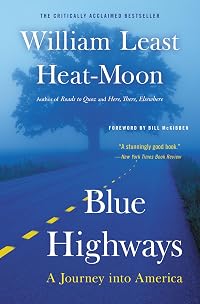
Hailed as a masterpiece of American travel writing, Blue Highways is an unforgettable journey along our nation's backroads.William Least Heat-Moon set out with little more than the need to put home behind him and a sense of curiosity about "those little towns that get on the map — if they get on at all — only because some cartographer has a blank space to fill: Remote, Oregon; Simplicity, Virginia; New Freedom, Pennsylvania; New Hope, Tennessee; Why, Arizona; Whynot, Mississippi."
His show more adventures, his discoveries, and his recollections of the extraordinary people he encountered along the way amount to a revelation of the true American experience. show less
Tags
Recommendations


















Member Recommendations

Polaris- Readers who enjoyed 'Blue Highways' will CERTAINLY enjoy 'Writing Blue Highways: The Story of How a Book Happened'!
Member Reviews
For armchair tourists like myself, who prefer reading to travelling, William Least Heat-Moon is the perfect tour guide to late 1970s America. Part travelogue, part journey of self-discovery, Heat-Moon set off one day in his campervan - a 'self-propelled box' he calls 'Ghost Dancing' - to drive around the 'blue highways', or b-roads, of America, meeting a host of wacky characters along the way. Really, without photographic evidence of some of the people he strikes up conversations with, I would have my doubts about the authenticity of his anecdotes! My favourites are the droll Carolina deputy - 'Garrantee one thing, Wim. This boy wouldn't sleep up here mongst the whangdoodles withouten his peace of mind' - the two women running a cafe on show more a bombing range in Nevada, the disgruntled husband in Hat Creek, California, and the eighty year old keeper of local history on Smith Island, Maryland. Sometimes, fact is stranger than fiction!
Heat-Moon, on his circular journey of 'emergence' around the States - taking in places with odd names from the east, south, west and north of the country - is a friendly and instructive combination of Bill Bryson and John Steinbeck. In between random dialogues with strangers, Heat-Moon is full of insightful and lyrical descriptions of his homeland. I also love his turn of phrase, from 'the expression of a man pulling on wet swimming trunks' (think about it) to the 'texturised substitute in polystyrene sarcophagus' he was forced to eat in a fast food outlet. People, places and poetic imagery, all in one entertaining guide (could have done with less Walt Whitman quotes, though).
Not only has Blue Highways left me hungry for more travelogues - perhaps Zen and the Art of Motorcycle Maintenance - but I am also tempted to start reading about the history of America, which hopefully survives in books where shopping malls and parking lots have destroyed the living evidence in real life. show less
Heat-Moon, on his circular journey of 'emergence' around the States - taking in places with odd names from the east, south, west and north of the country - is a friendly and instructive combination of Bill Bryson and John Steinbeck. In between random dialogues with strangers, Heat-Moon is full of insightful and lyrical descriptions of his homeland. I also love his turn of phrase, from 'the expression of a man pulling on wet swimming trunks' (think about it) to the 'texturised substitute in polystyrene sarcophagus' he was forced to eat in a fast food outlet. People, places and poetic imagery, all in one entertaining guide (could have done with less Walt Whitman quotes, though).
Not only has Blue Highways left me hungry for more travelogues - perhaps Zen and the Art of Motorcycle Maintenance - but I am also tempted to start reading about the history of America, which hopefully survives in books where shopping malls and parking lots have destroyed the living evidence in real life. show less
I've read many travelogues over the years. Some were bad, some were good, some were so good they made me anxious to take a similar journey (and sometimes I did). Of them all, this is the best.
It's William Least Heat Moon's circumnavigation of the United States, all the while avoiding the sterile super-highways usual for that purpose and trying to stay on the blue roads ... the secondary thoroughfares colored blue on road atlases before we all became reliant on GPS.
It's not just that he has a gift for a turn of phrase—a waitress with a "grudge of a face." Nor that he can describe the natural world so well that you can picture it—the Pine Barrens "six hundred fifty thousand acres (equal to Grand Canyon National Park) ... pitch pines show more and oaks and white cedars ... cranberry bogs and fields of high-bush blueberries opening the woods ... a stream [where] tannins had turned the transparent water the color of cherry cola .. a silence as if civilization had disappeared." Not even that he knows us—Americans—so well: "You might as well ask [the American traveler] to share his toothbrush as his bathroom."
It's all that plus a perfect blend of "This is what I saw" and "This is whom I met." It's a picture of place and people, many of them gone or going now. Colorful, rich, full of stories about how things got the way they are now, the people that embraced the changes and those who resisted them.
And you learn how to rate diners by the number of calendars on wall.
Absolutely read it. show less
It's William Least Heat Moon's circumnavigation of the United States, all the while avoiding the sterile super-highways usual for that purpose and trying to stay on the blue roads ... the secondary thoroughfares colored blue on road atlases before we all became reliant on GPS.
It's not just that he has a gift for a turn of phrase—a waitress with a "grudge of a face." Nor that he can describe the natural world so well that you can picture it—the Pine Barrens "six hundred fifty thousand acres (equal to Grand Canyon National Park) ... pitch pines show more and oaks and white cedars ... cranberry bogs and fields of high-bush blueberries opening the woods ... a stream [where] tannins had turned the transparent water the color of cherry cola .. a silence as if civilization had disappeared." Not even that he knows us—Americans—so well: "You might as well ask [the American traveler] to share his toothbrush as his bathroom."
It's all that plus a perfect blend of "This is what I saw" and "This is whom I met." It's a picture of place and people, many of them gone or going now. Colorful, rich, full of stories about how things got the way they are now, the people that embraced the changes and those who resisted them.
And you learn how to rate diners by the number of calendars on wall.
Absolutely read it. show less
For the past few days as I read Blue Highways by William Least Heat-Moon I have been glued to my computer so that I could use the Google maps to follow along with his journey. In 1978 after seeing his marriage fall apart and then his teaching job disappear, William Least Heat-Moon climbed into his van and set off to explore the byways of America. He tried to avoid all major routes and stick to the secondary roads that are marked by blue on the maps, hence the name of the book.
Setting off on the road with no set destination, just living moment by moment, I was green with envy. I would love to simply pack up and hit the roads for a tour around North America. The author travelled on very little money or comfort items, but managed to show more explore his country and meet and talk with some extremely interesting people all the while coming to terms with who he was and where he wanted to be. The book is rich in details of the trip. The sights, smells and tastes of America are detailed by this talented observer. By the time he headed for home in Missouri, he had completely circled the country.
As I read the book and checked the maps I was saddened by the changes that have occurred since then. Many of the roads have changed or no longer exist, and the same can be said for many of the small towns. Some have been swallowed up by ever expanding cities and some have just disappeared. It’s been over forty years since Blue Highways was published so at times this book seems more like a testament to days gone by. This became a journey of heart, mind and spirit for the author but he always kept America front and centre as the main character and delivers a wonderful road trip travelogue full of wit, humor and truth. show less
Setting off on the road with no set destination, just living moment by moment, I was green with envy. I would love to simply pack up and hit the roads for a tour around North America. The author travelled on very little money or comfort items, but managed to show more explore his country and meet and talk with some extremely interesting people all the while coming to terms with who he was and where he wanted to be. The book is rich in details of the trip. The sights, smells and tastes of America are detailed by this talented observer. By the time he headed for home in Missouri, he had completely circled the country.
As I read the book and checked the maps I was saddened by the changes that have occurred since then. Many of the roads have changed or no longer exist, and the same can be said for many of the small towns. Some have been swallowed up by ever expanding cities and some have just disappeared. It’s been over forty years since Blue Highways was published so at times this book seems more like a testament to days gone by. This became a journey of heart, mind and spirit for the author but he always kept America front and centre as the main character and delivers a wonderful road trip travelogue full of wit, humor and truth. show less
This was another buddy read with my dad, since we enjoyed PrairyErth so much. William Least Heat-Moon is an excellent writer, and there are so many beautiful turns of phrase and fascinating observations here. I did not enjoy it quite as much as PrairyErth, however. Part of that is just my attachment to the prairie (oh, I lit up when we got to his descriptions of the northern prairie in this book!), but part of it lies in Heat-Moon's attitude toward women, surely colored by the fact that this entire trip was in no small part motivated by the collapse of his relationship.
This sexist feeling isn't everywhere or even a constant theme, but it shows up often enough that it really started to drag on me. There are a couple (at least) of men show more who, when telling their life stories, spend a lot of time blaming women for their sorry states, and Heat-Moon listens sympathetically. Then when he picks up a young woman hitchhiking, who describes the objectively abusive home life she is fleeing, he argues with her, telling her it couldn't have been all bad, and maintains a disapproving attitude. Then there are the number of times women are described based primarily on their attractiveness, including some random speculation on what one woman (who does not flirt with him in any way) would be like in bed. YES, I GET IT. YOU ARE PROCESSING YOUR FAILED/FAILING RELATIONSHIP, BUT I AM HERE FOR THE DESCRIPTIONS OF AMERICANA, CAN WE NOT MAKE THEM SO ENTANGLED WITH YOUR FEMALE BAGGAGE, PLEASE?
That said, there was so much to love in this book. Scenes that spring to mind are the conversations on racism in the Deep South, the observations on sovereign lands in Northern Arizona, the bit on hang-gliding, the hitchhiking Seventh Day Adventist, the guy who ran a maple syrup operation. All of these tiny little hyper-local ways of life that are mostly inconceivable to people living a few states away. Amazing. show less
This sexist feeling isn't everywhere or even a constant theme, but it shows up often enough that it really started to drag on me. There are a couple (at least) of men show more who, when telling their life stories, spend a lot of time blaming women for their sorry states, and Heat-Moon listens sympathetically. Then when he picks up a young woman hitchhiking, who describes the objectively abusive home life she is fleeing, he argues with her, telling her it couldn't have been all bad, and maintains a disapproving attitude. Then there are the number of times women are described based primarily on their attractiveness, including some random speculation on what one woman (who does not flirt with him in any way) would be like in bed. YES, I GET IT. YOU ARE PROCESSING YOUR FAILED/FAILING RELATIONSHIP, BUT I AM HERE FOR THE DESCRIPTIONS OF AMERICANA, CAN WE NOT MAKE THEM SO ENTANGLED WITH YOUR FEMALE BAGGAGE, PLEASE?
That said, there was so much to love in this book. Scenes that spring to mind are the conversations on racism in the Deep South, the observations on sovereign lands in Northern Arizona, the bit on hang-gliding, the hitchhiking Seventh Day Adventist, the guy who ran a maple syrup operation. All of these tiny little hyper-local ways of life that are mostly inconceivable to people living a few states away. Amazing. show less
The author, an English professor who had just lost his job and his wife, decided to drive across the United States and return, as much as possible on the "blue roads" that were the main thoroughfares before the interstate highway system was built. Along the way, he visited many small towns, diners, gas stations and other local businesses where he hoped to find vestiges of the "real America". This is an endlessly fascinating exercise; Steinbeck did it twenty years earlier, with a dog; people are still doing it 30 years later. And it's great fun to read about.
I'm a sucker for travel memoirs. I just love hearing about the author's trip and the people they meet along the way. But a travel memoir is only as good as the author's writing and this one is wonderful. It reminded me a lot of Steinbeck's Travels With Charley.
Heat-Moon loses his job as a professor and separates from his wife. These two events motivate him to take a van and drive around the entire country. He tries to stick to the back roads instead of the interstates. He is truly gifted at describing people. This is just one example,
"Alice was one of those octogenarians who make old age look like something you don't want to miss."
I love that! On his journey he visits towns where racism sits just below the surface, kindness spills out show more onto the sidewalks, mosquito swarm, fisherman swear and there's no shortage of delicious food.
I listened to the audiobook, narrated by the amazing Frank Muller, but had a hard copy I flipped through while listening because it included maps and photos of the people he met. I would recommend doing the same if you listen to it. show less
Heat-Moon loses his job as a professor and separates from his wife. These two events motivate him to take a van and drive around the entire country. He tries to stick to the back roads instead of the interstates. He is truly gifted at describing people. This is just one example,
"Alice was one of those octogenarians who make old age look like something you don't want to miss."
I love that! On his journey he visits towns where racism sits just below the surface, kindness spills out show more onto the sidewalks, mosquito swarm, fisherman swear and there's no shortage of delicious food.
I listened to the audiobook, narrated by the amazing Frank Muller, but had a hard copy I flipped through while listening because it included maps and photos of the people he met. I would recommend doing the same if you listen to it. show less
Members
- Recently Added By
Published Reviews
ThingScore 100
[William Least] Heat Moon climbed into his Econoline van and drove 12,000 miles down the back roads of America — and recorded it all in this big, richly detailed book. ... Heat Moon writes from the perspective of "a contaminated man who will be trusted by neither red nor white." His Indian mind feels an especially violent antipathy to the wasteland of ecocidal capitalism, but his white mind show more knows how tenuous his red roots are. ... An immensely appealing performance. show less
added by Roycrofter
Lists

Best Travel Narrative
32 works; 20 members

Best of Travel Narratives
142 works; 28 members

Best Autobiographies and Memoirs
370 works; 67 members
Adventure Travel & Exploration In North America
12 works; 5 members

Non-Fiction Worth Reading
1,025 works; 264 members

Carole's List
445 works; 13 members

Books Read in 2016
4,666 works; 199 members

A Rainbow of Books: Colors in the Title
570 works; 24 members

Mustich's 1000 Books to Read Before You Die: A Life Changing List
1,001 works; 20 members
Author Information

21+ Works 6,725 Members
William Least Heat-Moon was born of English-Irish-Osage ancestry in Kansas City, Missouri. He holds a doctorate in English and a bachelor's degree in photojournalism from the University of Missouri.
Some Editions
Awards and Honors
Series

Belongs to Publisher Series
Ooievaar (280)
Work Relationships
Contains
Has as a student's study guide
Common Knowledge
- Canonical title
- Blue Highways: A Journey into America
- Original title
- Blue Highways: A Journey into America
- Alternate titles*
- Blauwe wegen : een ontdekkingsreis door Amerika
- Original publication date
- 1982
- Important places
- USA
- Dedication
- This book is for the wife of the Chief and for the Chieftain too. In love.
- First words
- Beware thoughts that come in the night.
- Quotations
- A frog, long-leggedy and green, belly-flopped across the road to the side where the puddles would be better. The land, still cold and wintery, was alive with creatures that trusted in the coming of spring.
Life doesn’t happen along interstates. It’s against the law.
At the Huntingburg exit, I turned off and headed for the Ohio River. Indiana 66, a road so crooked it could run for the legislature....
IT’S an old debate here: Is bluegrass indigenous to Kentucky or did it come accidentally to America as padding to protect pottery shipped from England?
The lawns went from Vertagreen bluegrass to thin fescue to hard-packed dirt glinting with fragments of glass, and the lawn ornaments changed from birdbaths to plastic flamingoes and donkeys to broken-down automobiles with rai... (show all)sed hoods like tombstones.
As I started the engine, Wheeler said, “If you get back this way, stop in and see me. Always got beans and taters and a little piece of meat.” Down along the ridge, I wondered why it’s always those who live on little wh... (show all)o are the ones to ask you to dinner.
I thought about “whangdoodles” in the night, about how they too were gifts of the road in their rupture of order, their break of throttling security; they were a challenge to step out and shake one’s own skeleton at the... (show all) world.
Trees burned so tobacco could grow so tobacco could burn.
He said, “I read not long ago—I mention this because of the license on your panel truck—that there’s a Missouri bank named after Jesse James. Now, is there any truth in that?” “It’s near where James lived.” â€... (show all)œWell, then, may I say it might be the only honestly named bank in the country?”
"All that killed off Cambridge, but it saved old Ninety Six from being built over. It’s alive today because it died a hundred and some years ago. But nothing’s left of Cambridge as you see.”
There was nothing but song and silences. No sermon, no promise of salvation, no threat of damnation, no exhortation to better conduct. I’m not an authority, God knows, but if there is a way to talk into the Great Primal Ear... (show all)s—if Ears there be—music and silence must be the best way.
The roots of Cajun cookery come from Brittany and bear no resemblance to Parisian cuisine and not even much to the Creole cooking of New Orleans. Those are haute cuisines of the city, and Cajun food belongs to the country whe... (show all)re things got mixed up over the generations. No one even knows the source of the word gumbo. Some say it derives from an African word for okra, chinggombo, while others believe it a corruption of a Choctaw word for sassafras, kombo, the key seasoning.
I picked her up at twelve. She asked about the trip, especially about Selma and how things were as I saw them. “A white man griped about changes, and a black said there weren’t enough changes to gripe about.” “That’... (show all)s us too. What we want is slow coming—if it’s coming at all. Older blacks here are scared of whites and won’t do much for change if it means risk. Others don’t care as long as everything gets smothered over with politeness by whites. Young blacks see the hypocrisy—even when it’s not there. But too many of them are juked on drugs, and that’s where some of this town wants us.”
The west fire exit unexpectedly opened and sunlight poured in; like Draculas before the cross, we cried out and covered our eyes.
I was in one of the strangest pieces of topography I’d ever seen, a place, until now, completely beyond my imaginings. What is it in man that for a long while lies unknown and unseen only one day to emerge and push him into... (show all) a new land of the eye, a new region of the mind, a place he has never dreamed of?
I suspected that the Boss embraced one crisis after another because they gave him significance, something like tragic stature. He had so lost belief in a world outside himself that, without crisis, he had nothing worth talkin... (show all)g about. On and on, the tolling of words revealed his expertise in living a life that baffled him.
After traveling nineteenth-century America, de Tocqueville came to believe one result of democracy was a concentration of each man’s attention upon himself.
I’ve read that Navajo, a language related to that of the Indians of Alaska and northwest Canada, has no curse words unless you consider “coyote” cursing. By comparison with other native tongues, it’s remarkably free o... (show all)f English and Spanish; a Navajo mechanic, for example, has more than two hundred purely Navajo terms to describe automobile parts. And it might be Navajo that will greet the first extraterrestrial ears to hear from planet Earth: on board each Voyager spacecraft traveling toward the edge of the solar system and beyond is a gold-plated, long-playing record; following an aria from Mozart’s Magic Flute and Chuck Berry’s “Johnny B. Goode,” is a Navajo night chant, music the conquistadors heard.
For miles at the highway edges sat little cardboard and scrapwood ramadas, each with a windblasted sign advertising jewelry and cedar beads. In another era, white men came in wagons to trade beads to Indians; now they came in... (show all) stationwagons and bought beads. History may repeat, but sometimes things get turned around in the process.
But the Spider Grandmother did give two rules. To all men, not just Hopis. If you look at them, they cover everything. She said, ‘Don’t go around hurting each other,’ and she said, ‘Try to understand things.’”
She’d read about people like me and stared in a bold, contemptuous way she never would have used had she been alone. I tried to check my own irritation. She probably wasn’t a bad sort; she had her good side. Surely she ha... (show all)d studied the Gospel According to Heloise and knew by rote the six helpful hints for removing catsup stains.
...someone else will have to do the looking. The past is for the present, the present for the future.
He seemed one of those men who wander all their lives. In him was something restless and unsatisfied and ancient. He was going everywhere, anywhere, nowhere. He belonged to no place and was at home anyplace. He understood tha... (show all)t the Bible, in spite of its light, isn’t a particularly cheerful book, but rather one with much darkness, and he recognized that is where its power comes from.
Yet the language of the plains harks to the ocean: pioneers came in “prairie schooners” (some even rigged with sails) and spoke of the “sea of grass” and the “prairie ocean,” and they cured hangovers with calf bal... (show all)locks they called “prairie oysters.” Maybe the sodbusters saw seascapes in the undulations of the grasses or in the immensity of sky or in the lack of refuge from wind and storm. Perhaps a sea crossing was still in the minds of the newest immigrants. And maybe also, their words expressed a prescient awareness of the tug between coming and going....
Until the ghost dance generation—the one that kissed the old life goodbye to face an enemy future—the tribes that dominated these grasslands for eight thousand years fought most of their battles over hunting territory. Th... (show all)e red man ate buffalo (transubstantiation in the Indian manner), he dressed in buffalo, he imitated and talked to it, and he died for and by the sacred buffalo.
The highway, oh, the highway. No place, in theory, is boring of itself. Boredom lies only with the traveler’s limited perception and his failure to explore deeply enough. After a while, I found my perception limited.
In a hotel room at the geographical center of North America, a neon sign blinking red through the cold curtains, I lay quietly like a small idea in a vacant mind.
...tried to keep from looking inward, tried to reach outward, but, as Black Elk says, certain things among the shadows of a man’s life do not have to be remembered—they remember themselves.
On the road, where change is continuous and visible, time is not; rather it is something the rider only infers. Time is not the traveler’s fourth dimension—change is.
As filling stations cease to be garages and community centers, as they become nothing but expensive nozzles, they too are losing ground. But, in the past, an American traveler depended on the local grease pit boys to tell him... (show all) (a) the best route to wherever; (b) the best place to eat, although librarians give better recommendations; and (c) what the townsfolk thought about whatsoever. Now, it already may be too late for a doctoral candidate to study the ways that Americans’ views of each other have been shaped while waiting for the tank to fill.
“This is about the limited capacity of men to understand because they measure time in terms of themselves. This is about men who won’t see causes and therefore can’t predict effects. This is about men who fail to realiz... (show all)e that geographical refuge is central to our history. It’s about men who exterminate the species of the earth at the rate of one every day.”
Any projection must allow for man to change his history, a power second only to that of nature. A projection must allow for free will because only it does not despise or distrust or fear the unknown even if it knows the futur... (show all)e is not a better place but only a different one. Any prognosis must consider that men can change their angles of vision and therefore change the future.”
...there’s only one place they can get an education—in the school of thought. Learning rules is useful but it isn’t education. Education is thinking, and thinking is looking for yourself and seeing what’s there, not w... (show all)hat you got told was there. Then you put what you see together.
...in my season on the blue highways, the voices I heard were those of men—men who knew about stumbling not from observation as gods know it, but rather from having stumbled. For that reason, their words carried a force clo... (show all)ud voices could not match.
By seeing both the futility in trying to relive the old life and the danger in trying to obliterate it, man can gain the capacity to make anew. His very form depends not on repetition but upon variation from old patterns. In ... (show all)response to stress, biological survival requires genetic change; it necessitates a turning away from doomed replication. And what of history? Was it different? Etymology: educate, from the Latin educare, “lead out.”
To be only a nub in the eternal temporary is still to have a chance to see, a chance to pry at the mystery. What is the blue road anyway but an opportunity to poke at the unseen and a hoping the unseen will poke back?
The “right” way was worn so deeply in the earth as to be unmistakable. But without the errors, wrong turns, and blind alleys, without the doubling back and misdirection and fumbling and chance discoveries, there was not o... (show all)ne bit of joy in walking the labyrinth. And worse: knowing the way made traveling it perfectly meaningless.
I can’t say, over the miles, that I had learned what I had wanted to know because I hadn’t known what I wanted to know. But I did learn what I didn’t know I wanted to know.
John Irving’s assertion that there are, at the heart of things, only two plots, two stories: a stranger rides into town, a stranger rides out of town. Without knowing it, I had a chance for both. - Last words
- (Click to show. Warning: May contain spoilers.)"Where else?" he said.
- Original language
- English
- Canonical DDC/MDS
- 917.304927
- Canonical LCC
- E169.Z8
*Some information comes from Common Knowledge in other languages. Click "Edit" for more information.
Classifications
- Genres
- Travel, Nonfiction, General Nonfiction, Biography & Memoir
- DDC/MDS
- 917.304927 — History & geography Geography & travel Geography of and travel in North America United States subdivisions and modified standard subdivisions Travel; guidebooks 1901- 1953-2001 1981-1989
- LCC
- E169 .Z8 — History of the United States United States General
- BISAC
Statistics
- Members
- 3,689
- Popularity
- 4,398
- Reviews
- 73
- Rating
- (4.04)
- Languages
- 5 — Dutch, English, German, Italian, Spanish
- Media
- Paper, Audiobook, Ebook
- ISBNs
- 43
- UPCs
- 1
- ASINs
- 25