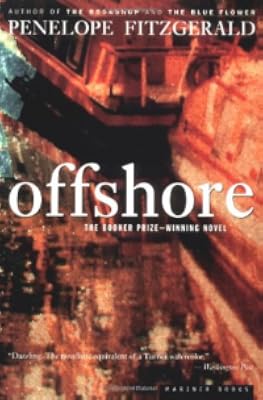
Offshore
by Penelope Fitzgerald
On This Page
Description
Penelope Fitzgerald's Booker Prize-winning novel of loneliness and connecting is set among the houseboat community of the Thames and has a new introduction from Alan Hollinghurst. On Battersea Reach, a mixed bag of the temporarily lost and the patently eccentric live on houseboats, rising and falling with the tide of the Thames. There is good-natured Maurice, by occupation a male prostitute, by chance a receiver of stolen goods. And Richard, an ex-navy man whose boat, much like its owner, show more dominates the Reach. Then there is Nenna, an abandoned wife and mother of two young girls running wild on the muddy foreshore, whose domestic predicament, as it deepens, will draw this disparate community together. show lessTags
Recommendations






























Member Reviews
Fitzgerald does a succinct and insightful job of presenting characters in brief sketches, characters who are becoming increasingly unmoored in life. Connected to each other in a makeshift community of barge-dwellers along a distressed section of the Thames at Battersea Reach, these characters aren’t going for a narrative arc in their lives: they are simply trying to stay afloat. Buffeted about by external forces, they are flotsam; while not appearing to have much agency in their affairs they are nonetheless an integral part of the ecosystem.
Ex-navy man turned investment counselor Richard is the only person with any real connection to dry land; he lives on a refurbished minesweeper and cannot detect that his marriage is detonating. show more Nenna and her two young daughters live close to the bone on the aptly-named ‘Grace’ and a handful of other characters either are seasonal boat-dwellers, or, like the young male prostitute Maurice, maintain a shaky existence on vessels in various states of disrepair. The loose connections among them slowly lead to a domino effect resulting in sudden and irrevocable changes for almost all of them.
‘Offshore’ was a controversial winner of the Booker in that it was a second choice for eat judge, the only choice that could be agreed upon. Many a winner for any similar type of prize has been selected this way over the years as consensus by committee is rarely easy. The book has its flaws: Fitzgerald should have made the six year old daughter older to fit her language, the character of Richard needed more interiority, there are one or two plot holes (with no job, an estranged husband and no other visible means of support, what is Nenna living on? Even a subsistence existence requires something) and the ending required a little more set-up.
Many people have remarked on the abruptness of the ending, all its ambiguity, but I don’t think either of those things were the problem: the ending, reflecting the themes of random chaos, characters adrift, and disintegration, could have worked very well with just a touch more care and a bit of foreshadowing. We’re left wondering about the fates of many of the characters, with no good options clearly on the horizon, but that’s the case with so many people who drift in and out of our lives. The story being told is less about the people than it is about a time and place, a slice of early 1960’s London, and about a precarious way of life — think more Dickens than Jane Austen.
The real protagonist is the river itself. Fitzgerald uses setting as character very efficiently. Anyone who has spent significant time living on a boat will immediately recognize how the water dominates the story and why the characters cannot explain or perhaps not feel it necessary to explain their need to stay within reach of the water. show less
Ex-navy man turned investment counselor Richard is the only person with any real connection to dry land; he lives on a refurbished minesweeper and cannot detect that his marriage is detonating. show more Nenna and her two young daughters live close to the bone on the aptly-named ‘Grace’ and a handful of other characters either are seasonal boat-dwellers, or, like the young male prostitute Maurice, maintain a shaky existence on vessels in various states of disrepair. The loose connections among them slowly lead to a domino effect resulting in sudden and irrevocable changes for almost all of them.
‘Offshore’ was a controversial winner of the Booker in that it was a second choice for eat judge, the only choice that could be agreed upon. Many a winner for any similar type of prize has been selected this way over the years as consensus by committee is rarely easy. The book has its flaws: Fitzgerald should have made the six year old daughter older to fit her language, the character of Richard needed more interiority, there are one or two plot holes (with no job, an estranged husband and no other visible means of support, what is Nenna living on? Even a subsistence existence requires something) and the ending required a little more set-up.
Many people have remarked on the abruptness of the ending, all its ambiguity, but I don’t think either of those things were the problem: the ending, reflecting the themes of random chaos, characters adrift, and disintegration, could have worked very well with just a touch more care and a bit of foreshadowing. We’re left wondering about the fates of many of the characters, with no good options clearly on the horizon, but that’s the case with so many people who drift in and out of our lives. The story being told is less about the people than it is about a time and place, a slice of early 1960’s London, and about a precarious way of life — think more Dickens than Jane Austen.
The real protagonist is the river itself. Fitzgerald uses setting as character very efficiently. Anyone who has spent significant time living on a boat will immediately recognize how the water dominates the story and why the characters cannot explain or perhaps not feel it necessary to explain their need to stay within reach of the water. show less
If, in your reading material, you appreciate a sublime but deliberate choice of wording which, in its calculated brevity, paints a magnificent panorama, then Penelope Fitzgerald’s Offshore will utterly delight – as it did me.
As plain as it is titled, this book is the briefest glimpse – a snapshot in essence – into a chapter of the lives of a disparate group of barge-dwellers; who actually live ‘offshore’ on the Thames River, in the shadow of Battersea Bridge, London, circa 1961. And much akin to the river itself, their lives are as ordered, oft-times, as the tides that control their houseboats, and as chaotic as living on a seething, ever-changing, moving mass of water can be – amidst the interminable consternation of the show more surrounding land-dwellers. Drawn together by their individuality, this unique little community, full of eclectic but endearing eccentrics, is thus peculiarly-shaped, and irrevocably altered, by the every choice of dwelling in such absurdity brings – the events which occur almost preordained in their inevitability.
In this book, there is so very much to like in so very little. This is my second Penelope Fitzgerald – and I have come to realise that Ms Fitzgerald is a consummate word-smith. In similitude with these floating lives, everything in this book is slightly askew, and intentionally so! Every word is chosen with a deliberation that in its conciseness elaborates, and discloses, such a welter of information and such colourful characterisations – which you know could never be conveyed as well, and would undoubtedly be lost, within a larger body of work – resulting in a superbly-crafted inference on the society of the time. By invoking a delicate humour on every page, this accentuates the underlying poignancy of the situation; detailing the random, indiscriminate thoughts of the barge residents - from wistful Nenna and her precocious brood to ex-navy Richard and his desire for everything to be ship-shape - discloses a complexity and a quality, a warmth, to this motley group inhabiting such a fascinating world.
But best of all, in regards to this marvellous book, is the respect Ms Fitzgerald pays her reader. She knows that in her succinct exposition the reader will grasp what is left unsaid; that a suggestion and a nuance, a dry wit, is all that is required to reveal the entire picture, and to be completely understood. There is a line on every page in Offshore that I could quote to exemplify the many, many beautiful constructs the author uses. This book made me laugh-out-loud, made me despair and made me ponder; made me return again and again to the immaculately-created phrasings, and in the end, yearn for more. Whereat I am left, like the inhabitants of Battersea Reach, floundering and in two minds, and all at sea with the world – and somewhat ‘off’!
Quite remarkable!
(May 1, 2009) show less
As plain as it is titled, this book is the briefest glimpse – a snapshot in essence – into a chapter of the lives of a disparate group of barge-dwellers; who actually live ‘offshore’ on the Thames River, in the shadow of Battersea Bridge, London, circa 1961. And much akin to the river itself, their lives are as ordered, oft-times, as the tides that control their houseboats, and as chaotic as living on a seething, ever-changing, moving mass of water can be – amidst the interminable consternation of the show more surrounding land-dwellers. Drawn together by their individuality, this unique little community, full of eclectic but endearing eccentrics, is thus peculiarly-shaped, and irrevocably altered, by the every choice of dwelling in such absurdity brings – the events which occur almost preordained in their inevitability.
In this book, there is so very much to like in so very little. This is my second Penelope Fitzgerald – and I have come to realise that Ms Fitzgerald is a consummate word-smith. In similitude with these floating lives, everything in this book is slightly askew, and intentionally so! Every word is chosen with a deliberation that in its conciseness elaborates, and discloses, such a welter of information and such colourful characterisations – which you know could never be conveyed as well, and would undoubtedly be lost, within a larger body of work – resulting in a superbly-crafted inference on the society of the time. By invoking a delicate humour on every page, this accentuates the underlying poignancy of the situation; detailing the random, indiscriminate thoughts of the barge residents - from wistful Nenna and her precocious brood to ex-navy Richard and his desire for everything to be ship-shape - discloses a complexity and a quality, a warmth, to this motley group inhabiting such a fascinating world.
But best of all, in regards to this marvellous book, is the respect Ms Fitzgerald pays her reader. She knows that in her succinct exposition the reader will grasp what is left unsaid; that a suggestion and a nuance, a dry wit, is all that is required to reveal the entire picture, and to be completely understood. There is a line on every page in Offshore that I could quote to exemplify the many, many beautiful constructs the author uses. This book made me laugh-out-loud, made me despair and made me ponder; made me return again and again to the immaculately-created phrasings, and in the end, yearn for more. Whereat I am left, like the inhabitants of Battersea Reach, floundering and in two minds, and all at sea with the world – and somewhat ‘off’!
Quite remarkable!
(May 1, 2009) show less
An exquisite little novel in which not much happens until the end, and yet, due to storms of all kinds, the whole world of each protagonist changes irrevocably.
Flux, Transition, Contrast, Stagnation
"Reality seemed to have lost its accustomed hold, just as the day wavered uncertainly between night and morning."
Everyone lives between land and water, but each is also caught in some other dichotomy: childhood or adulthood; togetherness or separation; comfort or poverty; in or out of love; life or death; artistry or manual labour; dreams or cold reality.
"Decision is torment for anyone with imagination... [because] you multiply the things you might have done and now never can".
But that can lead to paralysis.
Parallels in my Life
I don't show more relate to the specific circumstances, and it’s set before I was born, but the paralysis of indecision, when torn between two thoughts or situations is something I often struggle with. Sometimes it leads to an impulsive decision (which I may or may not regret), other times I try to pass the decision to someone else, or just avoid making it altogether. I feel I should be able to learn from this beautiful book, but it suggests diagnosis (which I'd already worked out), but no prescription. And that's fine.
Setting and Atmosphere
It is set in "the Reach", a small community of barge-dwellers in London, around 1962. The houseboats are permanently moored; their movement is limited to bobbing up and down on the tide.
The residents are very much a community, and yet they have almost nothing in common, other than the fact they are all adrift (even the cat), living in a never-world between land and water - literally, and in a more profound, psychological sense.
"The barge-dwellers, creatures neither of firm land nor water would have liked to be more respectable than they were... but a certain failure, distressing to themselves, to be like other people, caused them to sink back, with so much else that drifted or was washed up."
It vividly conjures the vicissitudes of the sights and sounds of the water and weather, aided by a splattering of boaty jargon.
"The river's most elusive hours, when darkness lifts off darkness, and from one minute to another the shadows declare themselves as houses or craft at anchor."
Characters
"Was there not, on the whole of Battersea Reach, a couple, married or unmarried, living together in the ordinary way?"
All the characters are Characters. As are the five boats. In fact, tradition dictates that owners are addressed by the name of their boat, though that doesn't happen all the time, and one owner thwarts it by changing the name of his boat to match his own name.
The main characters are Nenna (only 32, but with daughters Martha, 12, and Tilda, 6); Maurice, a young gay man making ends meet as a prostitute; Willis, an old marine painter, whose boat is in need of sprucing up; boat-proud Woodrow (Woodie); and Richard, a natural leader, ex-navy, now working in insurance, with the biggest, smartest boat.
All have troubles of some sort, though Nenna's are most evident. She's depressed and has other vague mental health issues. When she's alone, her thoughts "took the form of a kind of perpetual magistrates' hearing", perpetually having to defend her action and inaction regarding her marriage. Meanwhile, she is over-reliant on her daughters, who no longer attend school. Her "character was faulty, but she had an instinct to see what made other people unhappy".
Tilda is perhaps the least convincing character, which is a shame, as it could be fixed by making her 10, rather than 6. Growing up in the Reach, she is understandably fascinated by and knowledgeable about the river. She "had the air of something aquatic, a demon from the depths", and "respected the water and knew that one could die within sight of the Embankment". But her language and insight don't always sound right: "Do you think Ma's mind is weakening?" and "It's not the kind who inherit the earth... They get kicked in the teeth".
In contrast, Martha is
"armed at all points against the possible disappointments of her life, conscious of the responsibilities of protecting her mother and sister, worried a the gaps in her education... she had forgotten for some time the necessity for personal happiness."
Plot Summary
Nenna often chats long into the night with Maurice, but there is a frisson between her and Richard. Willis' barge (Dreadnaught) sinks, though he escapes, and is put up by Woodie. Eventually, Nenna plucks up courage to visit her husband, Edward. He's a wastrel, recently returned from a failed attempt to make money in South America, and won't come to the boat. (Meanwhile, Martha gets friendly with a 16-year old German, Heinrich, staying for 24 hours, as a friend of a friend of Nenna's sister.) She hoped to spend the night and win him back, but things don't go well, and she walks home, where Richard is waiting (his wife, Laura, has recently left him properly) and takes her out in a dinghy, before returning to the Reach. We later discover they did go into a cabin together. Meanwhile, Laura's wealthy sister is over from Canada, and wants to take her and the girls to start a new life there. But Richard is attacked by Harry, an acquaintance of Maurice (who uses Maurice's boat to store stolen goods) and is severely injured. His wife comes back to take care of him. Meanwhile, Edward comes looking for Nenna, but ends up drinking with Maurice, before trying to board Nenna's barge (she's not in, because of the storm) and possibly falling into the cold and turbulent waters.
Then it ends! I like untidy, open endings, but this was SO open, I was aghast.Do Edward and Maurice survive? Does Richard stay with Laura? Do Nenna and the girls go to Canada, and if not, do she and Richard have a chance, or even she and Edward? Will Harry be caught, and if so, what are the implications for Maurice (if he lived)? What about the homeless and penniless Willis - he surely can't go on living with Woodie?
Quotes
* "That crucial moment when children realise that their parents are younger than they are."
* The advantages of youth, "Tilda cared nothing for the future, and had, as a result, a great capacity for happiness." Also, "Her heart didn't rule her memory... she was spared that inconvenience."
* A petty criminal "had no expression, as though expressions were surplus to requirements."
* "Tenderly responsive to the self-deception of others, he was unfortunately too well able to understand his own."
* "Martha bruised so easily. A princess, unknown to all about her, she awaited the moment when these bruises would reveal her heritage."
* "Many enterprises in Chelsea which survived entirely by selling antiques to each other."
* A man, propositioning a woman on a street, "smelled of loneliness".
* "The kind of man who has two clean handkerchiefs on him at half past three in the morning."
* "She would go with him to the end of the world if his outboard motor was always going to start like that." ;)
* A young German (ex) aristocrat had "an upbringing designed to carry him through changes of regime and frontier, possible loss of every worldly possession... had made him totally self-contained and able with the sunny smile and formal handshake of the gymnast to set almost anybody at their ease."
* "The ship's cat was in every way appropriate for the Reach. She habitually moved in a kind of nautical crawl... Through years of attempting to lick herself clean, for she had never quite lost her self-respect, Stripey had become as thickly coated with mud inside as out. She was in a perpetual process of readjustment... to tides and seasons... The resulting uncertainty as to whether she was coming or going had made her, to some extent, mentally unstable."
More Fitzgerald?
Given how much I loved this, I was excited to pick up The Blue Flower (see my review HERE). It couldn't have been more different. I had to force myself to finish it. Nevertheless, this was so good, I will give Fitzgerald another chance. One day.
And there is a growing tide of support among my GR friends for The Bookshop, which - apart from its bookish appeal - sounds much closer to this. show less
Flux, Transition, Contrast, Stagnation
"Reality seemed to have lost its accustomed hold, just as the day wavered uncertainly between night and morning."
Everyone lives between land and water, but each is also caught in some other dichotomy: childhood or adulthood; togetherness or separation; comfort or poverty; in or out of love; life or death; artistry or manual labour; dreams or cold reality.
"Decision is torment for anyone with imagination... [because] you multiply the things you might have done and now never can".
But that can lead to paralysis.
Parallels in my Life
I don't show more relate to the specific circumstances, and it’s set before I was born, but the paralysis of indecision, when torn between two thoughts or situations is something I often struggle with. Sometimes it leads to an impulsive decision (which I may or may not regret), other times I try to pass the decision to someone else, or just avoid making it altogether. I feel I should be able to learn from this beautiful book, but it suggests diagnosis (which I'd already worked out), but no prescription. And that's fine.
Setting and Atmosphere
It is set in "the Reach", a small community of barge-dwellers in London, around 1962. The houseboats are permanently moored; their movement is limited to bobbing up and down on the tide.
The residents are very much a community, and yet they have almost nothing in common, other than the fact they are all adrift (even the cat), living in a never-world between land and water - literally, and in a more profound, psychological sense.
"The barge-dwellers, creatures neither of firm land nor water would have liked to be more respectable than they were... but a certain failure, distressing to themselves, to be like other people, caused them to sink back, with so much else that drifted or was washed up."
It vividly conjures the vicissitudes of the sights and sounds of the water and weather, aided by a splattering of boaty jargon.
"The river's most elusive hours, when darkness lifts off darkness, and from one minute to another the shadows declare themselves as houses or craft at anchor."
Characters
"Was there not, on the whole of Battersea Reach, a couple, married or unmarried, living together in the ordinary way?"
All the characters are Characters. As are the five boats. In fact, tradition dictates that owners are addressed by the name of their boat, though that doesn't happen all the time, and one owner thwarts it by changing the name of his boat to match his own name.
The main characters are Nenna (only 32, but with daughters Martha, 12, and Tilda, 6); Maurice, a young gay man making ends meet as a prostitute; Willis, an old marine painter, whose boat is in need of sprucing up; boat-proud Woodrow (Woodie); and Richard, a natural leader, ex-navy, now working in insurance, with the biggest, smartest boat.
All have troubles of some sort, though Nenna's are most evident. She's depressed and has other vague mental health issues. When she's alone, her thoughts "took the form of a kind of perpetual magistrates' hearing", perpetually having to defend her action and inaction regarding her marriage. Meanwhile, she is over-reliant on her daughters, who no longer attend school. Her "character was faulty, but she had an instinct to see what made other people unhappy".
Tilda is perhaps the least convincing character, which is a shame, as it could be fixed by making her 10, rather than 6. Growing up in the Reach, she is understandably fascinated by and knowledgeable about the river. She "had the air of something aquatic, a demon from the depths", and "respected the water and knew that one could die within sight of the Embankment". But her language and insight don't always sound right: "Do you think Ma's mind is weakening?" and "It's not the kind who inherit the earth... They get kicked in the teeth".
In contrast, Martha is
"armed at all points against the possible disappointments of her life, conscious of the responsibilities of protecting her mother and sister, worried a the gaps in her education... she had forgotten for some time the necessity for personal happiness."
Plot Summary
Then it ends! I like untidy, open endings, but this was SO open, I was aghast.
Quotes
* "That crucial moment when children realise that their parents are younger than they are."
* The advantages of youth, "Tilda cared nothing for the future, and had, as a result, a great capacity for happiness." Also, "Her heart didn't rule her memory... she was spared that inconvenience."
* A petty criminal "had no expression, as though expressions were surplus to requirements."
* "Tenderly responsive to the self-deception of others, he was unfortunately too well able to understand his own."
* "Martha bruised so easily. A princess, unknown to all about her, she awaited the moment when these bruises would reveal her heritage."
* "Many enterprises in Chelsea which survived entirely by selling antiques to each other."
* A man, propositioning a woman on a street, "smelled of loneliness".
* "The kind of man who has two clean handkerchiefs on him at half past three in the morning."
* "She would go with him to the end of the world if his outboard motor was always going to start like that." ;)
* A young German (ex) aristocrat had "an upbringing designed to carry him through changes of regime and frontier, possible loss of every worldly possession... had made him totally self-contained and able with the sunny smile and formal handshake of the gymnast to set almost anybody at their ease."
* "The ship's cat was in every way appropriate for the Reach. She habitually moved in a kind of nautical crawl... Through years of attempting to lick herself clean, for she had never quite lost her self-respect, Stripey had become as thickly coated with mud inside as out. She was in a perpetual process of readjustment... to tides and seasons... The resulting uncertainty as to whether she was coming or going had made her, to some extent, mentally unstable."
More Fitzgerald?
Given how much I loved this, I was excited to pick up The Blue Flower (see my review HERE). It couldn't have been more different. I had to force myself to finish it. Nevertheless, this was so good, I will give Fitzgerald another chance. One day.
And there is a growing tide of support among my GR friends for The Bookshop, which - apart from its bookish appeal - sounds much closer to this. show less
I suspect that Offshore, had it been written today, would be unbearably quirky. A young, newly single mother and her two precocious young daughters live on a disused barge that serves as a houseboat, right on the Thames, along with a cast of colorful, eccentric, very British characters? Eeesh, that sounds awful. Somehow -- perhaps because she more-or-less lived it -- Penelope Fitzgerald's "Offshore" is great. It's a novel about living in that grey area between land and water, sure, but the other thread that I think runs through this book is courage in the face of adaptation: to abandonment, to old age, to the passage of time, and to decisions that can't be undone. Nenna's children, verbose and wise, seem to have adapted completely to show more their new lives, and think nothing of spending an entire day watching the gulls and boats, while their mother struggles with who she might be outside the context of her failing marriage. It also helps that Fitzgerald can really write. Her prose is fluid, and, considering the subject matter, it feels surprisingly gentle and natural: both her writing and the characters' lives seem to move with the gentle ebb and flow of the river. "Offshore" might also be one of the few books that I've ever read that employs lots of nautical jargon without seeming to go out of its way to confuse or annoy its readers. It describes a waterway that was once vital but has since become a sleepy backwater, a peaceful, nearly forgotten place in the middle of a modern city.
In the end, this book's something of an exercise in nostalgia, or at least remembrance: its characters fight gamely to hold on to their places by the river, but their efforts seem doomed from the start. The book, written in the late seventies, looks back on a time and place that disappeared with the coming of the psychedelic sixties and with massive redevelopment. Nenna's children live a bit like gypsies, and the author seems to imply that the freedom they enjoy would be unthinkable these days. For all that, it's remarkably clear-eyed, a fond tribute to an ad-hoc community that flourished, in its way, before its inevitable disappearance. show less
In the end, this book's something of an exercise in nostalgia, or at least remembrance: its characters fight gamely to hold on to their places by the river, but their efforts seem doomed from the start. The book, written in the late seventies, looks back on a time and place that disappeared with the coming of the psychedelic sixties and with massive redevelopment. Nenna's children live a bit like gypsies, and the author seems to imply that the freedom they enjoy would be unthinkable these days. For all that, it's remarkably clear-eyed, a fond tribute to an ad-hoc community that flourished, in its way, before its inevitable disappearance. show less
Fitzgerald's pleasantly low-key Booker winner from 1979. It's set in the early sixties, among a group of odd characters who live on decaying Thames barges moored at a boatyard in Chelsea. Like The Bookshop, it's a story centred around the very English concept of heroic failure (not coincidentally, several of the barges turn out to be Dunkirk veterans).
The people living on the boats are all ignoring something unpleasant in their lives in the vain hope that it will go away. There's a commercially-unsuccessful rent-boy, a decrepit old painter in the Gulley Jimpson tradition, a former naval officer who doesn't want to let his wife turn him into a Home-Counties-stockbroker type, and Nenna, who's hiding from the failure of her marriage show more whilst her small daughters learn the skills of mudlarking and discover Swinging London in the nearby King's Road. We know from the beginning that it's a safe bet that at least one of the old boats is going to sink in the course of the story, but that's not really the point: the joy of the book is watching the ingenious and entertaining way Fitzgerald unfolds the stories of the various characters. As in The Bookshop, her very individual way of presenting small children is great fun. In her world, children are much more competent and self-assured than adults: the six-year-old Tilda, as dogmatic on the subject of ships, tides and the river as her modern coevals would be on the different species of dinosaurs, is a constant delight. And there are wonderful little throwaway lines everywhere. I loved the way she manages to cut sixties culture to size by describing the King's Road as "a playground for children", for instance (of course, she was writing this as a sixty-year-old during the era of punk and the Sloane Rangers, which probably gives you a bit of perspective). show less
The people living on the boats are all ignoring something unpleasant in their lives in the vain hope that it will go away. There's a commercially-unsuccessful rent-boy, a decrepit old painter in the Gulley Jimpson tradition, a former naval officer who doesn't want to let his wife turn him into a Home-Counties-stockbroker type, and Nenna, who's hiding from the failure of her marriage show more whilst her small daughters learn the skills of mudlarking and discover Swinging London in the nearby King's Road. We know from the beginning that it's a safe bet that at least one of the old boats is going to sink in the course of the story, but that's not really the point: the joy of the book is watching the ingenious and entertaining way Fitzgerald unfolds the stories of the various characters. As in The Bookshop, her very individual way of presenting small children is great fun. In her world, children are much more competent and self-assured than adults: the six-year-old Tilda, as dogmatic on the subject of ships, tides and the river as her modern coevals would be on the different species of dinosaurs, is a constant delight. And there are wonderful little throwaway lines everywhere. I loved the way she manages to cut sixties culture to size by describing the King's Road as "a playground for children", for instance (of course, she was writing this as a sixty-year-old during the era of punk and the Sloane Rangers, which probably gives you a bit of perspective). show less
This slim novel is perfectly wrought, captures the moment of a break up of an unlikely set of neighbors living on barges in the Thames in the middle of London in--I would guess the late sixties. Fitzgerald tosses you into the world with few explanations; you're like a guest who gets swiftly introduced and then forgotten as the conversation swirls on. The group have achieved the appearance of stability--that faux calm of late summer is how I see it--and all get along well and are supportive and helpful, for the most part, of each other. But the underlying question is why? Why live on a barge in the middle of a big city? There is no question but that it does signify an apartness, a separation from the regular way of living, unsettled show more issues and business... Nenna bought 'Grace' and lives in it with her two girls with the money left to her when her husband went off to Canada to work, Richard was in the Navy and loves living on boats. Maurice lives on his because it is fun, Willis on his because that is where he ended up somehow or other. Woodie is a bit like Richard, but retired. The core moment of the book for me was when Edward, Nenna's husband, wails at her that she is 'not a woman'. He is saying, I think, that her independence- the fact that she doesn't need him, diminishes him. He is a weak man and needs to be needed. Nenna and her very feisty and interesting girls surely are the central characters. The point being that this liminal place is where many people do 'belong' - maybe all of us - being more faceted and complex than we like others to think. A lovely biting and intelligent book. Stripey the cat is also one of the more memorable cat cameos! (And has the only truly happy ending to her situation.) ****1/2 show less
‘’I can’t do the things that women can’t do,’ she said. ‘I can’t turn over The Times so that the pages lie flat, I can’t fold up a map in the right creases, I can’t draw corks, I can’t drive in nails straight, I can’t go into a bar and order a drink without wondering what everyone’s thinking about it, and I can’t strike matches towards myself. I’m well educated and I’ve got two children and I can manage pretty well, there’s a number of much more essential things that I know how to do, but I can’t do those ones, and when they come up I feel like weeping myself sick.’’
A tender tale of a squad of ‘’eccentrics’’ who have refused to conform to society’s notions of ‘’residence’’ and show more ‘’family’’. Fitzgerald poignantly narrates the relationships between characters that jump right off the page, their marital woes, the fear over what tomorrow may bring, and the unavoidable uncertainty that comes with the decision to live outside the ordinary. Without judgement but tenderness, without dramatic rants but soft sadness, Penelope Fitzgerald ushers us into a world that changes.
‘’The lights dazzled, but on the broad face of the water there were innumerable V-shaped eddies, showing the exact position of whatever the river had not been able to hide. If the old Thames trades had still persisted, if boatmen had still made a living from taking the coins from the pockets of the drowned, then this was the hour for them to watch. Far above, masses of autumn clouds passed through the transparent violet sky.’’
From mudlarking to gender roles and expectations, sexuality, loyalty, obligations, decorum and estrangement, Fitzgerald’s elegant satire and acute observations elevate what may appear as a ‘’simple’’ story to a bittersweet account of individuals being ostracised, smothered even, by social rules and duty.
‘’All distances are the same to those who don’t meet.’’
My reviews can also be found on https://theopinionatedreaderblog.wordpress.com/ show less
A tender tale of a squad of ‘’eccentrics’’ who have refused to conform to society’s notions of ‘’residence’’ and show more ‘’family’’. Fitzgerald poignantly narrates the relationships between characters that jump right off the page, their marital woes, the fear over what tomorrow may bring, and the unavoidable uncertainty that comes with the decision to live outside the ordinary. Without judgement but tenderness, without dramatic rants but soft sadness, Penelope Fitzgerald ushers us into a world that changes.
‘’The lights dazzled, but on the broad face of the water there were innumerable V-shaped eddies, showing the exact position of whatever the river had not been able to hide. If the old Thames trades had still persisted, if boatmen had still made a living from taking the coins from the pockets of the drowned, then this was the hour for them to watch. Far above, masses of autumn clouds passed through the transparent violet sky.’’
From mudlarking to gender roles and expectations, sexuality, loyalty, obligations, decorum and estrangement, Fitzgerald’s elegant satire and acute observations elevate what may appear as a ‘’simple’’ story to a bittersweet account of individuals being ostracised, smothered even, by social rules and duty.
‘’All distances are the same to those who don’t meet.’’
My reviews can also be found on https://theopinionatedreaderblog.wordpress.com/ show less
Members
- Recently Added By
Published Reviews
ThingScore 88
Much of ''Offshore'' simply sets the scene and arranges the characters, tasks Ms. Fitzgerald accomplishes with style....These characters are described with great care and skill. Ms. Fitzgerald excels at deft touches of characterization and dialogue.
added by theaelizabet
"In all, a small and very bright treasure."
added by theaelizabet
Lists

Booker Prize
491 works; 62 members

Best Books Set in London
157 works; 42 members
Favourite Booker Prize contenders
73 works; 21 members

Top Five Books of 2014
1,064 works; 397 members

Top Five Books of 2020
982 works; 350 members
Booker Prize Shortlist: Titles Read
103 works; 10 members

Man Booker Prize Longlist 1979
5 works; 1 member

Books Read in 2015
3,299 works; 129 members

Spirit of Place
46 works; 1 member

Best books set in London
26 works; 1 member

Mustich's 1000 Books to Read Before You Die: A Life Changing List
1,001 works; 20 members
Author Information

24+ Works 12,114 Members
In 1997 Penelope Fitzgerald's novel The Blue Flower was named one of the New York Times Book Review's eleven Best Books of the Year. Winner of the 1979 Booker Prize for Offshore, Fitzgerald was also short-listed for the Booker for The Bookshop. The Beginning of Spring, and The Gate of Angels. Penelope Fitzgerald lives in England. (Bowker Author show more Biography) Penelope Fitzgerald, one of England's most-celebrated contemporary writers, is the author of "The Blue Flower," which won the National Book Critics Circle Award. Winner of the 1979 Booker Prize for "Offshore," she was also shortlisted for the Booker for "The Bookshop," "The Beginning of Spring," & "The Gate of Angels." She lives in London. (Bowker Author Biography) Admired by many as one of the leading English novelists of her day, Penelope Fitzgerald (1916-2000) wrote some twelve books of fiction and nonfiction over the course of her writing career; which began at the age of sixty. She won the National Book Critics Circle Award for "The Blue Flower" and the Booker Prize for "Offshore". She died on April 28, 2000, at the age of eighty-three. (Bowker Author Biography) show less
Some Editions
Awards and Honors
Series
Belongs to Publisher Series
Impedimenta (177)
Work Relationships
Common Knowledge
- Canonical title
- Offshore
- Original title
- Offshore
- Original publication date
- 1979
- People/Characters
- Nenna James; Martha James; Tilda James
- Important places
- Battersea, London, England, UK; London, England, UK; River Thames, England, UK
- Epigraph
- 'che mena il vento, e che batte la pioggia,
e che s'incontran con sì aspre lingue.' - Dedication
- For Grace
and all who sailed in her - First words
- 'Are we to gather that Dreadnought is asking us all to do something dishonest?' Richard asked.
- Quotations
- Willis set out to wade through the rolling wash. Something made for him in the darkness and struck him a violent blow just under the knee. Half believing that his leg was broken, he stooped and tried to fend the object of... (show all)f with his hands. It came at him again, and he could just make out that it was part of his bunk, one of the side panels. That, for some reason, almost made him give up, not the pain, but the familiar bit of furniture, the bed he slept in for fifteen years, now hopelessly astray and as it seemed attacking him. Everything that should have stood by him had become hostile.
- Last words
- (Click to show. Warning: May contain spoilers.)It was in this way that Maurice, with the two of them clinging on for dear life, put out on the tide.
- Original language
- English
Classifications
Statistics
- Members
- 1,483
- Popularity
- 15,762
- Reviews
- 65
- Rating
- (3.67)
- Languages
- 8 — Czech, English, German, Italian, Portuguese, Slovak, Spanish, Turkish
- Media
- Paper, Audiobook, Ebook
- ISBNs
- 29
- UPCs
- 1
- ASINs
- 10