Winter: Five Windows on the Season
by Adam Gopnik
On This Page
Description
Gopnik takes us on an intimate tour of the artists, poets, composers, writers, explorers, scientists, and thinkers, who helped shape a new and modern idea of winter. Here we learn how a poem by William Cowper heralds the arrival of the middle class; how snow science leads to existential questions of God and our place in the world; how the race to the poles marks the human drive to imprint meaning on a blank space. Gopniks kaleidoscopic work ends in the present day, when he traverses the show more underground city in Montreal, pondering the future of Northern culture. A stunningly beautiful meditation buoyed by Gopniks trademark gentle wit, Winter is at once an enchanting homage to an idea of a season and a captivating journey through the modern imagination. This deluxe 50th anniversary edition includes full-colour images printed on two 8-page inserts. show lessTags
Recommendations

























Member Reviews
I came to “Winter” from hockey, which is fitting. Hockey is a winter sport, a winter creation: one of the many ways that humans have sought to engage the blankness of the dead season, an expanse of slippery ice, and use it as our canvas, our mirror, reflecting our own image back into an uncaring void. This book is about how we humans (of the European variety, in any case) make everything about ourselves, even in a universe that, manifestly, is not about us at all.
I enjoyed “Winter: Five Windows on the Season” more than I thought I would; initially I borrowed it from the library, but when I was less than a chapter into it I purchased my own copy, which I have since adorned with innumerable scribbles and post-its. Gopnik’s text show more is dense with allusions; those as little-read as I will find it helpful to have browser near at hand. You will learn some things, only a few of which I have space to touch on below. “Winter” is a very rewarding read.
The subtitle’s “five windows” represent five paths of inquiry, five scavenger hunts, five different directions that Gopnik takes in his examination of our relationship with winter. The window itself represents, for Gopnik, that moment when we first stood inside our newly heated homes and looked out through the glass at the winter scenery--that moment when winter changed from being a thing endured to being a thing considered, engaged, imagined.
This moment dawned during the Romantic era, and “Romantic Winter” is Gopnik’s first window. With its roots in the mini-Ice Age that Europe experienced from 1550-1850, Romantic Winter, as portrayed by painter Caspar David Friedrich, composer Fanny Mendelssohn and others, became enmeshed with Northern Europe’s assertion of its identity. In revolt against France and the Enlightenment, the northern artist employed winter as “the poster scene of a national revival,” embracing its darkness, its storms and its cold; fascinated by the absence of vegetation that allowed him and her to see nature as she really is: minus the frills, the decorations, the adornments--ultimately, perhaps, minus God.
“Radical Winter” is Gopnik’s second window. Through it he sees the shadow of Mary Shelley’s Dr. Frankenstein, “the modern Prometheus,” in the polar expeditions, particularly that of the Englishman Robert F. Scott. Here the European takes on the blankness of the polar region, the enormity of its frozen indifference, and attempts not only to define and label its geography, but to imprint upon it his own character. As predictably as Frankenstein’s creation of the monster, this leads to tragedy, but it is tragedy on the explorer’s own terms. The polar expeditions represented, says Gopnik via Norman Mailer, “the WASP dream of doing things for their own sake, as a purely existential test of the national and personal will.” “The bad times,” continues Gopnik, “were real, but so was the ‘cleanness,’ the absence of sordid motives.” We may well laugh at Scott & co. in delicate communion with their silver tea service in a flimsy tent on the edge of death in the raging Antarctic, but along with the tea they brought a sort of clean, gentlemanly aesthetic. Neither piece of baggage served their stated goal particularly well, but their combined futility and comedic aspects, stiffened by unquestionable courage, form a picture of the human condition in Radical Winter: our meeting with the elements stretching us as far to the extreme as we can possibly go. There’s more: I could go on, but I’ll let you read it yourself, and if you read only one chapter of “Winter,” I recommend this one.
“Recuperative Winter” is largely about changing views of our winter festival, that is to say, Christmas, examined broadly and (for the most part) secularly. Gopnik begins with the dualism expressed by the twin Roman winter solstice festivals Saturnalia and Kalends--the reversal feast vs. the renewal feast--that still, to his mind, confuses us today. He places the birth of the modern holiday in the hands of Charles Dickens, in Scrooge’s dilemma between capitalism and charity. Scrooge wakes up from his famous dream renewed by a sense of caring and connection. After World War I and its “Christmas truce,” this domestic Victorian Christmas ideal becomes, grown fuzzy through nostalgia, entrenched (no pun intended) as the measure of the holiday. Faced in more recent times with an alarming abundance, we search frantically for renewal in the reversal, and we don’t find it. As Gopnik says, “the material festival turns out to be a fake...the earth does renew itself; we don’t.” Which is why the symbol of the newborn baby is so potent at mid-winter, and perhaps the reason that, as the song goes, “Christmas is for children.”
In “Recreational Winter,” Gopnik makes the case that our engagement with winter in the form of sport connects us to our most basic instincts, those that point us towards sex and violence. While the velocity of ice travel allows us to remove ourselves from our fellows in pursuit of the solitary and the soulful, the heat and speed generated by cold-weather sport, Gopnik argues, has a sexual edge that invites involvement. The sexuality--whether expressed by young women in the 19th century or homosexual men in the 20th, is rendered acceptable because of the healthful effects of the activity that masks it. But the impulse toward solitude--Gopnik calls it “freelancing”--is somehow more threatening within an industrialist, factory-oriented society, and team sport arises to suppress it. This inevitably brings Gopnik around to his dear hockey, in which he finds echoes of both themes: solitude vs. social involvement, and sexuality: expressed, perceived, repressed. He writes, “we race into the corners of the pond and find there the corners of our own minds.” Dr. Freud, call your office.
In “Remembering Winter,” Gopnik finally gets around to addressing the elephant in the room, the gigantic, ever-expanding behemoth known as global climate change. Will winter cease entirely to be? Are we exterminating it? And, what are the ways in which we have already forsaken it? What are the implications of abandoning winter, of ignoring it, of neglecting to engage it? For Gopnik, winter is many things, but, perhaps most poignantly to this grown-up school-girl, he calls the experience of winter “a snow day...a day a child spends outside of normal time.” What is the unquantifiable value of that experience? What is its measure once it is gone? What emptiness does it leave behind?
Winter symbolizes the moment that we, as humans, stare into the void of the universe--into the void of our own minds, individual and collective--and describe, discriminate, seek, move, create. Thus, it is potentially a moment of joy, of abandon, of ecstasy. You may call this humanist hubris; Gopnik calls it our attempt to “manufacture our love...our need for [winter].” Whatever you call it, I find this book to be a fascinating meditation not only on winter, but on “the northern consciousness” and on our connection with the physical and metaphysical form of the universe. show less
I enjoyed “Winter: Five Windows on the Season” more than I thought I would; initially I borrowed it from the library, but when I was less than a chapter into it I purchased my own copy, which I have since adorned with innumerable scribbles and post-its. Gopnik’s text show more is dense with allusions; those as little-read as I will find it helpful to have browser near at hand. You will learn some things, only a few of which I have space to touch on below. “Winter” is a very rewarding read.
The subtitle’s “five windows” represent five paths of inquiry, five scavenger hunts, five different directions that Gopnik takes in his examination of our relationship with winter. The window itself represents, for Gopnik, that moment when we first stood inside our newly heated homes and looked out through the glass at the winter scenery--that moment when winter changed from being a thing endured to being a thing considered, engaged, imagined.
This moment dawned during the Romantic era, and “Romantic Winter” is Gopnik’s first window. With its roots in the mini-Ice Age that Europe experienced from 1550-1850, Romantic Winter, as portrayed by painter Caspar David Friedrich, composer Fanny Mendelssohn and others, became enmeshed with Northern Europe’s assertion of its identity. In revolt against France and the Enlightenment, the northern artist employed winter as “the poster scene of a national revival,” embracing its darkness, its storms and its cold; fascinated by the absence of vegetation that allowed him and her to see nature as she really is: minus the frills, the decorations, the adornments--ultimately, perhaps, minus God.
“Radical Winter” is Gopnik’s second window. Through it he sees the shadow of Mary Shelley’s Dr. Frankenstein, “the modern Prometheus,” in the polar expeditions, particularly that of the Englishman Robert F. Scott. Here the European takes on the blankness of the polar region, the enormity of its frozen indifference, and attempts not only to define and label its geography, but to imprint upon it his own character. As predictably as Frankenstein’s creation of the monster, this leads to tragedy, but it is tragedy on the explorer’s own terms. The polar expeditions represented, says Gopnik via Norman Mailer, “the WASP dream of doing things for their own sake, as a purely existential test of the national and personal will.” “The bad times,” continues Gopnik, “were real, but so was the ‘cleanness,’ the absence of sordid motives.” We may well laugh at Scott & co. in delicate communion with their silver tea service in a flimsy tent on the edge of death in the raging Antarctic, but along with the tea they brought a sort of clean, gentlemanly aesthetic. Neither piece of baggage served their stated goal particularly well, but their combined futility and comedic aspects, stiffened by unquestionable courage, form a picture of the human condition in Radical Winter: our meeting with the elements stretching us as far to the extreme as we can possibly go. There’s more: I could go on, but I’ll let you read it yourself, and if you read only one chapter of “Winter,” I recommend this one.
“Recuperative Winter” is largely about changing views of our winter festival, that is to say, Christmas, examined broadly and (for the most part) secularly. Gopnik begins with the dualism expressed by the twin Roman winter solstice festivals Saturnalia and Kalends--the reversal feast vs. the renewal feast--that still, to his mind, confuses us today. He places the birth of the modern holiday in the hands of Charles Dickens, in Scrooge’s dilemma between capitalism and charity. Scrooge wakes up from his famous dream renewed by a sense of caring and connection. After World War I and its “Christmas truce,” this domestic Victorian Christmas ideal becomes, grown fuzzy through nostalgia, entrenched (no pun intended) as the measure of the holiday. Faced in more recent times with an alarming abundance, we search frantically for renewal in the reversal, and we don’t find it. As Gopnik says, “the material festival turns out to be a fake...the earth does renew itself; we don’t.” Which is why the symbol of the newborn baby is so potent at mid-winter, and perhaps the reason that, as the song goes, “Christmas is for children.”
In “Recreational Winter,” Gopnik makes the case that our engagement with winter in the form of sport connects us to our most basic instincts, those that point us towards sex and violence. While the velocity of ice travel allows us to remove ourselves from our fellows in pursuit of the solitary and the soulful, the heat and speed generated by cold-weather sport, Gopnik argues, has a sexual edge that invites involvement. The sexuality--whether expressed by young women in the 19th century or homosexual men in the 20th, is rendered acceptable because of the healthful effects of the activity that masks it. But the impulse toward solitude--Gopnik calls it “freelancing”--is somehow more threatening within an industrialist, factory-oriented society, and team sport arises to suppress it. This inevitably brings Gopnik around to his dear hockey, in which he finds echoes of both themes: solitude vs. social involvement, and sexuality: expressed, perceived, repressed. He writes, “we race into the corners of the pond and find there the corners of our own minds.” Dr. Freud, call your office.
In “Remembering Winter,” Gopnik finally gets around to addressing the elephant in the room, the gigantic, ever-expanding behemoth known as global climate change. Will winter cease entirely to be? Are we exterminating it? And, what are the ways in which we have already forsaken it? What are the implications of abandoning winter, of ignoring it, of neglecting to engage it? For Gopnik, winter is many things, but, perhaps most poignantly to this grown-up school-girl, he calls the experience of winter “a snow day...a day a child spends outside of normal time.” What is the unquantifiable value of that experience? What is its measure once it is gone? What emptiness does it leave behind?
Winter symbolizes the moment that we, as humans, stare into the void of the universe--into the void of our own minds, individual and collective--and describe, discriminate, seek, move, create. Thus, it is potentially a moment of joy, of abandon, of ecstasy. You may call this humanist hubris; Gopnik calls it our attempt to “manufacture our love...our need for [winter].” Whatever you call it, I find this book to be a fascinating meditation not only on winter, but on “the northern consciousness” and on our connection with the physical and metaphysical form of the universe. show less
Libro splendido, al tempo stesso dotto, curioso ed emozionante. Cinque storie che dicono dell'inverno costruendo trame e vicende che uniscono mondi, intrecciano le vite di personaggi, illustrano e musicano grazie a opere d'arte. Gopnik conosce i segreti del rendere un saggio un racconto dal quale è impossibile staccarsi.
I chose to read this collection of Massey Lectures broadcast on CBC Radio to satisfy the Keyword Challenge hosted by Bev at My Reader’s Block. I also thought that with some insight on this frigid season, I could learn to dislike it a little less.
The five windows or views of winter that Gopnik considers are: Romantic Winter, Radical Winter, Recuperative Winter, Recreational Winter, and Remembering Winter.
This book is a fascinating mix of history, art, science, religion, popular culture, and philosophy and flows like a great lecture should. I highly recommend it.
Read this if: you’re a fellow winter-survivor and want to have ‘warmer’ feelings about this difficult season; you’re one of that unusual specie – a winterphile and show more want factoids to dazzle and convince your friends that you’re not insane; or you’re a lucky warm-weather inhabitant and want a taste of what the big chill is all about. 4½ stars
Thanks to Buried in Print who first tipped me to this book. show less
The five windows or views of winter that Gopnik considers are: Romantic Winter, Radical Winter, Recuperative Winter, Recreational Winter, and Remembering Winter.
This book is a fascinating mix of history, art, science, religion, popular culture, and philosophy and flows like a great lecture should. I highly recommend it.
Read this if: you’re a fellow winter-survivor and want to have ‘warmer’ feelings about this difficult season; you’re one of that unusual specie – a winterphile and show more want factoids to dazzle and convince your friends that you’re not insane; or you’re a lucky warm-weather inhabitant and want a taste of what the big chill is all about. 4½ stars
Thanks to Buried in Print who first tipped me to this book. show less
....he tells the story of winter in five parts: Romantic Winter, Radical Winter, Recuperative Winter, Recreational Winter, and Remembering Winter. In this stunningly beautiful meditation, Gopnik touches on a kaleidoscope of subjects, from the German romantic landscape to the politics of polar exploration to the science of ice. And in the end, he pays homage to what could be a lost season — and thus, a lost collective cultural history....
Wondrous essays that read like literary stories. His homage to winter, to learned Canadians, might remind them of Morley Callaghan and his delightful thoughts on snow.
You might love the audio lecture found on CBC
Wondrous essays that read like literary stories. His homage to winter, to learned Canadians, might remind them of Morley Callaghan and his delightful thoughts on snow.
You might love the audio lecture found on CBC
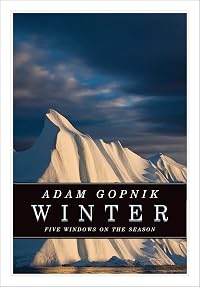
I really enjoyed reading this book. It is simply a deeply reflective meditation on the winter season. The five chapters are named for the five windows that Gopnik uses to frame his meditations: romantic, radical, recuperative, recreational, and remembering. Unusual for this printing of the CBC Massey lectures, The House of Anansi Press published five different covers to represent a different chapter. You can see them here: https://sites.google.com/view/coversforwinterbyadamgopnik/home
I like this rating system by ashleytylerjohn of LibraryThing (https://www.librarything.com/profile/ashleytylerjohn) that I have also adopted:
(Note: 5 stars = rare and amazing, 4 = quite good book, 3 = a decent read, 2 = disappointing, 1 = awful, just awful.)
I like this rating system by ashleytylerjohn of LibraryThing (https://www.librarything.com/profile/ashleytylerjohn) that I have also adopted:
(Note: 5 stars = rare and amazing, 4 = quite good book, 3 = a decent read, 2 = disappointing, 1 = awful, just awful.)
Ratings
Members
- Recently Added By
Lists

Top Five Books of 2013
1,562 works; 715 members

Books Read in 2015
3,299 works; 129 members

Books recommended by Calgary Public Library staff
1,588 works; 4 members

Science: Earth
109 works; 1 member
Author Information

46+ Works 6,616 Members
Adam Gopnik is the author of Paris to the Moon and Through the Children's Gate and is a contributor to The New Yorker. He lives in New York City with his wife and two children. His most recent book is Angels and Ages: A Short Book About Darwin, Lincoln and Modern Life, a comparison about how those men changed our nation with their history-making show more actions. (Bowker Author Biography) show less
Awards and Honors
Distinctions
Notable Lists
Series
Belongs to Publisher Series
CBC Massey Lectures (2011)
Common Knowledge
- Canonical title
- Winter: Five Windows on the Season
- Original publication date
- 2011
- Epigraph
- Our envelope, as I have called it, the cultural insulation that separates us from nature, is rather like (to use a figure that has haunted me from childhood) the window of a lit-up railway carriage at night. Most of the time ... (show all)it is a mirror of our own concerns, including our concern about nature. As a mirror, it fills us with the sense that the world is something which exists primarily in reference to us: it was created for us; we are the centre of it and the whole point of its existence. But occasionally the mirror turns into a real window, through which we can see only the vision of an indifferent nature that goes along for untold aeons of time without us, seems to have produced us only by accident, and, if it were conscious, could only regret having done so.
Northrop Frye, Creation and Recreation - Dedication
- For Gudrup Bjerring Parker
Filmmaker, feminist, lover of the world,
woman of the north,
who raised and loved and nutured and then
let go of my own true love,
and, knowing too well how Demeter felt, never le... (show all)t her heart
grow cold to the borrower. - First words
- I recall my first snowstorm as though it were yesterday, though it was, as it happens, November 12, 1968.
- Last words
- (Click to show. Warning: May contain spoilers.)For the time being, at least, the snow still fals, and the world, like this speaker, is given the winter gift of silence.
Classifications
Statistics
- Members
- 248
- Popularity
- 130,998
- Reviews
- 5
- Rating
- (3.67)
- Languages
- English, Italian
- Media
- Paper, Ebook
- ISBNs
- 7
- ASINs
- 4