A Log's Life
by Wendy Pfeffer
On This Page
Description
Introduction to the life cycle of a tree.Tags
Recommendations




Member Reviews
With an informative text from Wendy Pfeffer, a prolific picture-book author with many scientific and ecological titles under her belt, and lovely collage art from Robin Brickman, A Log's Life manages to be both educational and engaging, presenting the tale of a tree's death and decay, in the form of a fallen log, and the new arboreal life that springs up in its place, as it disintegrates. A host of species, from various insects to a porcupine, live off the log as it decays, demonstrating the importance of this seemingly "dead" phase of a tree's life-cycle, while the rich earth that comes from its final disintegration provides the material that a fallen acorn needs to eventually sprout.
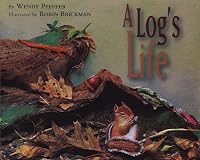
Although I don't know that I would list her as one show more of my favorite authors, when it comes to children's non-fiction, I have come to think of Wendy Pfeffer as a very dependable contributor to the field. I have enjoyed her exploration of the seasons (A New Beginning: Celebrating the Spring Equinox, We Gather Together: Celebrating the Harvest Season), as well as various ecosystems (Life in a Coral Reef), and A Log's Life is another one to add to the list of her appealing non-fiction selections. The central idea, in which the life cycles of various species are all tied together through their use of and residence in a tree (and then a log), is well communicated. The artwork, which sometimes seems like it must include actual leaves, and other natural specimens, is created entirely from paper which has been cut, painted and sculpted. Its effect is to place the reader right into the scene being discussed, making the text even stronger than it would otherwise have been.
In short, this is a picture-book that works, and I recommend it to all young nature lovers and would-be ecologists, who will delight in its visual detail, and possibly learn a little bit about an important aspect of a woodland habitat. show less
Although I don't know that I would list her as one show more of my favorite authors, when it comes to children's non-fiction, I have come to think of Wendy Pfeffer as a very dependable contributor to the field. I have enjoyed her exploration of the seasons (A New Beginning: Celebrating the Spring Equinox, We Gather Together: Celebrating the Harvest Season), as well as various ecosystems (Life in a Coral Reef), and A Log's Life is another one to add to the list of her appealing non-fiction selections. The central idea, in which the life cycles of various species are all tied together through their use of and residence in a tree (and then a log), is well communicated. The artwork, which sometimes seems like it must include actual leaves, and other natural specimens, is created entirely from paper which has been cut, painted and sculpted. Its effect is to place the reader right into the scene being discussed, making the text even stronger than it would otherwise have been.
In short, this is a picture-book that works, and I recommend it to all young nature lovers and would-be ecologists, who will delight in its visual detail, and possibly learn a little bit about an important aspect of a woodland habitat. show less
Wendy Pfeffer's A Log's Life is wonderfully informative and engaging, with a text that, although quite detailed and involved, manages to be both fascinating and compelling. Although the text flows well and reads easily, I would consider this book more suitable for older children (perhaps above the age of six or so), primarily due to the length of the narrative and the fact that some of the vocabulary used is rather advanced (a bit of a glossary or an author's note with additional ecological data and information and suggestions for further reading, would also have been a great added bonus and would have increased the educational potential of A Log's Life). I love how the never-ending circle of life, how forest ecology is featured, how an show more oak tree felled by a lightning strike becomes a log on the forest floor and thus home/nourishment for many different plants and animals. And in about ten years, the rotting log has again become earth; the cycle of life begins anew, with an acorn falling into the rich earth to become another oak tree.
The illustrations by Robin Brickman are both amazing and special. When I first perused the book, I was seriously wondering wether the illustrations were either photographs, or photographed displays of found objects and preserved animal and plant specimens (which would have been a bit of an ecological and ethical issue for me). However, in the note from the illustrator, Brickman states that he/she made all of the collages by cutting, painting, sculpting and gluing together pieces of watercolour paper; the illustrations thus consist only of painted paper and glue. And while, of course, paper does come from trees, I think that it was and is quite environmentally and ecologically responsible that no found objects, no preserved and/or mounted animal or plant specimens have been used in Robin Brickman's colourful collages. show less
The illustrations by Robin Brickman are both amazing and special. When I first perused the book, I was seriously wondering wether the illustrations were either photographs, or photographed displays of found objects and preserved animal and plant specimens (which would have been a bit of an ecological and ethical issue for me). However, in the note from the illustrator, Brickman states that he/she made all of the collages by cutting, painting, sculpting and gluing together pieces of watercolour paper; the illustrations thus consist only of painted paper and glue. And while, of course, paper does come from trees, I think that it was and is quite environmentally and ecologically responsible that no found objects, no preserved and/or mounted animal or plant specimens have been used in Robin Brickman's colourful collages. show less
My favorite ecosystem book this month in the Children's Books group. The illustrations are just incredible. All paper, even the slugs & salamanders - wow. I also liked the different perspectives, the birds-eye view of the trees in the beginning, and of the porcupine when the tree fell, for example. My son (16) says the pictures are better than real, and beautiful. And I managed to learn a few things, even about this relatively familiar ecosystem.
I really enjoyed this book. An informative story about how a tree falling in the woods becomes a home and meal for so many creatures helps the reader understand the cycle of tree decomposition. The most amazing part of this book is the illustrations. The illustrations looks like real specimens from nature but are actually water color paintings that are super realistic. I think children will love looking at the pictures and picking out every little detail that makes the illustrations so engaging.
A Log's Life is a nonfiction story about the process of becoming a log. The three-dementional paper sculptures make the book, as they show a very realistic view of a tree branch changing into a log.
Non-fiction narrative; reads like a story. Excellent illustrations (painted paper collage) add a lot to the book. Great connections to elementary science.
discusses the different animals and insects that have been living in a particular log in the forest. a fun discussion of the environment and how it works
3 books
3 books
Members
- Recently Added By
Lists

Youth: Earth Science
205 works; 1 member
Author Information

48 Works 10,687 Members
All Editions
Awards and Honors
Awards
Common Knowledge
- Canonical title
- A Log's Life
Classifications
Statistics
- Members
- 468
- Popularity
- 65,244
- Reviews
- 8
- Rating
- (4.05)
- Languages
- English
- Media
- Paper
- ISBNs
- 5