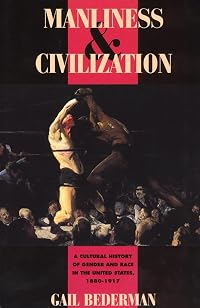
Manliness and Civilization: A Cultural History of Gender and Race in the United States, 1880-1917
by Gail Bederman
On This Page
Description
When former heavyweight champion Jim Jeffries came out of retirement on the fourth of July, 1910 to fight current black heavywight champion Jack Johnson in Reno, Nevada, he boasted that he was doing it ""for the sole purpose of proving that a white man is better than a negro."" Jeffries, though, was trounced. Whites everywhere rioted. The furor, Gail Bederman demonstrates, was part of two fundamental and volatile national obsessions: manhood and racial dominance. In turn-of-the-century show more America, cultural ideals of manhood changed profoundly, as Victorian notions of self-restrained, show lessTags
Recommendations







Member Reviews
Manliness and Civilization is a classic Foucauldian study of the Discourse (capital D intended) around gender and race in the Progressive period. Bederman tracks a shift from a Victorian conception of manliness as based around self-restraint of urges to a more modern one of active and powerful sexuality, using case studies of anti-lynching activist Ida Wells, psychologist and educator G. Stanley Hall, feminist author and activist Charlotte Perkins Gilman, and president Theodore Roosevelt, rounding out the detailed case studies with Black boxer Jack Johnson and the fictional character Tarzan.
Bederman's analysis shows that these three major themes of civilization, race, and masculinity, are impossible to separate. Civilization, the way show more not just in which we live now, but the better ways in which we intend to live tomorrow, as exemplified by the Chicago World's Fair, was tied up with the idea the civilization is a product of a biologically distinct racial universe. In the thinking of the times, Americans are the preeminent White Race, at the head of humanity as a whole, with a mission to civilize and lead the lesser races of the world. Civilization is a product of men primarily.
This book is at its best when it digs at the contradictions of the era's idea of civilization. The digressions on the deprecated mental illness neurasthenia, and how both Hall and Gilman struggled with it as individuals are fascinating stuff (though to be fair, also closest to my own scholarly interests). Wells, using the discourse of civilization to shame Americans about lynchings via the British press, is a fascinating ploy.
Unfortunately, the core case studies of the book don't quite connect, or at least don't make it beyond the first level. Once you accept that both Roosevelt and Gilman saw their political reforms in thoroughly racist frames, the racism is unsurprising. Whiteness is hoary nonsense, but extremely powerful hoary nonsense, and Bederman isn't critical enough. show less
Bederman's analysis shows that these three major themes of civilization, race, and masculinity, are impossible to separate. Civilization, the way show more not just in which we live now, but the better ways in which we intend to live tomorrow, as exemplified by the Chicago World's Fair, was tied up with the idea the civilization is a product of a biologically distinct racial universe. In the thinking of the times, Americans are the preeminent White Race, at the head of humanity as a whole, with a mission to civilize and lead the lesser races of the world. Civilization is a product of men primarily.
This book is at its best when it digs at the contradictions of the era's idea of civilization. The digressions on the deprecated mental illness neurasthenia, and how both Hall and Gilman struggled with it as individuals are fascinating stuff (though to be fair, also closest to my own scholarly interests). Wells, using the discourse of civilization to shame Americans about lynchings via the British press, is a fascinating ploy.
Unfortunately, the core case studies of the book don't quite connect, or at least don't make it beyond the first level. Once you accept that both Roosevelt and Gilman saw their political reforms in thoroughly racist frames, the racism is unsurprising. Whiteness is hoary nonsense, but extremely powerful hoary nonsense, and Bederman isn't critical enough. show less
The subtitle here is key to what to expect from the content of this excellent study: "A Cultural History of Gender and Race in the United". From Analysis: Gail Bederman’s Manliness and Civilization:
There are a lot of profiles of key figures in this fight to promote or reduce the period's racist "toxic masculinity" (thought the phrase did not exist then, such as Charlotte Perkins Gilman
Also profiled is Ida B. Wells - who as with Gilman traces roots of modern feminism. Wells-Barnett was an American investigative journalist, sociologist, educator, and early leader in the civil rights movement. She was one of the founders of the NAACP and dedicated her career to combating prejudice and violence, and advocating for African-American equality—especially for women.
It is interesting to me how the era wrung hands over imagined illnesses to like neurasthenia to support the views. Also interesting to me is something I think of as a feature of The Progressive Era (1890s–1920s), a period in the United States characterized by multiple social and political reform efforts, where people got together in associations, held conventions and put forward resolutions. Who does that?
All this sort of leads to Teddy Roosevelt who recast himself from effete and urbane modern man to a rough adventurer. Here is an available extract.
...
The race suicide controversy, then, was (like neurasthenia) one of many ways middle-class men addressed their fears about overcivilized effeminacy and racial decadence. Throughout the 1890s, elite American commentators bemoaned the falling birthrate, often blaming women's colleges or the new immigration. 129 Historians, following these sorts of articles, sometimes suggest increased immigration and new demands for women's rights explain these panicked fears. 130 Yet it would probably be more accurate to suggest that TR and his contemporaries saw both immigration and women's advancement, as well as the falling birthrate, as part of a wider threat to their race, manhood, and "civilization."
The author's Conclusion:
show more
Thesis: “this book will investigate this turn of the century connection between manhood and race. It will argue that, between 1890-1917, as while middle-class men actively worked to reinforce male power, their race became a factor which was crucial to their gender…whiteness was both a palpable fact and a manly ideal for these men.”—pg. 4-5
Argument: She argues that race, gender, and power were the defining attributes of the discourse of civilization. This is important because each person whom Bederman discusses uses race, gender, and
power in their own unique way to show how their people group was more civilized than others. She further argues that race and gender cannot be studied as separate categories, because they work in tandem throughout American history.
There are a lot of profiles of key figures in this fight to promote or reduce the period's racist "toxic masculinity" (thought the phrase did not exist then, such as Charlotte Perkins Gilman
Gilman's attack on male dominance had depended on the argument that the shared racial bonds between civilized men and civilized women far out-weighed primitive, animalistic, sexual difference. She was therefore both lost and defeated when, in the 1920s, white men began to believe that nature intended men to dominate women...
Also profiled is Ida B. Wells - who as with Gilman traces roots of modern feminism. Wells-Barnett was an American investigative journalist, sociologist, educator, and early leader in the civil rights movement. She was one of the founders of the NAACP and dedicated her career to combating prejudice and violence, and advocating for African-American equality—especially for women.
It is interesting to me how the era wrung hands over imagined illnesses to like neurasthenia to support the views. Also interesting to me is something I think of as a feature of The Progressive Era (1890s–1920s), a period in the United States characterized by multiple social and political reform efforts, where people got together in associations, held conventions and put forward resolutions. Who does that?
All this sort of leads to Teddy Roosevelt who recast himself from effete and urbane modern man to a rough adventurer. Here is an available extract.
By depicting imperialism as a prophylactic means of avoiding effeminacy and racial decadence, Roosevelt constructed it as part of the status quo and hid the fact that this sort of militaristic overseas involvement was actually a new departure in American foreign policy. American men must struggle to retain their racially innate masculine strength, which had originally been forged in battle with the savage Indians on the frontier; otherwise the race would backslide into overcivilized decadence. With no Indians left to fight at home, then, American men must press on and confront new races, abroad.
...
The race suicide controversy, then, was (like neurasthenia) one of many ways middle-class men addressed their fears about overcivilized effeminacy and racial decadence. Throughout the 1890s, elite American commentators bemoaned the falling birthrate, often blaming women's colleges or the new immigration. 129 Historians, following these sorts of articles, sometimes suggest increased immigration and new demands for women's rights explain these panicked fears. 130 Yet it would probably be more accurate to suggest that TR and his contemporaries saw both immigration and women's advancement, as well as the falling birthrate, as part of a wider threat to their race, manhood, and "civilization."
The author's Conclusion:
My major point is simpler, less tentative, and should by now be self-evident. This study suggests that neither sexism nor racism will be rooted out unless both sexism and racism are rooted out together. Male dominance and white supremacy have a strong historical connection. Here, surely, is a lesson that we all can learn from history.show less
In Manliness & Civilization, Gail Bederman argues that, “between 1890 and 1917, as white middle-class men actively worked to reinforce male power, their race became a factor which was crucial to their gender” (pg. 5). She writes, “This study is based on the premise that gender – whether manhood or womanhood – is a historical, ideological process. Through that process, individuals are positioned and position themselves as men or as women” (pg. 7). Bederman uses four case-studies in her analysis: the work of Ida B. Wells, G. Stanley Hall, Charlotte Perkins Gilman, and Theodore Roosevelt.
Bederman argues that Wells, in working against lynching, “convinced nervous white Northerners that they needed to take lynch law seriously show more because it imperiled both American civilization and American manhood” (pg. 46). Wells had to counter the myth of the black male rapist, which whites used to reinforce their linking of controlled masculinity to definitions of civilization. Wells promoted her ideas in Britain and, “by enlisting ‘Anglo-Saxons’ as her allies, Wells recruited precisely the spokesmen most able to disrupt the linkages between manliness and whiteness which kept white Americans tolerant of lynching” (pg. 61).
G. Stanley Hall worked to reconcile fears of neurasthenia, a “disease” believed to weaken men as a result of civilizing forces. Bederman crafts a Foucauldian argument, writing, “As an educator, Hall felt he could remake manhood by making men – literally. For what was education but the process of making boys into men? By encouraging educators to recognize the ‘savagery’ in young boys, Hall believed he could find a way to allow boys to develop into adult men with the virility to withstand the effeminizing tendencies of advanced civilization” (pg. 79). According to Bederman, “By transforming young men’s sexual passions into a source of scare nervous energy, Hall was able both to mitigate the danger of neurasthenia and to reconstruct adolescent male sexuality in ways which did not stress self-restraint” (pg. 103). Specifically, the betterment of the white race.
In her third example, Bederman examines Charlotte Perkins Gilman arguing that “because Gilman’s feminist arguments frequently revolved around women’s relation to civilization, implicit assumptions about white racial supremacy were as central to her arguments as they were to Hall’s” (pg. 123). Accordingly, Bederman argues that the point of Gilman’s work “was to create an alternative ideology of civilization in which white women could take their rightful place beside white men as full participants in the past and future of civilization” (pg. 135).
In writing about Theodore Roosevelt, Bederman argues, “TR framed his political mission in terms of race and manhood, nationalism and civilization. Like G. Stanley Hall and Charlotte Perkins Gilman, Roosevelt longed to lead evolution’s chosen race toward a perfect millennial future” (pg. 171). Though Roosevelt consciously crafted a rugged, masculine persona, Bederman argues, “his political ambitions ultimately served the purposes – not of his own selfish personal advancement – but of the millennial mission to advance his race and nation toward a more perfect civilization” (pg. 177). Bederman writes of Roosevelt’s politics, “America’s nationhood itself was the product of both racial superiority and virile manhood” (pg. 183). This idea later reinforced American imperialism. show less
Bederman argues that Wells, in working against lynching, “convinced nervous white Northerners that they needed to take lynch law seriously show more because it imperiled both American civilization and American manhood” (pg. 46). Wells had to counter the myth of the black male rapist, which whites used to reinforce their linking of controlled masculinity to definitions of civilization. Wells promoted her ideas in Britain and, “by enlisting ‘Anglo-Saxons’ as her allies, Wells recruited precisely the spokesmen most able to disrupt the linkages between manliness and whiteness which kept white Americans tolerant of lynching” (pg. 61).
G. Stanley Hall worked to reconcile fears of neurasthenia, a “disease” believed to weaken men as a result of civilizing forces. Bederman crafts a Foucauldian argument, writing, “As an educator, Hall felt he could remake manhood by making men – literally. For what was education but the process of making boys into men? By encouraging educators to recognize the ‘savagery’ in young boys, Hall believed he could find a way to allow boys to develop into adult men with the virility to withstand the effeminizing tendencies of advanced civilization” (pg. 79). According to Bederman, “By transforming young men’s sexual passions into a source of scare nervous energy, Hall was able both to mitigate the danger of neurasthenia and to reconstruct adolescent male sexuality in ways which did not stress self-restraint” (pg. 103). Specifically, the betterment of the white race.
In her third example, Bederman examines Charlotte Perkins Gilman arguing that “because Gilman’s feminist arguments frequently revolved around women’s relation to civilization, implicit assumptions about white racial supremacy were as central to her arguments as they were to Hall’s” (pg. 123). Accordingly, Bederman argues that the point of Gilman’s work “was to create an alternative ideology of civilization in which white women could take their rightful place beside white men as full participants in the past and future of civilization” (pg. 135).
In writing about Theodore Roosevelt, Bederman argues, “TR framed his political mission in terms of race and manhood, nationalism and civilization. Like G. Stanley Hall and Charlotte Perkins Gilman, Roosevelt longed to lead evolution’s chosen race toward a perfect millennial future” (pg. 171). Though Roosevelt consciously crafted a rugged, masculine persona, Bederman argues, “his political ambitions ultimately served the purposes – not of his own selfish personal advancement – but of the millennial mission to advance his race and nation toward a more perfect civilization” (pg. 177). Bederman writes of Roosevelt’s politics, “America’s nationhood itself was the product of both racial superiority and virile manhood” (pg. 183). This idea later reinforced American imperialism. show less
It's truly an interesting look at how manliness and masculinity worked to with ideas of civilization in the late nineteenth/early twentieth century.
Ratings
Members
- Recently Added By
Lists

r/AskHistorians' Recommended Books
1,068 works; 18 members

Works Cited in The History of White People by Nell Irvin Painter
321 works; 2 members
Author Information

1+ Work 299 Members
Gail Bederman was born on October 20, 1952, in Illinois. She received a B.F.A. from New York University in 1978 and an M.A. (1984) and a Ph.D. (1993) from Brown University. The result of her doctoral research was Manliness and Civilization: A Cultural History of Gender and Race in the United States, 1880-1917. The book addresses topics, such as show more masculinity, sex roles, race relations, and the white supremacy movement. Bederman has contributed to other books, including Gender and American History Since 1890, and has written articles for such periodicals as American Quarterly and Radical History Review. Since 1992, Bederman has taught history at the University of Notre Dame, where she is an assistant professor. (Bowker Author Biography) show less
Series
Belongs to Publisher Series
Women in Culture and Society (1995)
Common Knowledge
- Canonical title
- Manliness and Civilization: A Cultural History of Gender and Race in the United States, 1880-1917
- People/Characters
- Jack Johnson; Ida B. Wells-Barnett; G. Stanley Hall; Charlotte Perkins Gilman; Theodore Roosevelt
- Dedication
- To my parents
- First words
- Every society is known by the fictions that it keeps.
- Last words
- (Click to show. Warning: May contain spoilers.)Here, surely, is a lesson that we all can learn from history.
- Blurbers
- Cott, Nancy F.; Scott, Joan W. ; Hall, Jacquelyn Dowd
Classifications
- Genres
- Nonfiction, History, Sexuality and Gender Studies, General Nonfiction
- DDC/MDS
- 305.3 — Society, government, & culture Social sciences, sociology & anthropology Social group - Age, Gender, Ethnicity People by gender or sex
- LCC
- HQ1075.5 .U6 .B43 — Social sciences The family. Marriage, Women and Sexuality The Family. Marriage. Women Sex role
- BISAC
Statistics
- Members
- 299
- Popularity
- 106,960
- Reviews
- 4
- Rating
- (3.92)
- Languages
- English
- Media
- Paper, Ebook
- ISBNs
- 4
- ASINs
- 2