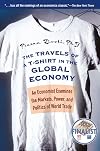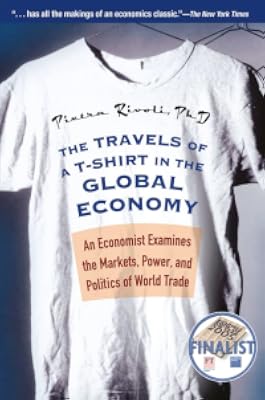
The Travels of a T-Shirt in the Global Economy: An Economist Examines the Markets, Power, and Politics of World Trade
by Pietra Rivoli
On This Page
Description
The Travels of a T-Shirt in the Global Economy is a critically acclaimed narrative that illuminates the globalization debates and reveals the key factors to success in global business. Tracing a T-shirt's life story from a Texas cotton field to a Chinese factory and back to a U.S. storefront before arriving at the used clothing market in Africa, the book uncovers the political and economic forces at work in the global economy. Along the way, this fascinating exploration addresses a wealth of show more compelling questions about politics, trade, economics, ethics, and the impact of history on today's business landscape. Using a simple, everyday T-shirt as a lens through which to explore the business, economic, moral, and political complexities of globalization in a historical context, Travels encapsulates a number of complex issues into a single identifiable object that will strike a chord with readers as they: investigate the sources of sustained competitive advantage in different industries; examine the global economic and political forces that explain trade patters between countries; analyze complex moral issues related to globalization and international business; and discover the importance of cultural and human elements in international trade. show lessTags
Recommendations

























Member Reviews
The narrative device that ties Rivoli's book together is the tracing of a T-shirt from the cotton field all the way to her closet. You could call it a gimmick, but it works much too well. Nothing shows how global the world economy is better than seeing all the places touched by that cotton as it turns into a shirt. At each step of the way, she backs off and tells the bigger story, for this book is really about international trade in general. Really excellent.
Before I discuss the book, I must mention the awful, awful German translation. The race to the bottom touches business books especially hard, as many translators are ignorant about the economic and social science vocabulary. The book's translator fails even at general vocabulary and has but a limited understanding of US society (The US Peace Corps is not part of the US army, soccer moms is a moniker for a lifestyle group, ...).Preserving the English sentence structure in the German text makes the author sound like a nine-year old. Epic fail.
The book itself does not fulfill the promise of its marvelous concept of following the life cycle of a t-shirt from its cotton origin in Texas to its manufacture in China to its sale in Florida to show more its disposal and resale to Tanzania. The first failure lies in the non-use of business concepts such as a value chain. It would have been fairly easy to depict the different cost structures and see who captures the most value. The second failure is the author's repeated misuse (or lack of understanding?) of terms such as comparative advantage. The author's argumentation suffers from multiple non-sequiturs and her George W. Bush worship and Republican bias (the Washington Post is left-leaning in her opinion) leads her to unresolved clashes between her ideology and the facts. In the clumsy translation, she seems to say many good things about slavery which "solved" the labor shortage for the US cotton industry. Protectionism for capitalists (in the form of subventions and trade restrictions) does not trouble her much. Protectionism for workers does.
Overall, the production of a t-shirt is distorted by protectionism at multiple levels. US cotton producers receive twice the world market price from Uncle Sam, US content restrictions distort trade flows and destroys local industries in LDC. The lack of regulation and control in China, while lifting millions out of the subsistence level, still leaves many in misery. Humane working conditions would add only a few cents to the total cost of a t-shirt. But the authors is already content with the present economic liberation of her Chinese sisters.
The book is at its best when she describes individuals and their work lives. Her ideas about economics and politics suffer from muddled thinking. Rising to the defense of US protectionism as a form of exaggerated patriotism conflicts with her (rather weak) free market ideas. Free markets are only ok if the US benefits. This is not how Smith and Ricardo see it. show less
The book itself does not fulfill the promise of its marvelous concept of following the life cycle of a t-shirt from its cotton origin in Texas to its manufacture in China to its sale in Florida to show more its disposal and resale to Tanzania. The first failure lies in the non-use of business concepts such as a value chain. It would have been fairly easy to depict the different cost structures and see who captures the most value. The second failure is the author's repeated misuse (or lack of understanding?) of terms such as comparative advantage. The author's argumentation suffers from multiple non-sequiturs and her George W. Bush worship and Republican bias (the Washington Post is left-leaning in her opinion) leads her to unresolved clashes between her ideology and the facts. In the clumsy translation, she seems to say many good things about slavery which "solved" the labor shortage for the US cotton industry. Protectionism for capitalists (in the form of subventions and trade restrictions) does not trouble her much. Protectionism for workers does.
Overall, the production of a t-shirt is distorted by protectionism at multiple levels. US cotton producers receive twice the world market price from Uncle Sam, US content restrictions distort trade flows and destroys local industries in LDC. The lack of regulation and control in China, while lifting millions out of the subsistence level, still leaves many in misery. Humane working conditions would add only a few cents to the total cost of a t-shirt. But the authors is already content with the present economic liberation of her Chinese sisters.
The book is at its best when she describes individuals and their work lives. Her ideas about economics and politics suffer from muddled thinking. Rising to the defense of US protectionism as a form of exaggerated patriotism conflicts with her (rather weak) free market ideas. Free markets are only ok if the US benefits. This is not how Smith and Ricardo see it. show less
Reading this book, made me angry about the unfair advantage that some of our cotton farmers have in this country. The insight into the workings of our government and the way we treat other developing countries brought tears to me eyes. Just another example of the bullying techniques that USA uses in our world.
The layout of the book by Pietra Rivoli makes for a easy way to follow a complex trail of how our country does and doesn't cooperate with our fellow planet residents.
A very thought provoking story.
The layout of the book by Pietra Rivoli makes for a easy way to follow a complex trail of how our country does and doesn't cooperate with our fellow planet residents.
A very thought provoking story.
Fascinating both for seeing how far a t-shirt travels from grower to the store rack (and afterwards) and for showing how complicated international trade really is. The author writes from an free-market perspective but acknowledges the concerns of those who favor more regulation.
What particularly sticks with me: her descriptions of the grueling work in a Chinese factory, and then pointing out that the reason these young women are working there is because it's easier work for better pay than they'd get back on the farm at home.
What particularly sticks with me: her descriptions of the grueling work in a Chinese factory, and then pointing out that the reason these young women are working there is because it's easier work for better pay than they'd get back on the farm at home.
Dr. Rivoli traces the history and processes that a tshirt undergoes, from cotton seed to finished product to throw away item. The chapter on trade policies was pretty brutal, but the rest of the book was interesting. BVUs Common Reading bok for 2011.
Started strong. Started to get a bit long winded about China. Also was repetitive quite a bit with the points. Enjoyed the discussion though.
This book tells about the textile industry in a global economy using a t-shirt as an example. She explains the entire travels of a t-shirt from the cotton farm in Texas to a used clothing dealer in Africa. Some of the economic policies about the textile industry are explained. This book is a must read for business students, especially those who are in former mill towns in order to understand the change that the economies in those towns did go through.
This review was written for LibraryThing Member Giveaways.
Members
- Recently Added By
Lists

aborted books in 2020
36 works; 1 member
Author Information

6 Works 713 Members
Pietra Rivoli, PhD, is Professor at Georgetown University's McDonough School of Business, where she specializes in international business, finance, and social issues in business. Travels of a T-Shirt has won numerous awards and has been translated into fourteen languages.
Awards and Honors
Common Knowledge
- Dedication
- For Dennis, Annalisa, and Denny
Classifications
- Genres
- Economics, Nonfiction, General Nonfiction, Business
- DDC/MDS
- 382.45687115 — Society, government, & culture Commerce, communications & transportation regulations International Trade (Commerce) By Product
- LCC
- HD9969 .S6 .R58 — Social sciences Industries. Land use. Labor Industries. Land use. Labor Special industries and trades Manufacturing industries
- BISAC
Statistics
- Members
- 704
- Popularity
- 40,544
- Reviews
- 10
- Rating
- (3.61)
- Languages
- 5 — Chinese, Dutch, English, French, German
- Media
- Paper, Audiobook, Ebook
- ISBNs
- 23
- UPCs
- 1
- ASINs
- 5