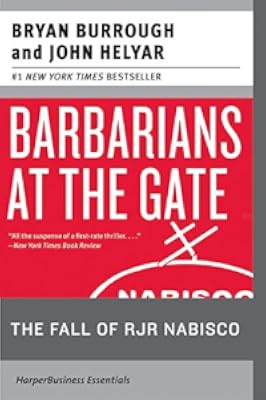
Barbarians at the Gate: The Fall of RJR Nabisco
by Bryan Burrough, John Helyar
On This Page
Description
A #1 New York Times bestseller and arguably the best business narrative ever written, Barbarians at the Gate is the classic account of the fall of RJR Nabisco. An enduring masterpiece of investigative journalism by Bryan Burrough and John Helyar, it includes a new afterword by the authors that brings this remarkable story of greed and double-dealings up to date twenty years after the famed deal.Tags
Recommendations
Member Recommendations
Member Reviews
An exhausistively researched and immensely entertaining of the RJR Nabisco leveraged buyout. At about five hundred pages, its attention to detail is truly breath-taking. Burroughs and Helyar provide insightful, detailed biographies of every major player involved in this deal, histories of each of the companies involved, and seem to have cross-examined their sources about the smallest details of how the takeover bids were put together. "Barbarians" serves as a straight-faced condemnation of eighties-era takeover mania and also illustrates a broader cultural shift that saw quiet, respectable businessmen pushed aside in favor of flashy, self-aggrandizing showmen obsessed with their perks, their bonuses, and their public image. In F. Ross show more Johnson, RJR Nabisco's shallow, incompetent, buffoonish CEO, Burrough gives us a villain for the ages. The fact that this embodiment of Reagan-era greed walked away from this fiasco fifty million dollars richer, received something called the "United States Silver Medal of Patriotism," and sits on Duke University's Board of Trustees is more proof, as if anybody needed any, that life just isn't fair.
Burroughs, a former Wall Street Journal reporter, knows this territory intimately and seems much more comfortable relating this story than he was talking about John Dillinger's escapades in "Public Enemies." It helps that he knows that he's got a terrific yarn on his hands and he works to keep the book's tempo on "high" from start to finish. This isn't to say that this story's always easy to keep track of. The financial transactions that Burrough describes are complex, and some of the financial slight-of-hand employed by this book's protagonists is positively Byzantine. I often found myself turning to the much-needed "Cast of Characters" that's included in the book's first few pages. Still, Burrough is careful to explain the basics of LBOs and other esoteric financial transactions in language that the average reader can understand, and he's not afraid to let his readers know when the details of a certain deal are best left to the real experts. His privileging of plot over financial nuance pays off handsomely: "Barbarians" is as addictive a book as I've ever had the pleasure to read. Burrough and Helyar's book is a fantastic piece of journalism and is highly recommended. show less
Burroughs, a former Wall Street Journal reporter, knows this territory intimately and seems much more comfortable relating this story than he was talking about John Dillinger's escapades in "Public Enemies." It helps that he knows that he's got a terrific yarn on his hands and he works to keep the book's tempo on "high" from start to finish. This isn't to say that this story's always easy to keep track of. The financial transactions that Burrough describes are complex, and some of the financial slight-of-hand employed by this book's protagonists is positively Byzantine. I often found myself turning to the much-needed "Cast of Characters" that's included in the book's first few pages. Still, Burrough is careful to explain the basics of LBOs and other esoteric financial transactions in language that the average reader can understand, and he's not afraid to let his readers know when the details of a certain deal are best left to the real experts. His privileging of plot over financial nuance pays off handsomely: "Barbarians" is as addictive a book as I've ever had the pleasure to read. Burrough and Helyar's book is a fantastic piece of journalism and is highly recommended. show less
OK, first - this is a truly ripping yarn. There's enough corporate intrigue, maniacal boardroom posturing, gulfstream abuse and small men with big egos in these riveting 600 pages to knock even the Ewing family of Dallas into a cocked hat. From the beginning Burrough draws you into the preposterousness of what is happening, setting out well drawn characterisations of each of the main players, flipping between them in that totally enchanting "meanwhile, in Gotham city" fashion. Before long the threads are pulling together into a whirling tarantella of greed assaulting you from every side. It's difficult to work out who's meant to be the villain, mostly because I think everyone was. Full grown men startle for their utter failure in show more self-reflexion as much as for the appalling lengths to which they will go in the name of self-interest.
The climax is as good as any thriller (I completely missed my stop on the tube, finally snapping out of a daze thinking, "hey I haven't been this excited since Jodi Foster went head to head with Buffalo Bill in Silence Of The Lambs!").
Secondly, and maybe not intentionally, Barbarians at the Gate is a piercing social/historical commentary - just by "telling it like it was" the narrative skewers the eighties, Wall street and the Reagan years so brutally it might as well be a spit roast.
On this level it is leagues ahead of the celebrated fictional works which purport to do the same thing. In particular, Brett Ellis' "American Psycho", and Tom Wolfe's "A Man in Full", fare badly against Burrough's genuine article. I would be amazed of either Ellis or Wolfe hadn't read this book, but the novels of both are anemic and implausible in comparison. Barbarians at the Gate is more deadly accurate, it doesn't exagerrate or caricature the wall street banker like American Psycho does (and what value is there in caricaturing something which is so patently ridiculous in itself?), and the plot - needless to say - has a ring of credibility which is singularly lacking from A Man In Full.
Oddly, the one area where the book falls down a little bit is in its aspiration (if it has one) to present a sensible, clear, commercial analysis of what was going on. But that's a trade off - had the Burroughs taken that route, then surely some of the dramatic impact would have been lost.
As it is, he's produced a cracker. show less
The climax is as good as any thriller (I completely missed my stop on the tube, finally snapping out of a daze thinking, "hey I haven't been this excited since Jodi Foster went head to head with Buffalo Bill in Silence Of The Lambs!").
Secondly, and maybe not intentionally, Barbarians at the Gate is a piercing social/historical commentary - just by "telling it like it was" the narrative skewers the eighties, Wall street and the Reagan years so brutally it might as well be a spit roast.
On this level it is leagues ahead of the celebrated fictional works which purport to do the same thing. In particular, Brett Ellis' "American Psycho", and Tom Wolfe's "A Man in Full", fare badly against Burrough's genuine article. I would be amazed of either Ellis or Wolfe hadn't read this book, but the novels of both are anemic and implausible in comparison. Barbarians at the Gate is more deadly accurate, it doesn't exagerrate or caricature the wall street banker like American Psycho does (and what value is there in caricaturing something which is so patently ridiculous in itself?), and the plot - needless to say - has a ring of credibility which is singularly lacking from A Man In Full.
Oddly, the one area where the book falls down a little bit is in its aspiration (if it has one) to present a sensible, clear, commercial analysis of what was going on. But that's a trade off - had the Burroughs taken that route, then surely some of the dramatic impact would have been lost.
As it is, he's produced a cracker. show less
The brilliantly-written, tragicomic account of the leveraged buy-out of RJR Nabisco in 1988. Very few, if any, of the players come out in a positive light, and there are times when you seriously wonder if there are any adults in the room. The tragedy, to a certain extent, goes to the workers on the sidelines of the transaction, which did not turn out well for many. Recommended.
Good storytelling for a finance book. At the end of the day, still a finance book so not super interesting. Learned a lot though and the CEO Ross Johnson. was an interesting character. Fun to read when the LBO bidding occurred.
The book is about the leveraged buyout of the RJR Nabisco, one of the largest deals during the LBOs of the 1980s. From practicing attorneys, it sounds like this book is more interesting history than illustrative of modern times, but I would recommend the read as entertaining regardless.
The book is relatively long, and at points drags a little, with excessive detail over trivial matters (the decoration and furnishings of various power players gets annoying the third time you read about it). However, once I got past the first half it was really hard to put down the book. There were at least two nights where I was up into the early AM reading this book instead of sleeping or reading my case books. The first half of the book can probably show more be characterized as background setting up the deal which occurs around the middle of the book. The authors meticulously collect anecdotes and background on the key players (there are so many it's hard to keep track of who is who sometimes, but the authors helpfully include a list in the front of the book and usually include some description to indicate who the player is) that suggest the various motivations and incentives of the players. There's also a fair amount of background information on the major companies involved, including RJR and Nabisco showing how far removed the machinations of management, the board and outsider bidders were from actual operations and building the businesses that the deals were around.
What makes the deal so interesting are that personalities driving the bidding process, the various back stabbings, press leaks, rumors and power plays of the entire ordeal. The process had a few main players, the special committee that would recommend the winning bid to the board, the management team, the Kravis team, Ted Forstmann's team, and First Boston. The management team was headed by RJR Nabisco's CEO, Ross Johnson, who was better at executive power plays (climbing from the head of a Canadian food company to the head of RJR Nabisco through political moves of threatening to resign until he was appointed CEO, schmoozing the correct people, sensing weaknesses and then cutting people off at the knees), spending money on corporate jets, and rubbing shoulders with celebrities than operating the business. It's clear from the book that Johnson who initiated the entire deal was like to stir things up (partially to take his mind off of his son's accident), liked to see everyone win and thought he was doing the only thing possible to give shareholders the correct value of the stock price (he felt like the market was unfairly treating RJR Nabisco like a tobacco stock). There's various double crossings, misunderstandings and miscommunications that lead the management team, and the Kravis team into a bidding war. While Kravis at first wished to work with management, the management team's bankers did not want to work with Kravis, leading Kravis to make a bid. While there were times that management and Kravis seemed to agree to work together, but any agreement was scuttled by the conflict between their bankers Drexel and Salomon. Eventually, Kravis working without internal data was outbid by a substantial amount by management but both were outbid by a hail mary bid from First Boston, who touted a crazy tax plan that justify the bid. The bidders then entered a second round, where First Boston failed to put together the logistics for their bid. Kravis, giving off the impression (either unintentionally or intentionally) that he was not going to bid, actually bid even higher than the past management bid and beat the second round bid. Once management found out, they insisted on rebidding. Eventually the board found both bids to be similar but choose the Kravis bid because of a few minor changes that the management team bankers refused to make, and possibly because they found Johnson's management agreement (which its bankers swore would be renegotiated but then was leaked, potentially by one of Kravis's bankers during management team/Kravis negotiations) insulting.
The deals, incentives and conflicts of loyalty are complicated and well detailed in the book. To me the deal is an interesting example of game theory and incentives. Clearly the special committee had an interest in keeping bidders active in competing against each other. The bidders had an incentive to cut a deal and split the gains but personality clashes and institutional barriers kept a deal from happening (to the benefit of the shareholder and the board). Additionally, the management's advantage, access and cooperation of the head of the company was a huge advantage over Kravis who had to bid blind. The book was also an interesting lesson in auction process, Kravis kept threatening to walk in order to keep the pressure up, and management was able to wedge in a last minute bid because the special committee had an obligation to hear the best bid and the procedure was unclear on ending the auction process. The deal is an interesting lesson on the best laid plans of mice and men. Management would have won the first bidding round if First Boston did not lob its mary hail bid (giving Kravis a second chance). The crosses of conflict of interest and personality clashes (Ted Forstmann hated Kravis and felt mistreated by the management team for example) drove the dynamics of the deal as much as any rational analysis did. In the end, the deal was also an interesting example of the winner's curse. Kravis ended up not profiting off the deal, while First Boston and Ted Forstmann took off after losing the deal. Kravis ended up selling RJR Nabisco, which could not split up until RJR settled its tobacco liability through a master settlement (driven by a need to split and spearheaded by the lawyer turned CEO that advised Johnson). Johnson ended up fine as well, while he lost his position as CEO, he retired comfortably and lived off of his over 50 million golden parachute. A fascinating story. show less
The book is relatively long, and at points drags a little, with excessive detail over trivial matters (the decoration and furnishings of various power players gets annoying the third time you read about it). However, once I got past the first half it was really hard to put down the book. There were at least two nights where I was up into the early AM reading this book instead of sleeping or reading my case books. The first half of the book can probably show more be characterized as background setting up the deal which occurs around the middle of the book. The authors meticulously collect anecdotes and background on the key players (there are so many it's hard to keep track of who is who sometimes, but the authors helpfully include a list in the front of the book and usually include some description to indicate who the player is) that suggest the various motivations and incentives of the players. There's also a fair amount of background information on the major companies involved, including RJR and Nabisco showing how far removed the machinations of management, the board and outsider bidders were from actual operations and building the businesses that the deals were around.
What makes the deal so interesting are that personalities driving the bidding process, the various back stabbings, press leaks, rumors and power plays of the entire ordeal. The process had a few main players, the special committee that would recommend the winning bid to the board, the management team, the Kravis team, Ted Forstmann's team, and First Boston. The management team was headed by RJR Nabisco's CEO, Ross Johnson, who was better at executive power plays (climbing from the head of a Canadian food company to the head of RJR Nabisco through political moves of threatening to resign until he was appointed CEO, schmoozing the correct people, sensing weaknesses and then cutting people off at the knees), spending money on corporate jets, and rubbing shoulders with celebrities than operating the business. It's clear from the book that Johnson who initiated the entire deal was like to stir things up (partially to take his mind off of his son's accident), liked to see everyone win and thought he was doing the only thing possible to give shareholders the correct value of the stock price (he felt like the market was unfairly treating RJR Nabisco like a tobacco stock). There's various double crossings, misunderstandings and miscommunications that lead the management team, and the Kravis team into a bidding war. While Kravis at first wished to work with management, the management team's bankers did not want to work with Kravis, leading Kravis to make a bid. While there were times that management and Kravis seemed to agree to work together, but any agreement was scuttled by the conflict between their bankers Drexel and Salomon. Eventually, Kravis working without internal data was outbid by a substantial amount by management but both were outbid by a hail mary bid from First Boston, who touted a crazy tax plan that justify the bid. The bidders then entered a second round, where First Boston failed to put together the logistics for their bid. Kravis, giving off the impression (either unintentionally or intentionally) that he was not going to bid, actually bid even higher than the past management bid and beat the second round bid. Once management found out, they insisted on rebidding. Eventually the board found both bids to be similar but choose the Kravis bid because of a few minor changes that the management team bankers refused to make, and possibly because they found Johnson's management agreement (which its bankers swore would be renegotiated but then was leaked, potentially by one of Kravis's bankers during management team/Kravis negotiations) insulting.
The deals, incentives and conflicts of loyalty are complicated and well detailed in the book. To me the deal is an interesting example of game theory and incentives. Clearly the special committee had an interest in keeping bidders active in competing against each other. The bidders had an incentive to cut a deal and split the gains but personality clashes and institutional barriers kept a deal from happening (to the benefit of the shareholder and the board). Additionally, the management's advantage, access and cooperation of the head of the company was a huge advantage over Kravis who had to bid blind. The book was also an interesting lesson in auction process, Kravis kept threatening to walk in order to keep the pressure up, and management was able to wedge in a last minute bid because the special committee had an obligation to hear the best bid and the procedure was unclear on ending the auction process. The deal is an interesting lesson on the best laid plans of mice and men. Management would have won the first bidding round if First Boston did not lob its mary hail bid (giving Kravis a second chance). The crosses of conflict of interest and personality clashes (Ted Forstmann hated Kravis and felt mistreated by the management team for example) drove the dynamics of the deal as much as any rational analysis did. In the end, the deal was also an interesting example of the winner's curse. Kravis ended up not profiting off the deal, while First Boston and Ted Forstmann took off after losing the deal. Kravis ended up selling RJR Nabisco, which could not split up until RJR settled its tobacco liability through a master settlement (driven by a need to split and spearheaded by the lawyer turned CEO that advised Johnson). Johnson ended up fine as well, while he lost his position as CEO, he retired comfortably and lived off of his over 50 million golden parachute. A fascinating story. show less
The fascinating story of the leveraged buy-out of RJR Nabisco in 1989. The authors do a great job of building up the backgrounds of the various players. There are lots of people involved and lots of details but the authors keep things straight so the story is not too hard to follow. Mostly I could keep the names straight though a few times I just gave up but in those cases it didn't make much difference anyway.
These are Wall Street Journal reporters. They outline the financial intricacies well enough so the story hangs together. What we never really get is any kind of reflection on the significance of the wild story. The extravagance, the waste... this is a much earlier phase of the kind of crazy financial engineering and concentration show more of wealth, the trend that has continued and grown over the twenty five years since this story unfolded. The book came out quite soon after the events so that already limits what kind of historical reflection would have been possible.
Definitely worthwhile snapshot of corporate craziness! show less
These are Wall Street Journal reporters. They outline the financial intricacies well enough so the story hangs together. What we never really get is any kind of reflection on the significance of the wild story. The extravagance, the waste... this is a much earlier phase of the kind of crazy financial engineering and concentration show more of wealth, the trend that has continued and grown over the twenty five years since this story unfolded. The book came out quite soon after the events so that already limits what kind of historical reflection would have been possible.
Definitely worthwhile snapshot of corporate craziness! show less
Rated: B
Fascinating account of the LBO of RJR Nabisco which was the largest of its day. The offers were driven by competing egos and arrogance for the sake of pride and greed. Great win for shareholders. Only fair return for investors. Utter destruction of a company culture with the fall of RJR. When people are critical of Corporate American and Wall Street, this history serves as an example of the need for greed.
Fascinating account of the LBO of RJR Nabisco which was the largest of its day. The offers were driven by competing egos and arrogance for the sake of pride and greed. Great win for shareholders. Only fair return for investors. Utter destruction of a company culture with the fall of RJR. When people are critical of Corporate American and Wall Street, this history serves as an example of the need for greed.
Members
- Recently Added By
Lists

Non-Fiction Worth Reading
1,025 works; 264 members

Read These Too
458 works; 9 members
Page Turners
185 works; 11 members

Books Read in 2022
5,226 works; 115 members

My List
302 works; 1 member
Author Information

14+ Works 5,644 Members
Bryan Burrough was born in 1961 in Temple, Texas. Burrough is a New York Times best-selling author, special correspondent at Vanity Fair, and former Wall Street Journal reporter. Burrough graduated from the University of Missouri's School of Journalism in 1983. While in college, he was a reporter for the Columbia Missourian and interned at the show more Waco Tribune-Herald and the Wall Street Journal's Dallas Bureau. Burrough's bestselling book, Public Enemies: America's Greatest Crime Wave and the Birth of the F.B.I., 1933-34, is scheduled to be released as a movie in 2009. Burrough is a three-time winner of the prestigious Gerald Loeb Award for Excellence in Financial Journalism. He lives in Summit, New Jersey with his wife and their two sons. show less

2 Works 2,531 Members
Awards and Honors
Distinctions
Notable Lists
Series
Belongs to Publisher Series
Work Relationships
Has the adaptation
Common Knowledge
- Canonical title
- Barbarians at the Gate: The Fall of RJR Nabisco
- Original title
- Barbarians at the Gate: The Fall of RJR Nabisco
- People/Characters
- F. Ross Johnson; Peter Cohen; Henry Kravis; Charlie Hugel; George Roberts; Jim Robinson
- Related movies
- Barbarians at the Gate (1993 | IMDb)
- Original language
- English
- Canonical DDC/MDS
- 338.8366400973
- Canonical LCC
- HD2796.R57
Classifications
Statistics
- Members
- 2,300
- Popularity
- 8,708
- Reviews
- 28
- Rating
- (3.95)
- Languages
- Dutch, English, German, Spanish
- Media
- Paper, Audiobook, Ebook
- ISBNs
- 27
- UPCs
- 1
- ASINs
- 17