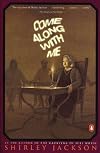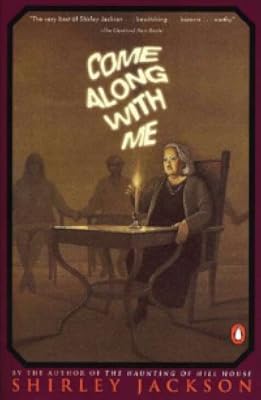
Come Along with Me
by Shirley Jackson
On This Page
Description
Come along with me -- Fourteen stories: Janice -- Tootie in peonage -- A cauliflower in her hair -- I know who I love -- The beautiful stranger -- The summer people -- Island -- A visit -- The rock -- A day in the jungle -- Pajama party -- Louisa, please come home -- The little house -- The bus -- Three lectures, with two stories: Experience and fiction -- The night we all had grippe -- Biography of a story -- The lottery -- Notes for a young writer.Tags
Recommendations












Member Reviews
Shirley Jackson wrote two very different kinds of stories, both of them represented in “Come Along with Me,” edited by her husband, Stanley Edgar Hyman and published in 1968.
When she died in 1965 she left an unfinished novel, “Come Along with Me,” and while it is only six chapters, we can be glad Hyman saw fit to publish it. These chapters, even the unedited ones, are brilliant, making readers wish desperately to know what happens next, or would have happened next if only Jackson had not died so prematurely. The rest of the book includes 16 stories, as well as three of her lectures.
The two kinds of stories she wrote include the fictional (although many initial readers of "The Lottery" were convinced it might be partly true) and show more the mostly true. The latter stories are humorous, and somewhat fictionalized, accounts of incidents involving her own family. This collection includes two gems, “Pajama Party” and “The Night We All Had Grippe.” These are similar in that, besides being funny, both involve people swapping beds all night long. In the first case it's the girls at her daughter's pajama party who, for a variety or reasons, can't settle long in one bed with one bedmate but keep moving around. In the other, everyone in the family is sick, and every bedroom is either too hot, too cold or whatever. No one can get comfortable, and so they stay in motion throughout the night.
If these tales suggest delightfully confused congestion, most of Jackson's other stories hint at isolation and menace. In "The Summer People," for example, a couple decides to stay in their summer cottage past Labor Day, rather than rushing back to the city as they usually do. The locals, who put up with summer people because they support their economy, seem to turn in unison against the Allisons when they do the unthinkable by staying too long.
"The Bus" finds an elderly woman dropped off by a bus driver in a strange town.
In "Louisa, Please Come Home," a teenage girl runs away from home and each year on the same day she listens to her mother's radio appeal for her to come home. Yet when Louise finally does return home after several years have passed, her parents don't recognize her, insisting that Louisa, now a grown woman, is an imposter.
In "A Day in the Jungle," the runaway is a married woman fed up with her husband and her life, but actually desiring only to be pursued and caught and valued by him. A similar woman in "The Beautiful Stranger" becomes convinced that her husband is an imposter, a handsome man only pretending to be her husband. She thrives on the excitement of this illicit relationship.
The book also includes Jackson's most famous short story, "The Lottery." Talk about isolation and menace. show less
When she died in 1965 she left an unfinished novel, “Come Along with Me,” and while it is only six chapters, we can be glad Hyman saw fit to publish it. These chapters, even the unedited ones, are brilliant, making readers wish desperately to know what happens next, or would have happened next if only Jackson had not died so prematurely. The rest of the book includes 16 stories, as well as three of her lectures.
The two kinds of stories she wrote include the fictional (although many initial readers of "The Lottery" were convinced it might be partly true) and show more the mostly true. The latter stories are humorous, and somewhat fictionalized, accounts of incidents involving her own family. This collection includes two gems, “Pajama Party” and “The Night We All Had Grippe.” These are similar in that, besides being funny, both involve people swapping beds all night long. In the first case it's the girls at her daughter's pajama party who, for a variety or reasons, can't settle long in one bed with one bedmate but keep moving around. In the other, everyone in the family is sick, and every bedroom is either too hot, too cold or whatever. No one can get comfortable, and so they stay in motion throughout the night.
If these tales suggest delightfully confused congestion, most of Jackson's other stories hint at isolation and menace. In "The Summer People," for example, a couple decides to stay in their summer cottage past Labor Day, rather than rushing back to the city as they usually do. The locals, who put up with summer people because they support their economy, seem to turn in unison against the Allisons when they do the unthinkable by staying too long.
"The Bus" finds an elderly woman dropped off by a bus driver in a strange town.
In "Louisa, Please Come Home," a teenage girl runs away from home and each year on the same day she listens to her mother's radio appeal for her to come home. Yet when Louise finally does return home after several years have passed, her parents don't recognize her, insisting that Louisa, now a grown woman, is an imposter.
In "A Day in the Jungle," the runaway is a married woman fed up with her husband and her life, but actually desiring only to be pursued and caught and valued by him. A similar woman in "The Beautiful Stranger" becomes convinced that her husband is an imposter, a handsome man only pretending to be her husband. She thrives on the excitement of this illicit relationship.
The book also includes Jackson's most famous short story, "The Lottery." Talk about isolation and menace. show less
I'm a Shirley Jackson fan, so I was happy to find this volume which includes her unfinished last novel, as well as otherwise uncollected stories chosen by her husband, and a couple of essays/lectures. The unfinished novel, "Come Along with Me," featured an intriguing and completely unreliable and possibly deluded protagonist who, after her husband dies, moves to an unidentified city/town, decides her name is Angela Motorman, and starts to hold seances. I was sorry it was unfinished. The stories vary in quality; I liked the later, creepier ones better, in which Jackson so deftly illustrates the terrible effects of conformity and the powers of the human mind to deceive. I particularly enjoyed "The Beautiful Stranger," "The Summer People," show more "A Visit" (I think this was my favorite), "Louisa, Please Come Home" (which was anthologized in Troubled Daughters, Twisted Wives), and "The Little House." Missing from these stories was the skewering of racism that was highlighted in several of the stories in The Lottery and Other Stories which I read several years ago. I also enjoyed the essays/lectures on experience and fiction (followed by an illustrative story, "The Night We All Had Grippe"), reactions to "The Lottery" (followed by the story itself), and advice to a young writer. show less
I love Shirley Jackson, she is an enigmatic storyteller, her narrators seem to inhabit another world even though they walk in our own. And their world seems completely ordinary to them. Jackson can almost convince you that it is ordinary to you as well (or at least me~but then again, i'm more than a little strange.)
What a shame Shirley Jackson wasn't able to finish the novel Come Along with Me... it had all the makings of a great book. Love the very beginning of Angela traveling to her new life, basically the happy twin to Nell's drive in Haunting of Hill House.
Favorites from this collection: Come Along with Me, Island, A Visit, Louisa Please Come Home, The Night We All Had Grippe, and Notes for a Young Writer
Favorites from this collection: Come Along with Me, Island, A Visit, Louisa Please Come Home, The Night We All Had Grippe, and Notes for a Young Writer
Part of a Novel, Sixteen Stories, and Three Lectures
In the preface Stanley Edgar Hyman (the late Shirley Jackson’s husband) tells us “Come Along with Me” is the novel Shirley Jackson was working on when she died, I suppose that is why there is an unfinished air to the store, it seems to just abruptly end, with no ending. The stories are short, some very short and leave much to the imagination, the characters and the readers. There are also two lectures that she gave and with these the last two stories. Included in this collection is the short story that has probably been read by most of the people in America, at least of my generation. I remember seeing the play when I was a girl. It is one of those rather unforgettable stories. I show more am talking about “The Lottery”.
If you are a fan of Shirley Jackson, or if you like quick short stories that leave you with a bit of a tingle or a thought, you would probably enjoy this collection of stories. show less
In the preface Stanley Edgar Hyman (the late Shirley Jackson’s husband) tells us “Come Along with Me” is the novel Shirley Jackson was working on when she died, I suppose that is why there is an unfinished air to the store, it seems to just abruptly end, with no ending. The stories are short, some very short and leave much to the imagination, the characters and the readers. There are also two lectures that she gave and with these the last two stories. Included in this collection is the short story that has probably been read by most of the people in America, at least of my generation. I remember seeing the play when I was a girl. It is one of those rather unforgettable stories. I show more am talking about “The Lottery”.
If you are a fan of Shirley Jackson, or if you like quick short stories that leave you with a bit of a tingle or a thought, you would probably enjoy this collection of stories. show less
Jackson's stories are well-crafted gems. The piece of a novel tantalizes the reader leaving us wishing for more.
Shirley as disturbing as ever.
Members
- Recently Added By
Lists

Most Popular Penguins
70 works; 5 members

Books Read in 2010
631 works; 10 members

Best Sellers / Popular 1968
237 works; 5 members
Author Information

121+ Works 40,146 Members
Shirley Jackson was born in San Francisco, California on December, 14, 1919. She received a Bachelor of Arts degree from Syracuse University in 1940. Much of her writing was done during the years she was raising her children. She is best-known for the short story The Lottery, which was first published in 1948 and adapted for television in 1952 and show more into play form in 1953. Her published works include articles, nonfiction prose, plays, poetry, seven novels, and fifty-five short stories. Her other works include Life among the Savages, Raising Demons, The Haunting of Hill House, which was adapted to film, and We Have Always Lived in the Castle. She died on August 8, 1965 at the age of 45. (Bowker Author Biography) show less
All Editions
Some Editions
Work Relationships
Is abridged in
Common Knowledge
- Dedication
- For Carol Brandt
- First words
- I always believe in eating when I can.
- Quotations
- "This is the one the artist was working on the morning of the day he died," and it was just as lousy as all the rest; not even imminent glowing death could help that Hughie.
- Last words
- (Click to show. Warning: May contain spoilers.)All you have to do then is write it, paying attention, please, to grammar and punctuation.
- Canonical DDC/MDS
- 813.54
- Canonical LCC
- PS3519.A392
Classifications
Statistics
- Members
- 547
- Popularity
- 54,585
- Reviews
- 10
- Rating
- (3.99)
- Languages
- English
- Media
- Paper, Ebook
- ISBNs
- 10
- ASINs
- 6