On This Page
Description
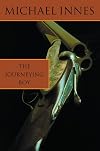
Humphrey Paxton, the son of one of Britain's leading atomic boffins, has taken to carrying a shotgun to 'shoot plotters and blackmailers and spies'. His new tutor, the plodding Mr Thewless, suggests that Humphrey might be overdoing it somewhat. But when a man is found shot dead at a cinema, Mr Thewless is plunged into a nightmare world of lies, kidnapping and murder - and grave matters of national security.Tags
Recommendations

















Member Reviews
(read as part of my "Michael Innes Treasury")
One of the things I like about (most) Innes' mysteries is his writing style. It won't appeal to everyone but I enjoy the way he uses language. In the first chapter, for example, Mr. Threwless is examining Sir Bernard Paxton's library and thinks of the furniture as covered in "horripilant velvet" -- I was unfamiliar with the word and could have passed it by assuming it was a fancy way of saying 'horrid' but decided to look up the word. The Merriam Webster online dictionary gave me this:
horripilation: a bristling of the hair of the head or body (as from disease, terror, or chilliness); goose bumps
What a great description of some types of velvet. And no wonder Mr. Threwless couldn't bring show more himself to sit on it!
I also enjoy the way Innes slyly pokes fun at himself & others who write mysteries and thrillers:
At one point on the train to Ireland, when Mr. Threwless is becoming suspicious of people & events that had occurred, there is this passage:
"Mr. Threwless halted, amazed at himself. He never read gangster stories. He never even read that milder sensational fiction, nicely top-dressed with a compost of literature and the arts, which is the produced by idle persons living in colleges and rectories."
Some readers might find that the "real plot" doesn't get going until the second half of the book (in which Threwless and his pupil Humphrey have some exciting adventures reminiscent of John Buchan's Richard Hannay) but I thought that the struggle Mr. Threwless undergoes during the train trip (deciding if Humphrey is an imposter or is mad or is just what he seems) fascinating. As much as I read suspense novels, I am sure that I would react in a very similar way if I was actually confronted by such a situation. show less
One of the things I like about (most) Innes' mysteries is his writing style. It won't appeal to everyone but I enjoy the way he uses language. In the first chapter, for example, Mr. Threwless is examining Sir Bernard Paxton's library and thinks of the furniture as covered in "horripilant velvet" -- I was unfamiliar with the word and could have passed it by assuming it was a fancy way of saying 'horrid' but decided to look up the word. The Merriam Webster online dictionary gave me this:
horripilation: a bristling of the hair of the head or body (as from disease, terror, or chilliness); goose bumps
What a great description of some types of velvet. And no wonder Mr. Threwless couldn't bring show more himself to sit on it!
I also enjoy the way Innes slyly pokes fun at himself & others who write mysteries and thrillers:
At one point on the train to Ireland, when Mr. Threwless is becoming suspicious of people & events that had occurred, there is this passage:
"Mr. Threwless halted, amazed at himself. He never read gangster stories. He never even read that milder sensational fiction, nicely top-dressed with a compost of literature and the arts, which is the produced by idle persons living in colleges and rectories."
Some readers might find that the "real plot" doesn't get going until the second half of the book (in which Threwless and his pupil Humphrey have some exciting adventures reminiscent of John Buchan's Richard Hannay) but I thought that the struggle Mr. Threwless undergoes during the train trip (deciding if Humphrey is an imposter or is mad or is just what he seems) fascinating. As much as I read suspense novels, I am sure that I would react in a very similar way if I was actually confronted by such a situation. show less
This was a slow-burn story for sure. First published in 1949, this is a contemporary novel about the son of an eminent physicist who is sent off to Ireland for a holiday. He and his tutor run into danger at just about every turn and have to rely on their wits to get through. It’s heavy going because Innes wields a very precise vocabulary and many of the words he chooses are not in common use today. The sentence structure is also ponderous, especially in the beginning. But like the tutor, Mr Thewless, the writing style loosens up and even becomes quite funny by the end of the book.
Most of the book ends up getting this a 4, but I’ve knocked off half a star for the scene where Mr Thewless encounters a train car full of circus show more performers; the othering and fatphobic inner monologue made me cringe. So would I recommend this book? With caution. show less
Most of the book ends up getting this a 4, but I’ve knocked off half a star for the scene where Mr Thewless encounters a train car full of circus show more performers; the othering and fatphobic inner monologue made me cringe. So would I recommend this book? With caution. show less
A rather intricate beginning in which two tutors are interviewed to accompany young Humphrey Paxton to Ireland. Mr Thewless is interviewed first and then informed in writing that he does not have the post. However the second successful interviewee notifies Sir Bernard that he is unable to accept the post after all. In the long run Mr Thewless meets his young charge for the first time on the railway station platform but his father fails to turn up to see him off, so during the train journey to catch the boat to Ireland Mr Thewless is beset by doubts about whether he has the right boy or not.
Meanwhile back in London the successful applicant is shot dead in a cinema and it rather looks as if Humphrey Paxton (whose actual identity is show more unknown to the police) may know something about the murder. Inspector Cadover attempts to identify the body, just knowing that he had recently got a position as tutor to the son of an atomic scientist and that he was meant to be escorting the boy to Ireland.
I don't think I have ever changed my mind so frequently about the merits of a story. I started off being rather frustrated by the style, but ended up enjoying it.
At times the style is rather ponderous and long-winded, and the initial plot rather complicated. The writing is littered with quotations and rather academic in-jokes, which presumably meant something to someone at the time. But there is something rather akin to Boys Own about this book and after Mr Thewless and Humphrey have crosed the sea to Ireland, and face various perils on their way to Humphrey's distant relatives, the action ramps up and it becomes a rollicking good story. Some people are not who they seem and both Humphrey and Mr Thewliss turn out to have interesting characters. In the end, they seem to have got into a very tight pickle and I really wanted to know how they got out of it.
Not everybody's cup of tea but an interesting insight into what appealed to readers in the uncertain times that followed the detonation of the atomic bombs at the end of World War Two. show less
Meanwhile back in London the successful applicant is shot dead in a cinema and it rather looks as if Humphrey Paxton (whose actual identity is show more unknown to the police) may know something about the murder. Inspector Cadover attempts to identify the body, just knowing that he had recently got a position as tutor to the son of an atomic scientist and that he was meant to be escorting the boy to Ireland.
I don't think I have ever changed my mind so frequently about the merits of a story. I started off being rather frustrated by the style, but ended up enjoying it.
At times the style is rather ponderous and long-winded, and the initial plot rather complicated. The writing is littered with quotations and rather academic in-jokes, which presumably meant something to someone at the time. But there is something rather akin to Boys Own about this book and after Mr Thewless and Humphrey have crosed the sea to Ireland, and face various perils on their way to Humphrey's distant relatives, the action ramps up and it becomes a rollicking good story. Some people are not who they seem and both Humphrey and Mr Thewliss turn out to have interesting characters. In the end, they seem to have got into a very tight pickle and I really wanted to know how they got out of it.
Not everybody's cup of tea but an interesting insight into what appealed to readers in the uncertain times that followed the detonation of the atomic bombs at the end of World War Two. show less
Richard Thewless travels to Ireland with Humphrey Paxton, son of Sir Bernard Paxton, Britain's leading nuclear physicist. He was second choice as the tutor for the boy, the first choice having been shot in a cinema. Can Inspector Cadover identify the corpse before Humphrey is kidnapped?
Lots of twists and turns in this combination of thriller and detective fiction.
Lots of twists and turns in this combination of thriller and detective fiction.
A boy and his tutor on a journey, suddenly there are spies and villains as the plot takes on a more sinister appearance. This is yet another good mystery from the pen of Michael Innes.
variable.
could have been much shorter
much unexplained eg the train accident
started this mid last year but put it aside
but it bugged me that it had good reviews so had to go back and finish it
Big ship
could have been much shorter
much unexplained eg the train accident
started this mid last year but put it aside
but it bugged me that it had good reviews so had to go back and finish it
Big ship
Reading this in 1969, I commented, “Good, with a style reminiscent of Buchan in the ending.”
Dec 17, 2024 (Edited)English (UK)
Members
- Recently Added By
Lists

The Top 100 Crime Novels of All Time
100 works; 15 members

Anthony Boucher's Best Crime Fiction of the Year
115 works; 5 members

Books mentioned in Julian Symons’ Bloody Murder
438 works; 6 members
Author Information

103+ Works 10,634 Members
John Innes Mackintosh Stewart was born in Edinburgh. He attended Oxford where he studied English. He taught English in universities at the University of Adelaide, in South Australia. Stewart published novels, short stories, studies in literature, biographies, and plays. Under his name, he wrote scholarly works such as Character and Motive in show more Shakespeare, Rudyard Kipling, and Thomas Hardy. As Michael Innes, he wrote over fifty detective novels with Inspector John Appleby of Scotland Yard in London as the main character. These titles include Death at the President's Lodging, The Journeying Boy, Lament for a Maker, Operation Pax, the Crabtree Affair and Silence Observed. Stewart died on November 12, 1994. (Bowker Author Biography) show less
Awards and Honors
Distinctions
Notable Lists
Series

Belongs to Publisher Series
SaPo (31)
Work Relationships
Common Knowledge
- Canonical title
- The Journeying Boy
- Original title
- The Journeying Boy
- Original publication date
- 1949
- People/Characters
- Sir Bernard Paxton; Richard Thewless; Inspector Cadover
- Important places
- London, England, UK; Belfast, Northern Ireland, UK
- First words
- On the morning of Monday, the 4th of August 1947, Mr. Richard Thewless walked in pleasant sunshine through the West End of London.
- Last words
- (Click to show. Warning: May contain spoilers.)'A capable boy,' he said. 'Really, a thoroughly capable boy.'
Classifications
Statistics
- Members
- 230
- Popularity
- 141,907
- Reviews
- 7
- Rating
- (3.43)
- Languages
- 5 — Dutch, English, Finnish, French, Spanish
- Media
- Paper, Audiobook, Ebook
- ISBNs
- 13
- ASINs
- 15