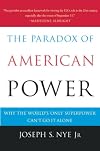
The Paradox of American Power: Why the World's Only Superpower Can't Go It Alone
by Jr. Joseph S. Nye
On This Page
Description
This title offers a critical appraisal of America's role in the future. It explains that challenges to America's power will come in the form of the very things that have made the last decade so prosperous: the information revolution and globalization.Tags
Recommendations


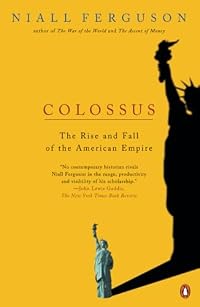
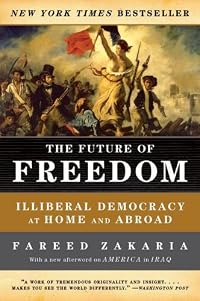
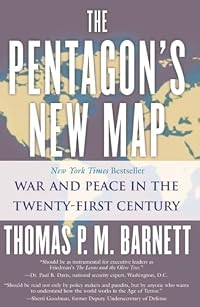
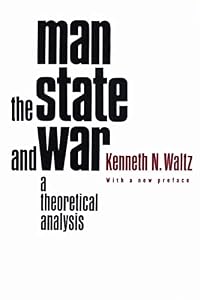








Member Reviews
Nye’s treatise on the declining influence of today’s hegemony is quite timely given the contentious political landscape of our times. Indeed, The Paradox of American Power: Why the World’s Only Superpower Can’t Go it Alone attempts to contextualise the consequences of the Bush Administration’s unilateralist policies and reminds the reader the subtle benefits of soft power. This book reminds me of former Canadian foreign minister, Lloyd Axworthy’s venture into the same fray a couple of years ago. Admittedly, I enjoyed the latter’s thoughts to a greater degree, but that can be attributed to my nationalist bias and my peculiar interests in the policies and ideals that Axworthy espouses. Overall, Nye’s treatise is eloquent show more as well as informative, yet the book contains some noticeable typos that distracted this reader from the argument at hand.
Nonetheless, Nye presents his hypothesis in a comprehensive fashion which serves the reader (and non-academics) to warm up to his thoughts and hopefully, to partake the author’s poignant advice. Overall, Nye believes that the U.S. should be mindful of emerging economic scions and to employ isolationist and unilateralist policies only as a last-chance measure. However, there are times when his point of view becomes almost simplistic, particularly when the author attempts to justify the Bush Administration’s unequivical denouncement of the Kyoto Protocol. All in all, Nye’s eloquence and pertinent framework would be well-placed to be the catalyst for many fiery political debates and discussions. show less
Nonetheless, Nye presents his hypothesis in a comprehensive fashion which serves the reader (and non-academics) to warm up to his thoughts and hopefully, to partake the author’s poignant advice. Overall, Nye believes that the U.S. should be mindful of emerging economic scions and to employ isolationist and unilateralist policies only as a last-chance measure. However, there are times when his point of view becomes almost simplistic, particularly when the author attempts to justify the Bush Administration’s unequivical denouncement of the Kyoto Protocol. All in all, Nye’s eloquence and pertinent framework would be well-placed to be the catalyst for many fiery political debates and discussions. show less
Joseph Nye argues that it is critical for the security of the USA that it listen closely to the rest of the world in a post 9/11 world, including economic interests in his forceful critique of American foreign policy.
Ratings
Members
- Recently Added By
Author Information

47+ Works 2,014 Members
Joseph S. Nye, Jr. is University Distinguished Service Professor Emeritus and former Dean at Harvard's Kennedy School of Government.
Awards and Honors
Awards
Distinctions
Common Knowledge
- Original publication date
- 2002
- Important places
- USA
Classifications
- Genres
- Politics and Government, Nonfiction, General Nonfiction, History
- DDC/MDS
- 327.73 — Society, Government, and Culture Political science International Relations: Spies North America United States
- LCC
- E183.7 .N94 — History of the United States United States History Diplomatic history. Foreign and general relations.
- BISAC
Statistics
- Members
- 386
- Popularity
- 80,637
- Reviews
- 2
- Rating
- (3.43)
- Languages
- 6 — English, German, Italian, Portuguese (Portugal), Serbian, Spanish
- Media
- Paper, Ebook
- ISBNs
- 16
- ASINs
- 1