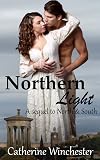
Northern Light
by Catherine Winchester
On This Page
Description
Sometimes described as the female Dickens, Elizabeth Gaskell's classic novel, North and South, dealt with issues of class, feminism, social reform and the plight of the working classes, entwining those themes seamlessly with a timeless romance between Margaret Hale and John Thornton. Northern Light is a continuation of that novel which sees John and Margaret embarking on their lives together whilst working to improve the lives of their work force.With the threat of another strike, a series show more of bad mill accidents, a lethal fire and failed speculation, life in Milton is not easy for anyone and it won't be long before the mill masters and their workers clash once more, with devastating consequences. Getting married and starting a family is difficult enough at the best of times but for John and Margaret, married life will present unique challenges and despite the reforms they are making, even they will not escape Milton's troubles unscathed. show lessTags
Recommendations
Member Recommendations
Shuffy2 Since this is the sequel, one should have read Gaskell's book first...
Member Reviews
When I first read Elizabeth Gaskell's North and South a couple of years ago, I wrote in my review that somebody should write a sequel to compensate for the rushed ending of the original. Catherine Winchester (and probably thousands of other fan fiction writers) has done just that, so how could I resist? And although no modern 'historical' novel can ever compare with the contemporary style and content of a story written over 155 years ago, Northern Light is a quick, frothy and loved-up Happy Ever After that will satisfy readers who love the romance of North and South, and couldn't care less about history.
Picking up immediately where Mrs Gaskell drew to a halt - 'that woman!' - Catherine Winchester follows John Thornton and Margaret Hale show more into marriage, business expansion, and family life over the course of five or so years. In her foreword - disclaimer - the author debates whether or not to imitate Gaskell or lapse into a more modern style, and decides on a 'hybrid'. The dialogue is therefore hopelessly modern, along with the behaviour of the characters, which sits ill with the original text but works on the whole. 'The morals of the day just weren't going to cut it for a modern audience', Miss Winchester claims, backing up her theory with the erroneous statement that John and Margaret never even share a kiss (they do, but the very Victorian Mrs Gaskell refers to the clinch as 'delicious silence'). So instead of veiled gestures and almost crippling erotic tension, the 'modern audience' gets a lot of bedroom scenes and public displays of affection. I'm not complaining - I'm perfectly sure that Mr and Mrs Thornton would be totally smitten, albeit carefully and discreetly - but I did rather miss the rather more subtle romance of the original.
What Catherine Winchester does get right is the spirit of the characters. Margaret is indepedent and forthright, John is intelligent and caring (though rather watered down), and they share a cheeky and amusing store of playful banter. Perhaps Margaret's autonomy is overplayed - she wants to work full time at the mill, yet complains when she hardly sees her husband because he is working all day at the mill - and John's 'progressive' attitude to his wife and his workers makes him seem more henpecked than liberal-minded, but to be fair, there are shades of both characteristics in Gaskell's novel. The model village that John and Margaret establish - like Saltaire in West Yorkshire, near where I live - is an inspired development, however, completely in keeping with both Margaret's philanthropy and John's ambition.
The affection - not the sex - shared by John and Margaret is tender and heart-warming. After years of unrequited, and then unresolved, love for Margaret, John Thornton cannot believe that such a beautiful, generous, confident woman is finally his wife. 'No, he would love her for as long as she would have him, and if he was good to her and very very lucky, that might just be for the rest of his life,' Thornton muses, in one of the more romantic scenes. I also love how their relationship matures into comfortable companionship, without losing that early spark of attraction - take out the smutty bedroom scenes, and I would be satisfied with Catherine Winchester's vision of married life for the Thorntons.
Northern Light (or should that be 'lite'?) is easy to read, entertaining, and unobjectionable. Like nineteenth century potboilers by Dickens and Gaskell herself, which were published serially, random scenes of drama are thrown in amidst the romance and domestic bliss to keep the reader engrossed. Illness, industrial action, financial ruin, and fire - but only one death (Gaskell notched up four, and three of them were in the last half of the book!) - keep John and Margaret from spending the whole novel in bed, yet there is no real fear for the main characters. Everything will work out well. Nor did I really get a sense of the era or location of the novel - the Thorntons' home arrangements and working partnership are viewed by outsiders as unconventional, but basically they are a modern married couple in Victorian dress. Margaret struggles to balance work with childcare and worries that John will no longer find her desirable, he clucks over her like an old woman, and they choose to defer having a family until the mill is up and running. This is supposed to be mid-nineteenth century England!
The modern dialogue and lack of attention to detail are also very distracting. John is referred to as a 'gold-digger', which is a twentieth century term, Margaret calls him a 'possessive Neanderthal', when in fact his behaviour is perfectly appropriate for a mid-Victorian husband, various children are given 'teddy bears' fifty years before the name was coined, and Margaret plays 'chopsticks' on the piano twenty years too early. Small details easily researched that drive me mad, I'm afraid. A half-decent editor, or beta-reader, would also have caught errors like calling Fanny's husband 'Wilson' and 'Watson' in the same book, increasing the number of John Boucher's orphaned children from six to eight, and hopefully, hopefully pointed out the difference between the possessive 'its' and the contraction 'it's'.
A very modern, cosy, non-threatening sequel to one of my favourite novels. Northern Light lacks Gaskell's knowledge of the industrial north in nineteenth century England - and Higgins' Lancashire dialect has been completely ironed out - but maintains the spirit and romance of John Thornton and Margaret Hale. Winchester has replaced Gaskell's literary depressant with a self-published happy pill, probably feeling that modern readers are unable to cope with the poverty, death and gritty realism of the Victorian era. There is little depth to this sequel, but I'll be honest, I was more interested in John and Margaret and 'what happens next', and so is everyone else. Anachronisms and rose-tinted glasses aside, therefore, I wasn't disappointed. show less
Picking up immediately where Mrs Gaskell drew to a halt - 'that woman!' - Catherine Winchester follows John Thornton and Margaret Hale show more into marriage, business expansion, and family life over the course of five or so years. In her foreword - disclaimer - the author debates whether or not to imitate Gaskell or lapse into a more modern style, and decides on a 'hybrid'. The dialogue is therefore hopelessly modern, along with the behaviour of the characters, which sits ill with the original text but works on the whole. 'The morals of the day just weren't going to cut it for a modern audience', Miss Winchester claims, backing up her theory with the erroneous statement that John and Margaret never even share a kiss (they do, but the very Victorian Mrs Gaskell refers to the clinch as 'delicious silence'). So instead of veiled gestures and almost crippling erotic tension, the 'modern audience' gets a lot of bedroom scenes and public displays of affection. I'm not complaining - I'm perfectly sure that Mr and Mrs Thornton would be totally smitten, albeit carefully and discreetly - but I did rather miss the rather more subtle romance of the original.
What Catherine Winchester does get right is the spirit of the characters. Margaret is indepedent and forthright, John is intelligent and caring (though rather watered down), and they share a cheeky and amusing store of playful banter. Perhaps Margaret's autonomy is overplayed - she wants to work full time at the mill, yet complains when she hardly sees her husband because he is working all day at the mill - and John's 'progressive' attitude to his wife and his workers makes him seem more henpecked than liberal-minded, but to be fair, there are shades of both characteristics in Gaskell's novel. The model village that John and Margaret establish - like Saltaire in West Yorkshire, near where I live - is an inspired development, however, completely in keeping with both Margaret's philanthropy and John's ambition.
The affection - not the sex - shared by John and Margaret is tender and heart-warming. After years of unrequited, and then unresolved, love for Margaret, John Thornton cannot believe that such a beautiful, generous, confident woman is finally his wife. 'No, he would love her for as long as she would have him, and if he was good to her and very very lucky, that might just be for the rest of his life,' Thornton muses, in one of the more romantic scenes. I also love how their relationship matures into comfortable companionship, without losing that early spark of attraction - take out the smutty bedroom scenes, and I would be satisfied with Catherine Winchester's vision of married life for the Thorntons.
Northern Light (or should that be 'lite'?) is easy to read, entertaining, and unobjectionable. Like nineteenth century potboilers by Dickens and Gaskell herself, which were published serially, random scenes of drama are thrown in amidst the romance and domestic bliss to keep the reader engrossed. Illness, industrial action, financial ruin, and fire - but only one death (Gaskell notched up four, and three of them were in the last half of the book!) - keep John and Margaret from spending the whole novel in bed, yet there is no real fear for the main characters. Everything will work out well. Nor did I really get a sense of the era or location of the novel - the Thorntons' home arrangements and working partnership are viewed by outsiders as unconventional, but basically they are a modern married couple in Victorian dress. Margaret struggles to balance work with childcare and worries that John will no longer find her desirable, he clucks over her like an old woman, and they choose to defer having a family until the mill is up and running. This is supposed to be mid-nineteenth century England!
The modern dialogue and lack of attention to detail are also very distracting. John is referred to as a 'gold-digger', which is a twentieth century term, Margaret calls him a 'possessive Neanderthal', when in fact his behaviour is perfectly appropriate for a mid-Victorian husband, various children are given 'teddy bears' fifty years before the name was coined, and Margaret plays 'chopsticks' on the piano twenty years too early. Small details easily researched that drive me mad, I'm afraid. A half-decent editor, or beta-reader, would also have caught errors like calling Fanny's husband 'Wilson' and 'Watson' in the same book, increasing the number of John Boucher's orphaned children from six to eight, and hopefully, hopefully pointed out the difference between the possessive 'its' and the contraction 'it's'.
A very modern, cosy, non-threatening sequel to one of my favourite novels. Northern Light lacks Gaskell's knowledge of the industrial north in nineteenth century England - and Higgins' Lancashire dialect has been completely ironed out - but maintains the spirit and romance of John Thornton and Margaret Hale. Winchester has replaced Gaskell's literary depressant with a self-published happy pill, probably feeling that modern readers are unable to cope with the poverty, death and gritty realism of the Victorian era. There is little depth to this sequel, but I'll be honest, I was more interested in John and Margaret and 'what happens next', and so is everyone else. Anachronisms and rose-tinted glasses aside, therefore, I wasn't disappointed. show less
When Margaret Hale finally accepts John Thornton's proposal, do they return to Milton and live happily ever after? What does their marriage mean for Thornton Mill?
This story picks-up where Elizabeth Gaskell ends 'North and South', the Industrial Revolution is booming, trade is expanding and money is being made but at who'se expense- the owners or the workers? John and Margaret are diligent in providing for their workers but not everyone feels the same as they do about healthy working conditions. Will their love survive the strain of spending day and night together; working side-by-side and attempting to start a family, or will it prove to be too much? Is Margaret still too good for Mr. Thornton?
As a fan of North and South, I was so show more happy when I stumbled across this book! I was hoping the romance of Mr. Thornton and Margaret would capture numerous hearts just like Mr. Darcy and Elizabeth. It was well written and the storyline stayed true to the original. I would recommend it to any Gaskell fan. Overall a great read! show less
This story picks-up where Elizabeth Gaskell ends 'North and South', the Industrial Revolution is booming, trade is expanding and money is being made but at who'se expense- the owners or the workers? John and Margaret are diligent in providing for their workers but not everyone feels the same as they do about healthy working conditions. Will their love survive the strain of spending day and night together; working side-by-side and attempting to start a family, or will it prove to be too much? Is Margaret still too good for Mr. Thornton?
As a fan of North and South, I was so show more happy when I stumbled across this book! I was hoping the romance of Mr. Thornton and Margaret would capture numerous hearts just like Mr. Darcy and Elizabeth. It was well written and the storyline stayed true to the original. I would recommend it to any Gaskell fan. Overall a great read! show less
Members
- Recently Added By
Author Information
20 Works 171 Members
Work Relationships
Is a (non-series) sequel to
Common Knowledge
- Original publication date
- 2011
Classifications
- Genres
- Fiction and Literature, Romance, Historical Fiction
- BISAC
Statistics
- Members
- 11
- Popularity
- 2,001,616
- Reviews
- 2
- Rating
- (4.00)
- Languages
- English
- Media
- Paper, Ebook
- ISBNs
- 1
- ASINs
- 1