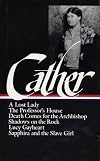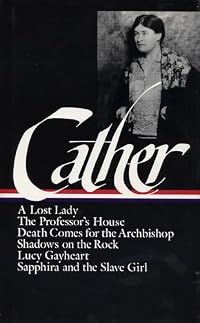
Later Novels: A Lost Lady / The Professor's House / Death Comes for the Archbishop / Shadows on the Rock / Lucy Gayheart / Sapphira and the Slave Girl
by Willa Cather 
On This Page
Description
Here are some of the most powerful and enchanting works by this renowned Southern author, contrasting grace and old-world charm with a new generation.Tags
Recommendations










Member Reviews
Having finished "The Professor's House," my first Cather work, I've become an instant fan of the author. This odd, slight, but highly moving tale draws in, with increasing interiority, like the unwrapping of a set of Russian nesting dolls, on its true subject: its protagonist's need to cope with a life that has lost its meaning.
That protagonist is Professor St. Peter, a history professor at a small college in the midwest. In the first book, "The Family," St. Peter is introduced, along with the family and friends whom we naively assume provide sufficient meaning to his world, and to the novel. His wife, daughters, sons-in-law, and colleagues are painted with warmth but candid awareness of their limitations, even while the point of view show more hovers more closely and sympathetically around St. Peter.
The book's most important character, after the Professor himself, is revealed elliptically and gradually; through dinner table conversation we come to understand that the Professor's son-in-law, Louie, is daughter Rosamond's second husband. First husband Tom Outland, a young man of mystery and brilliance, was killed in the World War I. This almost mythical figure, even though absent, gradually assumes ever greater importance throughout the novel, and ultimately overshadows everyone else in the Professor's world.
By the second book, "Tom Outland's Story," all of the family members save St. Peter are off on a trip to Paris, neatly removing them from the novel for its duration. St. Peter, having forsaken his usual scholarship, has decided to edit and annotate Tom Outland's diary for publication, and it is in St. Peter's remembrance of the young man's remarkable story, shared with the reader here, that we come to understand the reason for its importance, and for its centrality in the novel.
Cather uses the literal separation of St. Peter from his family to make a distinction of moral worth: the book turns to St. Peter and his relation to Outland's story because this is where the true meaning of the novel arises. While the first Book reads like a novel of manners, rooted in the preoccupations of a comfortable family in 1920's America, as we read on, those early chapters seem trivial and dated in retrospect. Perhaps this is Cather's aim or perhaps, like St. Peter, she is not really comfortable herself in that claustrophobic world. At any rate, it serves primarily as contrast. In Book Two the writing as well as the story takes on new beauty as it focuses on these two central characters, and on the vistas of the Southwest that provide its setting.
What distinguishes St. Peter and Outland is their relationship to money. Every other character fails Cather's litmus test on this subject. While she takes pains to paint Louie Marsellus as sympathetic and generous, not the easy mark who usurped Tom's wife and fortune, and while she makes it clear that Crane, colleague to St. Peter and Outland, has reasonable aspirations to benefitting from Outland's work, neither can ultimately find a higher value than the monetary. When Roddy, Outland's partner in the discovery of ancient relics in the southwest, sells them out for $4,000, unbeknownst to Outland, we understand the qualitative difference between the two men. Roddy is not an evil man, but he is a materialist.
Ultimately Outland gives up trying to explain to Roddy what the relics meant to him, irrespective of their monetary worth. Cather gives us to understand that Outland's legacy has assumed something of the relation to St. Peter that the relics had for Outland: the monetization of Outland's invention, while reasonable enough in the light of day, in some sense devalues the man by putting a price on his work, and all who benefit from that, himself included, lose favor in St. Peter's eyes.
The novel's final section, entitled "The Professor," is remarkable for its understanding of loss. St. Peter's attempts to prepare for his family's return force him to face the disjunction between the social creation that he has become during years of adulthood and the more essential self with which he is now connecting.
In part because he realizes that none of his relationships can meet the high bar set by his friendship with Outland, St. Peter seems to be confronting loss without hope.
"Perhaps the mistake was merely in an attitude of mind. He had never learned to live without delight. And he would have to learn to, just as, in a Prohibition country, he supposed he would have to learn to live without sherry. Theoretically he knew that life is possible, may be even pleasant, without joy, without passionate griefs. But it had never occurred to him that he might have to live like that." (p. 271)
Somehow, Cather shows us a stoicism without pathos; St. Peter can at least take consolation in knowing what he has lost. Through him, Cather discriminates between what matters and what does not, and shares her subtle understanding with her lucky readers. show less
That protagonist is Professor St. Peter, a history professor at a small college in the midwest. In the first book, "The Family," St. Peter is introduced, along with the family and friends whom we naively assume provide sufficient meaning to his world, and to the novel. His wife, daughters, sons-in-law, and colleagues are painted with warmth but candid awareness of their limitations, even while the point of view show more hovers more closely and sympathetically around St. Peter.
The book's most important character, after the Professor himself, is revealed elliptically and gradually; through dinner table conversation we come to understand that the Professor's son-in-law, Louie, is daughter Rosamond's second husband. First husband Tom Outland, a young man of mystery and brilliance, was killed in the World War I. This almost mythical figure, even though absent, gradually assumes ever greater importance throughout the novel, and ultimately overshadows everyone else in the Professor's world.
By the second book, "Tom Outland's Story," all of the family members save St. Peter are off on a trip to Paris, neatly removing them from the novel for its duration. St. Peter, having forsaken his usual scholarship, has decided to edit and annotate Tom Outland's diary for publication, and it is in St. Peter's remembrance of the young man's remarkable story, shared with the reader here, that we come to understand the reason for its importance, and for its centrality in the novel.
Cather uses the literal separation of St. Peter from his family to make a distinction of moral worth: the book turns to St. Peter and his relation to Outland's story because this is where the true meaning of the novel arises. While the first Book reads like a novel of manners, rooted in the preoccupations of a comfortable family in 1920's America, as we read on, those early chapters seem trivial and dated in retrospect. Perhaps this is Cather's aim or perhaps, like St. Peter, she is not really comfortable herself in that claustrophobic world. At any rate, it serves primarily as contrast. In Book Two the writing as well as the story takes on new beauty as it focuses on these two central characters, and on the vistas of the Southwest that provide its setting.
What distinguishes St. Peter and Outland is their relationship to money. Every other character fails Cather's litmus test on this subject. While she takes pains to paint Louie Marsellus as sympathetic and generous, not the easy mark who usurped Tom's wife and fortune, and while she makes it clear that Crane, colleague to St. Peter and Outland, has reasonable aspirations to benefitting from Outland's work, neither can ultimately find a higher value than the monetary. When Roddy, Outland's partner in the discovery of ancient relics in the southwest, sells them out for $4,000, unbeknownst to Outland, we understand the qualitative difference between the two men. Roddy is not an evil man, but he is a materialist.
Ultimately Outland gives up trying to explain to Roddy what the relics meant to him, irrespective of their monetary worth. Cather gives us to understand that Outland's legacy has assumed something of the relation to St. Peter that the relics had for Outland: the monetization of Outland's invention, while reasonable enough in the light of day, in some sense devalues the man by putting a price on his work, and all who benefit from that, himself included, lose favor in St. Peter's eyes.
The novel's final section, entitled "The Professor," is remarkable for its understanding of loss. St. Peter's attempts to prepare for his family's return force him to face the disjunction between the social creation that he has become during years of adulthood and the more essential self with which he is now connecting.
In part because he realizes that none of his relationships can meet the high bar set by his friendship with Outland, St. Peter seems to be confronting loss without hope.
"Perhaps the mistake was merely in an attitude of mind. He had never learned to live without delight. And he would have to learn to, just as, in a Prohibition country, he supposed he would have to learn to live without sherry. Theoretically he knew that life is possible, may be even pleasant, without joy, without passionate griefs. But it had never occurred to him that he might have to live like that." (p. 271)
Somehow, Cather shows us a stoicism without pathos; St. Peter can at least take consolation in knowing what he has lost. Through him, Cather discriminates between what matters and what does not, and shares her subtle understanding with her lucky readers. show less
I have read most of the novels in this collection and love them all. I really want this collection.
Ratings
Members
- Recently Added By
Author Information

151+ Works 45,816 Members
Willa Siebert Cather was born in 1873 in the home of her maternal grandmother in western Virginia. Although she had been named Willela, her family always called her "Willa." Upon graduating from the University of Nebraska in 1895, Cather moved to Pittsburgh where she worked as a journalist and teacher while beginning her writing career. In 1906, show more Cather moved to New York to become a leading magazine editor at McClure's Magazine before turning to writing full-time. She continued her education, receiving her doctorate of letters from the University of Nebraska in 1917, and honorary degrees from the University of Michigan, the University of California, Columbia, Yale, and Princeton. Cather wrote poetry, short stories, essays, and novels, winning awards including the Pulitzer Prize for her novel, One of Ours, about a Nebraska farm boy during World War I. She also wrote The Professor's House, My Antonia, Death Comes for the Archbishop, and Lucy Gayheart. Some of Cather's novels were made into movies, the most well-known being A Lost Lady, starring Barbara Stanwyck. In 1961, Willa Cather was the first woman ever voted into the Nebraska Hall of Fame. She was also inducted into the Hall of Great Westerners in Oklahoma in 1974, and the National Women's Hall of Fame in Seneca, New York in 1988. Cather died on April 24, 1947, of a cerebral hemorrhage, in her Madison Avenue, New York home, where she had lived for many years. (Bowker Author Biography) show less
Willa Cather has a Legacy Library. Legacy libraries are the personal libraries of famous readers, entered by LibraryThing members from the Legacy Libraries group.
All Editions
Series
Belongs to Publisher Series
Library of America (049)
Work Relationships
Is contained in
Contains
Common Knowledge
- Canonical title
- Later Novels: A Lost Lady / The Professor's House / Death Comes for the Archbishop / Shadows on the Rock / Lucy Gayheart / Sapphira and the Slave Girl
- Original publication date
- 1990-07-15
- Epigraph
- "A turquoise set in silver, wasn'it?..
Yes, a turquoise set in dull silver."
- LOUIE MARSELLUS
The professor's house - Dedication
- For Jan, because he likes narrative
The professor's house - First words
- The moving was over and done.
The professor's house - Last words
- (Click to show. Warning: May contain spoilers.)He thought he knew where he was, and that he could face with fortitude the Berengaria and the future.
The professor's house - Publisher's editor
- O'Brien, Sharon
- Disambiguation notice
- This is an omnibus unique to the Library of America; therefore, all CK facts apply to this publication only.
Classifications
Statistics
- Members
- 527
- Popularity
- 56,250
- Reviews
- 3
- Rating
- (3.98)
- Languages
- English
- Media
- Paper
- ISBNs
- 2
- ASINs
- 2