
On This Page
Description
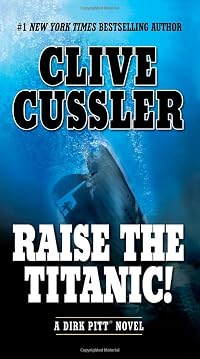
On orders from the Pentagon, marine explorer Dirk Pitt must salvage crucial material from the world's most infamous maritime disaster in this novel in the #1 New York Times-bestselling series.The President's secret task force has developed an unprecedented defensive weapon that relies on an extremely rare radioactive element—and Dirk Pitt has followed a twisted trail to a secret cache of the substance. Now, racing against brutal storms, Soviet spies, and a ticking clock, Pitt begins his show more most thrilling mission—to raise from its watery grave the shipwreck of the century... show less
Tags
Recommendations




Member Recommendations
Hedgepeth True accounts of Cussler's NUMA searches for shipwrecks
Member Reviews
Read: Raise the Titanic!; Clive Cussler
For reasons I have yet to question, I’ve started rereading Cussler’s novels, which I last read back in the 1980s and 1990s. And even then I thought they were bad. Raise the Titanic! is probably his most famous novel - it’s certainly the one that made him a bestselling author. It was his third novel, the first two had sold poorly, and this one was expected to do the same. But an editor visiting from the UK saw the manuscript at Cussler’s US publisher, and took a copy back home with him. This kicked off a bidding war on both sides of the Atlantic, resulting in Cussler pulling in a huge advance. The novel then went on to become a bestseller. (Soon after, Cussler bought back the rights to his show more earlier novels, and resold them to his then-current publisher for considerably more than he’d sold them originally.) The plot of Raise the Titanic! sees Dirk Pitt, special operations director the US National Underwater and Marine Agency, and all-round hard man, lady killer and Competent Man, is tapped to head a US project to raise the RMS Titanic from its seabed grave, 3800 metres below the surface (where the pressure is around 400 atmospheres). Because there’s a presidential black project to build an anti-missile screen around the US and it needs a supply of “byzanium” in order to work. The only known quantity of byzanium was secretly mined under the noses of the Soviets on Novaya Zemlya by US miners in 1912, but was shipped home on the RMS Titanic. Oops. The USSR learns of this plan and decides to hijack the Titanic once she is on the surface. Perhaps because of the amount spent to buy the novel, Raise the Titanic! seems to have been closely edited, and the prose is far better than in the earlier novels (although still not, well, good). The plot and setting is also much more science-fictional. The book was written before the wreck was found, and most people believed the ship had come to rest in one piece (she actually split in two). So Pitt’s plan is to plug the many holes in the Titanic’s hull with “wetsteel” and then pump the ship full of air… The novel was adapted for the screen in 1980 by UK TV production company ITC, but was a massive flop. ITC’s owner, Lew Grade, later said “it would have been cheaper to lower the Atlantic”, but he did like the film. Cussler didn’t. He refused to allow anyone to adapt his other books, and later sued the makers of Sahara, adapted from his 1992 Dirk Pitt novel of the same name. That film was huge flop too. Cussler died in 2020, but some time around the millennium he’d created an atelier, which has since produced a huge quantity of Dirk Pitt and NUMA novels by diverse hands (with Cussler’s name the most prominent on the cover, of course). His son, called Dirk, natch, now writes the Pitt novels. show less
For reasons I have yet to question, I’ve started rereading Cussler’s novels, which I last read back in the 1980s and 1990s. And even then I thought they were bad. Raise the Titanic! is probably his most famous novel - it’s certainly the one that made him a bestselling author. It was his third novel, the first two had sold poorly, and this one was expected to do the same. But an editor visiting from the UK saw the manuscript at Cussler’s US publisher, and took a copy back home with him. This kicked off a bidding war on both sides of the Atlantic, resulting in Cussler pulling in a huge advance. The novel then went on to become a bestseller. (Soon after, Cussler bought back the rights to his show more earlier novels, and resold them to his then-current publisher for considerably more than he’d sold them originally.) The plot of Raise the Titanic! sees Dirk Pitt, special operations director the US National Underwater and Marine Agency, and all-round hard man, lady killer and Competent Man, is tapped to head a US project to raise the RMS Titanic from its seabed grave, 3800 metres below the surface (where the pressure is around 400 atmospheres). Because there’s a presidential black project to build an anti-missile screen around the US and it needs a supply of “byzanium” in order to work. The only known quantity of byzanium was secretly mined under the noses of the Soviets on Novaya Zemlya by US miners in 1912, but was shipped home on the RMS Titanic. Oops. The USSR learns of this plan and decides to hijack the Titanic once she is on the surface. Perhaps because of the amount spent to buy the novel, Raise the Titanic! seems to have been closely edited, and the prose is far better than in the earlier novels (although still not, well, good). The plot and setting is also much more science-fictional. The book was written before the wreck was found, and most people believed the ship had come to rest in one piece (she actually split in two). So Pitt’s plan is to plug the many holes in the Titanic’s hull with “wetsteel” and then pump the ship full of air… The novel was adapted for the screen in 1980 by UK TV production company ITC, but was a massive flop. ITC’s owner, Lew Grade, later said “it would have been cheaper to lower the Atlantic”, but he did like the film. Cussler didn’t. He refused to allow anyone to adapt his other books, and later sued the makers of Sahara, adapted from his 1992 Dirk Pitt novel of the same name. That film was huge flop too. Cussler died in 2020, but some time around the millennium he’d created an atelier, which has since produced a huge quantity of Dirk Pitt and NUMA novels by diverse hands (with Cussler’s name the most prominent on the cover, of course). His son, called Dirk, natch, now writes the Pitt novels. show less
"Even if it were technically possible, and it isn't…" (pg. 124)
A really fun and well-put-together adventure potboiler, made more lasting by its successful Titanic novelty. Published about a decade before the real wreck's discovery by Robert Ballard, Clive Cussler's Raise the Titanic! is, of course, completely implausible. Most notably, we now know that the wreck was torn in half during its sinking and therefore not in one piece to raise. Titanic buffs will enjoy themselves picking holes elsewhere too (the boilers, for one thing, did not break loose).
Nevertheless, Cussler makes a pretty respectable go of it in his novel considering he lacked the facts we now have, and he makes some astute choices that seem uncanny in retrospect. His show more fictional Titanic wreck is discovered by a U.S. military expedition operating under the guise of an oceanographical scientific expedition, which is not too dissimilar from Ballard's real expedition (a military-funded expedition searching for a lost nuclear submarine that, once completed, started looking for the Titanic). Like Ballard, the first sight Cussler's expedition has of the wreck is its distinctive boilers. It even gets the date of discovery pretty close (1987 compared to Ballard's 1985). And, in 2023, the set-piece where one of the expedition's deep-sea submersibles is trapped at the bottom of the ocean among the wreckage recalls much of the speculation that initially surrounded the fate of OceanGate's doomed Titan a few months ago: "If the unthinkable happened, an accident at twelve thousand feet, there would be no hope of rescue. A quick death would be the only prayer against the appalling suffering of slow asphyxiation" (pg. 162). Suffice to say, there's plenty for those fascinated by the Titanic to get their teeth into.
Elsewhere, the book is that oddball mix of narm and genuine thrill that one gets from the best of Seventies pulp fiction, including some clumsy sexism that now seems almost endearingly quaint as you shake your head at it. The super-weapon MacGuffin never convinces – the Titanic's sunken cargo apparently contains an elusive element (the fictional 'byzanium') which can be used to create an all-powerful missile defence system – and nor does the corresponding Cold War espionage plot in which the dastardly Soviets seek to sabotage the salvage mission. (And, in one of the dumbest plot developments, why would the US government leak the information? If byzanium is such a game-changer, why start to play silly beggars with the Russians?) The hurricane also seemed a bit much at first, though it eventually worked in well enough, and the claim that the Titanic wreck had been kept free of rust and corrosion by unique ocean conditions was brazen hand-waving from the author to distract from the mighty plothole. And speaking of plotholes, I never understood why Dirk Pitt, our protagonist, was sent to interview a random Titanic survivor who provides crucial information – there just never seemed a realistic way for the two threads to link.
But the truth is that none of the above flaws matter a jot. Cussler's Titanic novelty is robust enough to ride over any flaw, and in truth it is – by thriller standards – a well-written story. Pitt is a decent protagonist and the pages turn easily. There is a globe-trotting adventure and enough research to give a thin veneer of plausibility to the Boy's Own nonsense. They raise the Titanic by blowing it off the bottom of the sea with explosives, which is so inappropriate it's staggering, but it's also so much fun to read as Cussler paints us the picture of how the dormant wreck, slowly but surely, begins to move. "We raise the Titanic!" a character proposes on page 108, and you can almost hear the triumphant music playing as it is said. The risen Titanic being towed into New York harbour, its original destination in April 1912 before fate intervened, is physically impossible and the most romantic of pipe dreams, but it's also a damn fine thing to read as Cussler makes it happen in this fairytale. For all its flaws, the book is a feast to read, and with such an alluring topic at hand it was always going to be so.
"'Strange thing about the Titanic,' Sandecker said softly. 'Once her spell strikes, you can think of nothing else.'" (pg. 161) show less
A really fun and well-put-together adventure potboiler, made more lasting by its successful Titanic novelty. Published about a decade before the real wreck's discovery by Robert Ballard, Clive Cussler's Raise the Titanic! is, of course, completely implausible. Most notably, we now know that the wreck was torn in half during its sinking and therefore not in one piece to raise. Titanic buffs will enjoy themselves picking holes elsewhere too (the boilers, for one thing, did not break loose).
Nevertheless, Cussler makes a pretty respectable go of it in his novel considering he lacked the facts we now have, and he makes some astute choices that seem uncanny in retrospect. His show more fictional Titanic wreck is discovered by a U.S. military expedition operating under the guise of an oceanographical scientific expedition, which is not too dissimilar from Ballard's real expedition (a military-funded expedition searching for a lost nuclear submarine that, once completed, started looking for the Titanic). Like Ballard, the first sight Cussler's expedition has of the wreck is its distinctive boilers. It even gets the date of discovery pretty close (1987 compared to Ballard's 1985). And, in 2023, the set-piece where one of the expedition's deep-sea submersibles is trapped at the bottom of the ocean among the wreckage recalls much of the speculation that initially surrounded the fate of OceanGate's doomed Titan a few months ago: "If the unthinkable happened, an accident at twelve thousand feet, there would be no hope of rescue. A quick death would be the only prayer against the appalling suffering of slow asphyxiation" (pg. 162). Suffice to say, there's plenty for those fascinated by the Titanic to get their teeth into.
Elsewhere, the book is that oddball mix of narm and genuine thrill that one gets from the best of Seventies pulp fiction, including some clumsy sexism that now seems almost endearingly quaint as you shake your head at it. The super-weapon MacGuffin never convinces – the Titanic's sunken cargo apparently contains an elusive element (the fictional 'byzanium') which can be used to create an all-powerful missile defence system – and nor does the corresponding Cold War espionage plot in which the dastardly Soviets seek to sabotage the salvage mission. (And, in one of the dumbest plot developments, why would the US government leak the information? If byzanium is such a game-changer, why start to play silly beggars with the Russians?) The hurricane also seemed a bit much at first, though it eventually worked in well enough, and the claim that the Titanic wreck had been kept free of rust and corrosion by unique ocean conditions was brazen hand-waving from the author to distract from the mighty plothole. And speaking of plotholes, I never understood why Dirk Pitt, our protagonist, was sent to interview a random Titanic survivor who provides crucial information – there just never seemed a realistic way for the two threads to link.
But the truth is that none of the above flaws matter a jot. Cussler's Titanic novelty is robust enough to ride over any flaw, and in truth it is – by thriller standards – a well-written story. Pitt is a decent protagonist and the pages turn easily. There is a globe-trotting adventure and enough research to give a thin veneer of plausibility to the Boy's Own nonsense. They raise the Titanic by blowing it off the bottom of the sea with explosives, which is so inappropriate it's staggering, but it's also so much fun to read as Cussler paints us the picture of how the dormant wreck, slowly but surely, begins to move. "We raise the Titanic!" a character proposes on page 108, and you can almost hear the triumphant music playing as it is said. The risen Titanic being towed into New York harbour, its original destination in April 1912 before fate intervened, is physically impossible and the most romantic of pipe dreams, but it's also a damn fine thing to read as Cussler makes it happen in this fairytale. For all its flaws, the book is a feast to read, and with such an alluring topic at hand it was always going to be so.
"'Strange thing about the Titanic,' Sandecker said softly. 'Once her spell strikes, you can think of nothing else.'" (pg. 161) show less
I opened this book for nostalgia's sake, looking for a good adventure story. But the ludicrously implausible plot ruined my enjoyment. From stumbling across the Titanic wreck on their first dive, to raising the Titanic with no difficulties, to then sailing the raised wreck straight through a hurricane… I can't even. And despite the title, the Titanic is raised "off screen," while Dirk Pitt is elsewhere.
I chose this book because I know that Cussler had an interest in maritime archeology. However, perhaps that interest only developed later on, because there's no evidence of it here. The rampant sexism is also rather hard to take.
I chose this book because I know that Cussler had an interest in maritime archeology. However, perhaps that interest only developed later on, because there's no evidence of it here. The rampant sexism is also rather hard to take.
My favourite Cussler by a long way. Apart from my lifelong interest in the Titanic, its a cracking read, albeit complete codswallop. Pace is frenetic, there's a satisfying supply of baddies (read, Russians), even a dash of hot sex. For a Titanicphile, there are two moments in the book that resonate with real emotion for me - when the ship returns to the surface, and when it makes port in New York. those two moments make the book and they are so well-written they still make hair stand up on back of my neck and bring a lump to my throat. Just for those two moment alone, encompassing every Titanic buff's fantasies, this is a 5 star book.
Deep in the North Atlantic is the rarest radioactive mineral on the planet that can power a strategically redefining missile defense shield, the problem is that it’s in vault of the most famous shipwreck in history. Raise the Titanic! is the third published book of Clive Cussler’s series featuring Dirk Pitt, who accepts the challenge to bring the most famous shipwreck in history only to find himself in the middle of a shadowy Cold War encounter in the middle of a hurricane.
A secret U.S. government think tank, Meta Section, sends a mineralogist to Novaya Zemlya in the Soviet Union to look for byzanium that will power their new antiballistic missile defense system. Unfortunately the scientist is discovered by Soviet security until show more he’s saved by Dirk Pitt whose “interference” of Meta Section’s plan upsets its chief, Dr. Gene Seagram who is married to a NUMA colleague of Pitt’s. The mineralogist how has both good and bad news, Novaya Zemlya does have byzanium but only a tiny fraction that did because it was mined earlier in the century by Americans from Colorado. Gene Seagram and his closest friend in Meta Section begin hunting down this new lead while Captain Prevlov of Soviet Naval Intelligence begins investigating the American incursion of Soviet territory both the recent and newly discovered mine from the turn of the century. Meanwhile Gene Seagram’s quest to get his secret project completed results in his wife Dana leaving him just as he learns that large amount of byzanium was found on Novaya Zemlya by Coloradan miners who spirited from Russia to Britain and loaded it on the Titanic. Gene Seagram finds Pitt and convinces him to lead the salvaging of the shipwreck. Over the course of the salvage, both American and Soviet intelligence agencies have a shadowy back and forth that Pitt only learns about close to the end of salvage which comes to a dramatic end when they raise it to save one of their submersibles. In preparing to tow the now risen Titanic, Pitt and crew learn that a mid-May formed hurricane is barreling towards them which for Prevlov is prefect for his plan to steal the ship and its “secret” cargo. Prevlov and his strike force board the Titanic while it’s in the eye of the hurricane and take the crew hostage, save Pitt, who confronts the Soviet captain before several minutes before Navy SEALS take out the Soviet soldiers except for Prevlov. The Titanic makes arrives in New York to fanfare, but Meta Section and NUMA learn that their efforts were for not because in the ship’s vault were only boxes of normal stones. Gene Seagram, who had slowly been losing his sanity, has a complete nervous breakdown and attacks the mummified remains of the last American miner who by coincidence was also insane by the time he boarded Titanic. Pitt travels to Scotland and makes his way across Britain until he finds a tiny village where one of the American miners was buried, with the bzyanium thus allowing the U.S. to create its missile defense system.
Written almost a decade before the Titanic was discovered, in two pieces, Cussler writes an intriguing narrative of underwater discovery and salvage with some nice Cold War intrigue thrown in. The main plot was basically really fun to read even with the knowledge that Cussler’s details were wrong in every regard to the shipwreck. While the Soviet spy subplot was completely fine as was Gene Seagram’s slow mental breakdown, the other subplots in the book were complete trash. First was Dana Seagram’s independent woman angle in which was asserted herself and also bashed women’s liberation (which went hand on hand with the usual chauvinistic streak of these early books), the second was the President of the United States being persuaded by the CIA and NIA to let Meta Section’s secret project get leaked to the Soviets which was completely unrealistic (even in a story about raising the Titanic!). Even with those I would have been fine, but Cussler for some reason had Pitt bed Dana Seagram after going the majority of the book seemingly like the Pitt later in the series.
Raise the Titanic! for the most part is a good book, which could have been better, but it’s better than The Mediterranean Caper and Iceberg especially since Dirk isn’t a complete jerk. Cussler did write a solid main plot, but the biggest problems were some of the subplots which undermined the work plus some poor decisions around Pitt close to the end. However, after Pacific Vortex this is the best early Pitt book so far. show less
A secret U.S. government think tank, Meta Section, sends a mineralogist to Novaya Zemlya in the Soviet Union to look for byzanium that will power their new antiballistic missile defense system. Unfortunately the scientist is discovered by Soviet security until show more he’s saved by Dirk Pitt whose “interference” of Meta Section’s plan upsets its chief, Dr. Gene Seagram who is married to a NUMA colleague of Pitt’s. The mineralogist how has both good and bad news, Novaya Zemlya does have byzanium but only a tiny fraction that did because it was mined earlier in the century by Americans from Colorado. Gene Seagram and his closest friend in Meta Section begin hunting down this new lead while Captain Prevlov of Soviet Naval Intelligence begins investigating the American incursion of Soviet territory both the recent and newly discovered mine from the turn of the century. Meanwhile Gene Seagram’s quest to get his secret project completed results in his wife Dana leaving him just as he learns that large amount of byzanium was found on Novaya Zemlya by Coloradan miners who spirited from Russia to Britain and loaded it on the Titanic. Gene Seagram finds Pitt and convinces him to lead the salvaging of the shipwreck. Over the course of the salvage, both American and Soviet intelligence agencies have a shadowy back and forth that Pitt only learns about close to the end of salvage which comes to a dramatic end when they raise it to save one of their submersibles. In preparing to tow the now risen Titanic, Pitt and crew learn that a mid-May formed hurricane is barreling towards them which for Prevlov is prefect for his plan to steal the ship and its “secret” cargo. Prevlov and his strike force board the Titanic while it’s in the eye of the hurricane and take the crew hostage, save Pitt, who confronts the Soviet captain before several minutes before Navy SEALS take out the Soviet soldiers except for Prevlov. The Titanic makes arrives in New York to fanfare, but Meta Section and NUMA learn that their efforts were for not because in the ship’s vault were only boxes of normal stones. Gene Seagram, who had slowly been losing his sanity, has a complete nervous breakdown and attacks the mummified remains of the last American miner who by coincidence was also insane by the time he boarded Titanic. Pitt travels to Scotland and makes his way across Britain until he finds a tiny village where one of the American miners was buried, with the bzyanium thus allowing the U.S. to create its missile defense system.
Written almost a decade before the Titanic was discovered, in two pieces, Cussler writes an intriguing narrative of underwater discovery and salvage with some nice Cold War intrigue thrown in. The main plot was basically really fun to read even with the knowledge that Cussler’s details were wrong in every regard to the shipwreck. While the Soviet spy subplot was completely fine as was Gene Seagram’s slow mental breakdown, the other subplots in the book were complete trash. First was Dana Seagram’s independent woman angle in which was asserted herself and also bashed women’s liberation (which went hand on hand with the usual chauvinistic streak of these early books), the second was the President of the United States being persuaded by the CIA and NIA to let Meta Section’s secret project get leaked to the Soviets which was completely unrealistic (even in a story about raising the Titanic!). Even with those I would have been fine, but Cussler for some reason had Pitt bed Dana Seagram after going the majority of the book seemingly like the Pitt later in the series.
Raise the Titanic! for the most part is a good book, which could have been better, but it’s better than The Mediterranean Caper and Iceberg especially since Dirk isn’t a complete jerk. Cussler did write a solid main plot, but the biggest problems were some of the subplots which undermined the work plus some poor decisions around Pitt close to the end. However, after Pacific Vortex this is the best early Pitt book so far. show less
[b:Raise the Titanic!|41706|Raise the Titanic! (Dirk Pitt, #4)|Clive Cussler|https://i.gr-assets.com/images/S/compressed.photo.goodreads.com/books/1439783780l/41706._SY75_.jpg|81973] is one of the Dirk Pitt books that I remember reading years and years ago. It's a fascinating story, mixing secret government espionage with the underwater salvage details that are one of the reasons I really do enjoy this series on the greatest salvage mission you could expect: The Titanic.
It's fascinating to realize that this book was published 10 years before the remains of the Titanic were discovered--and yet it's set in 1987, 2 years after. As such, you realize now that there are a few details that aren't entirely correct (such as the ship breaking in show more half). Also we're near the fall of the USSR, but they're quite the villains to be reckoned with hereabouts. Still, from the point of view it was written, it all seems reasonable enough. Otherwise, just treat it as a parallel universe and you're good to go. And both the salvage mission plus the harrowing account ofRussian agents and a hurricane once the Titanic is raised makes it a solid action book.
Sexism wise, it's at least better than any of the previous books, although there are still issues all over the place. But for once, we actually have a relatively strong woman character in Dana Seagram--for about 80% of the time she's on screen. It's weird and awkward and cartoony in completely the other direction. And there's a definite 'woman are strong; and then everyone clapped' moment that's rather eye-roll inducing, but it at least appears that Cussler is trying. There's hope yet. Now let's see if he can get more than one woman character at the same time. show less
It's fascinating to realize that this book was published 10 years before the remains of the Titanic were discovered--and yet it's set in 1987, 2 years after. As such, you realize now that there are a few details that aren't entirely correct (such as the ship breaking in show more half). Also we're near the fall of the USSR, but they're quite the villains to be reckoned with hereabouts. Still, from the point of view it was written, it all seems reasonable enough. Otherwise, just treat it as a parallel universe and you're good to go. And both the salvage mission plus the harrowing account of
Sexism wise, it's at least better than any of the previous books, although there are still issues all over the place. But for once, we actually have a relatively strong woman character in Dana Seagram--for about 80% of the time she's on screen. It's weird and awkward and cartoony in completely the other direction. And there's a definite 'woman are strong; and then everyone clapped' moment that's rather eye-roll inducing, but it at least appears that Cussler is trying. There's hope yet. Now let's see if he can get more than one woman character at the same time. show less
This is a terrible terrible book. Implausible, unlikable characters, a book that is very much of its time in so many ways, and I'm so glad we are no longer in that time. I found the 'struggling marriage because he is busy with his top secret work' plot particularly frustrating and unrealistic, possibly because it had so much potential to be more interesting than it was. And gah, the twist at the end invalidates the whole thing!
On the other hand, there is no way you can not be moved as the ghost hulk of the wreckage of the Titanic sails finally into New York Harbour. Or as she sails through the storm, bearing down on the tugs that try to save her in the hurricane. Or when the Russians try to humiliate our heroine, just to have her go show more 'yep, I look darn hot naked, deal with it'. Or when our heroes are trapped in a slowly filling submarine, on the bottom of the ocean floor, and the only way to save them is to raise the Titanic. A terrible book, but with some truly glorious moments show less
On the other hand, there is no way you can not be moved as the ghost hulk of the wreckage of the Titanic sails finally into New York Harbour. Or as she sails through the storm, bearing down on the tugs that try to save her in the hurricane. Or when the Russians try to humiliate our heroine, just to have her go show more 'yep, I look darn hot naked, deal with it'. Or when our heroes are trapped in a slowly filling submarine, on the bottom of the ocean floor, and the only way to save them is to raise the Titanic. A terrible book, but with some truly glorious moments show less
Members
- Recently Added By
Published Reviews
you can not go wrong with ANY of the dirk pitt books!great adventure
added by dorabum
Lists

100 Mysteries and Thrillers to Read in a Lifetime
99 works; 22 members
Tozai Mystery Best 100 | The Top 100 Mystery Novels
111 works; 3 members

Kindle Action/Adventure - Junior and Teenage
178 works; 1 member
Author Information

198+ Works 141,810 Members
Clive Cussler was born in Aurora, Illinois on July 15, 1931. He attended Pasadena City College for two years before enlisting in the United States Air Force during the Korean War. After his discharge from the military, he worked first as a copywriter and later as a creative director for two of the nation's most successful advertising agencies. At show more that time, he wrote and produced radio and television commercials that won numerous international awards, including one at the Cannes Lions International Advertising Festival. He began writing in 1965 and published his first novel featuring Dirk Pitt in 1973. His first non-fiction work, The Sea Hunters, was published in 1996. He has written over 50 books including the Dirk Pitt series, the NUMA Files series, Oregon Files series, Isaac Bell series, and the Fargo Adventure series. He is the Chairman of NUMA (National Underwater and Marine Agency), a non-profit group which he founded. He and his crew of marine experts and NUMA volunteers have discovered over 60 historically significant underwater wreck sites. Clive Cussler died on February 24, 2020 at the age of 88. (Bowker Author Biography) show less
Some Editions
Awards and Honors
Distinctions
Series

Belongs to Publisher Series
Zwarte Beertjes (2066)
Work Relationships
Has the adaptation
Common Knowledge
- Canonical title
- Raise the Titanic!
- Original title
- Raise the Titanic!
- Alternate titles*
- Bedreigde berging
- Original publication date
- 1976-10
- People/Characters
- Dirk Pitt; Georgi Antonov; Adeline Austin; Sir John L. Bigelow (Commodore, last surviving member of the Titanic's crew); Joshua Hayes Brewster; Marshall Collins (show all 30); Mel Donner; Ben Drummer; Graham Farley; Al Giordino; Rudi Gunn (Commander); Jake Hobart; Peter Jones (police officer); Joseph Kemper (Admiral); Sid Koplin; Pavel Marganin (Lieutenant); Sam Merker; Henry Munk; Warren Nicholson (director of the CIA); Ivan Parotkin (Captain); Vladimir Polevoi; Andre Prevlov (Captain); James Sandecker (Admiral); Dana Seagram; Gene Seagram; Murray Silverstein; Boris Sloyuk (Admiral); Vasily Tilevitch; John Vogel; Vernon Hall
- Important places
- Atlantic Ocean; New York, New York, USA; North Atlantic Ocean; Southby, England, UK; Titanic; USSR (show all 8); USA; England, UK
- Important events
- Sinking of the Titanic (1912-04-14 | 1912-04-15); Discovery of the Titanic (fictional)
- Related movies
- Raise the Titanic (1980 | IMDb)
- Dedication
- With gratitude to my wife, Barbara, Errol Beauchamp, Janet and Randy Richter, and Dick Clark
- First words
- The man on Deck A, Stateroom 33, tossed and turned in his narrow berth, the mind behind his sweating face lost in the depths of a nightmare.
- Last words
- (Click to show. Warning: May contain spoilers.)The Sicilian Project had proven itself an unqualified success on its first try.
- Original language*
- Englisch
*Some information comes from Common Knowledge in other languages. Click "Edit" for more information.
Classifications
Statistics
- Members
- 3,516
- Popularity
- 4,686
- Reviews
- 51
- Rating
- (3.71)
- Languages
- 13 — Czech, Danish, Dutch, English, Finnish, French, German, Italian, Norwegian (Bokmål), Portuguese, Spanish, Swedish, Turkish
- Media
- Paper, Audiobook, Ebook
- ISBNs
- 86
- ASINs
- 37