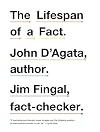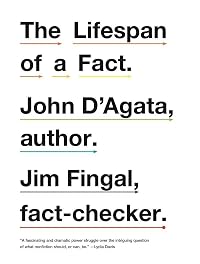
The Lifespan of a Fact
by John D'Agata, Jim Fingal
On This Page
Description
How negotiable is a fact in nonfiction? In 2003, an essay by John D'Agata was rejected by the magazine that commissioned it due to factual inaccuracies. That essay--which eventually became the foundation of D'Agata's critically acclaimed About a Mountain--was accepted by another magazine, but not before they handed it to their own fact-checker, Jim Fingal. What resulted from that assignment was seven years of arguments, negotiations, and revisions as D'Agata and Fingal struggled to navigate show more the boundaries of literary nonfiction. What emerges is a brilliant and eye-opening meditation on the relationship between "truth" and "accuracy" and a penetrating conversation about whether it is appropriate for a writer to substitute one for the other"--P. [4] of cover. show lessTags
Recommendations










Member Reviews
Warning: if you're anything at all like me, reading The Lifespan of a Factby John D'Agata and Jim Fingal (Knopf, 2012) is very likely to cause a major spike in your blood pressure.
This slim book presents an essay by D'Agata (published in the January 2010 issue of The Believeras "What Happens There"), alongside a series of emails between D'Agata and Fingal, who was assigned to fact-check the article prior to publication. The article concerns the suicide of 16-year-old Levi Presley, who jumped from the tower of the Stratosphere Hotel and Casino on 13 July 2002.
From literally the very first clause, Fingal found difficulties. D'Agata's scene-setting first paragraph contained at least eight statements that either couldn't be proven or were show more factually inaccurate, so Fingal began emailing D'Agata to try and make corrections. And things quickly turned ugly. D'Agata's responses to Fingal's (entirely fair) questions ranged from the snide to the sarcastic to the downright nasty. The author repeatedly maintained that he was perfectly justified in changing facts to suit his purposes for any reason whatsoever: switching the name of a bar from the Boston Saloon to the Bucket of Blood because the latter "is more interesting"; switching another suicide by jumping on the day of Presley's death to one by hanging because "I wanted Levi's death to be the only one from falling that day. I wanted his death to be more unique." You get the idea. This goes on for 123 pages, with Fingal probing for the facts, and D'Agata arguing that he could, and did, change them whenever he felt like it.
One exchange, from the last section of the piece, should give the flavor. Fingal asks D'Agata where he got information on the specific parking space Presley used the night of his death:
D'Agata: "Your nitpicking is absurd and its ruining this essay. So, as I've said, I'm not participating. Good luck."
Fingal: "In other words, you're taking your ball and going home. Very mature. You know, confirming factual details so that a piece like this has some semblance of accuracy isn't 'nitpicking,' and I think most readers would agree with me. This process is actually meant to help enhance your writing. But I can't imagine you could appreciate anything that would require you to alter your precious words, which no doubt fell into the world from your pen fully formed and immaculate."
D'Agata: "Yeah, I'm the immature one."
One can hardly blame Fingal for getting a bit snarky; I'm amazed at how long he held back.
The main thrust of D'Agata's argument throughout is that he's writing an "essay," not "journalism." This, he maintains, gives him the right to pretty much do whatever he wants. I'm not buyin' it. If you want to write an essay and smooth out some rough spots by changing a few facts here and there, you ought to tell your reader that up front. That's no big deal; easily done, and it hurts no one. D'Agata would disagree, but who's surprised at that?
The book is not enjoyable to read: it's stressful, and unpleasant, to see the abuse DAgata flings at Fingal, and to see the ridiculous excuses he comes up with for the factual misstatements he includes in the piece. That said, it's also a really fascinating look inside the fact-checking process, and I know I certainly won't read certain pieces of writing the same way again. Being published as it was right around the whole Mike Daisey kerfuffle, the book has a certain timeliness to it; I hope that it's widely read.
There are, however, some real missed opportunities. The book doesn't include any contextualization of the situation at all: mentioned only in passing (on the back cover) was that D'Agata's essay had previously been rejected by the magazine (Harper's) that originally commissioned the piece. Just a few of Fingal's interactions with editors about his exchanges with D'Agata are included, so it's difficult to get an overall sense of the process. Most notably, though, the book concludes at the end of the original draft text of the essay ... we don't get a chance to see what happened next in order to get the piece through to publishable form (presumably a whole lot of back-and-forthing with editors, I imagine). The Lifespan of a Fact doesn't include the final text of the essay as published - for that I ordered up a copy of the magazine where it appeared, because I really wanted to see how the battle ended up playing out.
As it turns out, much to my happiness, many (but not all) of Fingal's substantive issues with various elements of the essay are clarified or corrected in the final version. A couple amusing (or not) exceptions I found are cases where both Fingal and D'Agata agreethat D'Agata had made a mistake, but the errors remain in the article. That said, D'Agata's penchant for changing the names of businesses was allowed, as were a few other liberties and several outright factual misstatements.
I certainly came away from this book with a great appreciation for the fact-checkers of the world ...
http://philobiblos.blogspot.com/2012/05/book-review-lifespan-of-fact.html show less
This slim book presents an essay by D'Agata (published in the January 2010 issue of The Believeras "What Happens There"), alongside a series of emails between D'Agata and Fingal, who was assigned to fact-check the article prior to publication. The article concerns the suicide of 16-year-old Levi Presley, who jumped from the tower of the Stratosphere Hotel and Casino on 13 July 2002.
From literally the very first clause, Fingal found difficulties. D'Agata's scene-setting first paragraph contained at least eight statements that either couldn't be proven or were show more factually inaccurate, so Fingal began emailing D'Agata to try and make corrections. And things quickly turned ugly. D'Agata's responses to Fingal's (entirely fair) questions ranged from the snide to the sarcastic to the downright nasty. The author repeatedly maintained that he was perfectly justified in changing facts to suit his purposes for any reason whatsoever: switching the name of a bar from the Boston Saloon to the Bucket of Blood because the latter "is more interesting"; switching another suicide by jumping on the day of Presley's death to one by hanging because "I wanted Levi's death to be the only one from falling that day. I wanted his death to be more unique." You get the idea. This goes on for 123 pages, with Fingal probing for the facts, and D'Agata arguing that he could, and did, change them whenever he felt like it.
One exchange, from the last section of the piece, should give the flavor. Fingal asks D'Agata where he got information on the specific parking space Presley used the night of his death:
D'Agata: "Your nitpicking is absurd and its ruining this essay. So, as I've said, I'm not participating. Good luck."
Fingal: "In other words, you're taking your ball and going home. Very mature. You know, confirming factual details so that a piece like this has some semblance of accuracy isn't 'nitpicking,' and I think most readers would agree with me. This process is actually meant to help enhance your writing. But I can't imagine you could appreciate anything that would require you to alter your precious words, which no doubt fell into the world from your pen fully formed and immaculate."
D'Agata: "Yeah, I'm the immature one."
One can hardly blame Fingal for getting a bit snarky; I'm amazed at how long he held back.
The main thrust of D'Agata's argument throughout is that he's writing an "essay," not "journalism." This, he maintains, gives him the right to pretty much do whatever he wants. I'm not buyin' it. If you want to write an essay and smooth out some rough spots by changing a few facts here and there, you ought to tell your reader that up front. That's no big deal; easily done, and it hurts no one. D'Agata would disagree, but who's surprised at that?
The book is not enjoyable to read: it's stressful, and unpleasant, to see the abuse DAgata flings at Fingal, and to see the ridiculous excuses he comes up with for the factual misstatements he includes in the piece. That said, it's also a really fascinating look inside the fact-checking process, and I know I certainly won't read certain pieces of writing the same way again. Being published as it was right around the whole Mike Daisey kerfuffle, the book has a certain timeliness to it; I hope that it's widely read.
There are, however, some real missed opportunities. The book doesn't include any contextualization of the situation at all: mentioned only in passing (on the back cover) was that D'Agata's essay had previously been rejected by the magazine (Harper's) that originally commissioned the piece. Just a few of Fingal's interactions with editors about his exchanges with D'Agata are included, so it's difficult to get an overall sense of the process. Most notably, though, the book concludes at the end of the original draft text of the essay ... we don't get a chance to see what happened next in order to get the piece through to publishable form (presumably a whole lot of back-and-forthing with editors, I imagine). The Lifespan of a Fact doesn't include the final text of the essay as published - for that I ordered up a copy of the magazine where it appeared, because I really wanted to see how the battle ended up playing out.
As it turns out, much to my happiness, many (but not all) of Fingal's substantive issues with various elements of the essay are clarified or corrected in the final version. A couple amusing (or not) exceptions I found are cases where both Fingal and D'Agata agreethat D'Agata had made a mistake, but the errors remain in the article. That said, D'Agata's penchant for changing the names of businesses was allowed, as were a few other liberties and several outright factual misstatements.
I certainly came away from this book with a great appreciation for the fact-checkers of the world ...
http://philobiblos.blogspot.com/2012/05/book-review-lifespan-of-fact.html show less
Is accuracy important when trying to tell a story? I found this book delightful, interweaving the comments of the article's author, editor and fact checker. The author chooses to use facts based solely on the truthiness (a la Stephen Colbert) of the information. The fact checker battles against this by researching each line of the article to impressive depth. When he is able to confirm something, the passage is printed in black. The passages printed in red are the "facts" that cannot be proven or are outright wrong. There are far more red passages than black. It is interesting to see the author struggle to produce an article that is captivating and interesting, while the fact checker tries to keep him from outright lying for artistic show more effect. The snark in some of the exchanges between author and fact checker made this highly enjoyable. show less
Did John D'Agata plan this all along?
He's an awareness-raiser for the essay, and an envelope-pusher when it comes to genre. Was the making of this book just a 7-year plot to lean against the edges of what we expect an essay to be?
Here's what happened: D'Agata submitted a piece to The Believer for publication, a piece which was, ostensibly, a true account of the suicide of a Las Vegas teen. The article-essay also included D'Agata's own personal experience of the chain of events and explored the nature of our ideas about Las Vegas. But when fact-checking intern Jim Fingal got a hold of the piece, he quickly realized that it was riddled with factual inaccuracies - nearly all purposeful. ("I needed two beats there," John says to explain why show more he changed pink vans to purple vans; but much of his fact-massaging was significantly more...significant.)
Each page shows a section of D'Agata's work in the center with Fingal's fact-checking notes - and their correspondence - around the margins. As D'Agata responds with caustic snark and bluntly refuses to change anything, Fingal gets more nit-picky and obnoxious (at one point requesting D'Agata's mother's phone number so he can confirm that she has a cat, which D'Agata had mentioned in passing).
I predict readers will end up choosing sides - and I expect most will side with Fingal. Although a bit of a tedious read, the book was still funny and made somewhat of a comment on the boundaries between fiction and non-fiction, Truth and truth. show less
He's an awareness-raiser for the essay, and an envelope-pusher when it comes to genre. Was the making of this book just a 7-year plot to lean against the edges of what we expect an essay to be?
Here's what happened: D'Agata submitted a piece to The Believer for publication, a piece which was, ostensibly, a true account of the suicide of a Las Vegas teen. The article-essay also included D'Agata's own personal experience of the chain of events and explored the nature of our ideas about Las Vegas. But when fact-checking intern Jim Fingal got a hold of the piece, he quickly realized that it was riddled with factual inaccuracies - nearly all purposeful. ("I needed two beats there," John says to explain why show more he changed pink vans to purple vans; but much of his fact-massaging was significantly more...significant.)
Each page shows a section of D'Agata's work in the center with Fingal's fact-checking notes - and their correspondence - around the margins. As D'Agata responds with caustic snark and bluntly refuses to change anything, Fingal gets more nit-picky and obnoxious (at one point requesting D'Agata's mother's phone number so he can confirm that she has a cat, which D'Agata had mentioned in passing).
I predict readers will end up choosing sides - and I expect most will side with Fingal. Although a bit of a tedious read, the book was still funny and made somewhat of a comment on the boundaries between fiction and non-fiction, Truth and truth. show less
This book was a brief, inventive look at the issues surrounding accuracy, representation, and truth in nonfiction. It reproduces an essay by John D'Agata with the comments by his fact-checker, Jim Fingal, and chronicles their resulting conversation about whether D'Agata's liberties with truth are acceptable. It's a pretty lightweight book but is definitely thought-provoking, great for a book club or a high school classroom.
D'Agata is an essayist who doesn't identify as a journalist. He doesn't invent his stories, but he happily distorts and misrepresents reality in order to achieve an aesthetic effect. Fingal is a fact-checker who, well, checks facts. I found it easy to write off D'Agata as lazy and Fingal as overzealous, but they did show more both present interesting arguments about their approach to "truth."
Now, I lean pretty heavily on the side of fact-checking. Truth may just be a construct, but that doesn't mean that distortions are okay. They don't come from the ether. Distortions emerge from factors such as carelessness (often trivial to fix), popular imagination (interesting to put into perspective), or cultural bias (important to counter). When Mike Daisey claims that Chinese sweatshop security guards carry guns, he's not just being inventive, he's dismissing the reality of Chinese experience in favor of Hollywood melodrama.
I'd also like to really take issue with the suggestion that nonfiction which distorts the truth becomes fiction. No, good writers of fiction fact check too! We fact check in order to be respectful and believable and to couch our narrative lies in truth.
But D'Agata is right that factual accuracy is not the objective of art. Is cherry-picking facts in order to create an aesthetic mood the same as lying? Not exactly. And cherry-picking is what storytelling, what any argument does - selecting facts and arranging them. Storytelling doesn't and can't reproduce reality in its entirety.
Personally, I like the idea of the Brechtian essayist who doesn't try to control the reader's experience and admits on the page that he's used a story because it sounds good. There's something silver-tongued and deceptive, stereotypically (if not essentially) authorial about D'Agata's defense of his writing style. Can't good art have footnotes? show less
D'Agata is an essayist who doesn't identify as a journalist. He doesn't invent his stories, but he happily distorts and misrepresents reality in order to achieve an aesthetic effect. Fingal is a fact-checker who, well, checks facts. I found it easy to write off D'Agata as lazy and Fingal as overzealous, but they did show more both present interesting arguments about their approach to "truth."
Now, I lean pretty heavily on the side of fact-checking. Truth may just be a construct, but that doesn't mean that distortions are okay. They don't come from the ether. Distortions emerge from factors such as carelessness (often trivial to fix), popular imagination (interesting to put into perspective), or cultural bias (important to counter). When Mike Daisey claims that Chinese sweatshop security guards carry guns, he's not just being inventive, he's dismissing the reality of Chinese experience in favor of Hollywood melodrama.
I'd also like to really take issue with the suggestion that nonfiction which distorts the truth becomes fiction. No, good writers of fiction fact check too! We fact check in order to be respectful and believable and to couch our narrative lies in truth.
But D'Agata is right that factual accuracy is not the objective of art. Is cherry-picking facts in order to create an aesthetic mood the same as lying? Not exactly. And cherry-picking is what storytelling, what any argument does - selecting facts and arranging them. Storytelling doesn't and can't reproduce reality in its entirety.
Personally, I like the idea of the Brechtian essayist who doesn't try to control the reader's experience and admits on the page that he's used a story because it sounds good. There's something silver-tongued and deceptive, stereotypically (if not essentially) authorial about D'Agata's defense of his writing style. Can't good art have footnotes? show less
The majority of this book is composed of high spirited banter and a recital of the distance between D'Agata's prose and the facts. The meat of it comes in a one-two punch at the end: the issues regarding a definition of nonfiction come to a head in a conversation between the author and fact-checker that goes beyond particulars, and then Fingal ends with the only twist, in retrospect, that this text could have. I appreciated the layout, especially, which provided a pragmatic alternative to footnotes and a couple of interesting comparisons with medieval biblical manuscripts: both the formatting of original text centered in each page and the use of red ink as accent. Surely no other text is as relevant in comparison when considering our show more cultural understanding of truth. show less
The recent hullabaloo over Mike Daisey’s twisting of certain facts in his one-man show, The Agony and Ecstasy of Steve Jobs, has brought to attention an old debate over duties of authorship and essentially considering the rules for what is considered fiction vs. non fiction? Do people who shun the title of journalist in their work yet publish pieces surrounding true events have obligations to their audience who, given the fact that they’re clearly not reading fiction, purport such articles to be taken at face value as plain fact? At the center of the debate is an argument over integrity: is it better to stay factually honest or go for bridging a larger emotional response sure to capture a larger audience? Do certain authors get a show more pass just because human rights are involved?
Daisey, for all intents and purposes, doesn’t appear to be in it for the money. From his many interviews he legitimately seems concerned with shedding light on the conditions plaguing workers at China’s Foxconn facility (where many Apple products are built by human hands). It’s just that the most damning details - child employees as young as 12; workers whose repetitive job action led to medical defects - didn’t actually happen. At least, Mike Daisey didn’t see them happen.
Though Daisey was quick to offer a retraction in his theater show he offered a very familiar caveat: that he isn’t a journalist and thus thought he was exempt from the rules of reporting explicit fact. That the untrue horrors he wrote about was able to engage a larger audience via empathy. Like one-time Oprah guest and book club flub James Frey anything he publishes now has a cloud of uncertainty hanging over it. But what really hurts are the Foxconn workers, some of whom probably have horrific conditions that perhaps Daisey never got to see.
Curiously enough, this all happened around the same time in February as the release of the book-zine The Lifespan of a Fact by John D’Agata and Jim Fingal. Fingal, a fact checker at a magazine looking to publish an article from D’Agata about a Las Vegas teen suicide (an article that was eventually expanded into a book), began to cull through D’Agata’s article with a fine-tooth comb, picking at every factoid from witnesses interviewed by the police to street directions to the type of brick lining the driveway of the Stratosphere hotel where a young teenager plummeted to his death in 2003.
The book is structured in two parts that are printed parallel to each other. A box in the middle of each page contains D’Agata’s article, with surrounding text of back-and-forth conversation between Fingal, his boss, and D’Agata, who react to each claim (whether false or true). As is made clear right away, D’Agata is none too pleased with Fingal’s micro-fact checking skills and assures the young factchecker that the rules don’t technically apply to him, that his status as non-journalist (essayist, in his words) helps in his rewriting history to suit his literary pursuits. There are several instances where D’Agata excuses his manipulation of historical truth in pursuit of sentences that sound better when read aloud. Why say he fell for 8 seconds when the number 9 rolls off the tongue better?
The banter between Fingal and D’Agata turn downright nasty in some parts, introspective in others, and comes to a boiling point near the end where each side lays out his case before the judge (readers, in this case).
And who is ultimately right in the debate? In the case of accuracy vs. emotional truth D’Agata may be able to get away with his devices by justifying his intentions near the book’s end where he readily admits some blurring of the truth. But is he right when stating his intentions for pushing the boundaries of what the essay has come to signify in writerly pursuits? Or is he just bs’ing his way out of explaining what’s really at play here, messing with audience expectation? show less
Daisey, for all intents and purposes, doesn’t appear to be in it for the money. From his many interviews he legitimately seems concerned with shedding light on the conditions plaguing workers at China’s Foxconn facility (where many Apple products are built by human hands). It’s just that the most damning details - child employees as young as 12; workers whose repetitive job action led to medical defects - didn’t actually happen. At least, Mike Daisey didn’t see them happen.
Though Daisey was quick to offer a retraction in his theater show he offered a very familiar caveat: that he isn’t a journalist and thus thought he was exempt from the rules of reporting explicit fact. That the untrue horrors he wrote about was able to engage a larger audience via empathy. Like one-time Oprah guest and book club flub James Frey anything he publishes now has a cloud of uncertainty hanging over it. But what really hurts are the Foxconn workers, some of whom probably have horrific conditions that perhaps Daisey never got to see.
Curiously enough, this all happened around the same time in February as the release of the book-zine The Lifespan of a Fact by John D’Agata and Jim Fingal. Fingal, a fact checker at a magazine looking to publish an article from D’Agata about a Las Vegas teen suicide (an article that was eventually expanded into a book), began to cull through D’Agata’s article with a fine-tooth comb, picking at every factoid from witnesses interviewed by the police to street directions to the type of brick lining the driveway of the Stratosphere hotel where a young teenager plummeted to his death in 2003.
The book is structured in two parts that are printed parallel to each other. A box in the middle of each page contains D’Agata’s article, with surrounding text of back-and-forth conversation between Fingal, his boss, and D’Agata, who react to each claim (whether false or true). As is made clear right away, D’Agata is none too pleased with Fingal’s micro-fact checking skills and assures the young factchecker that the rules don’t technically apply to him, that his status as non-journalist (essayist, in his words) helps in his rewriting history to suit his literary pursuits. There are several instances where D’Agata excuses his manipulation of historical truth in pursuit of sentences that sound better when read aloud. Why say he fell for 8 seconds when the number 9 rolls off the tongue better?
The banter between Fingal and D’Agata turn downright nasty in some parts, introspective in others, and comes to a boiling point near the end where each side lays out his case before the judge (readers, in this case).
And who is ultimately right in the debate? In the case of accuracy vs. emotional truth D’Agata may be able to get away with his devices by justifying his intentions near the book’s end where he readily admits some blurring of the truth. But is he right when stating his intentions for pushing the boundaries of what the essay has come to signify in writerly pursuits? Or is he just bs’ing his way out of explaining what’s really at play here, messing with audience expectation? show less
A fun dialogue over the fact-checking process of an essay purposefully riddled with factual inaccuracies. The two characters in the dialogue take rather cartoonish positions---D'Agata is a bullshitting aesthete; Fingal the Javert of journalistic fact---and their arguments, presented by example, are engaging. If D'Agata's prose were indeed aesthetically pleasing, and if I hadn't read this shortly after listening to the Mike Daisey stories on This American Life, I might have had more sympathy for D'Agata's main thrust. But things being as they are, he comes off as a pretentious prick. Still, recommended reading.
Members
- Recently Added By
Author Information

9+ Works 955 Members
1 Work 283 Members
Common Knowledge
- Original publication date
- 2012
- Important places
- Las Vegas, Nevada, USA
- Epigraph
- True words are not beautiful
-- Lao-tzu
Beautiful words are not true
-- Lao-tzu - Dedication
- For Levi Presley
Royalties from this book -- for the life of its publication -- will be donated to a scholarship in Levi's name at Pino and Bantam ATA Black Belt Academy in Las Vegas, a Tae Kwon Do studio run by Levi's... (show all) best friend and his best friend's mom. The scholarship will give underprivileged kids in Las Vegas the chance to discover the sport that Levi loved. - First words
- "On the same day in Las Vegas when sixteen-year-old Levi Presley ... "
- Last words
- (Click to show. Warning: May contain spoilers.)But wouldn't he still be dead?
- Publisher's editor
- Jill Bialosky
- Blurbers
- Davis, Lydia; Koestenbaum, Wayne; Nelson, Maggie; Shields, David
Classifications
- Genres
- Nonfiction, Literature Studies and Criticism
- DDC/MDS
- 808.02 — Literature & rhetoric Literature, rhetoric & criticism Composition Rhetoric and anthologies Authorship techniques, plagiarism, editorial techniques
- LCC
- PN145 .D25 — Language and Literature Literature (General) Literature (General) Authorship
- BISAC
Statistics
- Members
- 282
- Popularity
- 114,051
- Reviews
- 13
- Rating
- (3.77)
- Languages
- English, French, German
- Media
- Paper
- ISBNs
- 4
- ASINs
- 1