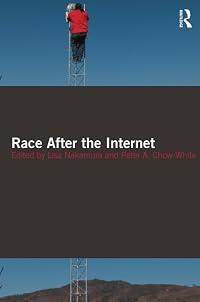
Race After the Internet
by Lisa Nakamura
41 Members (4.00)
On This Page
Description
"Digital media technologies like the Internet create and host the social networks, virtual worlds, online communities, and media texts where it was once thought that we would all be the same, anonymous users with infinite powers. Instead, the essays in Race After the Internet show us that the Internet and other computer-based technologies are complex topographies of power and privilege, made up of walled gardens, new (plat)forms of economic and technological exclusion, and both new and old show more styles of race as code, interaction, and image. Investigating how racialization and racism are changing in web 2.0 digital media culture, Race After the Internet contains interdisciplinary essays on the shifting terrain of racial identity and its connections to digital media, including Facebook and MySpace, YouTube and viral video, WiFi infrastructure, the One Laptop Per Child (OLPC) program, genetic ancestry testing, DNA databases in health and law enforcement, and popular online games like World of Warcraft. Ultimately, the collection broadens the definition of the "digital divide" in order to convey a more nuanced understanding of usage, meaning, participation, and production of digital media technology in light of racial inequality. "-- "Race After the Internet explores racial identity in the digital age, grappling with the complex role that the Internet and other digital technologies play in shaping our ideas about race. The readings are separated into sections that examine how digital media has complicated racial identity as well as the connection between limited digital access and social inequality. Other essays address new racial identities created by users of popular media of virtual worlds like World of Warcraft, and social networks like Facebook and MySpace. And a final group of essays enters the world of biotechnology to find ways that biometrics and new surveillance technologies are creating different forms of racial profiling. Race After the Internet investigates how racialization and racism are changing in web 2.0 digital media culture, thus making it a valuable text for anyone interested in digital media and race and ethnic studies.The essays incorporate science and technology studies, social scientific, rhetorical, textual, theoretical, and ethnographic approaches with some carefully selected demographic studies of Internet and technology use. This collection aims to broaden the definition of the "digital divide" in order to convey a more nuanced understanding of usage, meaning, participation, and production of digital media technology in light of racial inequality"-- show lessTags
Recommendations


































Member Reviews
Members
- Recently Added By
Lists

Books in the Bibliography of Digital Lethargy by Tung-Hui Hu
151 works; 3 members
Author Information
8+ Works 228 Members
Lisa Nakamura is Professor of Media and Cinema Studies and Director of the Asian American Studies Program at the University of Illinois, Urbana-Champaign. She is the author of Digitizing Race: Visual Cultures of the Internet, winner of the Association for Asian American Studies 2010 Book Award in Cultural Studios. She is also author of Cybertypes: show more Race, Ethnicity, and Identity on the Internet and co-editor, with Beth Kolko and Gilbert Rodman, oi Race in Cyberspace, both published by Routledge. Peter A. Chow-White is an Assistant Professor in the School of Communication at Simon Fraser University in Vancouver, Canada. His work has appeared in Communication theory, the International Journal of Communication. Media, Culture A Society. PLoS Medicine, and Science, Technology Human Values. show less
Classifications
- Genres
- Nonfiction, Technology, General Nonfiction
- DDC/MDS
- 302.23 — Society, government, & culture Social sciences, sociology & anthropology Mass Communication & Media Communication Media (Means of communication)
- LCC
- HT1523 .R25123 — Social sciences Communities. Classes. Races Communities. Classes. Races Races
- BISAC
Statistics
- Members
- 41
- Popularity
- 716,565
- Rating
- (4.00)
- Languages
- English
- Media
- Paper, Ebook
- ISBNs
- 4